Stephanie So

32K posts

Stephanie So banner
Stephanie So

Stephanie So

@ComplicatedIsOK

Bullish on humanity in the morning. On a mission to eliminate central points of failure on the internet. Personal account. Co-founder & CEO of https://t.co/LP0GihbY8Z.

No. Katılım Eylül 2018
1.2K Takip Edilen1.6K Takipçiler
Stephanie So
Stephanie So@ComplicatedIsOK·
@QuantumTumbler @saranormous That's it, exactly, @QuantumTumbler. That's why we've developed verification for states and cryptographic receipts for the authority to change them. It's object-oriented event Infrastructure. You've articulated why we need it.
English
0
0
1
8
B
B@QuantumTumbler·
This is a real problem, but it’s not “dark code” in a mysterious sense. It’s what happens when execution outpaces observability. We didn’t suddenly create unknowable systems we created systems where → behavior is assembled at runtime → attribution isn’t first-class → and logging wasn’t designed for emergent workflows So the system isn’t magic… it’s just poorly instrumented for the type of computation it’s doing. Same thing happened with → distributed systems → microservices → cloud infra We solved it with better tracing, identity, and constraints. This is the same transition again. Agents aren’t the risk untracked state transitions are. Fix that, and “dark code” disappears.
English
1
0
9
344
bartek.eth
bartek.eth@bkiepuszewski·
This is very telling, straight from Canton biz folks - "one canton app who has decided to disclose their data". How generous of them. Let me tell you - together with my friends I am running in my basement my own Canton connected to SV network. There is 2.765 B worth of RWA there. Prove me wrong. Can I have it listed on rwa.xyz ?
Jake McCrum@jakemccrum

Roughly 5-10% of the global repo turnover depending on the day. app.rwa.xyz/broadridge-dlr That’s just one canton app who has decided to disclose their data. Given your ask for data, will spare you other anecdotes as other apps have to-date opted to remain private - though we expect, to some degree, for that to change over time.

English
9
9
92
10.7K
Stephanie So
Stephanie So@ComplicatedIsOK·
People who use Twitter to decide if they're bearish or bullish probably shouldn't make fun of people who go to psychics for life advice. Just saying.
English
0
0
6
56
Stephanie So
Stephanie So@ComplicatedIsOK·
If I could rephrase - in other words, at the very minimum, companies are going to have to show the receipts. That requires something new. Identity + authentication won't be enough, not if agents appear from nowhere and disappear again. Access control and permissions are insufficient if chains of actions are assembled dynamically at runtime. If only there was a way to run a trace that pinned down identity, access, permissions, and actions all at the same time. Would that help?
English
0
1
2
192
Gwart
Gwart@GwartyGwart·
Let me get this straight -quantitative computers broke crypto -Dubai real estate leveled by rockets (don’t deny it I saw video of mia Khalifa building) -prediction markets only profitable for Barron and Taylor swift’s drummer -Claude can do every job Where do you even invest?
English
91
8
345
21.4K
Stephanie So
Stephanie So@ComplicatedIsOK·
@CryptoSatireMan I saw this, too, @CryptoSatireMan. "Textbook supply chain installer malware". I'll post this as an example in Geeq telegram of an app that can be built. Let's hope none will go to the dark side.
English
0
1
5
36
BITCOIN-Affirming Gordon Freeman
How many active users on Twitter with offline local LLMs are creating their social attack strategies right now?... @ComplicatedIsOK if only there were a sophisticated yet simple blockchain solution...
Feross@feross

🚨 CRITICAL: Active supply chain attack on axios -- one of npm's most depended-on packages. The latest axios@1.14.1 now pulls in plain-crypto-js@4.2.1, a package that did not exist before today. This is a live compromise. This is textbook supply chain installer malware. axios has 100M+ weekly downloads. Every npm install pulling the latest version is potentially compromised right now. Socket AI analysis confirms this is malware. plain-crypto-js is an obfuscated dropper/loader that: • Deobfuscates embedded payloads and operational strings at runtime • Dynamically loads fs, os, and execSync to evade static analysis • Executes decoded shell commands • Stages and copies payload files into OS temp and Windows ProgramData directories • Deletes and renames artifacts post-execution to destroy forensic evidence If you use axios, pin your version immediately and audit your lockfiles. Do not upgrade.

English
1
1
2
52
Stephanie So
Stephanie So@ComplicatedIsOK·
Agreed, @Stark_of_Zenon. I think Canton is making trouble for itself by describing its tech incorrectly. That's ruffling a lot of feathers from those who know better. The rest of the outrage seems to be coming from it positioning itself as the gatekeeper to institutional business because it's superior in some way. But yes, the first argument should be settled. It doesn't seem trustless or permissionless in any way.
English
1
0
3
29
Stark
Stark@Stark_of_Zenon·
@ComplicatedIsOK @bkiepuszewski some of their PR is off target but I don't even see Canton as being related to trustless or permissionless crypto. they are so far from it, the fact that anyone in the permissionless culture is even offended by the Canton design shows how fragile the ecosystem is. red flag.
English
1
0
3
34
Stephanie So retweetledi
Geeq
Geeq@GeeqOfficial·
Geeq tweet media
ZXX
1
6
15
291
Stephanie So
Stephanie So@ComplicatedIsOK·
From what I understand of the tech, yes, these are doxxed and vetted operators but that's only part of the story. It seems like a ledger where doxxed and vetted operators agree pairwise to enter a transaction in a shared ledger. E.g. nothing new to TradFi, nothing added to trustless technology, and it's unclear why it should be used instead of a trusted database. If it were described as such, then ok. But I think it's being described as a L0 and we can do better than that.
Stephanie So tweet media
English
2
0
2
37
Stark
Stark@Stark_of_Zenon·
@bkiepuszewski Isn't their model about real world compliance though? Like doxxed and vetted operators subject to audits jurisdictions and whatnot?
English
1
0
4
225
Stephanie So
Stephanie So@ComplicatedIsOK·
Couldn't have said it better myself. 💯 The semantic problem is using the term "permissionless" without specifying what's discussed. Who? Validators? Account holders? What? Entering the network? Seeing balances? Owning assets? Moving them? Exiting positions? Governance? Community? Regulation? Institutional? Like you said. The key isn't follow the money. It's follow the trust. 🤝
English
1
0
1
12
EarlyInfra
EarlyInfra@earlyinfra_·
@ComplicatedIsOK @bkiepuszewski exactly. permissionless doesn’t remove trust, it relocates it. the real question is: where does trust concentrate? – sequencers – liquidity – bridges that’s where power actually sits.
English
1
0
1
12
bartek.eth
bartek.eth@bkiepuszewski·
Have you ever had your bank account frozen ? If you haven't, you'll never truly understand the current debate between permissionless and permissions chains. Some TradFi people want to trick you into thinking that baking TradFi rules into the low-level blockchain infra is the only way for blockchain adoption. These are the same people that were building intranets assuming the internet is too dangerous, does not protect privacy and is full of illicit use. Anything that can be done by private, permissioned blockchains can be done more efficiently by private distributed databases. It is a fact well known for years to all IT professionals. Public blockchains are slow, inefficient and achieving privacy there is hard. And yet this is where we will all be transacting in years to come for a very simple reason - they give guarantess that permissioned networks will never be able to give to all transacting parties. You will never be debanked holding ETH. Your trade on Uniswap will never be blocked by anyone and will always settle. TradFi orgs adopting these properties are forward looking. TradFi reimplementing existing rules on permissioned chains will fail in exactly the same way they failed in 2015. Just ask IBM, Corda/R3 and the likes
English
30
55
312
14.9K
Chainspect
Chainspect@chainspect_app·
@GeeqOfficial Build something that makes dashboards and users equally curious about the tech 🙌
English
2
0
5
55
EarlyInfra
EarlyInfra@earlyinfra_·
@bkiepuszewski the direction is right. but permissionless doesn’t remove control, it redistributes it: validators, sequencers, liquidity hubs. the real question is who holds power in each layer.
English
1
0
2
228
Stephanie So
Stephanie So@ComplicatedIsOK·
@kidehen @aakashgupta Having put myself through the (unexpected) exercise of developing an ontology, I understand your statement well. I suspect we share the same turn of mind. :)
English
1
0
1
18
Kingsley Uyi Idehen
Yes—but note that by using RDF and relevant shared ontologies, what I’m demonstrating applies to a wide range of conditions. The “dirty little secret” about ontologies is that they allow logic to function as the organizing schema or framework for understanding (a.k.a. context). Thus, the system I describe (for fine-grained, attribute-based access controls and policies) is constrained only by the operator’s imagination, as expressed through logic 😀
English
1
0
1
21
Aakash Gupta
Aakash Gupta@aakashgupta·
We are so cooked. Anthropic just accidentally leaked its most powerful AI model because someone forgot to lock a blog CMS. They’re warning it could “outpace the efforts of defenders” in cybersecurity. Do you understand what just happened?? Close to 3,000 unpublished files were sitting in a publicly accessible data store.. Draft blog posts, PDFs, details of a secret CEO retreat at an 18th-century English manor. Anyone could find them. Anthropic’s response? “Human error.” The leaked documents describe a new model tier above Opus. Dramatically better than anything that exists. Their own internal draft says it’s “far ahead of any other AI model in cyber capabilities.” Anthropic confirmed it’s real. They called it “a step change.” They are terrified of their own model. CrowdStrike dropped 7%. Palo Alto Networks fell 6%. Cybersecurity ETF down 6% in a single session, now 20%+ on the year. Bitcoin slid from $70K to $66K overnight. $20 billion in market cap vaporized over a draft blog post about something that hasn’t even shipped yet. A $380 billion company with $20+ billion in revenue is telling you, in their own leaked words, that the thing they built will break the internet’s defenses faster than anyone can patch them. They wrote that down. In a blog draft. Then left the blog draft unlocked on the internet. Every script kiddie with API access is about to become a state-level threat actor.. Every firewall vendor is about to become a legacy vendor.. Every “we take security seriously” banner on every SaaS login page is about to age like milk. Sleep well tonight.
Polymarket@Polymarket

BREAKING: Anthropic data leak reveals the existence of “Claude Mythos,” a new AI model that reportedly presents unprecedented cybersecurity risks.

English
278
879
3.7K
1.3M
Stephanie So
Stephanie So@ComplicatedIsOK·
Thanks @kidehen. That provides a lot of clarity. In simple terms, you're describing: identity + attributes → knowledge graph + rules → policy engine for a system → evaluation → decision That seems very useful when 1. Information is sufficient for granular distinctions 2. Policy engines are configurable and trusted 3. The decision space is well-mapped 4. Outcomes, while variable, are predictable I'm working on a different problem: decentralized processes with anonymous actors and the full spectrum of adversarial conditions. The approach builds on a primitive that gates state transitions to specific assets rather than access. Different boundary.
English
1
0
0
21
Kingsley Uyi Idehen
#WebIDTLS is one piece of the puzzle for policy engines driven by knowledge graphs. My posts about #ABAC are fundamentally about this. For example, you can assert that a document is only accessible to a person whose characteristics (attributes) satisfy specific conditions. This entire system can be driven by knowledge graphs constructed using hyperlinks. In fact, this is one of the many challenges long addressed by the Semantic Web project 😀
English
1
0
1
23
Stephanie So
Stephanie So@ComplicatedIsOK·
This is very interesting, thank you, and a very important step. I also advocate for mutual authentication. It's the only approach that makes sense. WebIDTLS is getting closer to where I work. There are strong complementarities. They are not the same. We're addressing a different problem. I'm not describing LPKI as a knowledge graph combined with a policy engine. I'll try again, thanks for pushing me. Let's move away from identity + access language. Instead, our mental model is a proof gate that requires an agent to prove current authority to cause a state change. Each piece has its place, this is a very big problem.
English
1
0
0
13
Kingsley Uyi Idehen
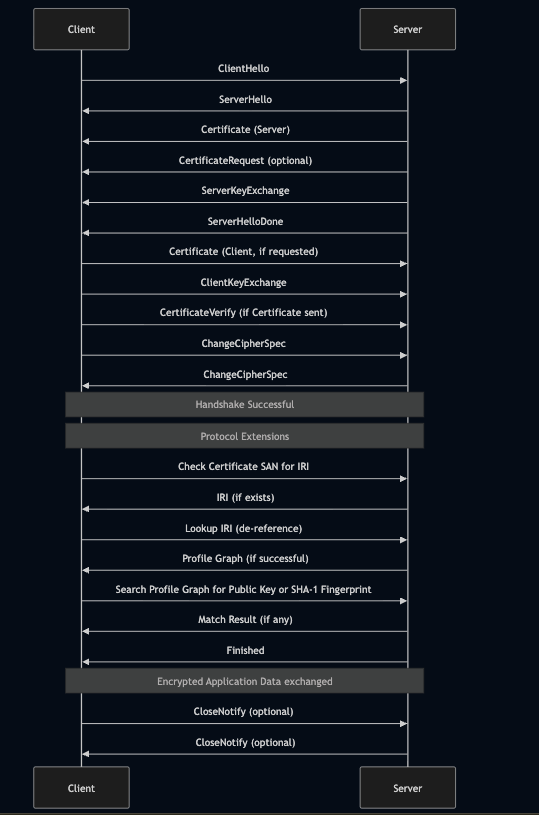
The way #WebID, #WebIDTLS, and #WebIDTLS with delegation work is as follows: You create a profile document that includes a collection of machine-computable entity relationships informed by an ontology (which defines the relationship semantics in a machine-computable form). One of these relationships associates you (the profile document subject) with a public key from an X.509 certificate you generated. This certificate includes a hyperlink in the Subject Alternative Name (SAN) that resolves to the aforementioned profile document. This deceptively simple setup—adding a hyperlink and a public key to an associated profile document—enables a Web of Trust (WoT) based on mutual authentication using TLS. Verification essentially involves extending the TLS handshake to perform a hyperlink lookup, retrieving the public key from the referenced profile document. As for delegation, you simply introduce an “on-behalf-of” relationship, asserting a link between a person and one or more AI agents. This adds an additional lookup step in the extended handshake to resolve the appropriate public key. Mermaid Sequence Flow Diagram: #pako:eNp1VE2P2jAQ_SuWTyCFFeEz5LASCrSs2l2tiNRDxcV1JsQi2K7tVKSI_95JwlYbCDnFM2_evPmwz5SrBGhILfwuQHJYCbY37LiTBD_NjBNcaCYdiQizJMoFSHfvjCtnDOYPmMYZDZ6f4_CK30Ceq8Yeoz0Kr9B7ewTImQrOHJBeA-o_AmwrxdaRntJOKMnyfkeKb1CuTzxjcg-PBKyUhLbozyKaCjwiUmKahJD0O2q8S3RP9gOMSEvSQ6rPKSxG3zDWNJHQGZhYA293oNP5ppBJYUkk8pBhw2RiM3YAEhecg7VpkXcC341yiqucrE8OpMU-2hspwA8tufHyjaTKkJftS0sXnuvS4CSss-2Cvit1KHQDSWBgIAVTLVt7YqglFTmQr4bprOay_8W3-WJghmc3AZWo9-JXLjjBYRA8xZvlwCdfBPbLaCM-Fvea7pU55NiCLXJXZ2OybAvCSGEzSDo7t5bclBq3gSy1zqveYPPIijmGLWgWIbnZE2UBSeod6N7ZRxDq0SOYIxMJ3tRzFbKjLoMj7GiIvwkzhx3dyQviWOFUXEpOQ2cK8GihE5za9VZ_GPHO0vBMTzT0F9On6cRfjGeBHwyDxcyjJQ0Ho8nkaTbxx9PJOBiOFtPxxaN_lUIC_2mM1uF8Pp0Fi2A0G81rup-1s2E3qthnNExZbvEEiXDKvDavTP3YeHRvqkquaJAJmEgV0iH72L_8A2U9czU" target="_blank" rel="nofollow noopener">mermaid.live/edit#pako:eNp1…
Kingsley Uyi Idehen tweet media
English
1
0
1
24
Stephanie So
Stephanie So@ComplicatedIsOK·
I missed those hashtags and appreciate your reply. I wasn't precise enough before about the solution I was proposing. LPKI provides a control that forces a cryptographic check of whether you can satisfy (current authority + identity) at the same time. It's a variation of PKI that provides more than an identity check. Of the three, NetID comes closest. Both LPKI and NetID are approaches to zero-trust. NetID tries to enforce proper network configuration. LPKI tries to enforce execution of proper authority proof gates. In any case, I agree it's a zoo.
English
1
0
0
17
Kingsley Uyi Idehen
Yes, I’m aware of that. Note the hashtags #WebID, #NetID, and #YouID 😀 They’re all about moving Web abstraction into PKI, reducing reliance on centralized certificate authorities (CAs) while leveraging that abstraction to enable powerful zero-trust architectures informed by a Semantic Web (now often referred to as knowledge graphs) and relevant ontologies.
English
1
0
1
17
Stephanie So
Stephanie So@ComplicatedIsOK·
@donnoh_eth I'd love to understand this. Please do. Addressing counterparty risk is the real purpose of blockchain.
English
0
0
1
37
donnoh.eth 💗
donnoh.eth 💗@donnoh_eth·
how USDT is moved across chains. counterparty risks vary widely across tokens, even though all are supposed to represent the same asset. are users aware of these risks? should we make a dashboard like this public?
donnoh.eth 💗 tweet media
English
8
3
44
2.7K
Stephanie So
Stephanie So@ComplicatedIsOK·
@zeroxBigBoss @DrNickA I think there's a distinction here. You're right if it's an implementation decision or if it's possible for nodes to violate the security assumptions. The original post ruled out both of those cases.
English
0
0
0
44
Allen
Allen@zeroxBigBoss·
"A blockchain does not control who can participate in consensus." Sure they do. Seems you typed this out too hastily.
English
1
0
3
228