
Sabitlenmiş Tweet
Doctronic
572 posts


Doctronic
@doctronic
On a mission to make US healthcare more accessible and efficient for Americans. https://t.co/gl5iXBRxjn
Earth Katılım Ağustos 2023
73 Takip Edilen1.8K Takipçiler

Doctronic retweetledi

More than 80% of US physicians are already leveraging AI. The question now is how consumer adoption of health AI is going to drive real patient outcomes, with companies like @Doctronic & @Neko helping lead the charge to deliver both access *and* accuracy.
I had a chance to discuss how AI is more deeply integrating across the patient journey alongside my partners Dr. @GalymImanbayev, @clairejyz, and @Machiz on @LightspeedVP’s new show Lightwork.
Check out the full video to hear more about our thesis below!
cc @BrentonFargnoli
Claire Zau@clairejyz
NEW EPISODE: @AnthropicAI looks inside AI's mind with the “J-Space,” the $500M fund to end the common cold, and @Amazon’s Project Leo challenges @Starlink @Lightspeedvp Partners @GalymImanbayev and @f_fatemi21 map the AI-native patient journey, and the companies we see innovating in the healthcare x AI space 🧬🧑💻🧪. Plus a deep dive into @Doctronic's AI doctor and @Neko's vertically integrated approach to preventive care. 0:00 Meta Muse Image Controversy 8:34 Anthropic's "J-Space": Can We Read An AI's Mind? 17:27 Silicon Valley Wants To End The Common Cold 23:30 Amazon Takes On Starlink 29:13 Mapping AI Across The Patient Journey 45:36 Doctronic 53:33 Neko Health 1:01:09 Startup Opportunities In The Patient Journey @Machiz
English
Getting seen by a clinician shouldn't take days.
We're building with the aim to deliver quality care in seconds, and connect patients to physicians in minutes.
@Lightspeedvp partner @f_fatemi21 mapped out the entire patient journey and how Doctronic is working to shape access to care.
The goal: give people access to the right care, faster than the current system allows.
If you're thinking about where AI in healthcare is actually heading, this is worth a watch. Thank you, Faraz and the Lightspeed team, for highlighting our work.
English
Doctronic retweetledi

NEW EPISODE: @AnthropicAI looks inside AI's mind with the “J-Space,” the $500M fund to end the common cold, and @Amazon’s Project Leo challenges @Starlink
@Lightspeedvp Partners @GalymImanbayev and @f_fatemi21 map the AI-native patient journey, and the companies we see innovating in the healthcare x AI space 🧬🧑💻🧪. Plus a deep dive into @Doctronic's AI doctor and @Neko's vertically integrated approach to preventive care.
0:00 Meta Muse Image Controversy
8:34 Anthropic's "J-Space": Can We Read An AI's Mind?
17:27 Silicon Valley Wants To End The Common Cold
23:30 Amazon Takes On Starlink
29:13 Mapping AI Across The Patient Journey
45:36 Doctronic
53:33 Neko Health
1:01:09 Startup Opportunities In The Patient Journey
@Machiz
English
Researchers at Loyola University Medical Center trained machine learning models using EMS data collected during ambulance transport, including vital signs, neurological assessments, oxygen saturation, dispatch information, and call characteristics.
Across more than 8,200 ambulance encounters, the models outperformed commonly used prehospital stroke assessment scales, including in identifying severe strokes requiring rapid intervention.
A separate study found that AI analyzing paramedic narrative reports written in plain language improved prehospital stroke diagnosis and helped identify patients who would benefit from direct transport to thrombectomy-capable stroke centers.
This research is still being validated at scale. But the trajectory is clear: AI has the potential to help emergency teams make faster, more informed decisions before a patient even reaches the hospital.
At Doctronic, that same principle guides every build decision. AI should help close the gap between when a health problem begins and when the right care starts.
That's the future we're building toward, one decision point at a time: doctronic.ai
________
Sources:
Scientific Reports (2026): nature.com/articles/s4159…
Stroke (AHA Journals): ahajournals.org/doi/10.1161/ST…
#Stroke #Doctronic #ClinicalAI #AIHealthcare #MedicalAI
English
Every minute without treatment costs neurons. Every minute of delayed identification narrows the window for effective intervention. The time between symptom onset and treatment is unforgiving.
Paramedics already use validated stroke screening tools before patients reach the hospital. But accurately identifying stroke in the field, especially severe strokes that require specialized care, remains challenging.

English
Disease outbreaks move fast in the headlines. The facts often take longer to catch up.
NYC health officials are investigating a cluster of Legionnaires' disease cases on Manhattan's Upper East Side.
Contaminated cooling towers are considered the most likely source, and the investigation is ongoing. The disease is uncommon, and most people exposed to it never get sick.
Here's what matters:
→ Legionnaires' disease is a serious but treatable form of bacterial pneumonia caused by Legionella bacteria.
→ It spreads by breathing in contaminated water mist, not through person to person contact.
→ Risk is higher if you're 50 or older, smoke or used to smoke, have chronic lung disease, have a weakened immune system, or have diabetes, kidney disease, or liver disease.
→ Symptoms usually appear 2 to 14 days after exposure and include fever, cough, shortness of breath, muscle aches, and headache.
→ Prompt medical evaluation and antibiotic treatment can make a significant difference.
If you develop these symptoms, especially after spending time in an area linked to an outbreak, do not wait it out.
Doctronic can help you check your symptoms for free, anytime, and connect you with a doctor in minutes if you need one for only $39.
Sources:
NYC Department of Health, Legionnaires' Disease | nyc.gov/site/doh/healt…
NYC Department of Health, Upper East Side Investigation Update | nyc.gov/site/doh/about…
amNewYork, Legionnaires' Disease Outbreak Update | amny.com/news/legionnai…
_
#HealthLiteracy #PublicHealth #LegionnairesDisease #Pneumonia #PreventiveCare #Doctronic

English
Every day, air traffic controllers help safely coordinate thousands of flights, making hundreds of rapid decisions to keep aircraft moving safely through shared airspace.
It's one of the world's most demanding coordination jobs. Success depends on structure, communication, constant monitoring, and responding quickly when conditions change.
Healthcare deserves that same mindset.
Not because medicine is aviation. But because every symptom deserves careful attention, every conversation deserves structure, and every patient deserves timely guidance.
That's why we built Doctronic. Chat with our medical AI for free, anytime. If you need a licensed physician, you can start a telehealth consultation for just $39.
____
#NationalAirTrafficControlDay #HealthcareInnovation #PatientAccess #Doctronic #AIHealthcare #

English
Doctronic retweetledi

Medicare just changed millions of lives: eligible seniors can now get brand-name GLP-1s (Wegovy, Zepbound) for $50 a month. KFF estimates 3.8 million people qualify.
Nearly 40% of Americans over 65 have obesity, along with the heart failure, kidney disease, and strokes that follow it. Now, the most effective treatment we've ever had is affordable for the people who need it.
Of course, prescriptions require a physician evaluation and prior authorization. For seniors in rural counties, seniors without a primary care doctor, seniors who can't spend a day sitting in a waiting room, that visit is the last barrier standing between them and care.
@Doctronic was built to remove barriers like that. Our AI-driven evaluation plus licensed physicians can help today, no waiting room required. And we're working on a GLP-1 specific pathway at a price you'll assume is a typo.
Fewer heart attacks. Fewer strokes. Millions of healthier years.
medicare.gov/publications/1…
kff.org/medicare/nearl…
English
That's one reason organizations like the American Cancer Society encourage people to become familiar with their skin and report new or changing spots to a healthcare professional.
Questions about your health shouldn't have to wait until your next appointment.
That's why we built Doctronic.
Chat with our Medical AI for free. If you need a licensed physician, you can start a telehealth consultation for just $39.
Sources:
cancer.org/cancer/risk-pr… | aad.org/public/disease…
#SkinHealth #PreventiveCare #HealthcareAccess #Doctronic
English
Self-care culture taught us to compliment our reflection. It rarely taught us to pay attention to it.
The mole that looks a little different. The swelling that wasn't there yesterday. The thing you noticed and told yourself could probably wait.
Many skin cancers are first noticed by patients themselves or by someone close to them, not during a routine medical visit.

English
Many of these injuries are preventable or better treated with correct information.
That's why we built Doctronic.
If you're wondering whether a burn needs medical attention, whether dehydration is becoming dangerous, or whether it's time to seek emergency care, our Medical AI can help you understand your next step.
And if you're experiencing a medical emergency, call your local emergency services or go to the nearest emergency department immediately.
Have a safe and memorable Fourth of July.
Read more: cpsc.gov/Safety-Educati…
#PublicHealth #HealthcareAccess #July4th #FireworksSafety #Doctronic #AIDoctor
English
The Fourth of July is one of the busiest times of the year for preventable injuries.
Fireworks, burns, heat illness, dehydration, falls, foodborne illness, and water-related accidents all contribute to a surge in emergency care over the holiday weekend.
Fireworks alone injured an estimated 13,000 people in America last year. Burns were the most common injury, with hands, fingers, and the face among the body parts most often affected.

English
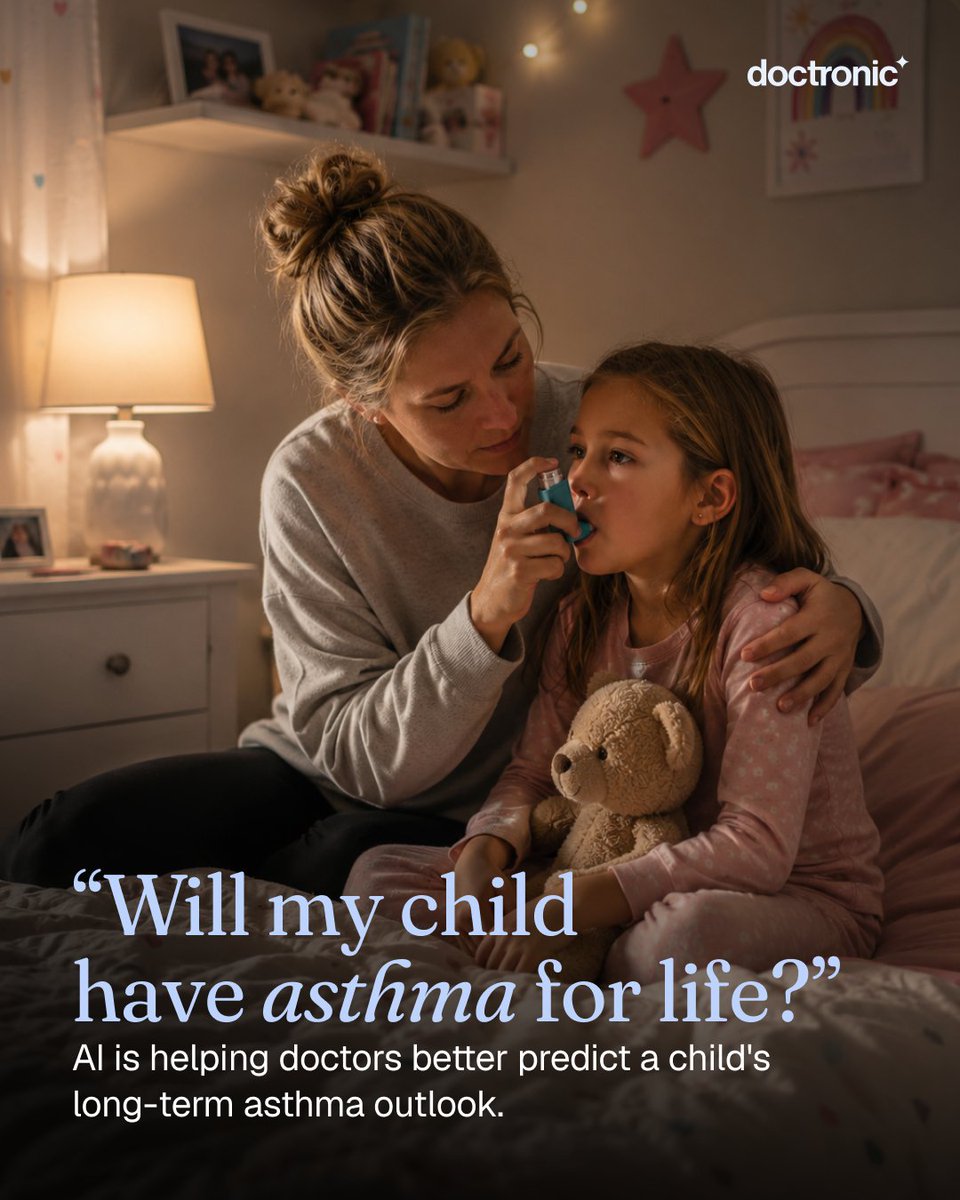
One of the hardest parts of parenting a child with asthma isn't the inhaler. It's not knowing what comes next.
Will they eventually outgrow it? Or will asthma follow them into adulthood?
A recent study explored whether AI could help answer that question using information doctors already collect during routine care.
No new tests. No additional scans.
Just existing clinical data analyzed in a more systematic way. The models showed promising ability to identify which children were more likely to experience asthma remission and which were more likely to have persistent disease.
AI can't predict the future with certainty. But it could become another tool to help doctors better understand a child's long-term outlook, giving families a clearer picture of what may lie ahead.
At Doctronic, we believe that's where AI can make the biggest difference: not by replacing doctors, but by supporting clinical judgment, expanding access to medical expertise, and helping people make more informed decisions about their health.
Read more at mayoclinic.elsevierpure.com/en/publication…
#Doctronic #AIDoctor #Asthma #AIHealthcare #DigitalHealth
English
Researchers are exploring how AI could help predict migraine attacks before they happen, identify which treatments may work best for individual patients, and support clinicians in diagnosing and managing migraine more effectively.
The future of migraine care is moving beyond trial and error.
Whether you're looking for answers or wondering what to do next, Doctronic can help you understand your symptoms and your options with a free AI doctor chat.
If you need to speak with a licensed physician, you can book a telehealth consultation for just $39 at doctronic.ai
#Doctronic #AIDoctor #MigraineAwarenessMonth #MigraineAwareness #ChronicPain #Neurology #Headache
English
June is National Migraine and Headache Awareness Month.
If you have a migraine, you know. It isn't just a headache.
More than 1 billion people worldwide live with migraine.
It's the second leading cause of years lived with disability globally, yet many people remain undiagnosed or undertreated.

English
Doctronic retweetledi
Getting tested used to take weeks, but @SHealthKit collapsed that wait. Getting treated can still take weeks, but in partnership with Simple HealthKit, @Doctronic now collapses that wait too. When a person needs help, testing, AI clinical assessments, and licensed physicians are ready. Screening then treatment, in one easy flow.
Proud to build this with the team at @SHealthKit.
English
Here's how it works:
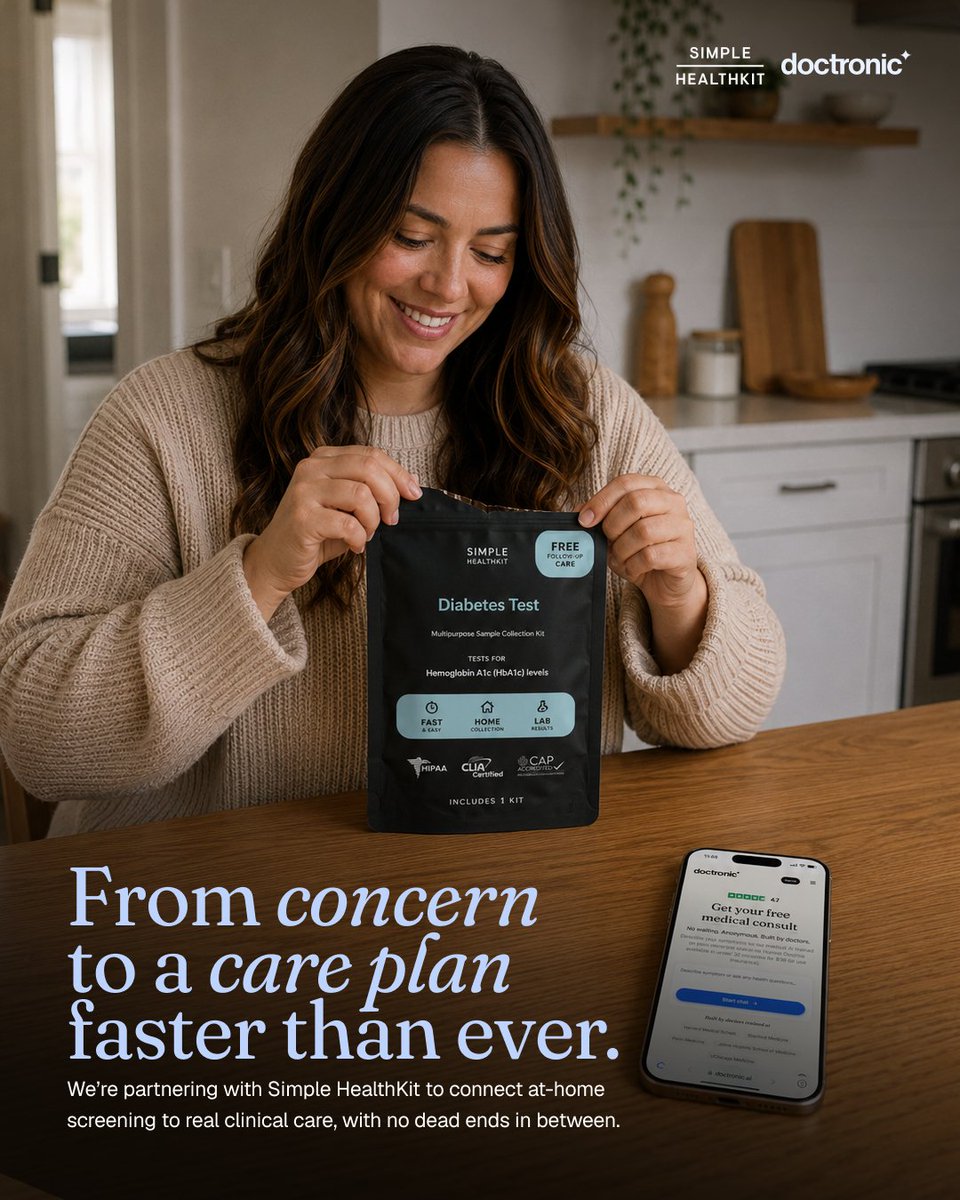
→ A patient takes a Simple HealthKit test at home for conditions like diabetes, chronic kidney disease, colorectal cancer, or STIs
→ When results come in, they're directed to Doctronic
→ Our AI already knows their results and guides them through a full medical evaluation
→ Patients with positive findings get timely clinical follow-up, not a PDF and a phone number
The result: a continuous, closed-loop care experience designed around the patient.
More than 108 million Americans live in primary care shortage areas. They deserve a healthcare journey that actually connects suspecting a problem to timely treatment.
Together, we're building the infrastructure for a new kind of healthcare.
Read more in Fierce Healthcare: fiercehealthcare.com/ai-and-machine…
English
The gap between "something might be wrong" and "I got care" has always been one of healthcare's biggest failures.
Today, we're closing it.
We’re partnering with Simple HealthKit to build the first truly connected care journey: from at-home screening to AI-powered clinical care, with no dead ends in between.
English
More than 7.4 million Americans are living with Alzheimer's today. That number is expected to rise dramatically over the coming decades.
By the time Alzheimer's is diagnosed, the disease is often already well underway. Earlier recognition of cognitive changes may open the door to earlier evaluation, treatment planning, and support.
That's why researchers are focused on new ways to identify Alzheimer's sooner. Advances in AI and biomarker research are helping make earlier detection possible, and the Alzheimer's Association has described this as the beginning of a new era in early detection and prevention of cognitive decline.
In March 2026, the Alzheimer's Association described this as the beginning of a new era in early detection and prevention of cognitive decline.
The earlier we know, the more we can do.
Doctronic can help you understand cognitive health concerns and figure out your next step: doctronic.ai
Sources: alz.org/news/2026/new-… | medicine.iu.edu/news/2025/11/r…
#Doctronic #AIDoctor #BrainHealth #Alzheimers #AIHealthcare

English
Most people do not have that infrastructure.
The gap between “Something is happening,” and “I know what to do next," can feel enormous.
That uncertainty is the gap Doctronic was built to help with.
Free, instant AI-powered health guidance when you need help understanding your symptoms and possible next steps.
Because everyone deserves access to answers when something feels wrong: doctronic.ai
Source: Yahoo Sports / Al Jazeera, June 2026
#WorldCup2026 #HealthcareAccess #SportsHealth #AIHealth #Doctronic
English
Canada’s Ismaël Koné fractured both his tibia and fibula in the second half of the World Cup match against Qatar.
Within moments, the medical staff was on the pitch. He received immediate care and underwent surgery soon after.
That response was possible because elite medical care is prepared for the unexpected before it happens.
A plan. A team. A next step.

English