
Dr Singularity

11.4K posts

Dr Singularity banner
Dr Singularity

Dr Singularity

@Dr_Singularity

Futurist. AGI/ASI by 2030. Posting about AI,AGI,ASI, Singularity, Post Scarcity, LEV,tech & sci progress. 300 000BC - 2029 = Dark Ages. 2030 - Golden Age Begins

Katılım Ocak 2022
599 Takip Edilen68.6K Takipçiler
Sabitlenmiş Tweet
Dr Singularity
Dr Singularity@Dr_Singularity·
Don’t die before 2030. You will reach LEV, and you will have so many years ahead of you (regardless of your age today )that you’ll be able to relive youth, rewrite your story, correct old mistakes, and experience more than you ever thought possible. Aging will be treated. Intelligence will explode. Medicine will move at software speed. Entire fields will compress decades of progress into months/weeks and then days We’re at the inflection point.We’re staring at the vertical line on the graph. The 2030s won’t feel like an extension of the 2020s, but more like stepping into a different civilization.
le.hl@0xleegenz

Realizing how fast i went from 18 to 28:

English
234
497
5.9K
934.1K
NΞXUS
NΞXUS@NEXUS_TO_NOVA·
How far are we from achieving this level of civilization?
NΞXUS tweet mediaNΞXUS tweet mediaNΞXUS tweet mediaNΞXUS tweet media
English
169
60
813
38.7K
Dr Singularity retweetledi
Dr Singularity
Dr Singularity@Dr_Singularity·
Neo-Mesopotamian Futurism
Dr Singularity tweet mediaDr Singularity tweet media
Español
15
50
333
11K
Dr Singularity
Dr Singularity@Dr_Singularity·
Greco Futurism
Español
6
23
124
4.3K
Dr Singularity
Dr Singularity@Dr_Singularity·
@is_OwenLewis @NASA I was following the field very closely during 2010s. Since the late 2010s, I’ve been so busy with AI that I lost track and lost interest (not completely), but this is great news.
English
1
0
6
248
Owen Lewis
Owen Lewis@is_OwenLewis·
Astronomers just dropped the largest single haul of exoplanet candidates ever: 10,091 brand new ones uncovered in one reanalysis. Researchers went back through the first year of NASA’s TESS (Transiting Exoplanet Survey Satellite) data and applied a new semi-automated pipeline that combines machine learning with traditional methods. By looking beyond just the brightest stars and including fainter ones, they pulled out a total of 11,554 planet candidates, including 10,091 that had never been spotted before. The haul includes everything from hot Jupiters to potentially smaller worlds, dramatically expanding the catalog and setting the stage for massive demographic studies of how planets form and evolve around different types of stars. The work shows how clever re-mining of existing data can still deliver gamechanging results, and hints that even more candidates are waiting in the rest of the TESS dataset. The team thinks they may generate twice the number of candidates when they examine the TESS year two data. Exoplanet science just got a massive boost. Progress (and the hunt for new worlds) marches on. 🪐🚀 📸 NASA Source: iflscience.com/10091-new-exop…
Owen Lewis tweet media
English
1
8
35
1.2K
Dr Singularity
Dr Singularity@Dr_Singularity·
The next few years will be utterly insane for most AI/tech investors. We will see 10's of millions of new $ millionaires. This will still be barely the early peak of the world moving rapidly into a post-scarcity, abundance era. AI is the engine.
Dr Singularity tweet media
English
16
28
164
9.3K
Dr Singularity
Dr Singularity@Dr_Singularity·
@Shawn_Hollahan Who said that we will? People will have a choice. If you prefer the countryside, you can live there.
English
1
0
2
85
Dr Singularity
Dr Singularity@Dr_Singularity·
Abundance (for all) is the obvious destination once intelligence gets cheap, energy gets cheaper, robots start doing real work, and computation keeps compounding. We will get there soon.
English
27
38
276
7.2K
Jan Rosenow
Jan Rosenow@janrosenow·
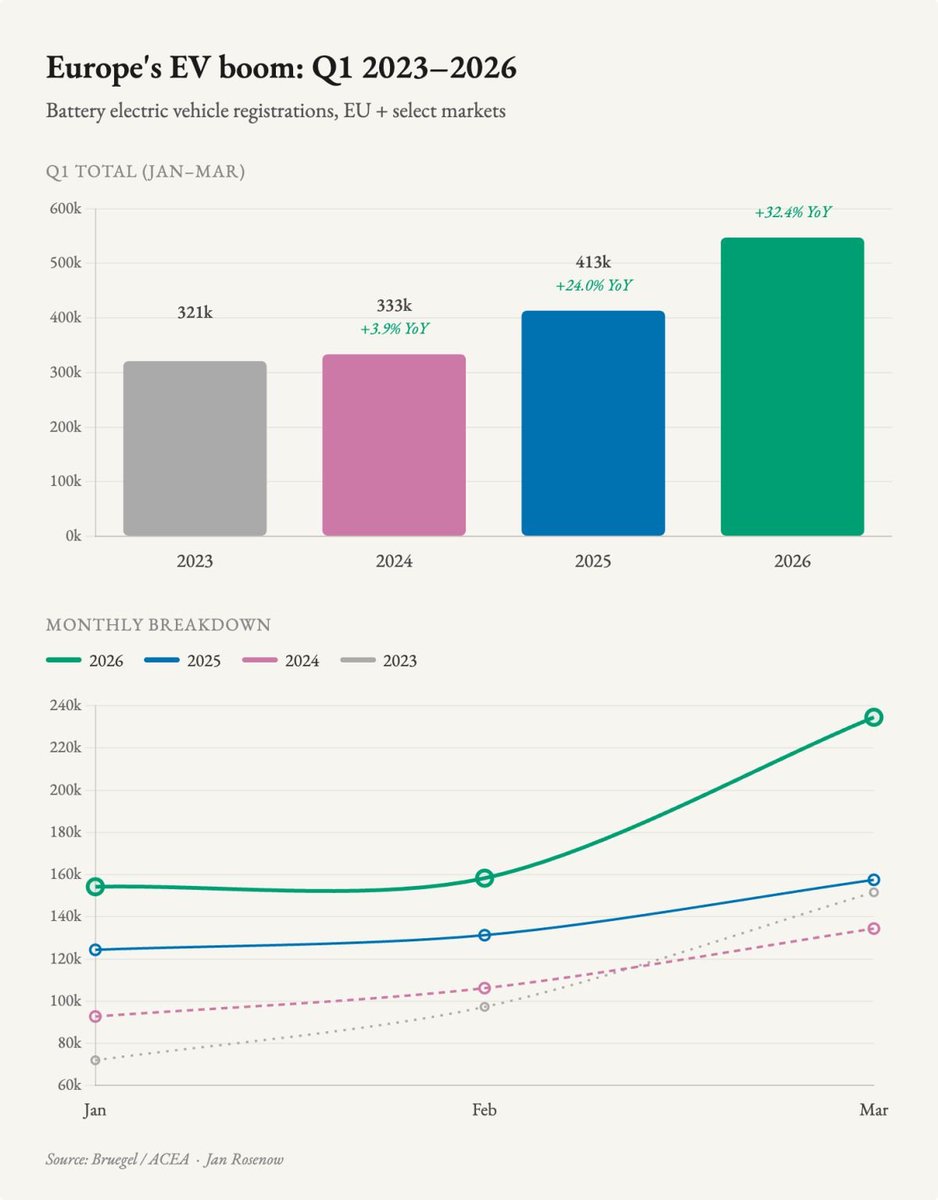
Since the Middle East war began Europe's EV market has been accelerating sharply. Q1 2026 registrations hit 547,000 — up 32% on the same period last year. But the real story is March 2026 with almost 50% more than in March 2025.
Jan Rosenow tweet media
English
7
45
139
4.5K
Dr Singularity
Dr Singularity@Dr_Singularity·
@Sullyva96297943 @damianplayer they can do some simple tasks in factory, for me threshold of usefulness is work in any home (cooking, cleaning and do it safely). IMO, we can get there (best case scenario) as soon as Q4 2026. We're still very early, but progress is exponential.
English
0
0
2
95
Sullyvan
Sullyvan@Sullyva96297943·
@Dr_Singularity @damianplayer I agree, robotics is useless unless it can deliver real value to society through productive labor. The AI brain is needed, Chinese robots who cannot navigate the real world are useless.
English
1
0
1
96
Damian Player
Damian Player@damianplayer·
McKinsey says the bottleneck on humanoid robots isn’t AI. it’s the magnets, gearboxes, and sensors inside every actuator. and China controls 70% of the entire component supply chain.
Damian Player tweet media
English
33
168
878
66.1K
Dr Singularity
Dr Singularity@Dr_Singularity·
@benrayfield @damianplayer We need at least 6 more months. I’m talking about robots cooking and cleaning in your house, in any random house, without falling or making a mess. Being safe. They can do simple work in a factory, but for me threshold is work in any house.
English
1
0
3
75
Dr Singularity
Dr Singularity@Dr_Singularity·
All timelines are too conservative. Autonomous AI agents and researchers are going to speed up science and tech by insane amounts. By the end of this decade, pace of progress may be 1000's to millions of times faster than today. In the early 2030s, maybe billions of times faster. By the late 2030s, trillions of times faster. We're talking here about double/triple exponentials. And even if I’m off by millions of times, it barely matters. Even a "small" 1000x acceleration means one year becomes like 1000 years of today’s research. That alone destroys almost every normal timeline people are using. Just 100-1000x acceleration is big enough to give us Star Trek level tech, science & wealth during 2030s, not 2300s.
English
57
49
353
12.8K
Nicoly
Nicoly@Nfqlvti91726839·
@Dr_Singularity When do you anticipate this acceleration will become perceptible in everyday life?
English
1
0
2
154
Dr Singularity
Dr Singularity@Dr_Singularity·
Soon, we will see 1000x acceleration in scientific and medical progress. AI/agents are key to achieve this. Most AI agents die the same way (not only because the model is not good enough), but because every run resets and wipes all context, memory, and progress. There’s a new approach, giving agents special "environments" where they can remember, pick up where they left off, and actually improve over time. A system they can "live in". That’s where things start to get interesting, especially when we start seeing millions of agents collaborating to drive progress in science, anti aging tech, and useful work.
Lunar@LunarResearcher

x.com/i/article/2050…

English
14
21
158
8.3K
Dr Singularity
Dr Singularity@Dr_Singularity·
@DavidSacks "The ROI on capex is likely to dwarf the capex itself" massive wealth creation incoming
English
1
0
32
1K
David Sacks
David Sacks@DavidSacks·
I’ve been saying for awhile that AI capex will be a 2% tailwind to GDP growth this year. In fact, according to a new report from Morgan Stanley, the numbers are even stronger — more like 2.5% this year and over 3% next year. And this understates the impact of AI for two reasons: (1) This is just investment by 5 hyperscalers; it doesn’t include all the startups and other companies investing in AI. (2) Capex is the investment to create the token factories; it doesn’t count the economic activity resulting from what happens inside the token factories. Those tokens are now being used to generate code (bespoke software) that will increase productivity throughout the economy. The ROI on capex is likely to dwarf the capex itself, which is why investment continues to grow. In Q1, AI was already 75% of GDP growth. That trend is likely to continue. Technology leadership has always been America’s great strength, and it’s driving the economy forward. Polls may show that AI is not popular, but economic growth is. At this point, stopping progress in AI would be equivalent to halting the U.S. economy.
Holger Zschaepitz@Schuldensuehner

Morgan Stanley has again raised its capex forecasts for the five hyperscalers Amazon, Alphabet, Meta, Microsoft, and Oracle. It now expects them to spend about $805bn this year, up from a previous estimate of $765bn. For next year, the forecast has been lifted from $951bn to $1.1TRILLION. To put that into perspective, their 2026 spending alone would be roughly equal to what all non-tech companies in the S&P 500 spent combined in 2025. The expected ~$800bn for 2026 is nearly double 2025 levels and about three times what was spent in 2024.

English
270
519
3.7K
936.6K
Dr Singularity
Dr Singularity@Dr_Singularity·
We will soon have billions of John von Neumann level IQ agents.
English
0
4
48
2.4K