EdNA

984 posts

EdNA banner
EdNA

EdNA

@EdNeuropsych

Katılım Mayıs 2016
303 Takip Edilen96 Takipçiler
EdNA retweetledi
Carl Hendrick
Carl Hendrick@C_Hendrick·
When students can’t find the "main idea", the problem is almost never a missing strategy.
Carl Hendrick tweet media
English
16
134
449
92.9K
EdNA retweetledi
Arianna Huffington
Arianna Huffington@ariannahuff·
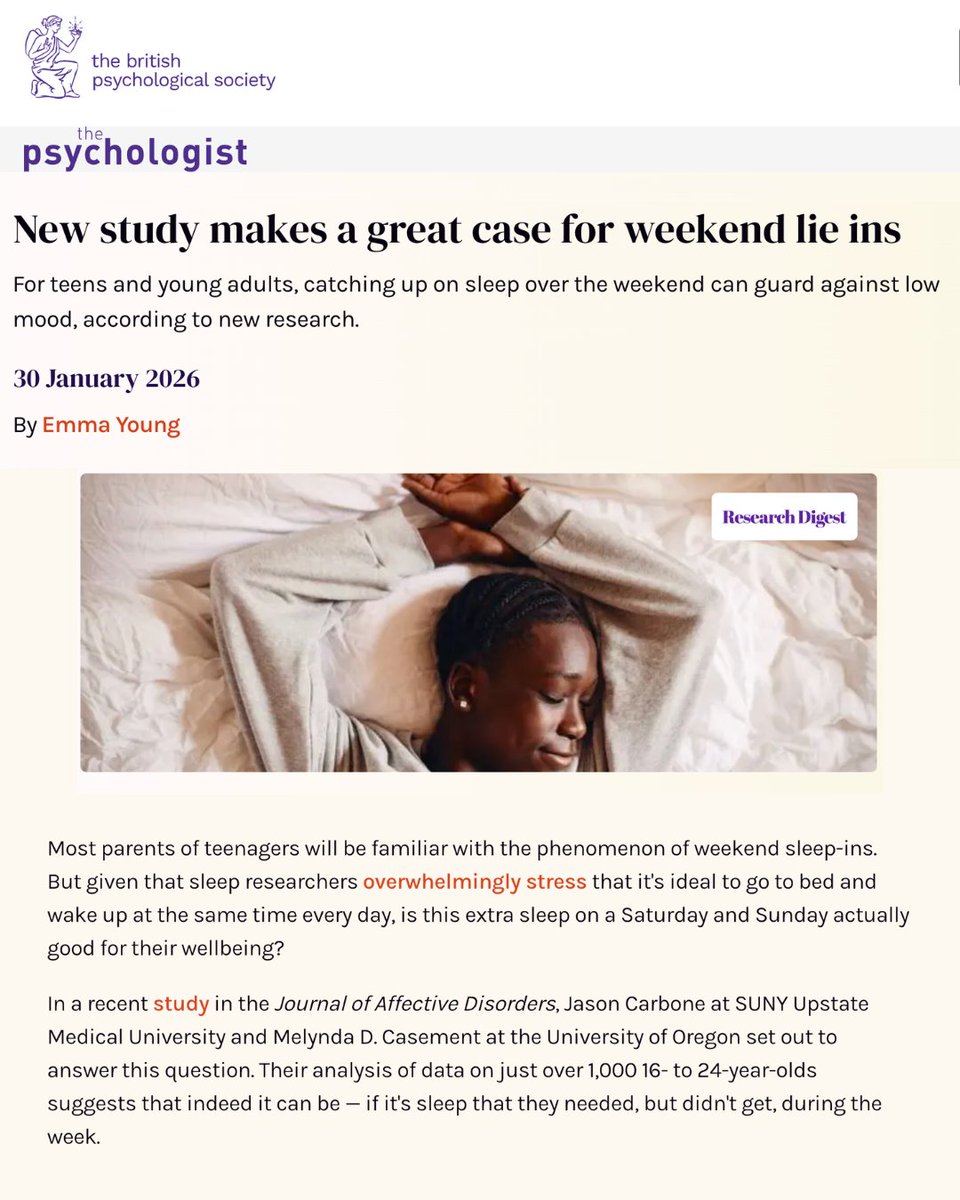
Is sleeping in on the weekends bad or good for teens and young adults? Looking strictly at mental health, the answer seems to be: good. A new study in the Journal of Affective Disorders looked at sleep data of over 1,000 16- to 24-year-olds. They found that the roughly 60% of them who slept in on the weekends had a 41% reduced risk of suffering from depressive symptoms. That’s a huge effect, especially given that, as Emma Young notes for the British Psychological Society, 17% of adolescents and young adults experience a depressive episode each year. Though of course, the best option is for teens and young adults to get the recommended eight to ten hours of sleep every night. But that’s not always realistic given schoolwork, jobs, socializing and, yes, late-night scrolling. As a former parent of teens (or a parent of former teens?), I’m very familiar with the closed bedroom door late into the morning (and sometimes the afternoon). And if that describes your weekends, maybe it’s best to let sleeping teens lie. You can read more here: bit.ly/4aNyYp7
Arianna Huffington tweet media
English
1
4
19
6.1K
EdNA retweetledi
Steve Stewart-Williams
Steve Stewart-Williams@SteveStuWill·
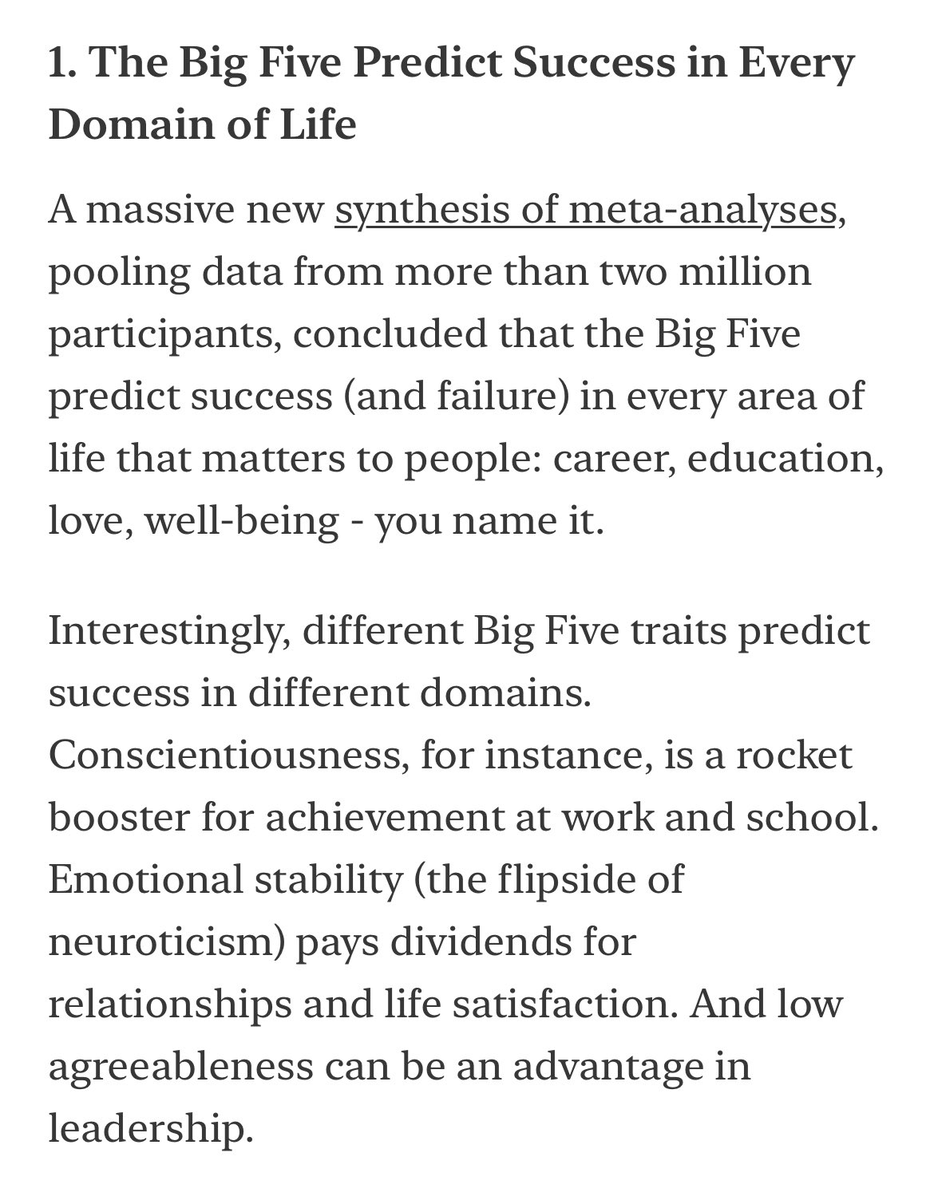
12 Things Everyone Should Know About the Big Five Personality Traits 1. The Big Five Predict Success in Every Domain of Life [Link below.]
Steve Stewart-Williams tweet mediaSteve Stewart-Williams tweet media
English
3
21
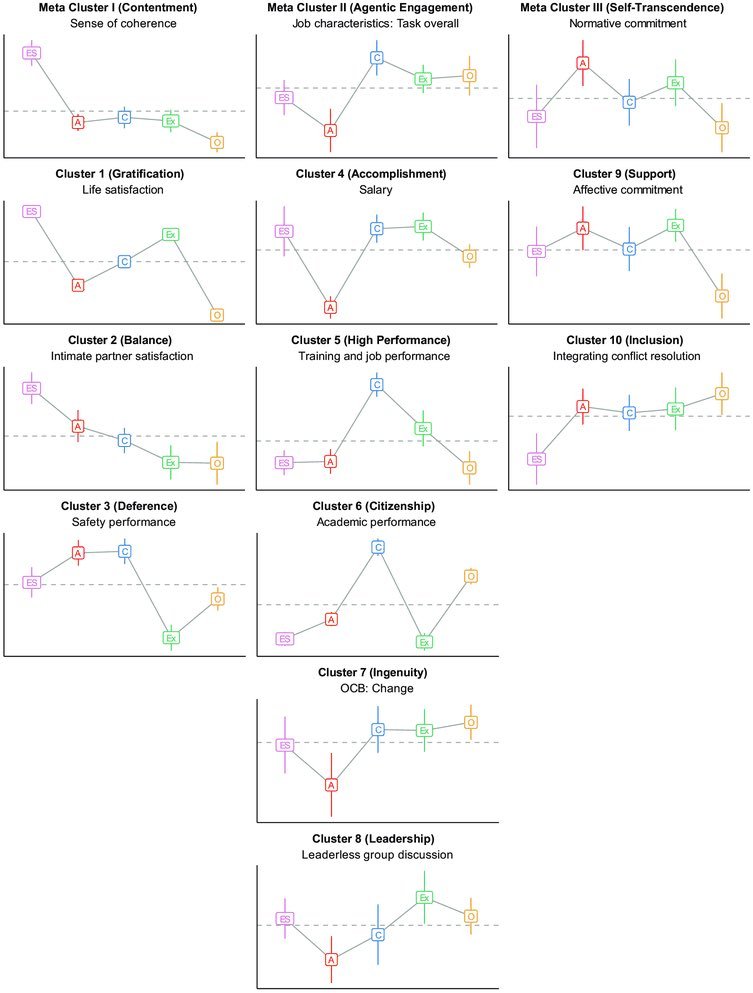
181
17.1K
EdNA retweetledi
Jonathan Haidt
Jonathan Haidt@JonHaidt·
For those who say that "it should be up to the parents" and that "parents need to parent:" Turns out that Meta's own research shows that parents have little ability to control how bad their kids' "problematic use" will be, once the kid opens an account: techcrunch.com/2026/02/17/met…
English
66
265
938
86.3K
EdNA retweetledi
Ammar A. Merhbi
Ammar A. Merhbi@AmmarMerhbi·
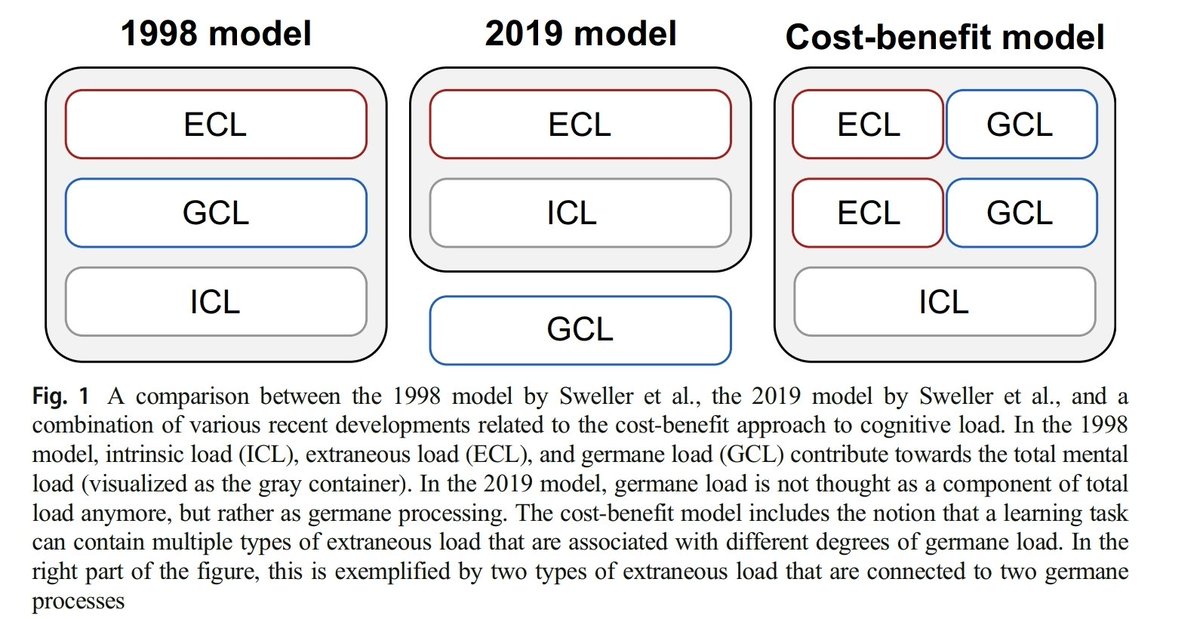
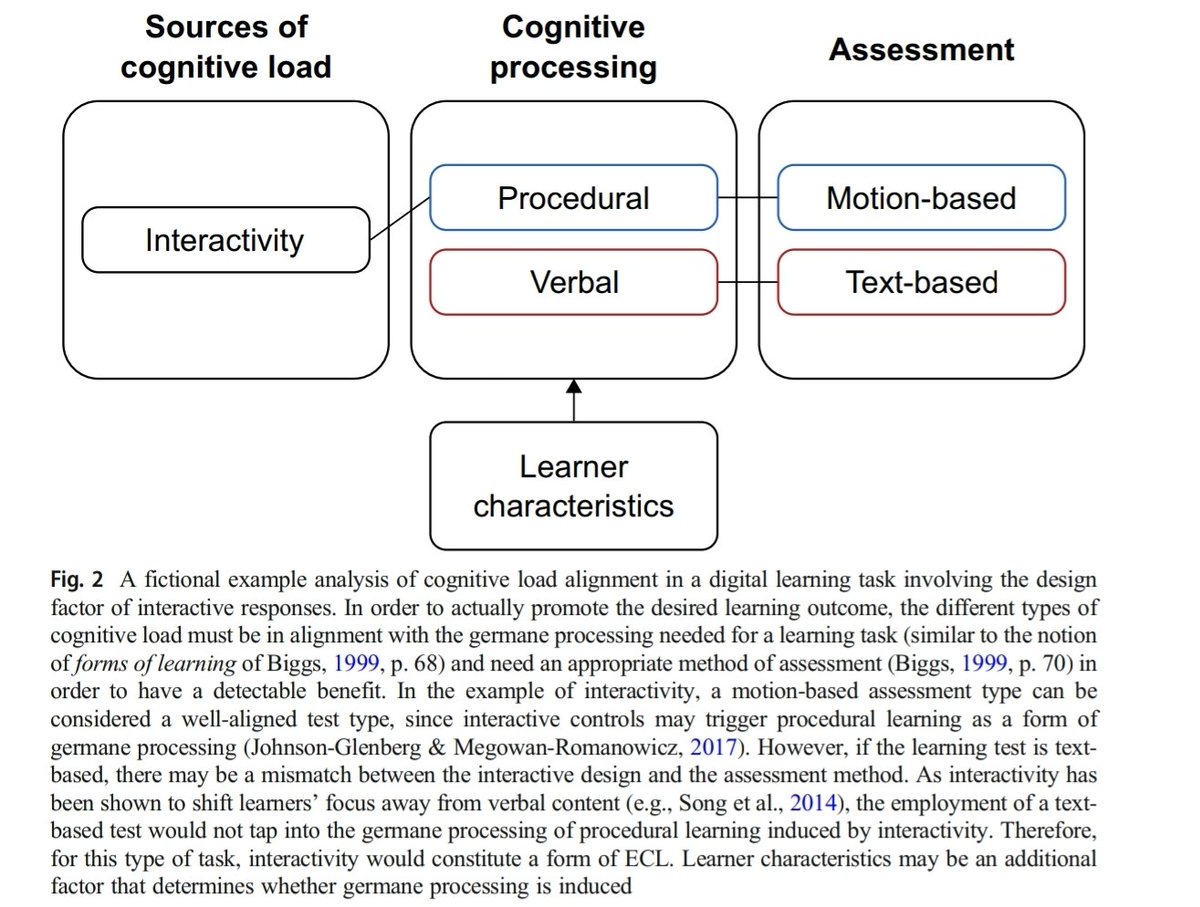
We’ve been told for years that the secret to learning is "less is more". Strip away the fluff, simplify the visuals, and protect the student's working memory at all costs. But what if "clean" design is actually making learning less effective? The Realism Paradox, a shift in Cognitive Load Theory (CLT) is turning traditional instructional design on its head. The "Cost-Benefit" Shift We used to treat the mind like a bucket with limited space. The new Cost-Benefit Model suggests a more strategic trade-off: we can intentionally "spend" a little mental energy on a realistic or immersive interface to "buy" a massive spike in student motivation and deep processing. Realistic details may be harder to process, but they lead to significantly better retention of visual nuances. Intentional Immersion: VR demands more sensory resources, yet it dramatically improves a learner’s ability to transfer skills to the real world. Emotional Design: Warm colors and human-like cues aren't "noise"; they are motivational engines that can lower the perceived difficulty of a task. The most critical takeaway is that Cognitive load is task-specific. We aren't just trying to make learning "easier"; we are trying to make it authentic. But kf course, sequencing learning matters, a lot . Read why "aligned complexity" is the new standard for the digital age: open.substack.com/pub/ammaramerh…
Ammar A. Merhbi tweet mediaAmmar A. Merhbi tweet media
English
2
3
4
390
EdNA retweetledi
Justin Skycak
Justin Skycak@justinskycak·
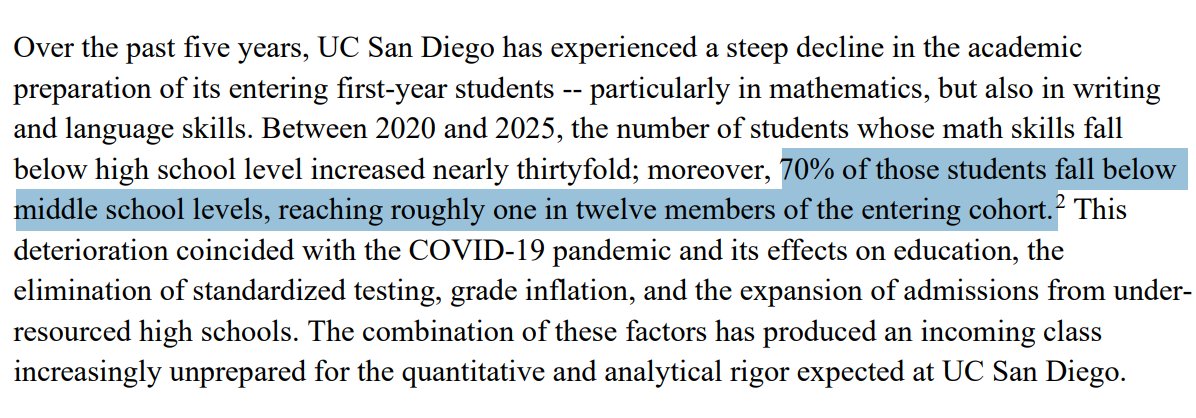
This sounds like a joke, but it's not: – 1 in 12 incoming UCSD freshmen don’t know middle school math, – and the remedial math course was too advanced, – so UCSD had to create a remedial remedial math course, – and a quarter of the students placing into it had a perfect 4.0 GPA in their high school math courses. That sounds so ridiculous, like something you’d read in The Onion, but it’s unfortunately real. Here are some direct quotes from the UCSD report: "Between 2020 and 2025, the number of students whose math skills fall below high school level increased nearly thirtyfold; moreover, 70% of those students fall below middle school levels, reaching roughly one in twelve members of the entering cohort." "While Math 2 was designed in 2016 to remediate missing high school math knowledge, now most students had knowledge gaps that went back much further, to middle and even elementary school. To address the large number of underprepared students, the Mathematics Department redesigned Math 2 for Fall 2024 to focus entirely on elementary and middle school Common Core math subjects (grades 1-8), and introduced a new course, Math 3B, so as to cover missing high-school common core math subjects (Algebra I, Geometry, Algebra II or Math I, II, III; grades 9-11)." "Few, if any, students who place into Math 2 have successfully completed an engineering degree." "high school math grades are only very weakly linked to students’ actual math preparation." "The correlation between the average math grade and the placement result is only around 0.25 on a scale of 0 to 1. In 2024, over 25% of the students in Math 2 had a math grade average of 4.0." "of those who demonstrated math skills not meeting middle school levels, 94% went beyond [the minimum high school course requirement], with 42% percent completing Calculus or Precalculus." "The pattern of high school math classes taken in many cases suggests much higher levels of math skill than the actual math skill the student often has." "In fact, for more than two decades the Mathematics Department has found that out of all available student data, the single best predictor for math placement has been the SAT (math section) score, with the ACT score being an equally good predictor."
Justin Skycak tweet media
English
2
3
25
1.8K
EdNA retweetledi
Justin Skycak
Justin Skycak@justinskycak·
There are plenty of learning-enhancing practice strategies that have been tested scientifically, numerous times, and are completely replicable. They might as well be laws of physics. For instance: we know that actively solving problems produces more learning than passively watching a video/lecture or re-reading notes. (To be clear: active learning doesn’t mean that students never watch and listen. It just means that students are actively solving problems as soon as possible following a minimum effective dose of initial explanation, and they spend the vast majority of their time actively solving problems.) Another finding: if you don’t review information, you forget it. You can actually model this precisely, mathematically, using a forgetting curve. I’m not exaggerating when I refer to these things as laws of physics – the only real difference is that we’ve gone up several levels of scale and are dealing with noisier stochastic processes (that also have noisier underlying variables). Okay, but aren’t these findings obvious? Yes, but… -- Yes, but in education, obvious strategies often aren't put into practice. For instance, plenty of classes still run on a pure lecture format and don't review previously learned unless it's the day before a test. -- Yes, but there are plenty of other findings that replicate just as well but are not so obvious. Here are some less obvious findings:
Justin Skycak@justinskycak

x.com/i/article/2013…

English
3
17
120
7.5K
EdNA retweetledi
Jay Van Bavel, PhD
Jay Van Bavel, PhD@jayvanbavel·
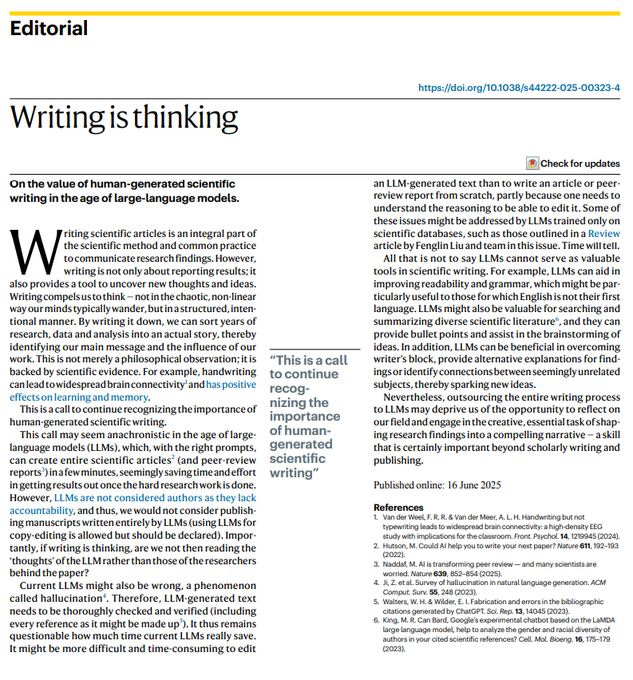
Writing is thinking Outsourcing the entire task of writing to LLMs will deprive us of the essential creative task of interpreting our findings and generating a deeper theoretical understanding of the world.
Jay Van Bavel, PhD tweet media
English
105
1.2K
5.3K
203.4K
EdNA retweetledi
0️⃣BlackBetty ⚓️
0️⃣BlackBetty ⚓️@BabyD1111229·
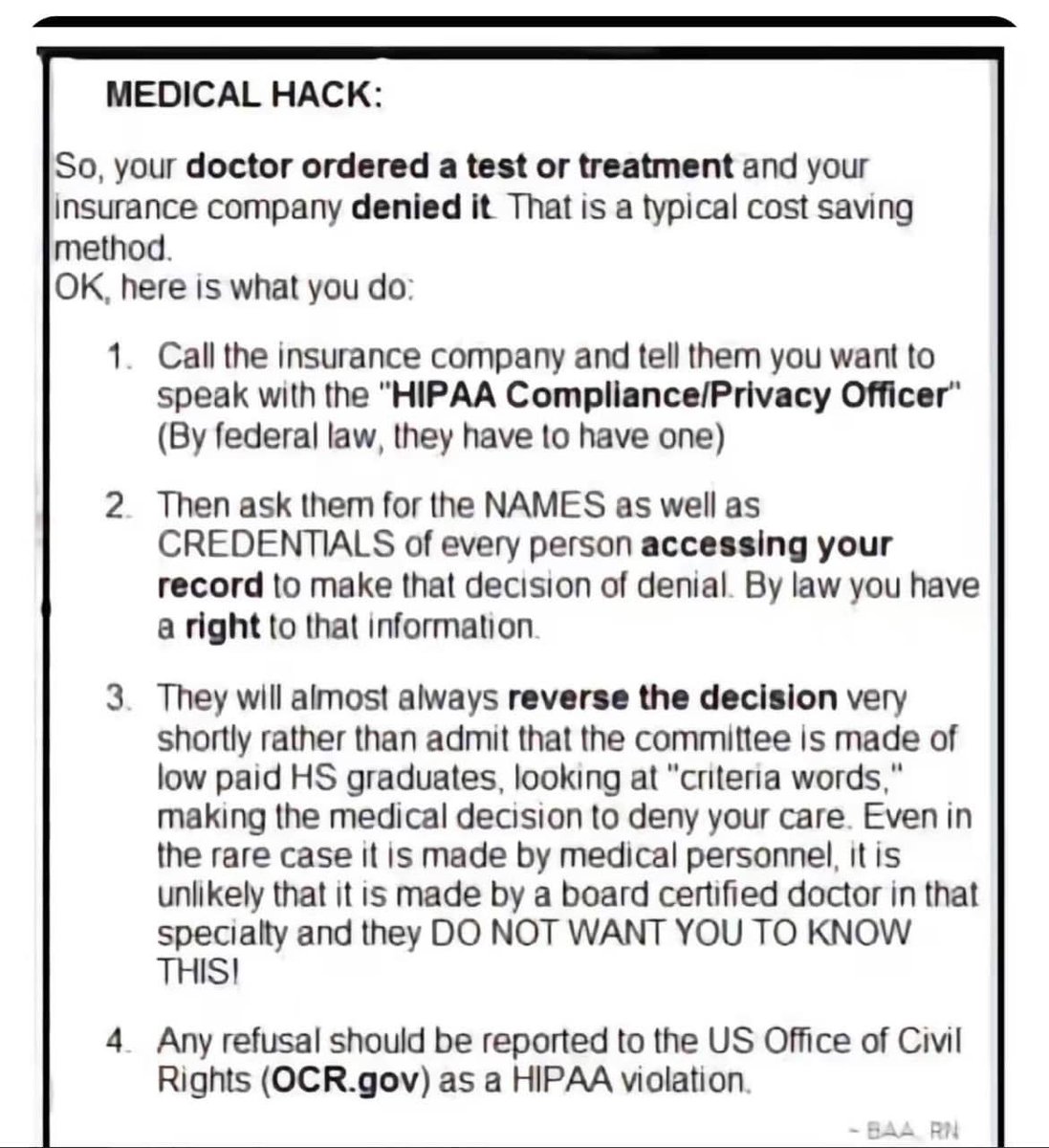
So, your doctor ordered a test or treatment and your insurance company denied it. That is a typical cost saving method. OK, here is what you do: 1. Call the insurance company and tell them you want to speak with the "HIPAA Compliance/Privacy Officer" (By federal law, they have to have one) 2. Then ask them for the NAMES as well as CREDENTIALS of every person accessing your record to make that decision of denial. By law you have a right to that information. 3. They will almost always reverse the decision very shortly rather than admit that the committee is made of low paid HS graduates, looking at "criteria words." making the medical decision to deny your care. Even in the rare case it is made by medical personnel, it is unlikely that it is made by a board certified doctor in that specialty and they DO NOT WANT YOU TO KNOW THIS!! 4. Any refusal should be reported to the US Office of Civil Rights (OCR.gov) as a HIPAA violation. Be safe out there 🫵🏻✨ Know your rights 👊🏼 #ThrowbackThursday
0️⃣BlackBetty ⚓️ tweet media
English
543
12.6K
38.6K
1.4M
EdNA retweetledi
Brandon Luu, MD
Brandon Luu, MD@BrandonLuuMD·
ADHD is closely linked to circadian rhythm dysfunction. Growing evidence suggests that targeting circadian misalignment can meaningfully improve symptoms. Grateful to Dr. Matt Walker for sharing our new study! frontiersin.org/journals/psych…
Brandon Luu, MD tweet media
Matt Walker@sleepdiplomat

ADHD may be more than an attention disorder; new data suggests it's linked to mismatched circadian rhythms. A study found 78% of individuals with ADHD had delayed melatonin and cortisol release. #ADHD #CircadianRhythm
English
73
578
5K
544.3K
EdNA retweetledi
Justin Skycak
Justin Skycak@justinskycak·
So let me get this straight: – 1 in 12 incoming UCSD freshmen don’t know middle school math, – and the remedial math course was too advanced, – so UCSD had to create a remedial remedial math course, – and a quarter of the students placing into it had a perfect 4.0 GPA in their high school math courses. That sounds so ridiculous, like something you’d read in The Onion, but it’s unfortunately real. Here are some direct quotes from the UCSD report: “Between 2020 and 2025, the number of students whose math skills fall below high school level increased nearly thirtyfold; moreover, 70% of those students fall below middle school levels, reaching roughly one in twelve members of the entering cohort.” “While Math 2 was designed in 2016 to remediate missing high school math knowledge, now most students had knowledge gaps that went back much further, to middle and even elementary school. To address the large number of underprepared students, the Mathematics Department redesigned Math 2 for Fall 2024 to focus entirely on elementary and middle school Common Core math subjects (grades 1-8), and introduced a new course, Math 3B, so as to cover missing high-school common core math subjects (Algebra I, Geometry, Algebra II or Math I, II, III; grades 9-11).” “Few, if any, students who place into Math 2 have successfully completed an engineering degree.” “high school math grades are only very weakly linked to students’ actual math preparation.” “The correlation between the average math grade and the placement result is only around 0.25 on a scale of 0 to 1. In 2024, over 25% of the students in Math 2 had a math grade average of 4.0.” “In fact, for more than two decades the Mathematics Department has found that out of all available student data, the single best predictor for math placement has been the SAT (math section) score, with the ACT score being an equally good predictor.”
Justin Skycak tweet media
Justin Skycak@justinskycak

Why Can’t College Students Do Middle School Math? New @_MathAcademy_ podcast episode with @exojason – posted here and everywhere else (see comment) 0:00 - Introduction 2:11 - Freshmen math collapse: 1 in 12 UCSD freshmen don't know middle school math 6:45 - Remedial remedial math: UCSD created remediation for remedial math 8:40 - Inflated grades: 25% of remedial-remedial students had perfect GPA in HS math 10:06 - Test-optional admissions removed the last objective metric 12:13 - Pandemic inflation: GPAs skyrocketed 14:37 - Removing tests pressures teachers to inflate grades 16:52 - Grade-grubbing: endless negotiating, complaining, accusations 19:01 - Then vs. now: parents, tests, accountability 27:38 - Crisis opportunism: “Never let an emergency go to waste” 29:33 - No tests = no knowledge requirements 33:28 - Elite collapse: Harvard has the same problem 36:31 - No enforcement means no standards 37:40 - LLM cheating is trivially easy 38:25 - Catching a cheater and turning him around 48:46 - Cheating is like taking mob money. Now you’re in, you’re never out. 50:41 - Assessments must be done in person 55:06 - LLM cheating is often obvious yet hard to prove 57:17 - How to prevent cheating on long papers 58:28 - Start hardcore, then lighten up gradually 1:01:37 - Good teachers play bad cop when needed

English
461
2.1K
8.6K
2M
EdNA retweetledi
EdNA retweetledi
Cell Press
Cell Press@CellPressNews·
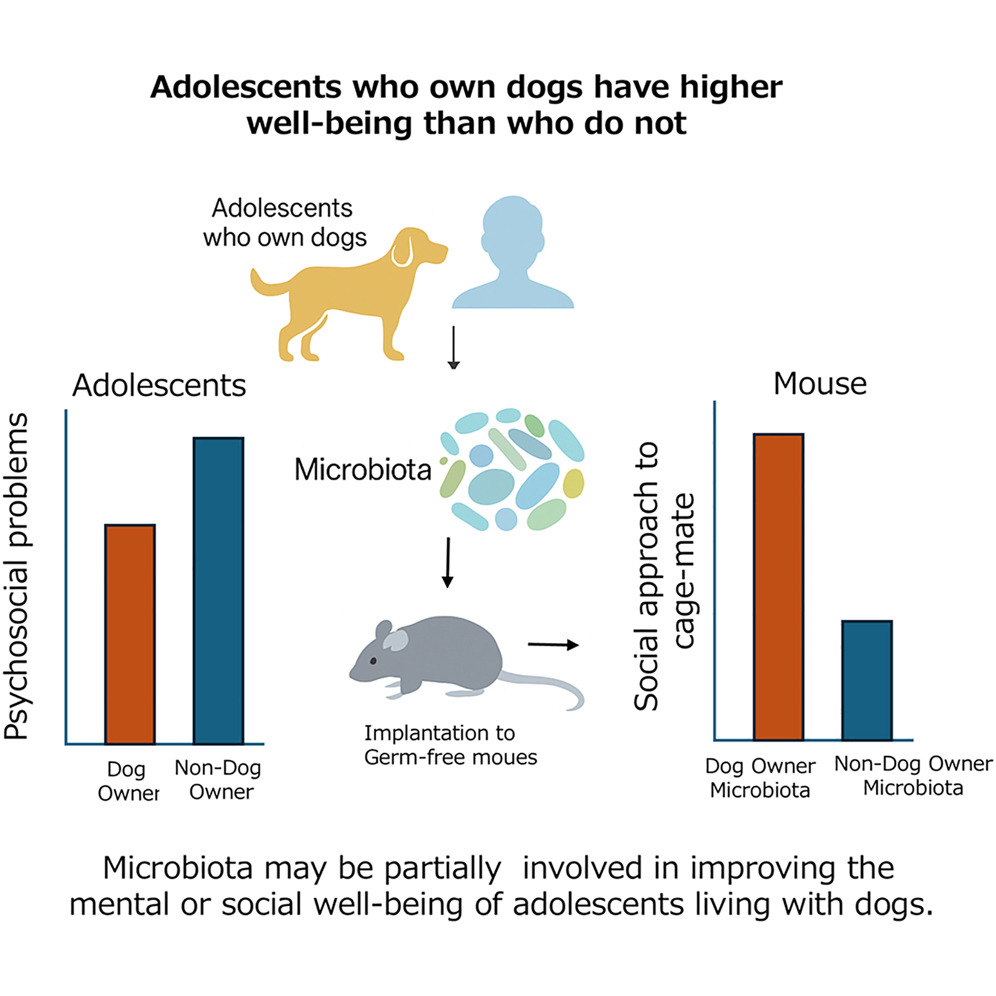
A family dog can boost teens' mental health through the microbiome, study suggests. spkl.io/6012AgJ2K.?utm_source=x&utm_medium=organic&utm_campaign=pr Takefumi Kikusui & colleagues #iScience
Cell Press tweet media
English
4
1
4
1.3K
EdNA retweetledi
SoL in the Wild
SoL in the Wild@SoLInTheWild·
Every lesson is a series of cognitive decisions: What will students attend to? How will I manage working memory? How will they encode & retrieve? Here’s how I use Willingham’s Simple Memory Model as a “cognitive checklist” to guide each decision. 👇🔗
SoL in the Wild tweet mediaSoL in the Wild tweet media
English
6
25
114
9.9K
EdNA retweetledi
Emil Kirkegaard
Emil Kirkegaard@KirkegaardEmil·
20 years of growth mindset mania, millions of dollars spent on research, interventions, and hype. What have we learned? "We conclude that apparent effects of growth mindset interventions on academic achievement are likely attributable to inadequate study design, reporting flaws, and bias."
Emil Kirkegaard tweet media
English
33
122
770
129.1K
EdNA retweetledi
Jonathan Haidt
Jonathan Haidt@JonHaidt·
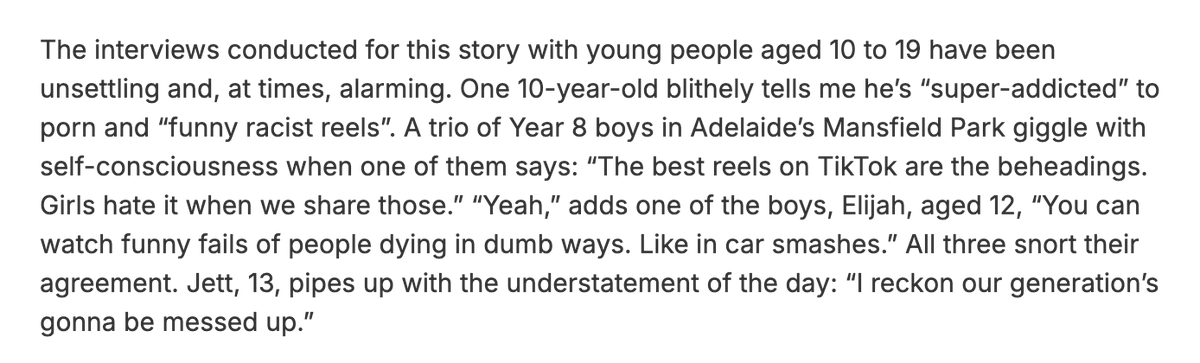
There's a major essay on what teens think about social media, in @TheAustralian. Its so important that they took down the paywall for a while: #comments" target="_blank" rel="nofollow noopener">theaustralian.com.au/weekend-austra… So many powerful quotes, this one stunned me:
Jonathan Haidt tweet media
English
40
302
900
126.3K
EdNA retweetledi
Today in History
Today in History@TodayinHistory·
Today in 1945, George Orwell published a devastating critique of Communism. Animal Farm reveals why every communist revolution follows the same tragic pattern: liberation to corruption to oppression. Here are 10 truths from Animal Farm Orwell warned us never to forget 🧵👇🏼
Today in History tweet media
English
3K
33.6K
124.8K
16.4M