Effective Kotlin retweetledi
Effective Kotlin
952 posts

Effective Kotlin
@EffectiveKotlin
Profile of the Effective Kotlin book by @marcinmoskala
Katılım Temmuz 2018
7 Takip Edilen1.8K Takipçiler
Effective Kotlin retweetledi

If Python is your “get things done” language, what starts breaking once the codebase grows to years, not weeks?
This article by Marcin Moskala compares Python vs Kotlin through real code (scripts → CRUD → backend), and shows why teams are increasingly treating Kotlin as a pragmatic “Python, but production-scalable” option.
Originally published on the JetBrains blog.
Read: kt.academy/article/python…

English
Effective Kotlin retweetledi

Most Compose teams don’t struggle because Compose is complex.
They struggle because everyone applies different patterns.
When knowledge lives in a few people’s heads, UI behavior becomes accidental.
Advanced Compose helps teams build shared mental models, so everyone reasons about UI changes the same way.
That’s when code reviews get easier and regressions drop.
Explore how Advanced Compose aligns teams → advancedcompose.com

English
Effective Kotlin retweetledi

No matter if you want to write documentation, an article, or just better understand what you read, you should know the essential programming nomenclature
Stop confusing:
🚨 arguments and properties,
🚨 statements and expressions,
🚨 properties and fields
and much more
kt.academy/article/progra…

English
Effective Kotlin retweetledi

Have you ever “fixed” a Compose performance issue by randomly reshuffling state or adding `remember`, without being sure *why* it worked?
I published a short quiz to help you check whether you actually understand recomposition and stability in Jetpack Compose.
Verify your mental model, catch common misconceptions and get a clearer direction on what to revisit next 👇
kt.academy/article/quiz-r…

English
Effective Kotlin retweetledi

Have you heard about the bug that nearly destroyed Earth? In 1983, the soviet early warning system showed five incoming nuclear missiles from the USA. Lt. Col. Stanislaus Petrov reasoned that if the U.S. wanted to attack the Soviet Union, would it really launch only five missiles? He ordered his men to stand down (which was against higher orders), and 23 minutes later, radar outposts confirmed that there were no incoming missiles. The mistake was due to a system bug. So if you accidentally released a bug on production, know that it could have been worse, much worse.

English
Effective Kotlin retweetledi

Certificates are external proof. Confidence is internal. A certificate works well on LinkedIn. It’s also something you can show to your team or manager. But real confidence comes from being able to explain: – why this UI behaves correctly
– why a refactor is safe
– and when an approach will break
The certificate is the signal. The understanding is what you use at work.
If this fits your work, explore Advanced Compose -> advancedcompose.com

English
Effective Kotlin retweetledi

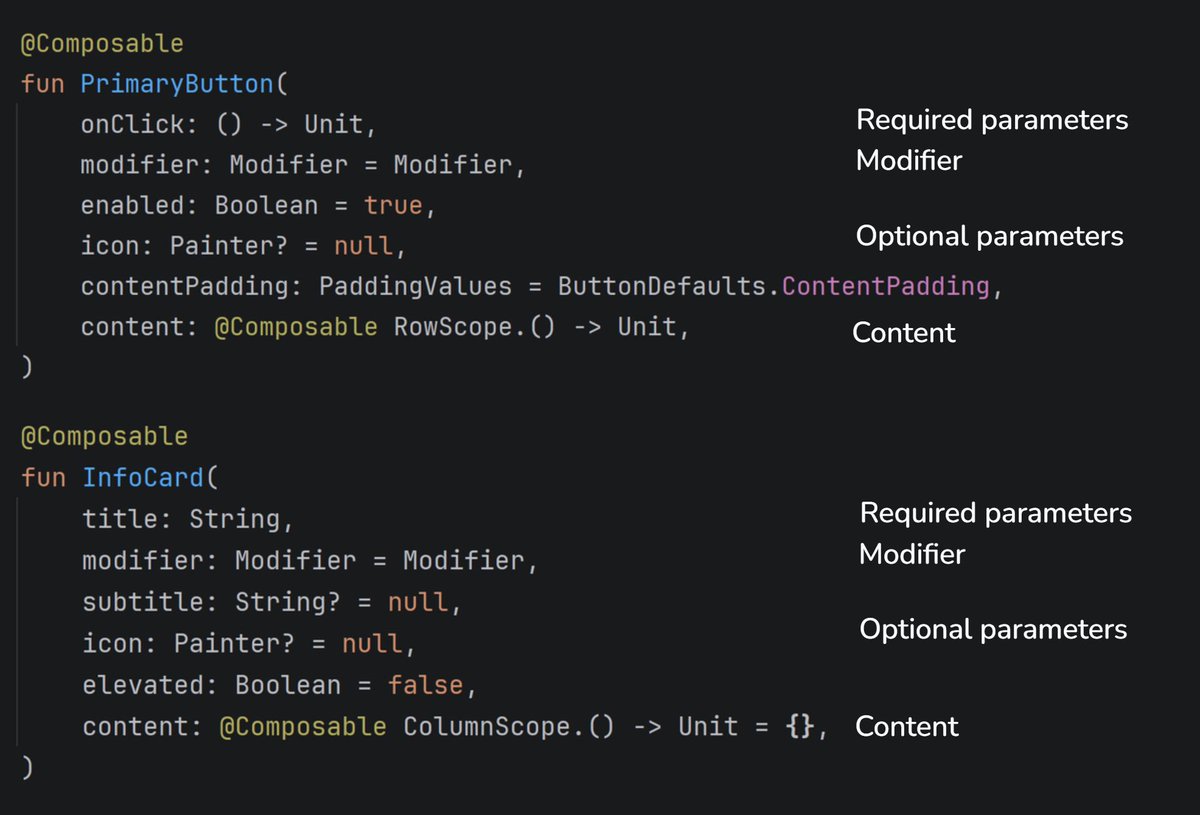
Component parameter order should never be random! This is how we order them:
1. Required parameters (no optional value). Those should be essential parameters of this component. For non-essential, provide default value.
2. modifier: Modifier = Modifier at first optional position.
3. Optional parameters, so parameters with default values. Those should be majority of your parameters.
4. Finally, layouts or components that have content might please content slot at the last position to support trailing lambda convention.

English
Effective Kotlin retweetledi

Simplest Nav2 → Nav3 Migration Guide
If you’ve already used Nav2, here’s the quick “what maps to what” when moving to Nav3:
Destinations → NavKey
NavController → BackStack
NavGraphBuilder → entryProvider
composable<...> → entry<...>
navigate(Destination) →.add(Destination)
navigateUp() →removeLastOrNull()
enterTransition + exitTransition → transitionSpec
popEnterTransition + popExitTransition → popTransitionSpec
@jovchem
Get the full migration walkthrough here 👇
kt.academy/article/nav2-t…

English
Effective Kotlin retweetledi

AI makes writing code cheaper.
It does not make judgment cheaper.
AI can generate Compose code, but it cannot reliably explain behavior, predict consequences, or choose long-term trade-offs. Those limits are exactly where career value concentrates as teams adopt AI.
Engineers who understand how UI actually works are the ones trusted with reviews, refactors, and architectural decisions. That trust is what drives job security and advancement in an AI-assisted world.
Advanced Compose builds the ability to reason about behavior and correctness. Polished Compose extends it to designing UI that stays consistent under change.
Details on building that understanding are available here:
Advanced Compose 👉 advancedcompose.com
Polished Compose 👉 polishedcompose.com

English
Effective Kotlin retweetledi

This is how modifiers are applied one after another:
👉 Background draws behind the whole area.
👉 Clip limits drawing space to the circle shape.
👉 Border draws border, around whole square, but it gets limited by circular area. It also clips the area where border is drawn (to prevent overdrawing it)
👉 Offset moves component area.
👉 Padding limits component area.
👉 Image is drawn in this area (changed by offset and padding) where not clipped (by clip and offset).
GIF
English
Effective Kotlin retweetledi

This crash is brutal because it often happens only with “real” data and often only in “specific” situations
`IllegalArgumentException: Key … was already used`
Why does it happen?
Elements in collections are identified by values returned from a key function. So this result MUST BE unique. If two elements on the same list have the same key, this error occurs.
How to prevent it?
- Use immutable and unique values as keys, typically IDs from the data layer.
- If the domain model doesn’t provide a unique ID, construct your key in a way that is unique.
Learn about using keys in Compose collections in the Advanced Compose course
👉 advancedcompose.com

English