E N V O Y

285 posts

E N V O Y banner
E N V O Y

E N V O Y

@ENVOYesp

Planetary Planning and Design Concepts for Mars and Lunar Colonization through Expansionism, Architecture, Science, Technology, Engineering, and Mathematics.

Katılım Nisan 2024
14 Takip Edilen13 Takipçiler
Sabitlenmiş Tweet
E N V O Y
E N V O Y@ENVOYesp·
ENVOY | Mars Timeline With basic human needs met, Mars’s can one day be a self sustaining planet. SpaceX’s CEO, entrepreneur, and advocate for occupying Mars @elonmusk is predicting a self-sustaining planet within 20 to 30 years from the first Starship arrival on Mars. However, with the current human technology available and the increased speed of @SpaceX’s Starship (compared to Voyager 1) it will take 90-104 days to get to Mars. At this advanced speed and for the upmost importance of human safety, the following timeline should be considered: May 4, 2031 - 6 years from 2025 First Starship payload to Mars: with teleoperated Optimus and construction materials, such as ice and cement mix for building rocket pads, @Tesla_Optimus will arrive on Mars, the first extension of human consciousness. February 5, 2042 - 17 years from 2025 First Starship human transport to Mars: with many prior payloads to Mars carrying supplies for self-sustenance, humans can finally arrive safely to their new planet. Preparation of the planet via @Tesla’s Optimus humanoid robot will provide the start to a new Mars colony. The first among many. December 5, 2069 - 44 years from 2025 A self-sustaining Mars: with technological advantages of humans on Mars, water cultivation, and other basic Martian needs, the planet will no longer rely on payloads from Earth. Humans will have attained the goal of being a multi-planet species.
English
0
0
1
50
E N V O Y
E N V O Y@ENVOYesp·
Mars is reality. It awaits on the outside. To get there you must abide by the rules. It is the main quest for some, but not for all. Only those who want to go to Mars will go, and those who want to stay behind will stay behind.
English
0
1
0
41
E N V O Y
E N V O Y@ENVOYesp·
Pluto is full of ice. Mars is a desert. Wouldn’t it be nice if they could help each other out?
English
0
0
0
5
E N V O Y
E N V O Y@ENVOYesp·
ENVOY | Explore
Español
0
0
1
8
E N V O Y
E N V O Y@ENVOYesp·
ENVOY | Water on Mars Hiding in plane sight on the poles and also under the regolith of the red soil on Mars, ice does exist. Landing a rocket on the polar ice caps is a bad idea, but a static fire would surely help melt the ice! @SpaceX Starship’s static fire test, typically involving multiple Raptor engines (up to 6 for Super Heavy, fewer for Starship), produces intense heat, with exhaust temperatures exceeding 1,500°C near the engines. x.com/SpaceX/status/…
English
0
0
1
36
E N V O Y
E N V O Y@ENVOYesp·
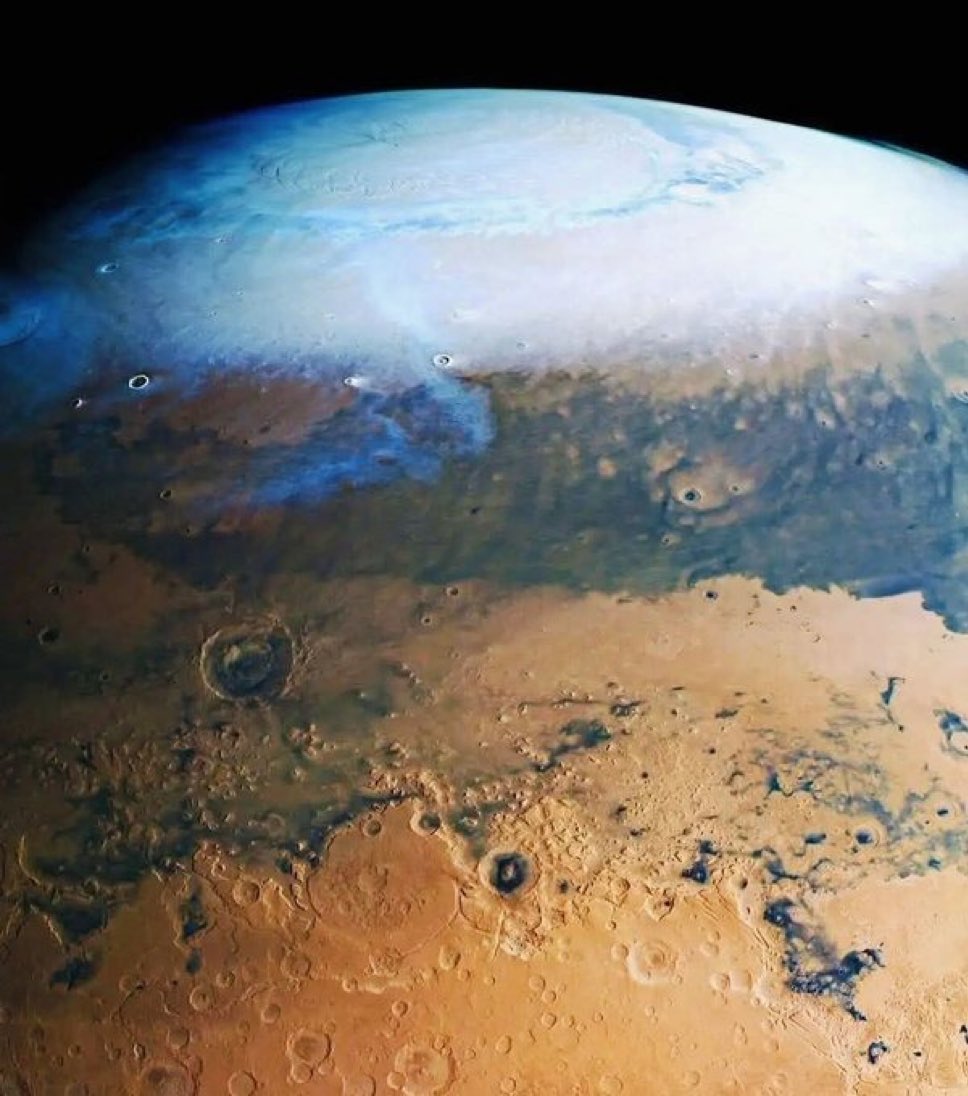
ENVOY | Water on Mars Polar ice caps exist on the planet Mars. The basic human needs to exist on other planet include O2, H2O, food, shelter, building, materials, and (at first) continued payloads from Earth. Water is the key to a self sustaining planet. With water, the planet will still be able to sustain human life even without support from Earth. The polar ice on Mars is the perfect solution for continued to expansion of the human consciousness outside of Earth because life is not possible without water. Water is the sustenance of life especially for a planet such as Mars, which humanity needs to colonize. However, Mars’ temperature is ice cold. The immense amount of ice on the poles will need to be melted, transported to the Mars base (one day, the first city), and collected for use. Upon first colonization of the planet, resources will be limited. A single static fire from a rocket engine produces enough heat to melt large amounts of ice. A system of collection of H2O from the polls to the base could happen at first through rocket engine heat. This image was originally taken by the ESA's Mars Express mission in 2019.
E N V O Y tweet media
English
0
0
1
18
E N V O Y
E N V O Y@ENVOYesp·
@elonmusk Very true! The regolith on Mars hides a lots of what is underneath. The key to a sustainable Mars is water.
English
0
0
0
11
E N V O Y
E N V O Y@ENVOYesp·
ENVOY | Water on Mars The structure of wastewater plants on Mars needs to be partially submerged into the surface of the planet. Having at least one basement level will be attainable with the limited manpower to build the first wastewater plants, followed by the surface-level concrete circular domed buildings This structure will be entirely built with extruded concrete and with no glass whatsoever. This is necessary for external safety from the harsh Martian elements. A large entrance, like a vault door, big enough to move the 3D concrete extruder equipment, in and out of the structure, will be required. In addition, a future subterranean entrance and tunnels for water will be necessary. This will allow for eventual, highly insulated water pipes, to exist within the tunnels. Is extremely cold, so an excess of insulation will deter pipe freezing and maintain water pressure. Just to recap, @boringcompany uses a machine called Prufrock of advanced tunnel boring machines, designed to dig tunnels rapidly and cost-effectively. They aim to revolutionize transportation. With this technology, Mars “Waterloops” or plumbing could be possible, in time, with effort and teamwork.
E N V O Y tweet media
English
0
0
0
44
E N V O Y
E N V O Y@ENVOYesp·
“Mars city self-sustaining in 20 to 30 years.” —Elon Musk Prediction: 30 years from now, a single Martian city may be self-stabilized. By 2069 Mars may be self-sustained.
English
0
1
1
153
E N V O Y
E N V O Y@ENVOYesp·
ENVOY | Water on Mars Water is necessary for life on Mars, yet the planet has a lack of this elemental resource. Wastewater plants, required to clean and recycle water on Mars, will be built, at a smaller scale on the surface. To circumvent any natural storms occurring on Mars’ surface, the wastewater plants will need to be enclosed in a hard exterior building. If a self sustaining plant is the goal, these wastewater buildings will need to be constructed of solid concrete with limited resources, using additive manufactured architecture, similar to 3D printing. This is an architectural technology currently in use on Earth. Humans, or @elonmusk’s teleoperated @Tesla_Optimus, will be required to save our limited concrete and water payloads from Earth by using this technology.
MIT Media Lab@medialab

Steven's research in additive manufacturing, architecture, and robotics led him to create the Digital Construction Platform, a system that can 3D print the structure of an entire building: mitsha.re/VwpL30pbyWE

English
0
0
0
32
E N V O Y
E N V O Y@ENVOYesp·
ENVOY | Water on Mars Earth’s original civilizations, pioneers, and settlers will be president studies for our next endeavor: Mars. Learning from current technological advantages paired with ancient civilizations, such as the Romans, Aztecs, and the Mayans will aid in the development process of our new planet. Rome was one of the first to create indoor plumbing, aqueducts, and water management. They were also among the first to build roads. However, on Mars, our ‘roads’ (aqueducts) will be bored underground, just like Prufrock’s capabilities, similar to @elonmusk’s Hyperloops. The Boring Company’s Hyperloop is a high-speed transportation system using pods in low-pressure tubes to travel at speeds up to 760 mph. But instead of electric vehicles, this underground tunnel will transport water! This Martian technology, made by humans on Mars, will sustain life on Mars. water is the answer to our self-sustaining planet! Similar to the Romans, the Aztecs cultivated their water supply by constructing chinampas, artificial islands in Lake Texcoco, to grow crops using nutrient-rich water from canals. They also built aqueducts and dikes to manage freshwater flow and control flooding in Tenochtitlan. These practices could be used underground as well on Mars. As well as the Romans and the Aztecs, the Mayans cultivated their water supply by constructing reservoirs, canals, and aguadas to collect and manage rainwater, supplemented by cenotes for groundwater access in their cities. On Mars, learning from Earth’s history will be efficient. We can learn so much from these civilizations and become the first pioneers to occupy Mars.
English
0
0
0
15
E N V O Y
E N V O Y@ENVOYesp·
ENVOY | Water on Mars 1. Starship payloads to Mars: What is lacking in the current existence of a self-sustaining Mars? Water and oxygen. With current technology, artificial O2 will maintain human life on Mars. Oxygen plants will initially take precedence overall else, except water plants. Wastewater management plants will need to be built and sustained for water cleanliness. In the early years of life on Mars, Starship transports of ice will create a stronghold for humans. Ice is less dense than water. This will be an easier payload delivery. More liquid water will emerge when the ice melts as ice’s density is 8.4% less than water. 2. Recycling H2O on Mars: Upon continued arrivals of Spaceship’s ice payloads, the maintenance of clean water is to be implemented. In time, reservoirs of potable water will arise. Once sustained these reservoirs will need to be recycled through wastewater plants. A wastewater plant is a facility that treats and purifies sewage and industrial wastewater to remove contaminants before releasing it into the environment or reusing it. In all reality, the colonization of Mars will begin with water cultivation, oxygen maintenance, and farming water distribution practices. Unlike on earth, farming, and water distribution practices on Mars will not be for crops (yet), but for human sustenance. In time, continued payloads of ice will maintain life on Mars until wastewater management practices create a fraction of the production of water on Mars. Luckily, at first, human arrival will not outweigh the production of water.
English
0
0
0
13
E N V O Y
E N V O Y@ENVOYesp·
ENVOY | Transports to Mars For the success of Starship’s human transport to Mars, many measures must be taken into consideration. The safety of the crew and payload on a 3-5 month trip must survive. The liquid oxygen and payload will take up the majority of space on a single Starship. However, a tandem flight to Mars will benefit greatly. Without much friction during flight in the vacuum of space, more liquid oxygen will be pulled alongside Starship 2, while Starship 1 carries the crew and payload. This would enable a fuel transfer from Starship 2 to Starship 1 during the 90-104 day trip. Starship 1, with the crew and payload, will not yet have the capability of artificial gravity. So how will the crew withstand such a long trip? The muscular health of the human body must stay intact. So upon human arrival, the crew can remain fit. Life on Mars will not be easy for the weak. Pods of water to maintain muscular health should be on board. Unfortunately, hypersleep will not yet be possible. The crew will need to use these pods of water for exercise daily. For the human crew on board SpaceX’s starship, CEO @elonmusk, should consider these water pods. Upon arrival, the water could then be cleaned/recycled with simple microfiber/membrane filtration and distillation technology. This would be a compound voyage for the transport of, not only the crew, payload, and liquid oxygen, but also water. Water is the answer to a self-sustaining planet!
E N V O Y tweet media
English
0
0
0
12
E N V O Y
E N V O Y@ENVOYesp·
ENVOY | Explore What if Portals could bend the fabric of time and space to deliver water to Mars from Earth? A portal, in the context of space and time, is a theoretical construct, often called a wormhole, that connects two distant points in spacetime. Predicted by Einstein’s general relativity, it acts as a tunnel allowing near-instantaneous travel or communication across vast distances or different times. These portals remain hypothetical, with no empirical evidence confirming their existence. In science fiction, portals are depicted as gateways or rifts for traversing space or time. Their theoretical formation requires extreme conditions, like massive energy or exotic matter, to stabilize the connection.
English
0
0
0
20
E N V O Y
E N V O Y@ENVOYesp·
ENVOY | Water on Mars There are two options for a self-sustaining planet on Mars: 1. Use Prufrock to bore and oil rigs to drill for water. Oil rigs can be adapted to drill for water. Drilling technology for oil and gas is similar to that used for groundwater, targeting aquifers instead of oil reservoirs. Modified rigs can drill deep wells to access underground water sources, though adjustments may be needed for different geological conditions. 2. Artificial rain clouds for rain cultivated indoors because Mars’ atmosphere is 95.3% carbon dioxide, 2.7% nitrogen, 1.6% argon, 0.13% oxygen, and trace amounts of carbon monoxide, water vapor, and methane. It’s thin, about 1% of Earth’s atmospheric pressure not suitable for healthy rain clouds.
English
0
0
0
30
E N V O Y
E N V O Y@ENVOYesp·
ENVOY | Water on Mars The biggest obstacle to a self-sustaining planet is a lack of water. With the discovery of ice on Mars, boring deep into the layers of the rock hard planet will be beneficial and could solve the H2O problem. @boringcompany has the ability to dig deep in hopes of finding water under the layers of the planet from years past. Prufrock is The Boring Company’s advanced tunnel boring machine (TBM) designed for high-speed, low-cost tunneling. It can mine over 1 mile per week, six times faster than the previous Godot TBM, with a goal of reaching 7 miles per day. Key features include simultaneous tunnel lining, zero-people-in-tunnel (ZPIT) operation for safety, and “porpoising” to launch and emerge without extensive site preparation. In addition to Prufrock’s capabilities, it would be vital to add new features to this machine: The ability to sift through soil for ice, separate, and collect water on Mars. Any viable nutrient rich, subterranean soil will also have to be collected for reuse, if in existence. Mars will become self-sustaining when water is found!
English
0
0
0
16
E N V O Y
E N V O Y@ENVOYesp·
ENVOY | Life on Mars To live on Mars, the most basic need for humans is H2O, O2, and an atmosphere that can hold the elements. Through billions of years of Sol’s cooling into a main-sequence star (specifically a G-type yellow dwarf) has decreased the ozone layer of Mars. While in process of evolution, the red planet once looked like earth. In due process, similar to the greenhouse effect currently happening with the climate crisis on earth, Mars did also die out. However, for humanity to exist in the Solar System and maintain a stake in our conscious collective, we must venture to Mars as a stepping stone for survival. Sol will become a red giant in about 5 billion years when it exhausts its hydrogen fuel and begins fusing helium. At this stage, our sun will won’t explode. In about 5 billion years, it will expand into a red giant, then shed its outer layers to form a planetary nebula, leaving a white dwarf core. No supernova; it lacks the mass, but at this stage will no longer have the capacity to sustain planetary life.
English
0
0
0
22