GlobalX

35.8K posts

GlobalX banner
GlobalX

GlobalX

@GlobalXInt

Science and Tech News, Opinion, Stats 📊 Around The Globe & Beyond Too ↘️ !

Katılım Şubat 2021
19 Takip Edilen8.3K Takipçiler
GlobalX retweetledi
SciTech Era
SciTech Era@SciTechera·
This is insane Scientists just built an intracortical brain computer interface (iBCI) that let monkeys navigate a 3D virtual world using only their thoughts. Electrodes implanted in the motor and premotor cortex captured brain activity, and an AI-based neural decoder trained on this data translated it into continuous velocity commands for real-time movement. The monkeys moved through complex environments, avoided obstacles, and adapted dynamically without any physical movement. Even more impressive, the system worked across tasks without retraining. The key insight: decoding intention (premotor cortex) worked better than decoding movement itself. This marks a shift from movement based control to true intent-based brain interfaces. Acceleration is everywhere
SciTech Era tweet media
English
2
26
79
2.7K
GlobalX retweetledi
SciTech Era
SciTech Era@SciTechera·
This is huge. BIG STEP IN QUANTUM GENOMICS For the first time, scientists have successfully loaded a complete genome onto a quantum computer. Researchers from Wellcome Institute and Oxford encoded the full genome of the Hepatitis D virus into a quantum system. The genome contains about 1,700 RNA bases, and they compressed and mapped it into 117 qubits on IBM’s 156-qubit Heron processor. Instead of just storing data, they translated biological sequences into quantum circuits, meaning the genome can actually be processed inside a quantum machine. Why it matters: Modern genomics is becoming too complex for classical computers, especially with pangenomes that combine data from many individuals. Quantum systems could eventually handle this complexity by exploring many genetic possibilities at once. For now, this is a proof of concept. But it shows that real biological data can exist and be manipulated inside quantum hardware. And if quantum computing scales, this could change how we study diseases, mutations, and human genetics entirely. Acceleration is getting harder to ignore 👀
SciTech Era tweet media
English
14
74
247
9K
GlobalX retweetledi
SciTech Era
SciTech Era@SciTechera·
Wow Leju Robotics unveils the world's first automated factory for humanoid robots, 1 robot every 30 minutes.
English
4
35
80
3.8K
GlobalX retweetledi
SciTech Era
SciTech Era@SciTechera·
🚨 SOLID-STATE BATTERIES ARE FINALLY GOING REAL China is moving towards all-solid-state batteries toward real world production, targeting 2026 with broader commercialization projected between 2027 and 2028. These batteries could reach around 400 Wh/kg, which means EVs with 800 km+ range, faster charging, and much better safety without flammable liquids. It’s starting to happen faster than you think..
SciTech Era tweet media
English
10
47
141
4.8K
GlobalX retweetledi
SciTech Era
SciTech Era@SciTechera·
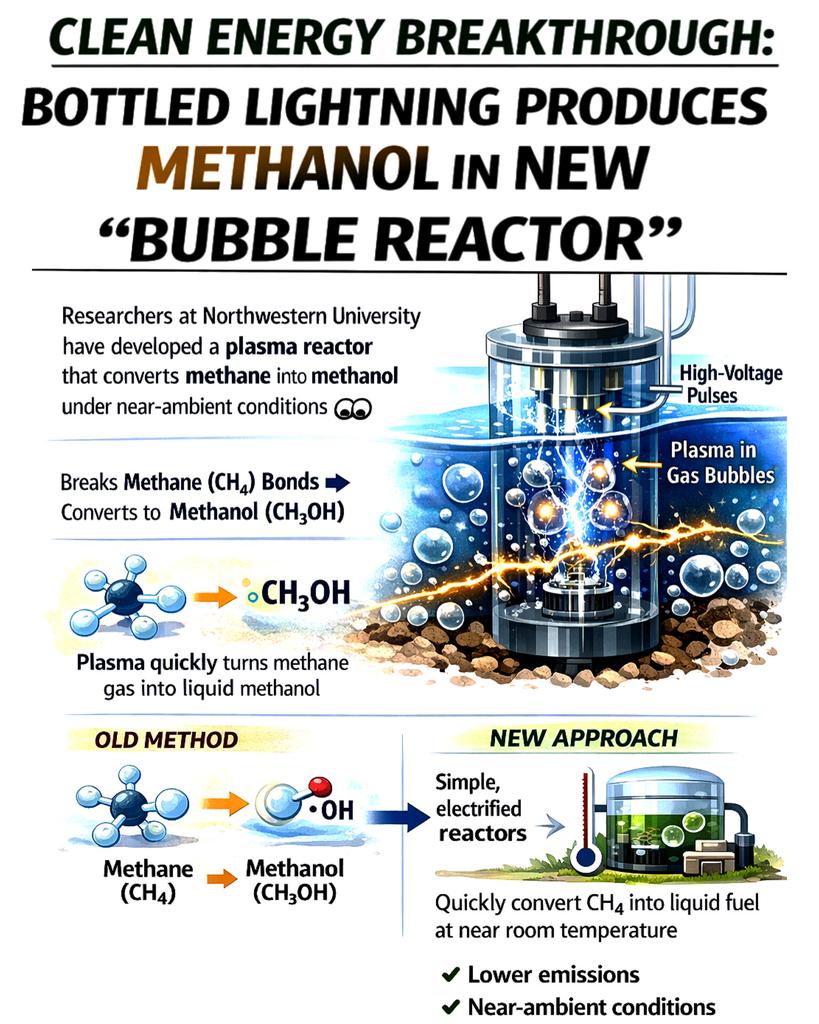
BIG BREAKTHROUGH: Scientists just turned methane into liquid fuel using bottled lightning. Researchers have developed a plasma based reactor that converts methane directly into methanol under near ambient conditions 👀 This system uses high voltage pulses to generate non-thermal plasma inside microscopic gas bubbles, creating highly energetic electrons that break methane’s strong C–H bonds without heating the entire reactor. At a gas–liquid–catalyst interface, reactive species like methyl (•CH₃) and hydroxyl (•OH) radicals recombine in a controlled pathway, achieving 96.8% methanol selectivity with 57% overall carbon conversion. Unlike traditional methods that require 800°C temperatures and 200–300 atm pressure, this approach operates close to room temperature and atmospheric pressure in a single step. The reactor uses a copper oxide catalyst and water to stabilize intermediates, preventing overoxidation into CO₂, which is one of the hardest problems in methane chemistry 👀! This breakthrough could enable small, electrified reactors that convert stranded or wasted methane into liquid fuel on-site, reducing emissions and reshaping how we produce chemicals.
SciTech Era tweet media
English
8
43
133
5.6K
GlobalX retweetledi
SciTech Era
SciTech Era@SciTechera·
Scientists reversed brain aging using a simple nasal spray. Brain aging breakthrough In a new study texas A&M University, researchers used a two dose nasal spray to deliver microRNA-loaded extracellular vesicles directly into the brain. This treatment reduces neuroinflammation by targeting key pathways like NLRP3 and cGAS–STING, while restoring mitochondrial function and rebalancing brain immune cells. In aging mice, this led to improved memory and cognitive function within weeks, with effects lasting for months after just two doses 👀 This new study suggests brain aging may be reversible by targeting inflammation at the molecular level.
SciTech Era tweet media
English
16
88
415
21.1K
GlobalX retweetledi
SciTech Era
SciTech Era@SciTechera·
Good progress! OpenArm: An open-source humanoid arm platform developed by Enactic in Tokyo. It includes full CAD files, control code, firmware, and simulation tools, that allows users to build, modify, and test the system themselves.
English
5
27
70
4.7K
GlobalX retweetledi
SciTech Era
SciTech Era@SciTechera·
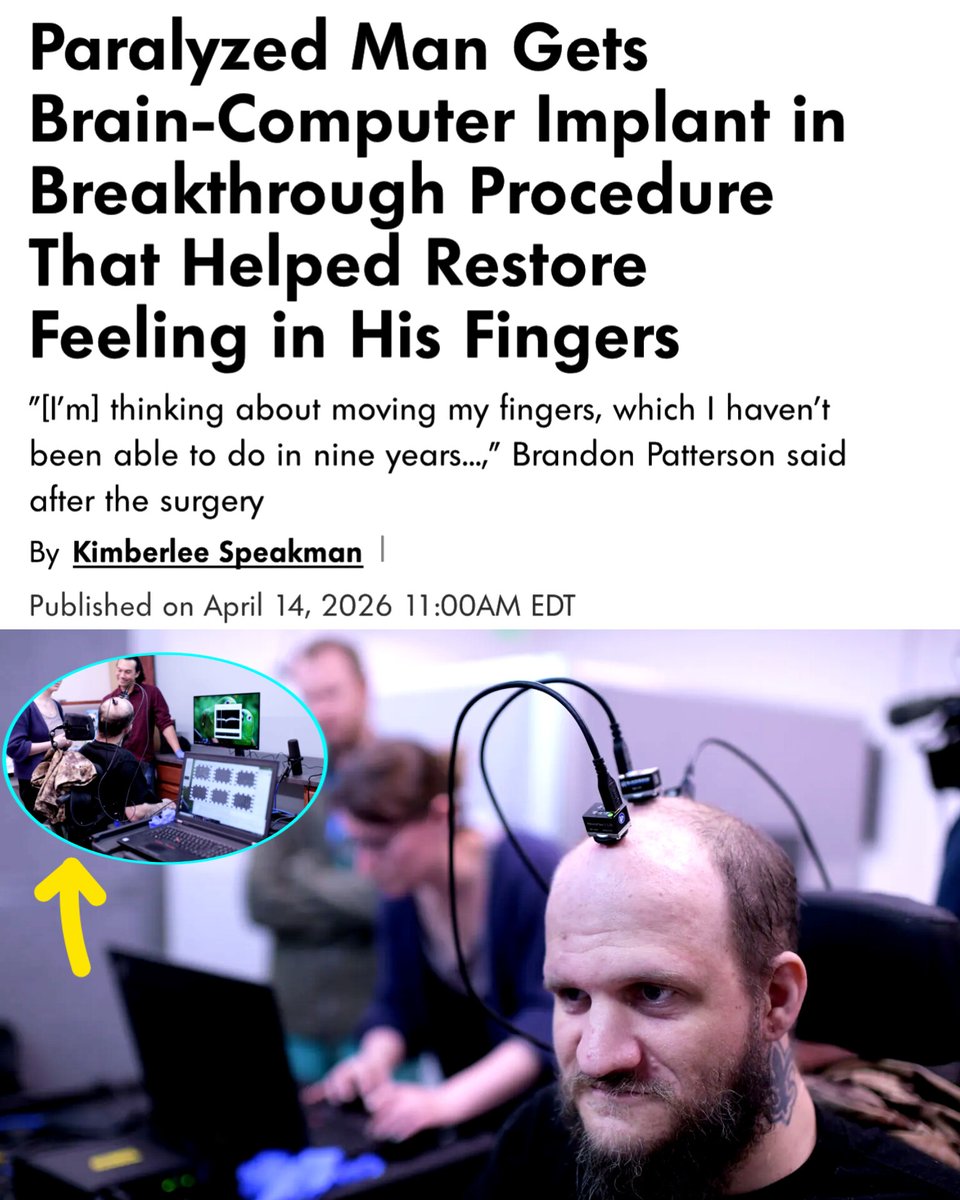
Wow A 41-year old man, paralyzed for 9 years after a spinal cord injury, has experienced something remarkable. Through an advanced BCI implanted directly into his cerebral cortex, researchers enabled his brain signals to bypass damaged spinal pathways. The system uses high-resolution neural recording, capturing signals from individual neurons and translating them into meaningful output. For the first time in years, he reported feeling sensations in his fingers again, even without visible movement 👀
SciTech Era tweet media
English
6
26
99
3.4K
GlobalX retweetledi
SciTech Era
SciTech Era@SciTechera·
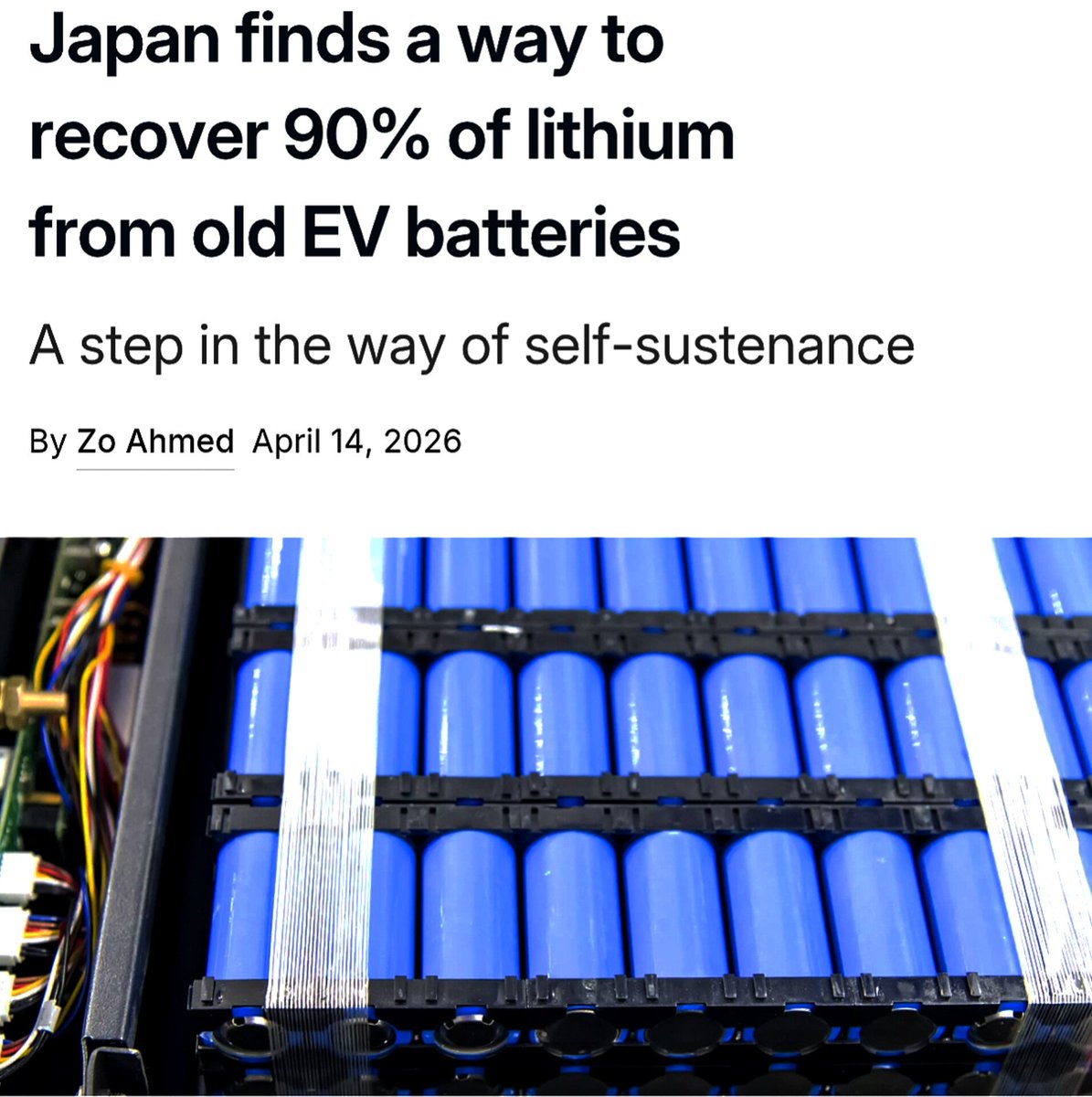
“Japanese researchers just developed a recycling process that can recover up to 90% of lithium from used lithium-ion batteries.” “The method combines pyrometallurgical pre-treatment with hydrometallurgical extraction to efficiently isolate lithium from battery waste.” “Batteries are first thermally treated to remove organics, then processed into ‘black mass’ containing lithium, cobalt, nickel, and manganese.” “Through controlled acid leaching and chemical separation, lithium is recovered as high-purity compounds like lithium carbonate (Li₂CO₃).” “Traditional recycling methods recovered less than 50% of lithium, making this a major efficiency breakthrough.” “For a country that imports nearly 100% of its battery metals, this enables ‘urban mining' recovering critical resources from waste.”
SciTech Era tweet media
English
8
114
293
16.3K
GlobalX retweetledi
SciTech Era
SciTech Era@SciTechera·
Aging and cancer are not inevitabilities, they are unsolved problems. Soon we’ll see massive progress around them. And once we solve aging and cancer, we’ll be far less likely to die from disease, maybe even reach a point where will be very few biological reasons left to die.
English
8
17
92
2.9K
GlobalX retweetledi
SciTech Era
SciTech Era@SciTechera·
Jeff Bezos, At Italian Tech Week: i believe there will be Millions of People living in space by 2045, robots doing our dirty work. He calls this future “civilizational abundance.” Al and interplanetary travel will allow humans to be happier, richer and to live beyond Earth while working far fewer hours. Jeff also said the next 20 years will be a golden age.
SciTech Era tweet media
English
23
30
132
5.5K
GlobalX retweetledi
SciTech Era
SciTech Era@SciTechera·
In the near future, you body will become as editable as software.
English
7
7
66
1.7K
GlobalX retweetledi
SciTech Era
SciTech Era@SciTechera·
By 2030, we could approach near immortality through nanorobots that repair the body at a cellular level. Many groundbreaking developments are coming soon.
SciTech Era tweet media
English
34
92
477
12.3K
GlobalX retweetledi
SciTech Era
SciTech Era@SciTechera·
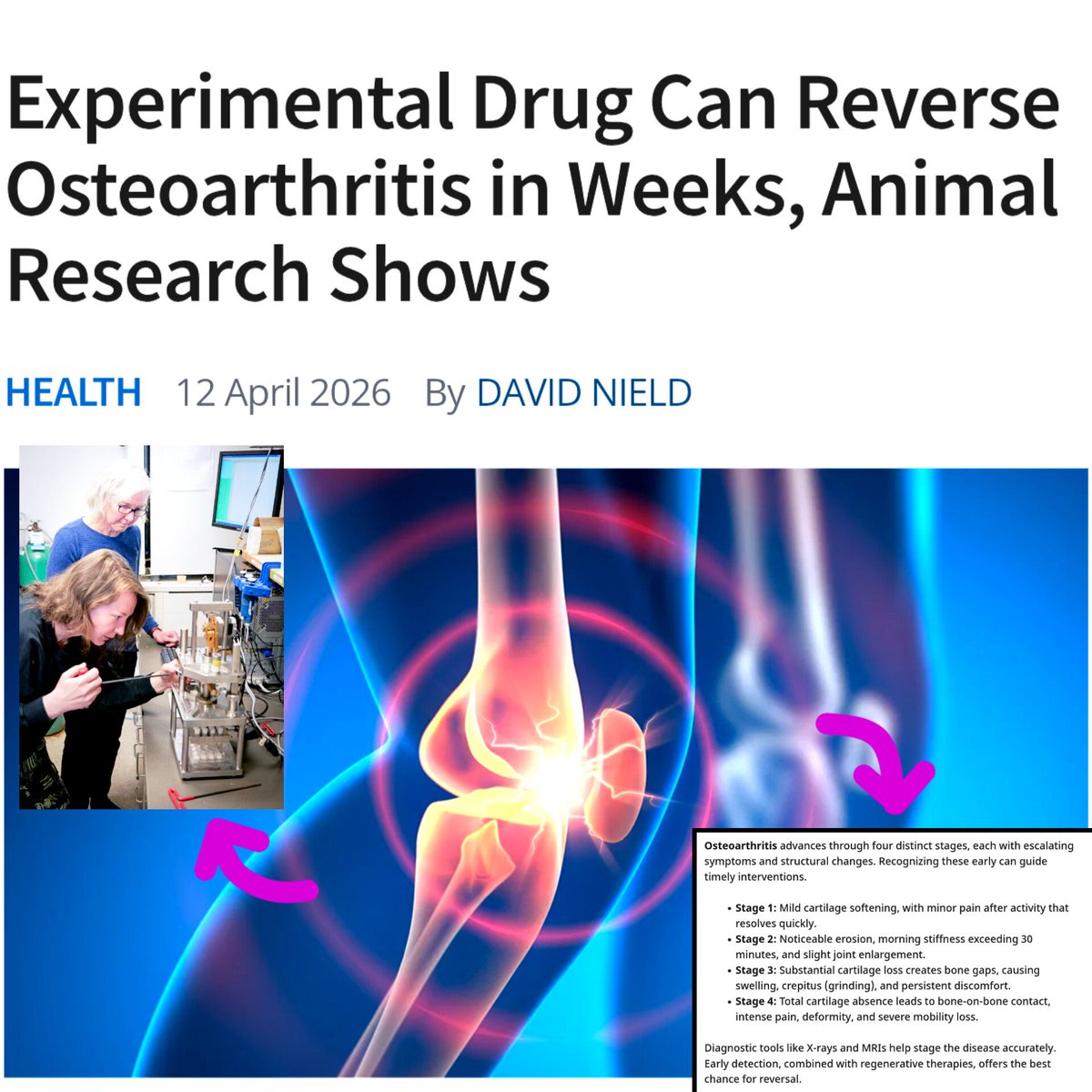
This is HUGE A BIG real step toward REVERSING osteoarthritis. “Scientists have developed a new single injection therapy that can regenerate damaged joints within 4–8 weeks in animal studies.” “This treatment combines a patented particle-based drug delivery system with an injectable protein biomaterial scaffold to rebuild cartilage and bone.” “After injection, the particles release a repurposed FDA-approved drug in controlled pulses over several months, continuously activating the body’s natural repair pathways.” “At the same time, the biomaterial forms a scaffold inside the joint, guiding regenerative cells directly to damaged tissue and supporting new growth.” “This work is part of ARPA-H’s NITRO program, backed by up to $33.5 million, with Renovare Therapeutics preparing to move the therapy toward human trials in about 18 months.” “Instead of reducing pain or slowing degeneration, this approach targets the root cause of osteoarthritis: the loss of joint tissue.”
SciTech Era tweet media
English
7
60
220
8K
GlobalX retweetledi
SciTech Era
SciTech Era@SciTechera·
Wow. This is amazing Researchers just developed DNA-level encryption to protect bioengineered cells. A team of US researchers has created a system that scrambles genetic instructions into a nonfunctional state, meaning engineered cells simply don’t work unless they’re unlocked. This new approach uses site specific recombinases and a 45-input chemical keypad to control access. The keypad is built from 9 small molecules. It requires the exact sequence and timing of chemical inputs to act as a biological password. Only then do recombinases restore the DNA to its functional state. In ethical hacking tests simulating real-world attacks, unauthorized access succeeded just 0.2% of the time, showing strong protection of biological assets. Damn.. we are moving toward a highly secure biological future.
SciTech Era tweet media
English
12
48
130
8.8K
GlobalX retweetledi
SciTech Era
SciTech Era@SciTechera·
🚨 AI-powered brain upload startups might arrive sooner than expected, according to Andrej Karpathy. Instead of scanning the human brain like in science fiction, these startups could take a different approach. They would conduct detailed interviews with a person, collect their thoughts, memories, and communication style, and then fine-tune large language models to simulate them. The result would be a digital version of that person, accessible through an API, allowing others to interact with their simulated personality. “It’s trippy and somewhat dystopian,” Karpathy noted, “but in principle, it’s already possible.”
SciTech Era tweet mediaSciTech Era tweet media
English
27
54
242
35.5K
GlobalX retweetledi
SciTech Era
SciTech Era@SciTechera·
This is big. Really big. Scientists have just created a molecule that can store sunlight like a rechargeable battery. In a new study published in Science, researchers designed a pyrimidone based system that captures solar energy and locks it into a high energy form called Dewar pyrimidone. When exposed to UV light (~300 nm), the molecule undergoes photoisomerization, transforming into a strained structure that stores energy in its chemical bonds. What makes this powerful is that the energy can be stored for years and then released on demand as heat, simply by triggering the molecule with heat or an acid catalyst 👀 The system achieves an energy density of ~1.6 MJ/kg, which is nearly 2× higher than lithium-ion batteries. In experiments, the stored energy was strong enough to boil water in seconds, proving it’s not just theoretical. The molecule is also inspired by DNA chemistry, designed to be compact, stable, and even work in water-based environments. This is part of a growing field called Molecular Solar Thermal (MOST) energy storage, where the material itself acts as a solar battery. Instead of converting sunlight into electricity, it stores it directly as chemical energy. We’re starting to move toward a world where sunlight isn’t just used instantly.. but saved, transported, and released whenever we need it. Welcome to fastest accelerating SciTech Era ♥️
SciTech Era tweet media
English
37
267
821
67.7K
GlobalX retweetledi
SciTech Era
SciTech Era@SciTechera·
🚨 BREAKTHROUGH: Scientists just built living robots with a nervous system. Researchers used cells from Xenopus laevis to create neurobots that can self-organize neurons and coordinate their own movement. In a 2026 study published in Advanced Science, neural precursor cells developed into functional networks with axons and synapses, influencing behavior. These living machines show more complex motion, altered body structure, and activation of genes linked to sensory systems, and survive for ~10 days without feeding. This work shows that functional nervous systems can emerge in entirely new biological bodies, offering a new platform for studying intelligence and bioengineering.
SciTech Era tweet media
English
14
78
224
9.5K
GlobalX retweetledi
SciTech Era
SciTech Era@SciTechera·
Wow Cancer therapy reverses 3 diseases A woman who needed daily blood transfusions is now in remission after an experimental immune system reset. This is the first time this specific combination of conditions has been treated simultaneously.
SciTech Era tweet media
English
4
23
58
2.2K
GlobalX retweetledi
SciTech Era
SciTech Era@SciTechera·
My brain broke after reading this paper 🤯! Quantum computing just took a serious step toward breaking classical AI limits. MIT Scientists just showed that small quantum computers can outperform EXPONENTIALLY larger classical systems on massive datasets. In a new study, researchers introduced a framework called Quantum Oracle Sketching, where instead of loading entire datasets, the system streams random classical samples, processes them in quantum superposition, and then discards them. This directly bypasses the biggest bottleneck in quantum machine learning, which is data loading 👀 The results are honestly kind of ridiculous. A system with fewer than 60 logical qubits can perform core machine learning tasks that would require exponentially larger classical memory, translating to roughly 10,000× to 1,000,000× smaller system size. They validated this on real data, including single-cell RNA sequencing and movie review sentiment analysis, and showed it works across fundamental tasks like classification, dimension reduction, and linear algebra. They also used Classical Shadows to efficiently extract useful outputs from quantum states, solving another long standing limitation. This matters because modern AI is basically brute force, more data, more GPUs, more cost.
SciTech Era tweet media
English
40
155
642
105K