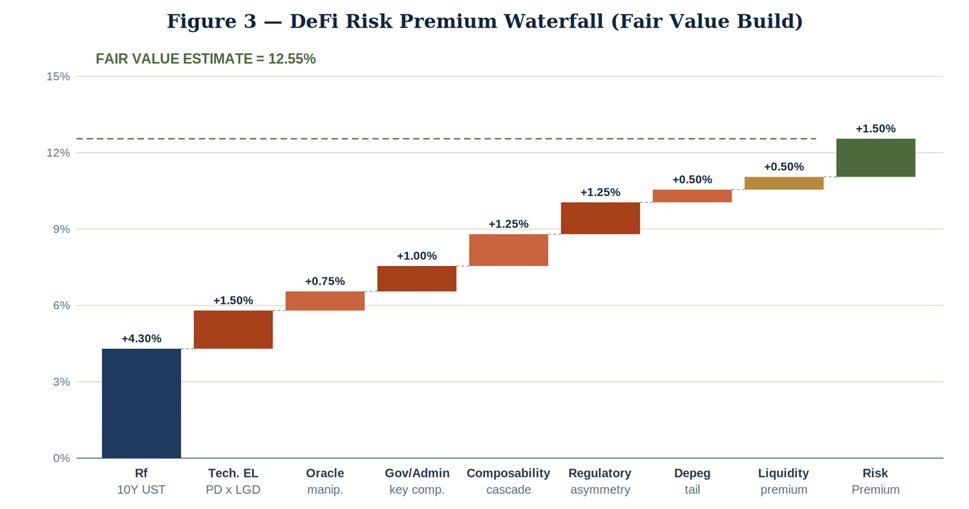
Excellent read. The embedded optionality of DeFi lending is often overlooked. DeFi rates should not converge to risk free rate even if smart contract security risk is fully eliminated
Alex McFarlane@flipdazed
English
Gordon Liao
975 posts

@gordonliao
Chief Economist & Head of Research @circle Prior: Research @Uniswap, economist @federalreserve, trader@harvardmanagement, PhD&AB @harvard all view are mine only

I just finished doing some simple vibecoding earlier because I suddenly had an idea around how @arc could be used for a more practical payment experience. The idea behind the app is called ArcSettle. What pushed me to think about this was something pretty common that I keep seeing, especially for freelancers, small agencies, online sellers, or Web3 contributors working with international clients. Global payments are still unnecessarily complicated. Sometimes transfers take too long, fees are unclear, and invoice tracking is still very manual. On the other side, crypto payments can definitely make transactions faster. But honestly, for a lot of people, it still feels too technical... IMO. You need to understand wallets, networks, gas fees, transaction hashes, and all of that stuff. For non-technical users, it can feel confusing before they even make the payment. So I started thinking... what if traditional invoices could connect directly with stablecoin settlement? That’s where the idea for ArcSettle. In simple terms, ArcSettle is a USDC invoice and settlement app built on Arc Network. The flow is intentionally very simple: create invoice → share payment link → client pays with USDC → transaction gets verified → invoice automatically changes to paid. So users don’t need to manually check whether payments already came in or not. The reason I chose Arc is because I think Arc is really interesting for this kind of use case. They focus heavily on stablecoin finance, and one thing I really like is that USDC is also used as the gas token. That makes the payment experience feel much more predictable and simpler since users don’t have to think about separate gas tokens just to complete a payment. And I intentionally don’t want this to become an overly complex DeFi app. The focus is more on building a practical everyday business tool something as simple as creating invoices and receiving global payments. The target users would be freelancers, creators, agencies, remote workers, or even small Web3 teams that want a cleaner and faster payment experience. Some features I imagine for the app are: - invoice creation - public payment links - wallet-based payments - automatic onchain payment detection - transaction dashboard - CSV or PDF report export So the invoice is no longer just a billing document, but something directly connected to settlement as well. And just to add a little context I’m not really coming from a hardcore full-stack engineering background myself. So for now, this is still more of a concept and product-flow idea focused on how Arc could be used to solve a real payment problem. For deeper technical implementation like optimization, scaling, backend architecture, and security, I’ll continue exploring and learning those parts over time while also learning more about the Arc ecosystem itself. So yeah, this is still an early - stage idea, but I genuinely think this kind of use case feels realistic and fits naturally with what Arc Network is trying to build. but you can probably get a rough picture of the kind of direction and ideas I’ve been thinking about, here: arc-settle-pay.lovable.app cc: @gordonliao @Soghoian @0xrachelita @blockjain @samconnerone


propAMMs can kiss my ass. Here is a mixed pool with $3M USDC and $3M USDT. For a $2M USDC swap, i.e. 2/3 of the entire reserves, there is -2bps on USDC and +6bps on USDT. You simply are not ready for the new Multiswap model.
The rsETH Exploit and the Case for Interest Rate Markets A forensic analysis of how a $290M bridge exploit deadlocked Aave lending markets — and why on-chain interest rate swaps are the missing stabilizer.

Circle Ventures is purchasing $AAVE tokens because strong DeFi infrastructure does not build itself. Aave is helping to shape the future of onchain finance, and we’re backing that ecosystem and the entire community built around it. DeFi United


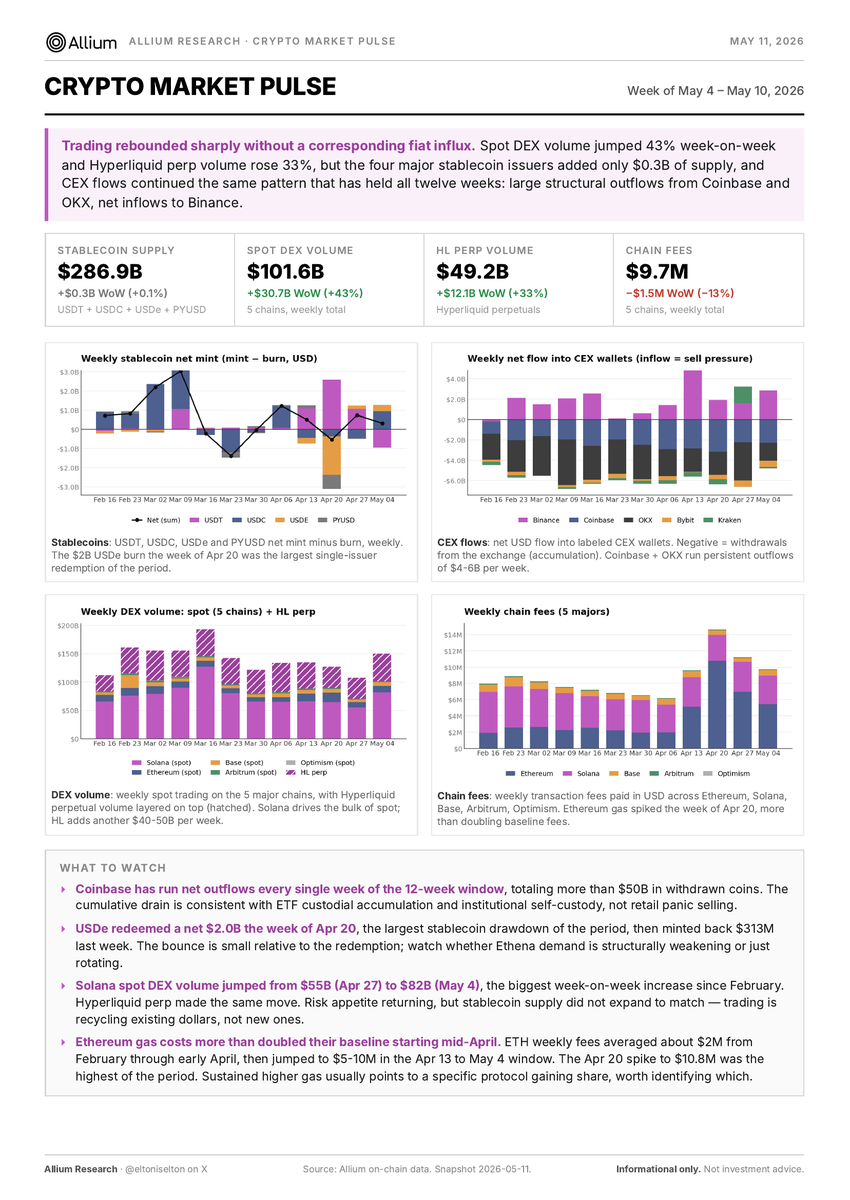
Yesterday @gordonliao posted a great proposal on how to fix the current deadlock situation of the AAVE V3 USDC market and received so big pushback coming from loopers and borrowers, so I check who is actually in danger I constructed USDC borrower snapshot as of 2026-04-23 07:00:00 UTC with a forward-looking deterministic analysis over the most vulnerable USDC positions. TL;DR - USDC remains highly utilized (98.06%), but is no longer fully pinned; available liquidity is about $34,938,518 - Observed variable borrow APR is 11.68% at snapshot time (2026-04-23 07:00:00 UTC). - Under proposal scenarios at current utilization, modeled 30-day material debt-at-risk is concentrated around $61,288,618. - Under pinned-utilization stress (99.87%), target-curve stress introduces one material <=7d account and raises 30-day material debt-at-risk to $70,142,038. Methodology - User set: addresses with positive net USDC debt. - Risk state: live getUserAccountData for HF, debt, collateral. - Debt mix modeling: reconstructed USDC share applied to user-level debt growth; non-USDC debt accrues at current debt-weighted baseline APR. - Assumptions: static prices, no top-ups/repay/migrations, deterministic accrual. Current State Snapshot - Supply: $1,803,583,630 - Borrow: $1,768,645,111 - Available liquidity: $34,938,518 - Utilization (borrow/supply): 98.06% - Observed USDC variable borrow APR: 11.68% - Observed USDC supply APR: 10.32% - Population covered: 9,036 users - Material users (debt >= $100k): 1,408 - Current observed APR 7-Day Risk: 0 Users / $0.00M Vol 30-Day Risk: 1 Users / $0.90M Vol - Interim @ current util 7-Day Risk: 0 Users / $0.00M Vol 30-Day Risk: 3 Users / $61.29M Vol - Target @ current util 7-Day Risk: 0 Users / $0.00M Vol 30-Day Risk: 3 Users / $61.29M Vol - Interim @ 99.87% util 7-Day Risk: 0 Users / $0.00M Vol 30-Day Risk: 3 Users / $61.29M Vol - Target @ 99.87% util 7-Day Risk: 1 Users / $0.90M Vol 30-Day Risk: 5 Users / $70.14M Vol Largest Address Deep-Dive: 0x0591926d5d3b9cc48ae6efb8db68025ddc3adfa5 This address is the largest debt concentration in the sensitivity set and materially drives scenario-level debt-at-risk outcomes. Total debt: $60,157,937 Reconstructed USDC debt: $50,804,404 (84.45% of total debt) Non-USDC debt (modeled baseline accrual): $9,353,533 Collateral: $66,203,217 Current HF: 1.0125 Debt headroom to HF=1 under static prices: $749,022 (1.25% debt growth buffer) At current-utilization interim/target scenarios, this single address contributes ~98% of 30-day material debt-at-risk, highlighting strong single-name concentration. Interpretation Count-based risk is dominated by dust accounts; debt-weighted risk remains concentrated in a small set of loop-heavy wallets. At the current (not fully pinned) utilization, no material account is in <=7d liquidation under interim/target-at-current-util scenarios. Under pinned stress, the target curve notably tightens clocks for the most levered material accounts. Caveats This is sensitivity analysis, not a forecast of realized liquidations. It excludes collateral price shocks and behavioral responses. Full post: governance.aave.com/t/arfc-improve…
lido earn has $23M in rsETH But its looped up so really they're $282M of the TVL and holding plenty of the ETH people are trying to withdraw This is the case for all loopers as most 10-12x... and basically all usage of rsETH across aave (even on L2) is looping Socializing losses liquidates them just as badly as a full wipeout would Ideally lz/aave/kelp find a way to make the bridge users whole as not whole is the same as doing nothing for em
2/ First, you need the market to calm down, if not any rates changes will not help. Based on the data during the SVB bankrun, you can divide it into 2 phases: Panic and Post-Panic During Panic phase, the correlation of rate hikes and utilization is very low, you can hike rates, but if borrowers are desperate will keep sucking the liquidity. And I believe we are still in panic phase. Reason in the next 2 tweets.


A proposal on AAVE USDC market and liquidity parameters from Circle's Chief Economist @gordonliao governance.aave.com/t/arfc-improve…

Lots of people are dunking on the Circle proposal to shift Aave rates, and I have, inevitably, been asked my opinion. I’ll share it here publicly. Gordon’s proposal is not incorrect directionally. He correctly diagnoses that the market is not clearing, and provides a pretty standard solution that would fit into half the textbooks on my bookshelf. Where I disagree with him are on his rate (in)sensitivity assumptions. Going straight to 40% seems destined to force liquidations. In the current market, contagion risk is already high, so cascades would need to be mitigated. I don’t know if Aave can throttle the liquidation throughput like the old Maker vaults could, but that would be a way to do that. It’s an open question whether this would be a good idea. I’m open to considering it, but am not convinced at this time. Gordon doesn’t say that the goal is repayment or liquidation, though. He believes this is a way to finance attracting supply, which I agree WOULD be the best way to unstick the market for the moment. However, the rate can’t just be the usual mechanics. For starters, anyone who has been in DeFi knows that juicy rates get diluted quickly in a floating rate lending protocol. Given the high probability of at least some loss, why would a lender put their stables to work even for a temporary (maybe a week?) 40% rate? Imagine you had $100m, and you saw this 40% deposit rate on Aave. Knowing there is more than $1b of impaired collateral in the system, are you going to risk your clients’ money for $109k/day? You’d need a week and a half just to break even on a 1% loss to your deposited funds. Except this is a floating rate. Once danger has passed, the rates drop down. And if they stay elevated it’s likely because the situation hasn’t gotten better. The calculus COULD be different if it was 40% for 6 months or a year. But you’re really just getting outsized rates for a few days in the best case scenario, and it is rising or realized risk that would let you keep earning that rate. This is at its heart a risk that is unmeasured, and so you can’t know what is the correct rate to price it at. You can’t tell if this is picking up nickels in front of a steam roller or the trade of the century. So I think depositors are the most rate insensitive group at the moment, and due to a very wide range of possible outcomes at the intersection of distressed collateral assets, ultimate recovery rates on those assets, timeline to realize that recovery, secondary damage that has created bad debt, and governance risk around things like implementation of Umbrella or the funds seized by Arbitrum. Basically everyone is standing around keeping rsETH marked to some imaginary number because we don’t have enough guidance from Kelp (and possibly L0 and now Arbitrum) for Aave to know how to begin liquidations and realize losses without accidentally taking on someone else’s loss because they were too pessimistic in valuing the impaired collateral. I do think at this point, Aave would be better off making an “ok” plan and acting today than waiting for a “good” plan that requires information from Kelp/L0/Arbitrum/law enforcement that may not be available for some time.

to give some unsolicited feedback - raise slope2 params asap - set ltv0 for any markets that are nearing illiquidity (100% utilization) - seriously consider freezing borrows across all assets for markets with material rsETH exposure and/or illiquid markets - seed aWETH/ETH pools at 2-4% range discount on uniswap to allow users to liquidate unsafe positions within the liq penalty
@gordonliao @aave @LlamaRisk Best thread I've read this month. "Price control doesn't fail because sellers are greedy. It fails because prices carry information." This applies way beyond DeFi lending. Every builder designing financial systems on-chain should read this twice.