Sabitlenmiş Tweet

ʜʏᴘᴇᴅ ᴛᴏ ᴜɴᴠᴇɪʟ ᴘᴜꜱʜ ᴄʜᴀɪɴ: ᴛʜᴇ ꜱʜᴀʀᴇᴅ ꜱᴛᴀᴛᴇ ʙʟᴏᴄᴋᴄʜᴀɪɴ ꜰᴏʀ ᴜɴɪᴠᴇʀꜱᴀʟ ᴀᴘᴘʟɪᴄᴀᴛɪᴏɴꜱ! 🚀
It’s born from years of R&D, bridging Web3’s biggest gaps one by one. What started as a quest to perfect consumer apps (like the Push Notification & Communication Protocol) has evolved into something far more impactful and widely applicable tech that we are now launching as Push Chain.
This long-form thread dives deep into the tech that makes Push Chain tick, the architecture behind it, and the ambitious vision driving us forward. Stay tuned—greatness awaits!
ᴡʜᴀᴛ ɪꜱ ᴘᴜꜱʜ ᴄʜᴀɪɴ, ᴀɴᴏᴛʜᴇʀ ʟ1?
Glad you asked. NO, while Push Chain is an L1, it’s not another L1. Instead, it’s a shared state chain for shared app experience created to solve the fragmentation and unify all the amazing L1s and awesome L2s, L3s.
ᴘᴜꜱʜ ᴄʜᴀɪɴ – ᴀɴʏ ᴄʜᴀɪɴ. ᴀɴʏ ᴜꜱᴇʀ. ᴀɴʏ ᴀᴘᴘ.
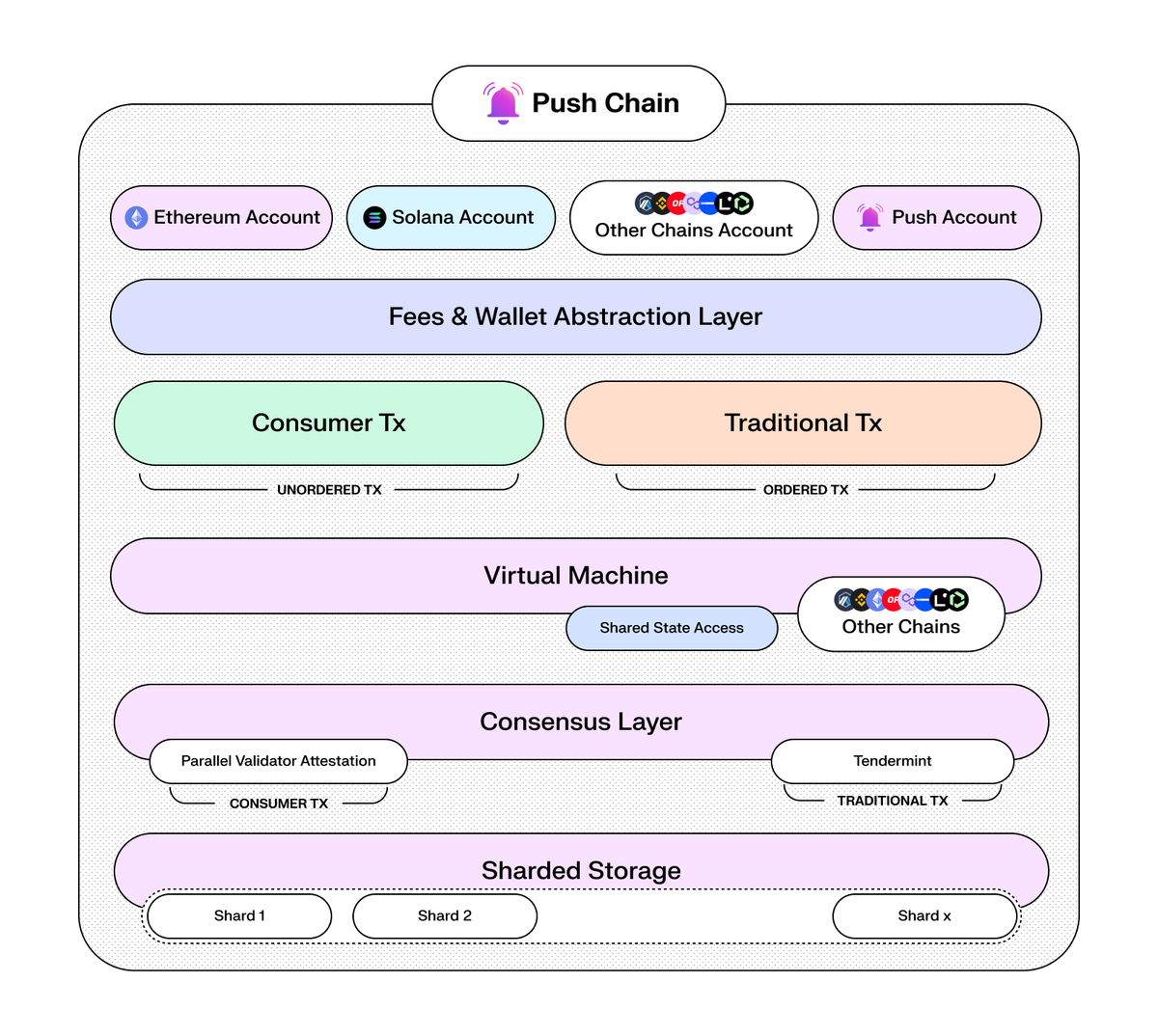
Push Chain is a consumer centric chain designed to allow transactions from any chain (ETH, Solana, EVM, non-EVM), has <1s fast finality and has true scalability (read and write throughput increases as the number of nodes increases).
It is a Proof-of-Stake (PoS) chain that has different types of nodes – validators, storage and archival — that handle different roles and responsibilities. Validators take on the role of writing transactions. Storage nodes which are dynamically sharded perform the role of fetching transactions from the network. Archival nodes exist to give the full snapshot of the blockchain.
It also introduces some key innovations in web3. At launch, those innovations are consumer transactions, which ensure that tx order isn't critical, and Push ID, which maps multiple EVMs and non-EVMs to one user. In later phases, shared state and universal smart contracts will launch. These features will enable smart contracts on Push Chain to know the state of EVM and non-EVM wallets connected to one user.
The end result is universal applications for web3. In this world, what was previously a user of "Uniswap on Ethereum" or "Uniswap on Polygon" or "Uniswap on Arbitrum" simply becomes ... ... a user of Uniswap.
ᴛʜᴇ ᴅᴇꜱɪɢɴ ᴀɴᴅ ʀᴀᴛɪᴏɴᴀʟᴇ ʙᴇʜɪɴᴅ ᴛʜᴇ ꜰᴇᴀᴛᴜʀᴇꜱ
Any Chain Txs and Blockchain Agnostic Wallet Addresses 🌏🔑
As a shared-state blockchain, Push Chain adopts CAIP-10 standards (huge shoutout to @pedrouid), allowing it to parse the chain, network, and address of each transaction. This ensures true interoperability across multiple blockchain ecosystems.
A universal chain must handle transactions from any wallet—Ethereum, Solana, and beyond. Push Chain achieves this by accepting signed payloads from native chain signers. Validator nodes verify signatures, check fees, and then admit transactions seamlessly.
Fee Abstraction 💰🪄
Cross-chain transactions are great, but not if fees become a hurdle. Here’s how Push Chain tackles this with fee abstraction:
🔘 Onchain Swappers: Fee contracts on each chain convert native tokens to cover fees automatically—no more buying fees on our chain.
🔘 Bulk Fee Payments: Lock and release fees in bulk, then send them to Push Chain directly in the transaction. This removes the bottleneck of waiting on a specific blockchain’s speed.
🔘 Delegated Fees: Allow a wallet or even a web3 app to cover fees, paving the way for web2-like UX where the “website” pays for the user.
These features streamline the user experience, ensuring that cross-chain transactions are as seamless and intuitive as possible.
Consumer txs (unordered) and Traditional txs (ordered) 🛍️
Web3 was built for financial apps that have strict order and it really makes sense for pure financial actions like when you DeFi. However, when you look at consumer apps of web2, you quickly notice that they are made of two components - 1) those in which order is necessary (user payments, financial instruments) and 2) those in which order is not critical (messages, comments or likes on a post, retweet, chat, email, gameplay, etc.). These are the things that we do the most in consumer apps, but traditional chains don’t provide the right experience for it.
We unlocked these learnings when we were sending notifications or using chat, where we realized that these consumer actions can benefit hugely if done without order yet still have decentralization (we still want web3 to replace web2, right?)
This insight gave us the opportunity to define a new type of tx for web3 which we call consumer tx, and this innovation instantly unlocked non-financial, mixed-financial apps for web3 other than the obvious market fit that we see with financial apps.
Sub-second finality ⚡⏱️
Any consumer chain requires txs to be done in an instant as that is what a user has come to expect from virtual apps they use. You don’t wait 5 seconds once you like a tweet.
To achieve this, Push Chain splits the nodes into three types - Validator, Storage and Archival - and enables parallel validation to be done on any type of consumer tx, as long as they are also attested by random validators. Either of them behaving maliciously results in a slash.
These parallel validator means that consumer txs are packed in orderless blocks (or should we call them stateless blocks 🤔) and txs can land onto any of the validator nodes in the network, resulting in near instant finality and write throughput or tps of the chain to increase linearly as number of nodes in the network increase.
Parallel Validators and Dynamic Sharding 🛠️
To achieve the same for storage nodes, as without it they will get bloated and read throughput or fetching tx will suffer, we introduced a node governing smart contract onto which each node (regardless of the type) is registered before getting admitted to the network.
Since this node-governing smart contract knows the number of nodes in the network, it is able to dynamically shard and assign data chunks and replication factor (that keeps on adjusting) as the number of storage nodes goes up or down.
This ensures that txs are stored in specific shards and fetched from there for a range of wallets, ensuring the network is fast and becomes faster in retrieving things as new nodes are added. Additionally, a quorum ensures that PoS is still applicable and it’s really difficult for a shard or malicious node to compromise the system.
Wallet Abstraction 🌀
Having powerful features is great, but understanding users and their needs is crucial. Through countless experiments with different user personas, we learned one key lesson: making web3 onboarding seamless for everyone is hard, because each type of user has unique expectations.
Our solution? Wallet abstraction that provides a flexible, embeddable wallet experience, tailored to individual user journeys while preserving decentralization. Here’s how it works:
🔘 Existing Web3 Users: Already using Ethereum, Solana, or another chain? Push Wallet lets you continue using your existing setup—no extra hoops. Combined with fee abstraction, transactions stay native to the source blockchain, making cross-chain use effortless.
🔘 New Web3 Users (Web2 Normies): Not web3-savvy? No problem. Just log in with an email or social account. Under the hood, the wallet uses sharding and pass keys to stay non-custodial, but feels as simple and intuitive as web2.
🔘 Signless Experiences: Some apps—like poker games or social platforms—need frequent, frictionless interactions. With Push Wallet, both new and existing web3 users can enjoy signless transactions that feel instant and fluid.
For existing web3 users, the added benefit is mapping multiple chain wallets to their Push ID. After a quick one-time onboarding (just a few seconds), they gain seamless access to all of Push’s features, no matter their chain of origin.
Ultimately, wallet abstraction is about making web3 truly usable for everyone. It ensures that consumer apps built on Push can jump straight into delivering value—no complex onboarding required. And for advanced developers, it’s an option, not a mandate, preserving the flexibility and choice that make web3 great.
Push ID 🔔🆔
The next piece of the puzzle was the identity of a user—what should it look like? Our experience with Push notifications taught us that multiple wallets aren’t just a rarity, especially if you’re building a universal chain.
Users will have multiple EVM and non-EVM wallets, and sometimes web3 apps need to connect with the user’s identity, not just the wallet they happen to be using. The missing UX is defining a user’s identity in a way that isn’t chained to a single wallet. Multiple wallets aren’t an edge case—especially in a universal chain setting—so we needed an approach that focuses on the user, not just their wallet addresses.
This led us to create the unified Push ID, giving each user one identity that spans all their wallets, both EVM and non-EVM. Instead of tying interactions strictly to a single wallet, transactions are now accredited to a user’s Push ID.
This makes app experiences smoother and more intuitive—developers can fetch, index, and understand a user’s full spectrum of interactions across chains, all mapped to one identity. The result is a user-centric, universal interface that’s built for the reality of multi-wallet web3 usage.
Shared State 🤝🔗and Universal Smart Contracts 🌐💡
With Push ID and Any Chain Tx, we realized that accessing a wallet’s state across different blockchains is a game changer. Now, you can see wallet activities like NFTs, DeFi positions, governance participation, and so much more! 🎨📈🗳️
This insight led us to create Universal Smart Contracts, where the shared state of a Push ID enables automated, smart transactions between chains with seamless interoperability—all done in a single action. 🔄✨ More details will follow as our research progresses!
Ultimately, Universal Smart Contracts and the ability to interact with all chains through Push Chain represent our ultimate goal: eliminating web3 friction and delivering the best shared app experience possible. 🚀🔓
ɪᴛ ꜱᴏᴜɴᴅꜱ ᴄᴏᴏʟ ʙᴜᴛ ᴡʜᴀᴛ ᴀʀᴇ ᴛʜᴇ ᴀᴘᴘꜱ ᴀɴᴅ ꜱʜᴀʀᴇᴅ ᴇxᴘᴇʀɪᴇɴᴄᴇꜱ ᴛʜɪꜱ ᴜɴʟᴏᴄᴋꜱ?
This thread explains some of the innovations that can happen on Push Chain and the apps and experiences PC can bring to web3: x.com/Riijo/status/1…
ᴡʜᴀᴛ ᴀʙᴏᴜᴛ ᴘᴜꜱʜ ᴘʀᴏᴛᴏᴄᴏʟ?
Today's push notification and chat protocols will benefit significantly from being built on top of Push Chain. A dedicated section of the team will focus on maintaining and enhancing these protocols, ensuring they remain the de-facto standard in their respective domains.
By aligning with Push Chain, notifications and chat sent through the protocols will be processed as transactions on the chain. This integration not only enables these protocols to accrue value but also marks the beginning of a new chapter in their evolution, further enhancing their utility and impact within the web3 ecosystem.
ꜱᴏ, ᴡʜᴀᴛ’ꜱ ɴᴇxᴛ? ᴡᴇɴ ʟᴀᴜɴᴄʜ?
Push has put out the proposal for the evolution of Push Protocol to Push Chain: gov.push.org/t/introducing-…, vote or participate now! We are pushing the boundaries of web3 and we want to do it again with you all, Push Fam!
Check out Website: push.org/chain
Give Feedback on Whitepaper: whitepaper.push.org
Push Chain (testnet arc)@PushChain
1/🚀 Today, we’re proposing Push Chain ✨ Push Chain is a shared-state L1 for universal applications. It acts as a universal hub and shared settlement layer for all L1s 🤝 L2s 🤝 L3s and enables universal apps. Read the full governance proposal and 🧵👇 gov.push.org/t/introducing-…
English