.

1.5K posts

.

.

@Hotlinetime

Katılım Şubat 2009
0 Takip Edilen25.5K Takipçiler
. retweetledi
Dave Lee
Dave Lee@heydave7·
Championing free speech by efforts like @elonmusk is more crucial than ever. As AI gets more powerful and governments increasingly use AI in the name of "security," our personal liberties and rights face existential risk. Societies who have weak values regarding personal liberties as evidenced through their views on free speech might be tempted to trade some personal liberties in exchange for government's promise of security but that is a slippery slope. An autocratic government will not easily give up its power. The best way to prevent government's gaining obscene amounts of power via AI is to safeguard and champion freedom of speech and personal liberties now. Our future depends on this.
English
647
687
2.4K
791.8K
. retweetledi
Dave Lee
Dave Lee@heydave7·
Elon Musk: “The table stakes for being competitive in AI are at least several billion dollars per year at this point.” This why I’m not in favor of advocating for a stock buyback for Tesla currently. I’d rather have them invest in AI infrastructure/GPUs. If the board/management want to do a buyback then that’s fine. But I’d want it to happen because they think it’s best capital allocation and not because shareholders are clamoring for it.
English
198
110
1.7K
194.8K
. retweetledi
Dave Lee
Dave Lee@heydave7·
Tesla's operating goal in 2023 was to grow volumes and meet their 1.8m unit target even if they had to cut prices and hurt their gross margins. Results were mixed. Yes they hit their unit target but they hurt their gross/operating margins and now investors are left with a lot of questions. Where do margins go in 2024? Will there be more price cuts? Will Tesla continue to sacrifice margins in favor of volume growth? Does Tesla have a strategy to increase their market size w/o price cuts? If gross margins are 15-20% with Model 3/Y, then with the next-gen low cost vehicle will the gross margins be lower or if not, then why would they be comparable or higher? How much is management depending on unsupervised FSD completion to improve margins for next-gen low cost vehicle? Fair questions IMO.
English
105
47
793
141.8K
. retweetledi
Dave Lee
Dave Lee@heydave7·
Some more constructive thoughts for 2024... I think management should target 20%+ gross margins for 2024. And I think they should not rely on price cuts to drive volume this year or else we'll see a further hit to gross and operating margins which would cause a lot more investors to walk. If Tesla wants to increase volume for Model 3/Y then they should find creative and effective ways to increase that demand via awareness/outreach/marketing. There's a lot of perception that needs to change to grow the EV market even faster, and to change that perception should be part of the mission that Tesla undertakes. On earnings, Tesla management could have said, "We pushed margins lower than we should have through price cuts in an effort to drive volume and meet our unit goals for 2023. But we think that was a mistake in hindsight. In 2024, we are focusing on growing but with a higher priority on increasing our gross margins to 20% by the end of the year." And... "We really shouldn't have a mature product with less than 20% gross margins. We are going to double down on growing our market via awareness campaigns so that we don't need to do price cuts that take our gross margin under 20%." And... "Our next-gen low cost vehicle will have gross margin of at least 20% when fully ramped. Under 20% gross margins aren't acceptable at Tesla."
English
64
34
449
43.7K
. retweetledi
Dave Lee
Dave Lee@heydave7·
TSLA stock a mess today. Here’s how I look at it. Two main issues: 1. Long limbo 2. Margins Long Limbo - With the next-gen low cost vehicle not starting production until 2nd half of 2025 we have a long period where Model Y has finished ramping and Tesla doesn’t have new products to drive unit volume this year or into next year. Cybertruck could have helped significantly with unit volume but management is cautioning ramp will be slow due to manufacturing complexity. Margins - Investors (talking more about institutional investors) could handle a period of slow unit growth better if they had insight on what would happen with Tesla’s margins this year. If investors knew margins would improve over the course of the year, then being in a slow growth limbo period is tolerable. But with Tesla management giving investors unclear guidance regarding margins, some investors fear Tesla will choose sacrifice even more margin through price cuts. I think it's possible Tesla management has already adjusted their strategy away from their "grow at any cost" approach of 2023 and will be more sensitive and cautious regarding the impact of volume growth on supply, price and margins. But that wasn't communicated in the earnings report or call, so even I'm not sure as to their volume vs margin strategy for 2024. I share more thoughts in this video. Tesla Q4 Earnings - Key Takeaways (Ep. 754)
English
130
98
1.2K
193.9K
. retweetledi
Dave Lee
Dave Lee@heydave7·
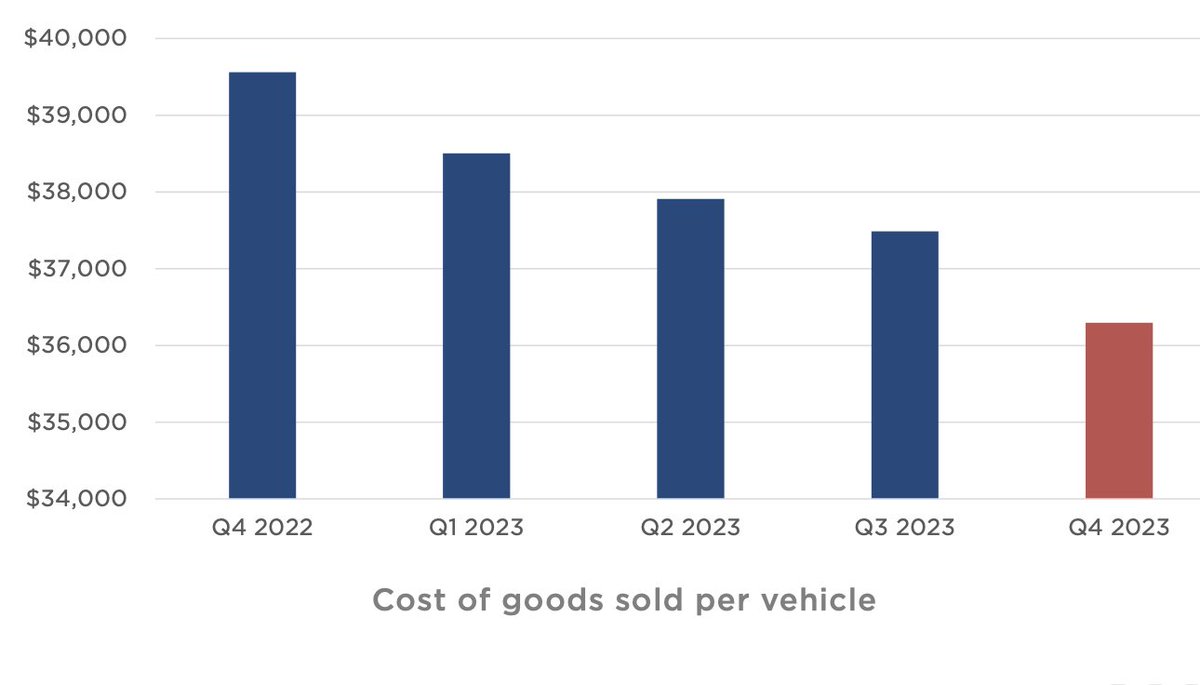
Interesting chart. "Cost of goods sold per vehicle declined sequentially to slightly above $36,000. Even as we approach the natural limit of cost down of our existing vehicle lineup, our team continues to focus on further cost reductions across all points of production, from raw materials to final delivery." - TSLA Q4 earnings shareholder letter
Dave Lee tweet media
English
38
56
839
83.7K
. retweetledi
Leigh
Leigh@LeighMonti13·
Omg Again ?
English
0
8
249
593.5K
. retweetledi
Dave Lee
Dave Lee@heydave7·
Here's two concepts that will unlock a better understanding of Tesla's FSD efforts: 1. Narrow Driving Intelligence (NDI) 2. General Driving Intelligence (GDI) Narrow Driving Intelligence (NDI) is an approach to autonomous driving where each unique driving challenge, or edge case, is solved individually with a specific solution or algorithm. This is why Tesla's previous FSD versions had 300k+ lines of C code to establish heuristics or rule-based planning for driving. It's like a game of whack-a-mole. Every time an edge case pops up, Tesla would try to whack that edge case by coming up with a specific solution. This was a never-ending cycle. Tesla's new FSD v12 is about shifting FSD toward a new paradigm that I'm calling General Driving Intelligence (GDI). The goal is to build a generalized driving intelligence that can handle complex and new edge cases, much like a human driver would. In other words, GDI would be able to extrapolate its learnings and understanding of driving like a human so that it drives safely even in complex, challenging situations it's never seen before. To achieve General Driving Intelligence (GDI), Tesla is tossing the heuristics and code-based rules used in its former approach and creating a massive neural network to form the brain of GDI. This massive neural net, with billions of parameters or viewing angles, is able to learn driving in a more holistic and comprehensive way by analyzing millions of videos of various driving situations. It's like teaching the network the fundamentals of physics rather than just memorizing individual equations. The result (or at least the goal) is that Tesla is building a general driving AI that can intelligently navigate through situations and edge cases it's never seen before, reducing the number of edge cases over time. If Tesla is able to successfully navigate this transition from narrow driving intelligence to general driving intelligence, it's extremely promising in my opinion. It unlocks a whole new paradigm in autonomous driving and potentially unlocks a whole new level of ability for FSD. I share more about all this in this video. Tesla FSD v12: The Quest for General Driving Intelligence (Ep. 753)
English
34
64
552
48K
. retweetledi
Dave Lee
Dave Lee@heydave7·
How does FSD v12 come to a complete stop at a stop sign if the real life data it's trained on shows nobody completely stopping at a stop sign? My quick take: I think Tesla is being careful of what it's training v12 on specifically for reasons like this. If you want the car to stop at stop signs then you need to feed it a lot of video showing drivers stopping at stop signs (and exclude videos of drivers not stopping at stop signs). So, there's going to be curation going on in terms of what kind of video data is fed into the neural nets for training. You want to feed it video data that comprehensively represents the type of driving you want out of v12. In addition to this curated training approach, Tesla might also employ post-training techniques like reinforcement learning. This method involves fine-tuning the FSD model by rewarding desired behaviors (like making a full stop at a stop sign) and penalizing undesirable actions.
Dave Lee tweet media
English
97
28
439
83.7K
. retweetledi
Dave Lee
Dave Lee@heydave7·
I think this highlights how important not just the amount of data but the type of data. Tesla needs massive amounts of the right kind of video data that show safe driving across a vast amount of varied situations/conditions. The more they feed the neural net with this right kind of data, the better the neural net will perform.
English
13
10
133
19.7K
. retweetledi
Dave Lee
Dave Lee@heydave7·
Last night Tesla rolled out their FSD v12 beta software to some non-Tesla employees including @wholemars. This is a really big deal because it ditches thousands of lines of rule-based code and for the first time implements an end-to-end approach for driving. In this video I go over: - Why Tesla FSD had rules for their driving in the first place - The challenge of removing rules (aka heuristic code) - The challenges and potential of improving FSD v12 - What this means for the future of autonomous driving Tesla FSD v12 Rollout - first thoughts (Ep. 752)
English
33
78
828
71.4K
. retweetledi
Dave Lee
Dave Lee@heydave7·
I’m very hands-on creating a personalized education for my kids (ages 6 and 9). The approach is constantly changing but here’s the status of what my kids are currently doing. The key is none of these activities are coerced. CURRENT EDUCATION FOCUS VIA FLOW-STATES: 1). Reading Frequency: Roughly 2 hours a day. Method: A selection of over 100 books at a time from a larger collection of 1000s of children’s books, allowing free choice of books and no coerced minimum reading time. Goal: To cultivate a love for reading/curiosity, enhance knowledge acquisition, understand character interactions, become expert in storytelling, develop a strong command of language, potentially understanding profound nature of language/communication, provide foundation for lifelong learning across many subjects/areas, equip to impact people via effective communication. 2). Piano Frequency: 1-2 hours a day. Method: Learning with the SimplyPiano app. Goal: To grow in brain development, pattern recognition, musical skills, appreciation of profound nature of music/metaphysical. 3). Video Games (Street Fighter, Tetris, Adventure iPad games) and iPad educational apps (reading, math, brain puzzle, etc apps) Frequency: 1-2 hours per day Method: Playing a mix of strategic and creative video games, as well as educational iPad apps. Goal: Develop cognitive decision making and rationale choices in high-intensity, fast-paced, high-amygdala situations to equip with skills of calm decision-making in real life, learn game dynamics/design, learn math/reading/logic skills in enjoyable manner. 4). Hiking Frequency: 4-5 times a week for one hour each time. Method: Hiking on nature paths. Goal: To promote physical fitness, connection with nature/metaphysical, mindfulness/awareness, brain health. 5). Legos and Building Frequency: Approximately 2 hours a day, three times a week. Method: Building Lego sets and other building kits. Goal: To encourage building skills/experience/confidence, creative thinking, spatial reasoning, and problem-solving skills. 6). Singing Frequency: 30 minutes daily. Method: Using the SimplySing app for guided singing practice. Goal: To develop connection with music/metaphysical, develop singing ability for self-expression and influence of others. 7). Paw Patrol TV Episodes Frequency: 30 minutes per day Method: Watching episodes of Paw Patrol Goal: To learn about storytelling, character interaction. PROPOSED ADDITIONAL FLOW-STATES: 1). Second Language Learning (Spanish and Korean) Frequency: To be determined. Method: Interactive methods such as apps, games, or immersion techniques. Goal: To enhance cognitive flexibility, cultural understanding, and communication skills in multiple languages. Take advantage of pre-puberty window of opportunity for second language acquisition’s impact on brain development. 2). Tennis Frequency: 2-3x week up to 1 hour each time Method: Hire private tennis coach or enroll in class Goal: Get more blood and oxygen flowing to brain and organs to improve brain health and body health, reduce anxiety. 3). Martial Arts and Dance Frequency: To be determined. Method: Participation in martial arts or dance classes. Goal: Increase blood/oxygen to brain/organs, develop spatial awareness, gain skills. 4). Drawing Frequency: 30-60 minutes daily Method: Learning to draw through SimplyDrawing app, other app, or classes. Unclear how to reach flow-state with kids. Goal: Develop skills of drawing/art, encourage brain health. Note: My kids are not enrolled in a traditional school... but are the sole students of my (and my wife's) school. 😂
English
131
79
982
121.8K
. retweetledi
Dave Lee
Dave Lee@heydave7·
Forgot to add an hour or so a day chatting with ChatGPT audio app with my kids asking it various questions throughout the day, in the car and at home. It's not really a "flow state" per se but actually it's starting to become one as my 9 year old's been having more longer chats with ChatGPT over various topics.
English
3
5
92
29.7K