Javier Blas

58.1K posts

Javier Blas banner
Javier Blas

Javier Blas

@JavierBlas

Energy and commodities columnist at Bloomberg. Co-author of the 'The World for Sale' Any views expressed are my own. [email protected]

London Katılım Ağustos 2013
1.5K Takip Edilen394.5K Takipçiler
Sabitlenmiş Tweet
Javier Blas
Javier Blas@JavierBlas·
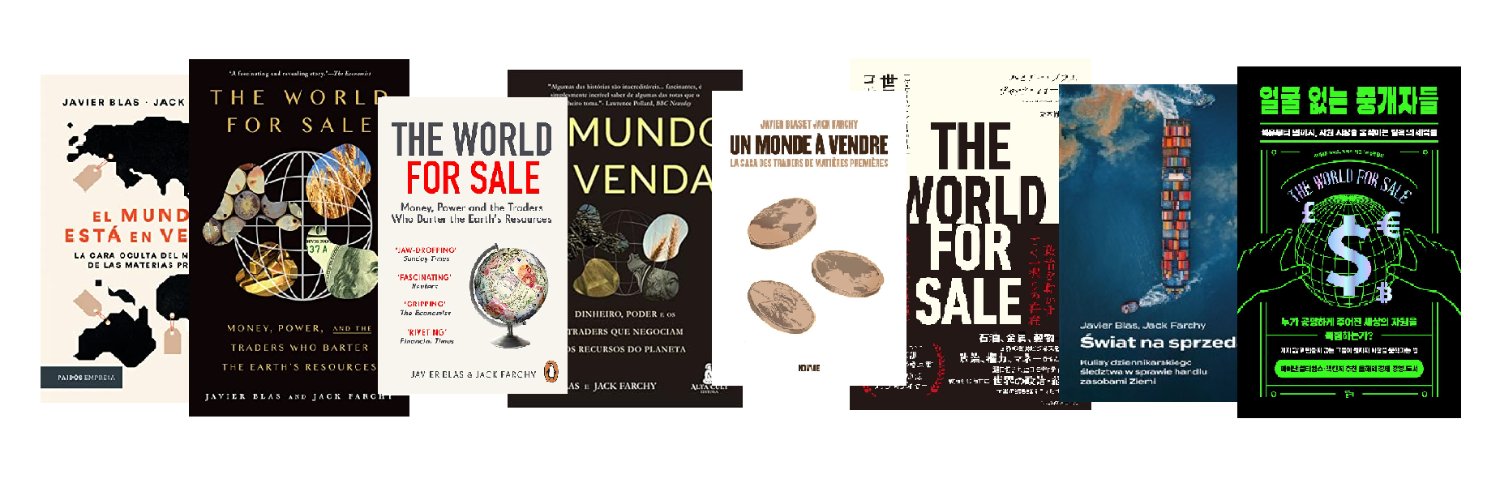
This week, The World for Sale comes out in paperback It explains how oil and commodity markets work, how they influence geopolitics, and the extraordinary power of a few traders you've probably never heard of Please take a look smarturl.it/TheWorldForSal…
Javier Blas tweet media
English
382
712
4.2K
0
Javier Blas
Javier Blas@JavierBlas·
The lowest paid seafarer gets about $1,500 per month, so the bonus comes at ~$9,000 per crossing and back for the lowest paid crew. A captain may take home $15,000 a month, so the bonus comes at ~$90,000.
English
6
8
73
14.3K
Javier Blas
Javier Blas@JavierBlas·
Mexico hedges a significant chunk of its oil exports every year, typically in the Jul-Aug-Sept period in a massive program known as the "Hacienda" hedge. I claim no knowledge of what sovereign hedgers are doing, but clearly current oil prices are quite inviting. Just saying.
English
23
27
259
43.6K
Javier Blas
Javier Blas@JavierBlas·
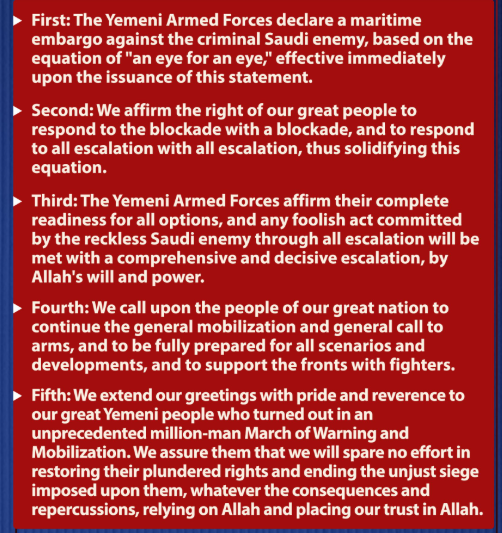
BREAKING: Houthis of Yemen announce a a "maritime embargo" against Saudi Arabia, "effective immediately." Saudi Arabia has until now exported ~4.5m b/d from Yanbu in the Red Sea, most of it heading South throughout the Bab al-Mandab Strait between Yemen and Djibouti-Eritrea
Javier Blas tweet media
English
116
726
2.3K
1.3M
Javier Blas
Javier Blas@JavierBlas·
CHART OF THE DAY: Morgan Stanley reckons that more than half of Russian oil refinery capacity is down due to Ukrainian attacks. Typically, Russia is the world's second-largest diesel exporter - normally around 11% of global seaborne trade.
Javier Blas tweet media
English
35
344
1.2K
127.7K
Javier Blas
Javier Blas@JavierBlas·
Iran has received “some proposals” from unspecified mediators regarding the war with the US, Iranian Foreign Ministry Spokesman Esmail Baghaei says in press conference, without elaborating.
English
23
49
287
56.5K
Javier Blas
Javier Blas@JavierBlas·
Another ugly night in the Strait of Hormuz, with at least one tanker hit and on fire (according to @UK_MTO warning). The Greek shipowners (plus a few others) are still crossing the strait, at great risk for crews and ships.
English
24
111
562
73.5K
Javier Blas
Javier Blas@JavierBlas·
For the third day in a row, Kuwait says that Iran attacked one of its water desalination and power plants. Kuwait says a “large number” of units were impacted.
English
78
230
1.1K
394.8K
Javier Blas retweetledi
Ayatollah Mojtaba Khamenei
Now that the American enemy is seeking to escalate the conflict thereby incurring even heavier costs and further humiliation, it should know that the noble nation of Iran and the Resistance Front have unforgettable lessons in store for it.
English
155
916
3.9K
147.7K
Javier Blas
Javier Blas@JavierBlas·
As Kuwait’s water desalination plants are attacked for the second day in a row, re-publishing this @Opinion column originally posted in March during the early days of the U.S.-Iran war. Sadly, it’s still relevant. bloomberg.com/opinion/articl…
English
33
73
317
41.3K
Javier Blas
Javier Blas@JavierBlas·
BREAKING: Kuwait state-owned company says “one of the vital sites in the oil sector” was attacked by Iran, resulting in “significant material losses.”
English
59
462
1.8K
291.3K
Javier Blas retweetledi
Babak Vahdad
Babak Vahdad@BabakVahdad·
My take on the regional diplomatic landscape. - One of the most striking features of the current phase of the Iran-US confrontation is not only the daily exchange of strikes, but also the relative absence of the regional diplomacy that proved so important only a few weeks ago. - During the previous crisis, Pakistan, Saudi Arabia, Turkey and Egypt-the so-called Islamabad Quartet (STEP)-worked through different channels, with Qatar and Oman also playing important roles, creating the conditions that eventually led to the ceasefire and the Islamabad Memorandum of Understanding. Today, that diplomatic momentum appears much weaker. - Pakistan, which had emerged as perhaps the most effective intermediary between Washington and Tehran, now finds itself operating in a much narrower diplomatic space. Islamabad has developed pragmatic and constructive relations with Iran over the years, shaped by geography, shared security concerns and the presence of a large Shiite community representing around one-fifth of Pakistan's population. At the same time, Pakistan remains deeply connected to the Persian Gulf monarchies through decades of political, economic and military cooperation. Its security partnership with Saudi Arabia-including a long-standing mutual defence framework-remains one of the pillars of its regional policy, while reports have recently suggested discussions on a similar arrangement with Kuwait. - As long as Tehran and the Persian Gulf monarchies manage their differences, Pakistan can effectively and successfully balance these relationships. But the more direct the confrontation becomes, the narrower Islamabad's diplomatic room for manoeuvre. The renewed Houthi-Saudi escalation, combined with growing tensions around Bab al-Mandab, makes that balancing act increasingly delicate. Pakistan is not stepping away from diplomacy; it is being forced to navigate between two strategic relationships that have both become more difficult to manage simultaneously. - Saudi Arabia itself is once again focused on its own security concerns, while Qatar also finds itself in a much more difficult position. Doha was previously one of the few actors able to speak credibly with both Washington and Tehran. Today, however, it has become directly exposed because of the Iranian strikes. A mediator inevitably loses room for manoeuvre once it becomes part of the battlefield. - At the same time, Iranian security-linked media have become increasingly critical of Erdogan and Turkey’s regional posture, openly portraying Ankara as a strategic rival. This does not necessarily signal a rupture, but it does suggest that the political cohesion which characterised the Islamabad Quartet during the previous round of diplomacy has weakened. - Egypt, which was the first country to promote the regional diplomatic initiative that later evolved into the Islamabad Quartet, bringing Saudi Arabia into the process with Washington’s encouragement, now appears increasingly isolated. Cairo remains committed to diplomacy, but it no longer seems to enjoy the same regional alignment that made the previous initiative possible. - This, perhaps, is the main difference from the previous crisis. Regional diplomacy has not disappeared, but each of its key actors is now constrained by a different strategic dilemma. Pakistan is trying to preserve its balancing role between Iran and the Persian Gulf monarchies. Saudi Arabia is preoccupied with Yemen. Qatar is directly exposed. Relations between Iran and Turkey have become more strained. The result is a fragmented diplomatic landscape precisely when a coordinated regional effort is needed the most. - The key question is therefore not only whether Washington and Tehran can eventually return to negotiations, but whether the regional diplomatic architecture that made the last de-escalation possible can be rebuilt. Without that convergence, another ceasefire will be considerably harder to achieve. #Iran
English
0
46
172
48K
Javier Blas retweetledi
U.S. State Dept - Near Eastern Affairs
The United States welcomes the signing of a historic MOU between the Governments of Iraq and Syria on the rehabilitation and reconstruction of the Iraq-Syria crude oil pipeline. This priority infrastructure project will advance security and stability through regional interconnectivity and prosperity. U.S. companies will play a key role in advancing construction. state.gov/releases/offic…
English
54
460
1.9K
416.9K
Javier Blas retweetledi
Barak Ravid
Barak Ravid@BarakRavid·
Scoop: The Trump administration notified Israel it is sending dozens more refueling planes to the country ahead of a potential expansion of military operations against Iran, three U.S. and Israeli officials said. My story on @axios axios.com/2026/07/17/tru…
English
93
384
1.2K
274.7K
Javier Blas
Javier Blas@JavierBlas·
“The world has changed considerably, with key European industries facing an unlevel playing field, heavy state subsidies, dumping, dubious labor conditions abroad,” EU Climate Commissioner Wopke Hoekstra said. (No, the world has not changed: Brussels has woken up to reality)
English
10
11
114
13.6K
Javier Blas
Javier Blas@JavierBlas·
CLIMATE CHANGE: The European Commissions has proposed a **weaker CO2 reduction plan**, with an annual reduction on its carbon market’s emissions cap of 3.7% per year from 2031-2035, and 1.7% from 2036 (under current plans, the annual reduction was ~4.4%). bloomberg.com/news/articles/…
English
20
43
160
43.9K
Javier Blas
Javier Blas@JavierBlas·
MUST READ: As Michal Meidan, head of China energy research at the Oxford Institute for Energy Studies, puts it, when (and by how much) China would return to the global oil market is the "million-dollar question." reuters.com/business/energ…
English
17
29
172
30K