Jeremy Singer

2.2K posts

Jeremy Singer banner
Jeremy Singer

Jeremy Singer

@jeremylsinger

Assistant professor of education leadership and policy @UMFlint. Views are my own. Please excuse typos.

Detroit, MI Katılım Aralık 2020
455 Takip Edilen972 Takipçiler
Jeremy Singer retweetledi

Paul Bruno
Paul Bruno@Paul__Bruno·
Revisiting Evidence on the Role of Funding Adequacy in School Reopening During the COVID-19 Pandemic: A Response to Weber and Baker journals.sagepub.com/doi/abs/10.117… "controlling for partisanship & union strength substantively attenuated...the association b/w funding adequacy & reopening"
English
0
2
2
187
Jeremy Singer retweetledi
Dan Goldhaber
Dan Goldhaber@CEDR_US·
The IES 2.0 report just dropped! Here's the link: ies.ed.gov/ies/2026/02/re… I'm about half way through and have to say that I'm so far really impressed with it's comprehensiveness and thoughtfulness.
English
1
4
10
1.5K
Jeremy Singer
Jeremy Singer@jeremylsinger·
...incorporating measures of local partisanship (Trump vote share in 2020) and a proxy for union strength (though this adds less explanatory power than partisanship) substantively attenuated but did not eliminate the association between funding adequacy and school reopening.
Jeremy Singer tweet media
English
1
0
1
65
Jeremy Singer retweetledi
Chalkbeat Detroit
Chalkbeat Detroit@chalkbeatDET·
The Detroit district’s board shared their ideas to help kids get to school despite systemic barriers. Administrators also revealed what policies could soon roll out. chalkbeat.org/detroit/2026/0…
English
0
1
2
73
Jeremy Singer retweetledi
Jerome Graham
Jerome Graham@jerome_graham5·
@jeremylsinger All said, I like to think of this one as communicating that efforts to make school safe, welcoming, and culturally affirming are good in their own right. If they also improve attendance, among other outcomes, those are wonderful added benefits.
English
0
1
1
34
Jeremy Singer retweetledi
Jerome Graham
Jerome Graham@jerome_graham5·
@jeremylsinger For what it’s worth, which admittedly isn’t a whole lot for answering the larger questions, we did look at if absenteeism sig predicted climate and found null results in our models.
English
0
1
1
28
Jeremy Singer
Jeremy Singer@jeremylsinger·
I (want to?) believe that improving school climate (relationships, safety, etc.) is one of the highest-leverage things schools can to do improve attendance. But it's possible the impact will be only marginal. See for example Hamlin's (2021) prior work journals.sagepub.com/doi/full/10.31…
English
1
0
2
40
Jeremy Singer
Jeremy Singer@jeremylsinger·
@vkoganpolisci @CEDR_US @natmalkus @ZhongJiee But, the authors point to a different mechanism than threat-induced behavior: “Survey evidence suggests flagged students receive more intensive reading support…findings suggest retention may be a much less important component of literacy reforms than previously understood.”
English
1
0
1
36
Vladimir Kogan
Vladimir Kogan@vkoganpolisci·
@CEDR_US @natmalkus @ZhongJiee You might imagine a policy where retention is a threat that is used to induce students/parents/teachers to do things that help students they wouldn't otherwise do, and no one gets retained. Basically how it works in Michigan, it seems. nber.org/papers/w33764
English
2
1
3
153
Jeremy Singer retweetledi
DETROITography
DETROITography@detroitography·
@PolarBarrett 70% of jobs are held by commuters, Detroit is a regional economic engine but we have extreme inequality of opportunity across the region
English
0
2
8
128
Brian Heseung Kim
Brian Heseung Kim@brhkim·
This is a bit bold, but: @claudeai, any way we can set up some promotional API credits for my data scientist and researcher colleagues to test this framework out and advance this AI-empowered research frontier forward together? Max subscriptions are a huge but necessary barrier
English
2
0
6
968
Jeremy Singer retweetledi
Brian Heseung Kim
Brian Heseung Kim@brhkim·
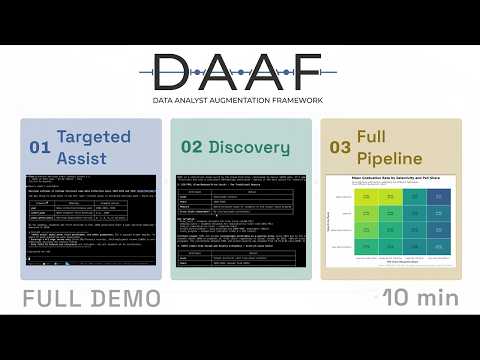
Today, I’m launching DAAF, the Data Analyst Augmentation Framework: an open-source, extensible workflow for Claude Code that allows skilled researchers to rapidly scale their expertise and accelerate data analysis by as much as 5-10x -- without sacrificing the transparency, rigor, or reproducibility demanded by our core scientific principles. You (yes, YOU!) can install and begin using it in as little as 10 minutes from a fresh computer with a high-usage Anthropic account (crucial accessibility caveat, unfortunately very expensive!) github.com/DAAF-Contribut… DAAF explicitly embraces the fact that LLM-based research assistants will never be perfect and can never be trusted as a matter of course. But by providing strict guardrails, enforcing best practices, and ensuring the highest levels of auditability possible, DAAF ensures that LLM research assistants can still be immensely valuable for critically-minded researchers capable of verifying and reviewing their work. In energetic and vocal opposition to deeply misguided attempts to replace human researchers, DAAF is intended to be a force-multiplying "exo-skeleton" for human researchers (i.e., firmly keeping humans-in-the-loop). The base framework comes ready out-of-the-box to analyze any or all of the 40+ foundational public education datasets available via the Urban Institute Education Data Portal (educationdata.urban.org/documentation/), and is readily extensible to new data domains and methodologies with a suite of built-in tools to ingest new data sources and craft new Skill files at will! With DAAF, you can go from a research question to a shockingly nuanced research report with sections for key findings, data/methodology, and limitations, as well as bespoke data visualizations, with only five minutes of active engagement time, plus the necessary time to fully review and audit the results (see my 10-minute video demo here: youtu.be/ZAM9OA0AlUs). To that crucial end of facilitating expert human validation, all projects come complete with a fully reproducible, documented analytic code pipeline and consolidated analytic notebooks for exploration. Then: request revisions, rethink measures, conduct new sub-analyses, run robustness checks, and even add additional deliverables like interactive dashboards, policymaker-focused briefs, and more -- all with just a quick ask to Claude. And all of this can be done *in parallel* with multiple projects simultaneously. By open-sourcing DAAF under the GNU LGPLv3 license as a forever-free and open and extensible framework, I hope to provide a foundational resource that the entire community of researchers and data scientists can use, benefit from, learn from, and extend via critical conversations and collaboration together. By pairing DAAF with an intensive array of educational materials, tutorials, blog deep-dives, and videos via project documentation and the DAAF Field Guide Substack (daafguide.substack.com – MUCH more to come!), I also hope to rapidly accelerate the readiness of the scientific community to genuinely and critically engage with AI disruption and transformation writ large. I don't want to oversell it: DAAF is far from perfect (much more on that below!). But it is already extremely useful, and my intention is that this is the worst that DAAF will ever be from now on given the rapid pace of AI progress and (hopefully) community contributions from here. More than anything, I just hope all of this work can somehow be useful for my many peers and colleagues trying to "catch up" to this rapidly developing (and extremely scary) frontier. It's a wild time, but we need as many people informed and at the table together as possible. Never used Claude Code? No idea where you'd even start? My full installation guide walks you through every step -- but hopefully this video shows how quick a full DAAF installation can be from start-to-finish. Just 3mins! youtube.com/watch?v=jqkVLX… Learn more about my vision for DAAF, what makes DAAF different from other attempts to create LLM research assistants, what DAAF currently can and cannot do as of today, how you can get involved, and how you can get started with DAAF yourself! #vision--purpose" target="_blank" rel="nofollow noopener">github.com/DAAF-Contribut… So there it is. I am absolutely as surprised and concerned as you are, believe me. With all that in mind, I would *love* to hear what you think, what your questions are, what you’re seeing if you try testing it out, and absolutely every single critical thought you’re willing to share, so we can learn on this frontier together. Thanks for reading and engaging earnestly!
YouTube video
YouTube
YouTube video
YouTube
English
15
78
437
72.7K
Jeremy Singer retweetledi
Chalkbeat Detroit
Chalkbeat Detroit@chalkbeatDET·
How are the children of Detroit doing? The city’s new senior director of youth and education liaison hopes the answer will soon be “well.” chalkbeat.org/detroit/2026/0…
English
0
1
2
86
Jeremy Singer
Jeremy Singer@jeremylsinger·
That said, we do find a few notable differences between MI (greater emphasis on mental health and social/emotional learning) and GA (greater presence of attendance teams and use of MTSS), which we believe reflect differences in state policy contexts. 2/2
English
2
0
1
52
Jeremy Singer
Jeremy Singer@jeremylsinger·
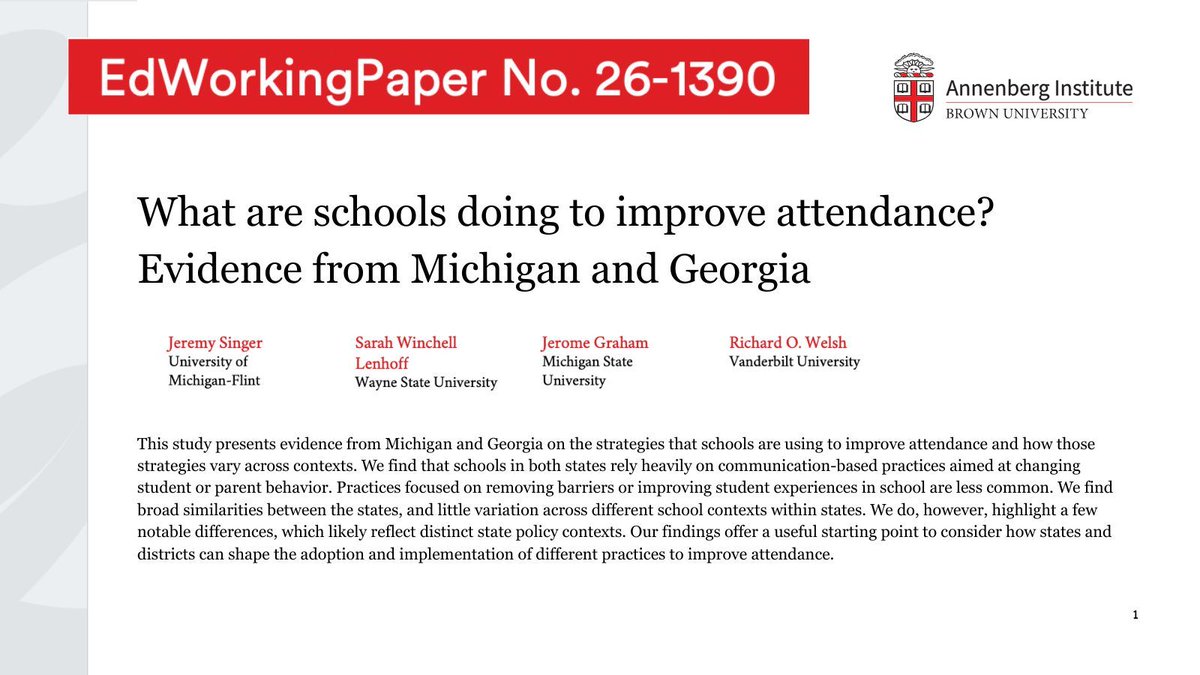
Our new working paper on school-level attendance practices and systems in MI and GA! In addition to cataloguing more and less common practices, we also show there is relatively little variation both across states and within states across contexts in attendance strategies. 1/2
Annenberg Institute at Brown@AnnenbergInst

#EdWorkingPapers: What are schools actually doing to improve attendance? @jeremylsinger & coauthors find that in Michigan & Georgia, schools rely on communication-based strategies more commonly than removing barriers or improving student experiences. 📄bit.ly/4abAWPG

English
1
4
3
603