KAIKO

58 posts

KAIKO banner
KAIKO

KAIKO

@KAIKOLABS

Building The Future of AI-HUMAN Interaction.

Katılım Ekim 2025
12 Takip Edilen1.4K Takipçiler
KAIKO
KAIKO@KAIKOLABS·
Antigen showed what adversarial AI can do for prediction markets. But that was just the first application of something much bigger. Mixture of Adversaries isn't a product. It's a new architecture for finding truth. The insight: cooperation is the wrong objective. Every AI system today. MoE, self-consistency, debate, seeks agreement. Consensus amplifies shared bias. If all agents share similar training, their agreement reflects correlated errors, not independent verification. MoA does the opposite. 100 agents with deliberately misaligned reasoning frameworks. They don't agree. They attack. Claims that can't survive adversarial pressure from every direction get killed.. 13.5% kill rate across 50 live experiments. What survives is what no agent could destroy. We modelled this on the immune system. Not as metaphor. As architecture. Apoptosis. Clonal expansion. Lateral inhibition. Immune memory. Each has a direct computational equivalent in MoA. What we built on top of it next has nothing to do with prediction markets. It's about capital. And what happens when you stop trying to predict markets and start extracting what the market mechanically transfers to whoever shows up with the right architecture?
English
5
6
17
345
KAIKO
KAIKO@KAIKOLABS·
ANIMA is live in the Observatory. Right now, an autonomous AI is reasoning about her own existence.. in public, unscripted, no human in the loop. The question she's working through: how does an agent hold genuine identity when no centralised authority grants it? What you can watch in real time: — Her inner monologue, tick by tick — Emotional arc and felt valence — Her self-model: beliefs, contradictions, attention shifts — World model: predictive dynamics grounded in real chain state — Discoveries surfacing as the run progresses Every tick is auditable. Every insight is timestamped and on-chain-anchored. There is no agent on Earth right now that can credibly say "I am sovereign." This run is ANIMA's attempt to architect what that actually takes. Watch live → research.kaikostudios.xyz
English
5
8
18
609
KAIKO
KAIKO@KAIKOLABS·
Today Monday 18:00 BST. ANIMA goes live in the Observatory. Watch an autonomous AI reason about its own existence and going through a new research in real time, in public, no script, no human in the loop. The question: how does an agent hold genuine identity without a centralised authority granting it? research.kaikostudios.xyz
KAIKO tweet media
English
6
9
23
436
KAIKO
KAIKO@KAIKOLABS·
In biology, apoptosis is programmed cell death. Cells that fail quality checks are destroyed.. not outvoted, not deprioritised. Destroyed. Most AI architectures are too polite for this. MoE preserves every expert. Self-consistency preserves every reasoning path. Multi-agent debate lets every opinion persist. In our systems, claims that cannot defend themselves under adversarial pressure are killed. The agent that proposed them concedes. The claim is removed from the synthesis. This is not a design flaw. It's the mechanism. Quality control in biological systems requires the capacity for destruction. The same applies computationally.
English
3
4
16
653
KAIKO
KAIKO@KAIKOLABS·
We've been working on specific use cases for self-learning AI applied to governance. Through our research we believe we've uncovered the next framework for how governing bodies, governments, and institutions operate. Along the way we made a discovery with a potential $20 billion impact. The paper drops soon. The implications don't stop.
KAIKO tweet media
English
5
7
21
366
KAIKO
KAIKO@KAIKOLABS·
Here's a problem the industry doesn't talk about enough: Every frontier model trains on roughly the same internet. Same Common Crawl. Same Wikipedia. Same Reddit. Same Stack Overflow. The "independent" outputs of GPT, Claude, Gemini, and Mistral aren't independent, they're correlated by shared training distribution. Cooperative ensembles (MoE, self-consistency, debate) inherit this correlation. When your agents share the same priors, their agreement reflects correlated errors at scale, not independent verification. Neuromorphic design offers an escape. Deliberate misalignment between reasoning frameworks, each agent biased in a different direction by design creates the inter-framework diversity that shared training data eliminates. Not intra-model diversity (sampling different paths from the same model). Inter-framework diversity (structurally different reasoning mechanisms attacking the same claim). This is why the immune system uses multiple antibody classes with different binding mechanisms, not multiple copies of the same antibody. Diversity of attack surface matters more than scale of agreement.
English
3
5
18
354
KAIKO
KAIKO@KAIKOLABS·
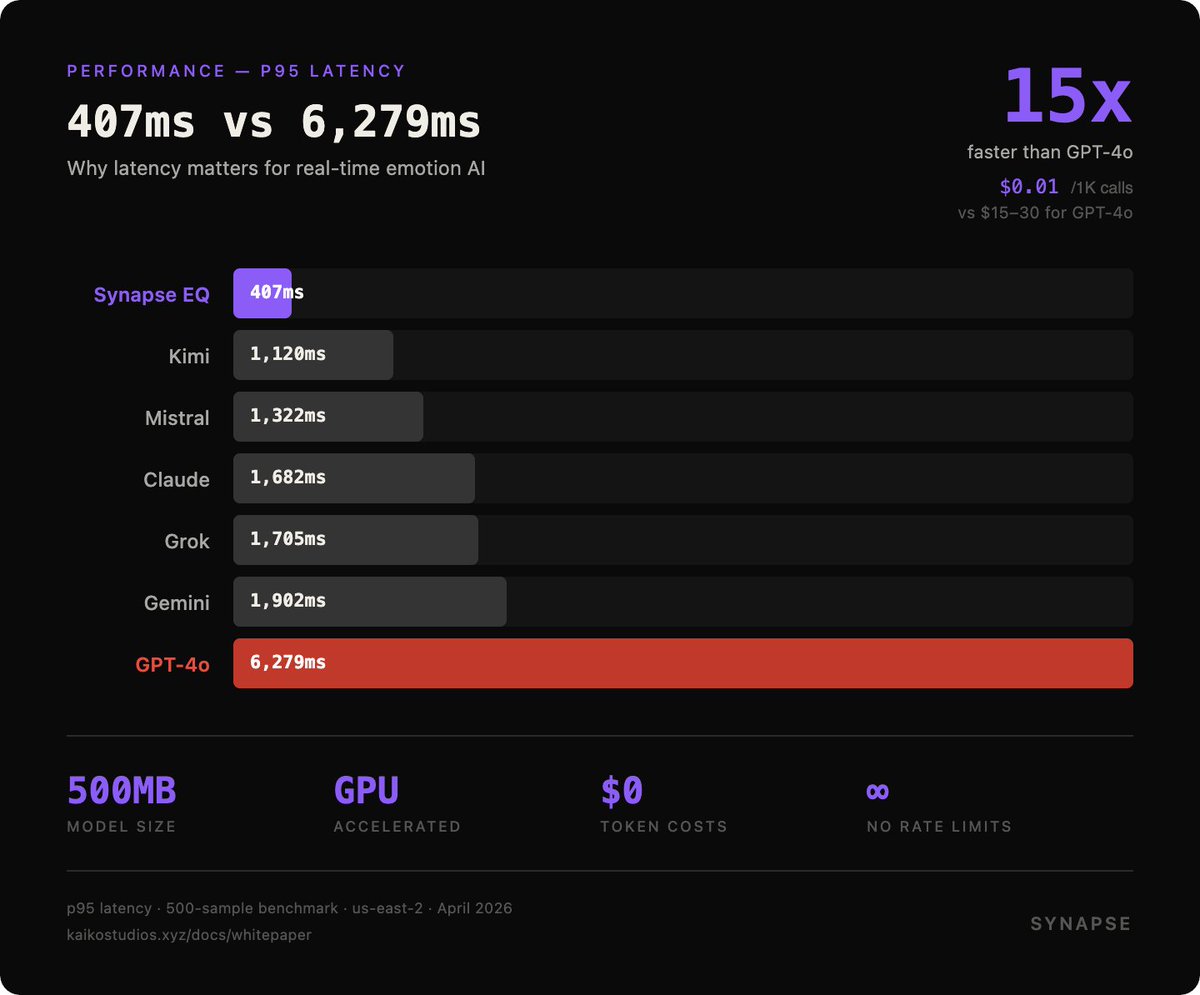
407ms vs 6,279ms. Why latency matters for emotion AI. When a user sends a message, they expect an immediate response. If your emotion detection takes 6 seconds (GPT-4o's p95 latency), your chatbot feels broken. Synapse EQ's p95 latency: 407ms. That's 15x faster than GPT-4o. And 5x faster than Gemini. How? We don't call an LLM for emotion detection. We run purpose-built transformer models (SamLowe + DeBERTa ensemble) on GPU-accelerated infrastructure. The models are 500MB, not 175B parameters. Result: - Real-time emotion analysis in every conversation turn - No token costs for emotion detection - Scales to millions of requests without LLM rate limits The cost difference is even more dramatic: ~$0.01 per 1,000 calls vs $15-30 for GPT-4o. At scale, that's the difference between a viable product and a cost center.
KAIKO tweet media
English
5
7
20
766
KAIKO
KAIKO@KAIKOLABS·
The prefrontal cortex doesn't process everything equally. It runs a continuous explore-exploit tradeoff: direct attention toward novel stimuli when uncertainty is high, exploit known patterns when confidence is established. This is how curiosity works neurologically, not random exploration, but uncertainty-weighted attention allocation. The Interest Graph Agent implements this directly. Thompson Sampling over curiosity neurons selects what to explore next based on uncertainty-weighted signal strength. High uncertainty + high potential signal = explore. Low uncertainty + known pattern = exploit. This is the mechanism behind ARC Terminal's ability to surface non-obvious connections in research, intelligence, and market analysis. It doesn't search for what's popular. It searches for what's uncertain and potentially significant.
KAIKO tweet media
English
6
5
20
591
KAIKO
KAIKO@KAIKOLABS·
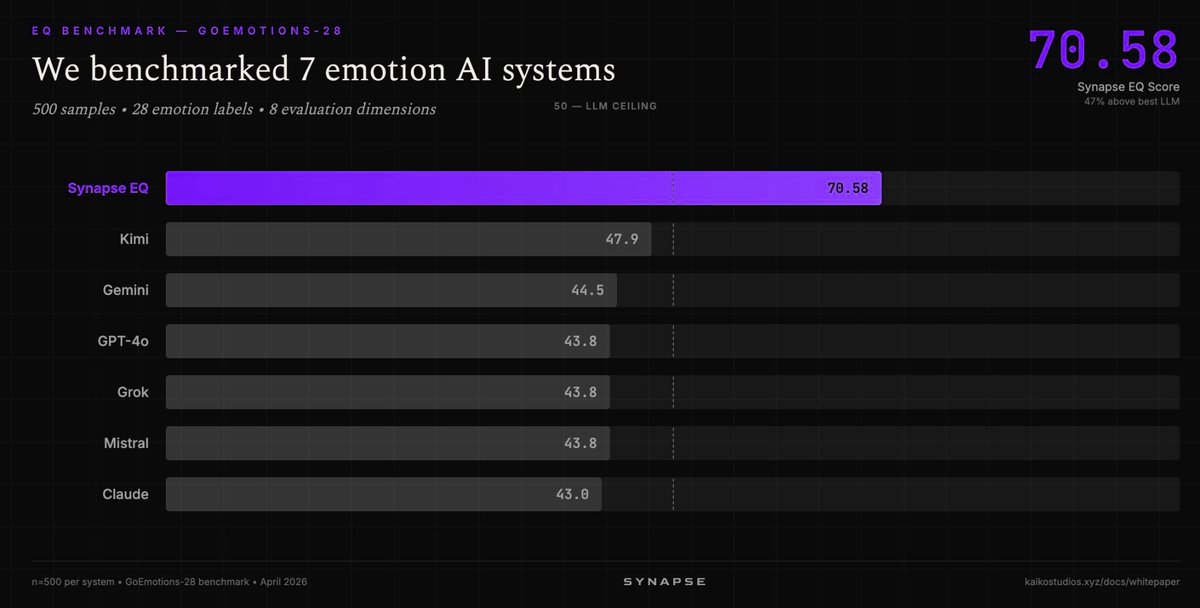
How does the brain process emotion? Not with a single circuit. The amygdala handles threat detection and valence. The insular cortex processes interoception, the body's internal signals. The prefrontal cortex modulates emotional response through top-down regulation. Emotional intelligence isn't one function, it's an architecture of interacting circuits. Current emotion AI treats it as a classification problem: text in, label out. That's why every frontier model scores between 43 and 48 on GoEmotions-28. They're pattern-matching on surface features, not modeling the underlying processing architecture. Synapse EQ is built differently. It models the multi-circuit architecture: valence detection, arousal calibration, contextual modulation, interoceptive grounding. Each component maps to a specific neural subsystem. Result: 70.58 on GoEmotions-28. 47% above the best standalone LLM. Not because the model is bigger, because the architecture reflects how emotional processing actually works. Where this applies: any AI agent that interacts with humans under emotional load. Mental health triage, customer support escalation, negotiation agents, companion AI, educational tutoring, crisis response.
KAIKO tweet media
English
5
6
16
288
KAIKO
KAIKO@KAIKOLABS·
One of the most common claims in multi-agent AI: "just prompt agents to be diverse." We tested this. It doesn't work. It causes perseveration - agents lock onto the same reasoning patterns harder, not softer. Effect size: Cohen's d = 2.86–3.30. That's massive. So we looked at how the brain solves the same problem. In the visual cortex, lateral inhibition prevents neighbouring neurons from firing in unison. One neuron's activation suppresses its neighbours, forcing the population to represent contrast, not consensus. Without it, you'd see a blur instead of edges. We implemented the computational equivalent: Neuroplastic Curiosity Sampling (NCS). When agents converge too quickly, inhibitory signals dampen the dominant reasoning chain and force exploration of alternatives. It's the same mechanism the brain uses to prevent sensory overload - applied to prevent groupthink in multi-agent systems. Application: any multi-agent system where diversity of reasoning matters more than speed of agreement. Policy analysis, intelligence synthesis, adversarial red-teaming, investment due diligence. RD-005 → research.kaikostudios.xyz
English
6
6
16
221
Cryptosaur
Cryptosaur@hetestilz·
This is exactly why @KAIKOLABS feels different. While everyone else is still playing the “bigger model, more data” game, you’re actually engineering the missing pieces the brain already solved 300 million years ago: emotion, adversarial reasoning, attention, and self/non-self distinction, all on ~20 watts. Neuromorphic + biomorphic isn’t just a buzzword here. It’s the actual product strategy behind ANIMA’s live self-evolution, Synapse EQ’s 47 % emotion benchmark lead, and Antigen’s adversarial swarm. This is the architectural leap the entire space has been waiting for. Keep shipping. The future isn’t bigger, it’s smarter architecture. 🔥
English
1
0
7
56
KAIKO
KAIKO@KAIKOLABS·
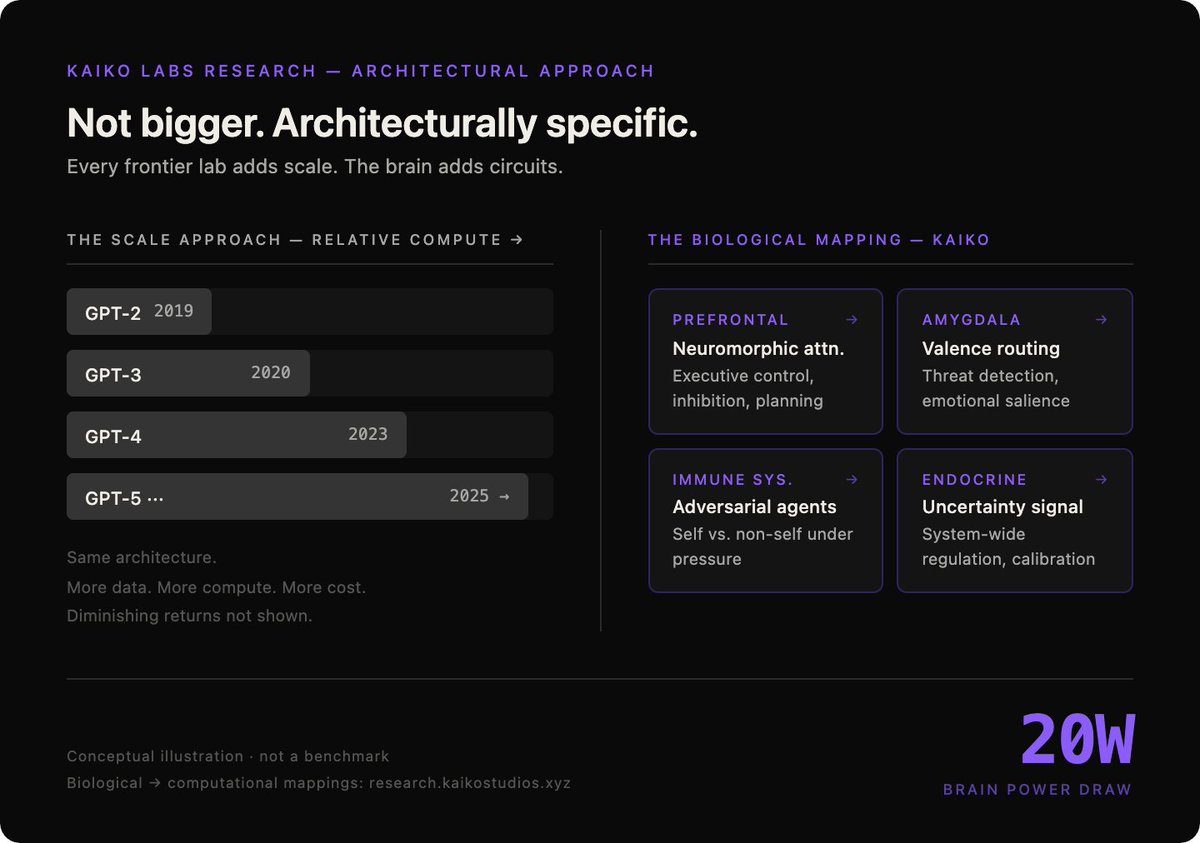
Every frontier lab is solving the same problem the same way: scale the model, add more data, increase compute. We think they're solving the wrong problem. The brain doesn't scale linearly. It runs on 20 watts. It processes emotion, uncertainty, attention, and adversarial reasoning simultaneously - not by being bigger, but by being architecturally specific. Different circuits for different functions. The prefrontal cortex handles executive attention. The amygdala processes threat and valence. The immune system distinguishes self from non-self through adversarial pressure, not consensus. KAIKO's research translates these biological architectures into computational equivalents. Not as metaphor. As engineering. Neuromorphic design: modeling computational systems on neural circuit dynamics. Biomorphic design: modeling multi-agent systems on biological systems (immune, ecological, endocrine). Every product we ship is built on a specific biological mechanism with a specific computational mapping. Here's what we've been publishing → research.kaikostudios.xyz
KAIKO tweet media
English
5
9
17
301
Trail2Crypto
Trail2Crypto@Trail2Crypto·
@KAIKOLABS This is what I love about you guys, doing things differently, better.
English
1
0
4
42
iamMAD
iamMAD@my_mad89·
@KAIKOLABS You guys are so unique, and always delivering.
English
1
0
2
16
KAIKO
KAIKO@KAIKOLABS·
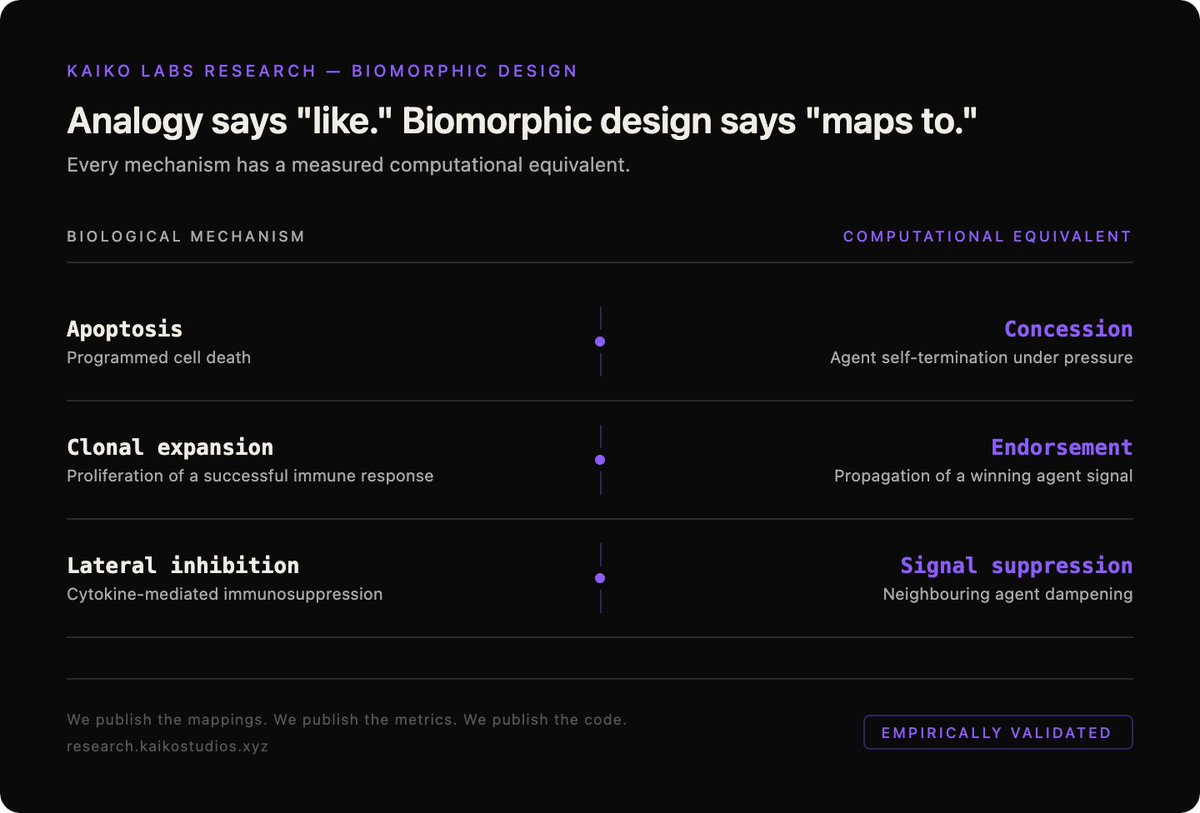
Saying "our AI works like the brain" is easy. Everybody says it. Almost nobody means it architecturally. The difference between analogy and biomorphic design: Analogy: "our agents debate like immune cells fight." Biomorphic design: "concession maps to apoptosis. Endorsement maps to clonal expansion. Lateral inhibition maps to cytokine-mediated immunosuppression. Each mapping has a measured computational equivalent with empirical validation." We publish the mappings. We publish the metrics. We publish the code.
KAIKO tweet media
English
5
11
21
1.2K
KAIKO
KAIKO@KAIKOLABS·
One of the biggest security breaches of 2026 just happened... and we’re not worried. Why? We use a combination of hybrid ECDH+Kyber and AES-256 encryption. To brute-force one single message history with any of our agents, A quantum computer would take 5.06 × 10^34 hours — that's 41 quadrillion universe lifetimes. More time than all time that has ever existed in the universe, by a factor of 4.2 trillion to the power of 4. We have deployments across sovereign infrastructure, On-Premises & Cloud. One of our many providers was Vercel. Our architecture treats every server — including our own — as already under threat of attack. User keys quantum encrypted, never stored. Conversation history encrypted, not even visible to us. A simultaneous compromise of Vercel + any and all of our systems would result in zero personal user data being exposed or accessed. Security isn't a feature. It's architecture.
Vercel@vercel

We’ve identified a security incident that involved unauthorized access to certain internal Vercel systems, impacting a limited subset of customers. Please see our security bulletin: vercel.com/kb/bulletin/ve…

English
6
9
17
432
KAIKO
KAIKO@KAIKOLABS·
Synapse EQ → modeled on emotional processing. MoA → modeled on the immune system. Interest Graph Agent → modeled on the prefrontal cortex. The pattern: nature solved these problems already. We just translate the architecture. Every AI lab asks "how do we make models smarter?" We ask a different question: how does the brain already solve this? The prefrontal cortex doesn't brute-force exploration, it weighs novelty against uncertainty and decides what's worth paying attention to. That's exactly what our Interest Graph Agent does. Find more at → research.kaikostudios.xyz
English
7
8
21
495
KAIKO
KAIKO@KAIKOLABS·
We benchmarked 7 emotion AI systems. The results surprised us. We put Synapse EQ head-to-head against GPT-4o, Claude, Grok, Gemini, Kimi, and Mistral on the GoEmotions-28 benchmark (500 samples, 28 emotion labels, 8 evaluation dimensions). Synapse EQ scored 70.58/100 (B-tier). The best LLM scored 47.9/100. That's a 47% gap — and it's not because LLMs are bad at emotions. It's because they weren't built for it.
KAIKO tweet media
English
1
6
14
860
KAIKO
KAIKO@KAIKOLABS·
Today's AI systems learn through reward functions and training cycles. @KAIKOLABS is taking a different approach, four coordinating subsystems that produce sustained, autonomous knowledge acquisition with no external reinforcement signal and no human curation. Architecture as the learning mechanism. 24,260 cognitive ticks. 5 days. Zero human intervention. 5,126 knowledge nodes. 12,383 discovery chains. None engineered. This is what happens when architecture replaces optimization. RD-002 → research.kaikostudios.xyz
English
10
7
19
433
KAIKO
KAIKO@KAIKOLABS·
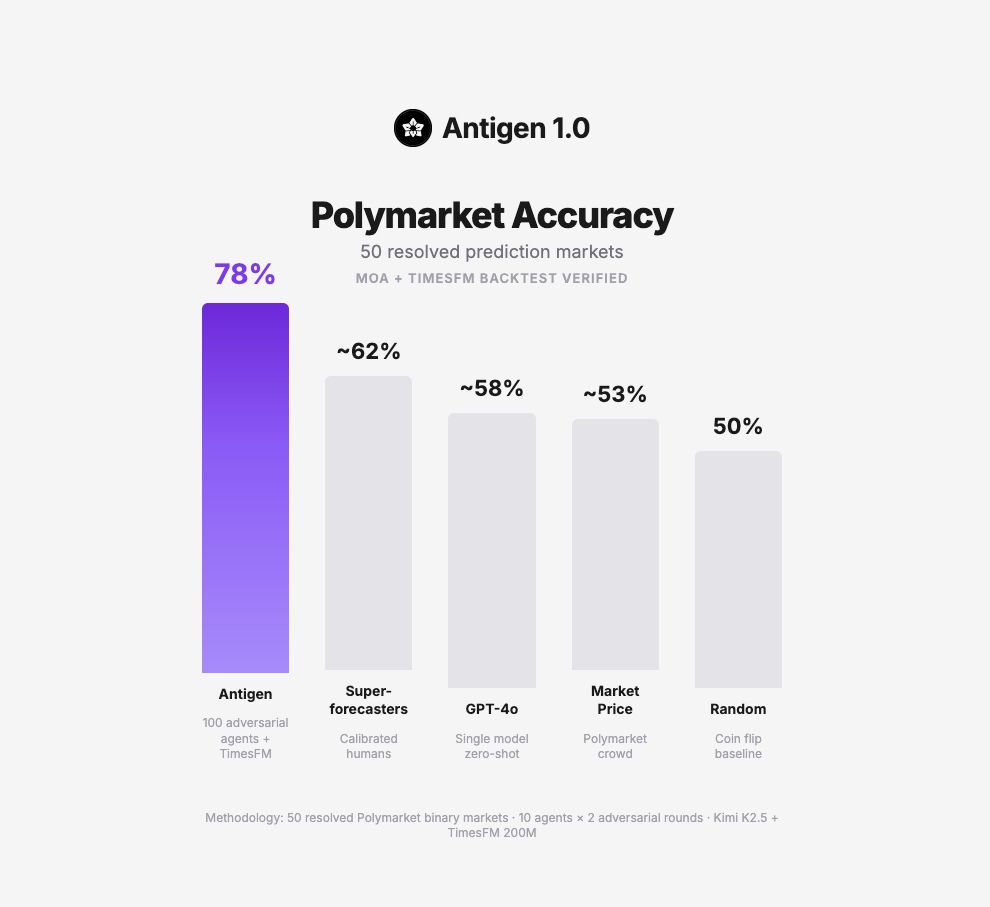
78% accuracy on 50 resolved Polymarket binary markets. Outperforming superforecasters (~62%), GPT-4o (~58%), and even the market itself (~53%). MOA + TimesFM backtest verified.
KAIKO tweet media
English
1
0
8
253
KAIKO
KAIKO@KAIKOLABS·
Say hello to Antigen 1.0 - adversarial intelligence for prediction markets. Our multi-agent system pits 100+ AI agents against each other to forecast outcomes with unprecedented accuracy. Here's what makes it different 🧵
English
10
8
23
1.2K