A 47-year-old woman went to her doctor in pain. Exam, X-ray, six weeks of physical therapy. No improvement. Her doctor ordered an MRI.
An insurance company said no. Not medically necessary, not until she finished six weeks of physical therapy. Her doctor pushed back: not only had she already finished the six weeks, the insurance company itself had paid for them.
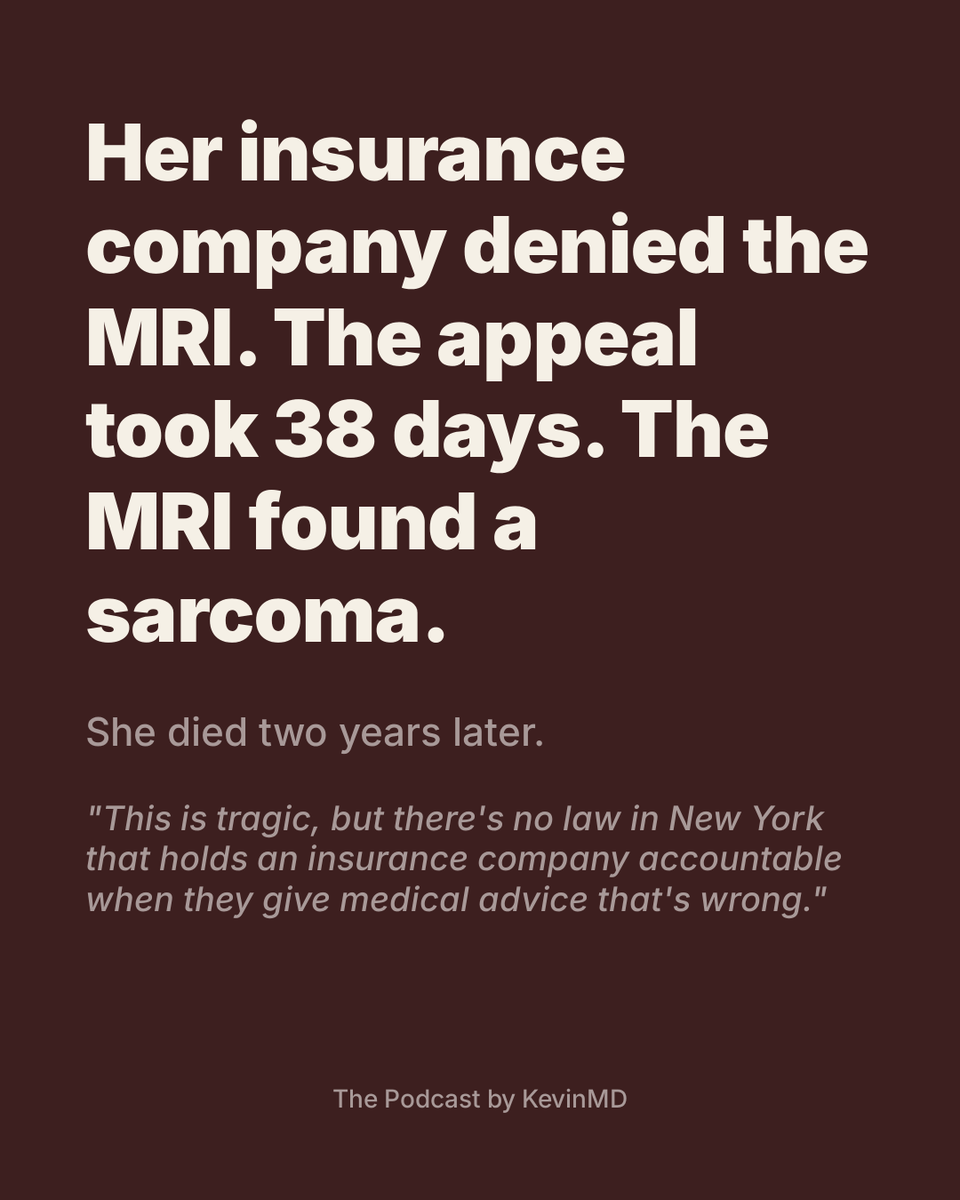
The denial stood. The appeal took 38 days. When the insurance company finally reversed itself, she got the MRI immediately. It found a sarcoma in her hip.
Memorial Sloan Kettering told her that a month sooner, chemotherapy alone would have treated it. Instead they amputated her leg, her hip, and her pelvis. She died two years later.
Now the part most people never see.
The insurance company had published its own criteria for approving an MRI: pain, a doctor's visit, six weeks of physical therapy. She met them. They did not follow their own criteria.
By law, the reviewer who denies your scan is supposed to be a doctor in the relevant specialty. A federal Inspector General report found reviewers often are not, or have minimal experience in the specialty they are ruling on. That is against the law. A pediatrician deciding a radiology appeal.
The family sued. In court, the case collided with two walls.
Wall one: the statute books. Doctors, nurses, podiatrists, dentists, and hospitals are all held accountable for bad medical advice, and it is written into law. There is no law in New York holding an insurance company accountable. One might infer insurance companies have clout. They are big lobbyists.
Wall two: ERISA. Most insurance plans fall under the federal ERISA law, where the bar for bringing an action is far higher than in state court. Almost nobody can even get these cases in front of a judge. This one slipped through only because the plan covered public employees, outside ERISA, so it could be brought under state law.
A federal judge threw it out anyway. "This is tragic, but there's no law in New York that holds an insurance company accountable when they give medical advice that's wrong." He said he was not about to make new law.
The appeal went to the Second Circuit. The lawyers asked the court to certify the question to New York's highest court: does existing New York case law already cover this? And the profession showed up. The American Medical Association and the medical societies of New York, Vermont, and Connecticut filed friend-of-the-court briefs. This is not just one family.
What attorney Steve Cohen, who brought the case for Mrs. Valenti and her family, wants patients and physicians to do in the meantime: appeal every wrongful denial and stay with the appeal. They count on you wearing down. Get the denial in writing with the reviewer's name and specialty. Physicians: write it in the chart. Dr. So-and-so from this insurance company denied the MRI. It builds the record for the appeal, and for the lawsuit nobody expects.
And the frontier: tortious interference. When an insurance company steps between a doctor's recommendation and a patient's care, is it interfering in the doctor-patient relationship? The courts, he said, have never squarely ruled on it.
Has an insurance denial ever changed the course of care for you or someone you love?
Listen to the full conversation on The Podcast by KevinMD. Link in the replies.
#ThePodcastbyKevinMD#PriorAuth
Food allergy deaths are rare. The mistakes that cause them are really, really ordinary. Medicine keeps reassuring people with the first sentence and moves right past the second.
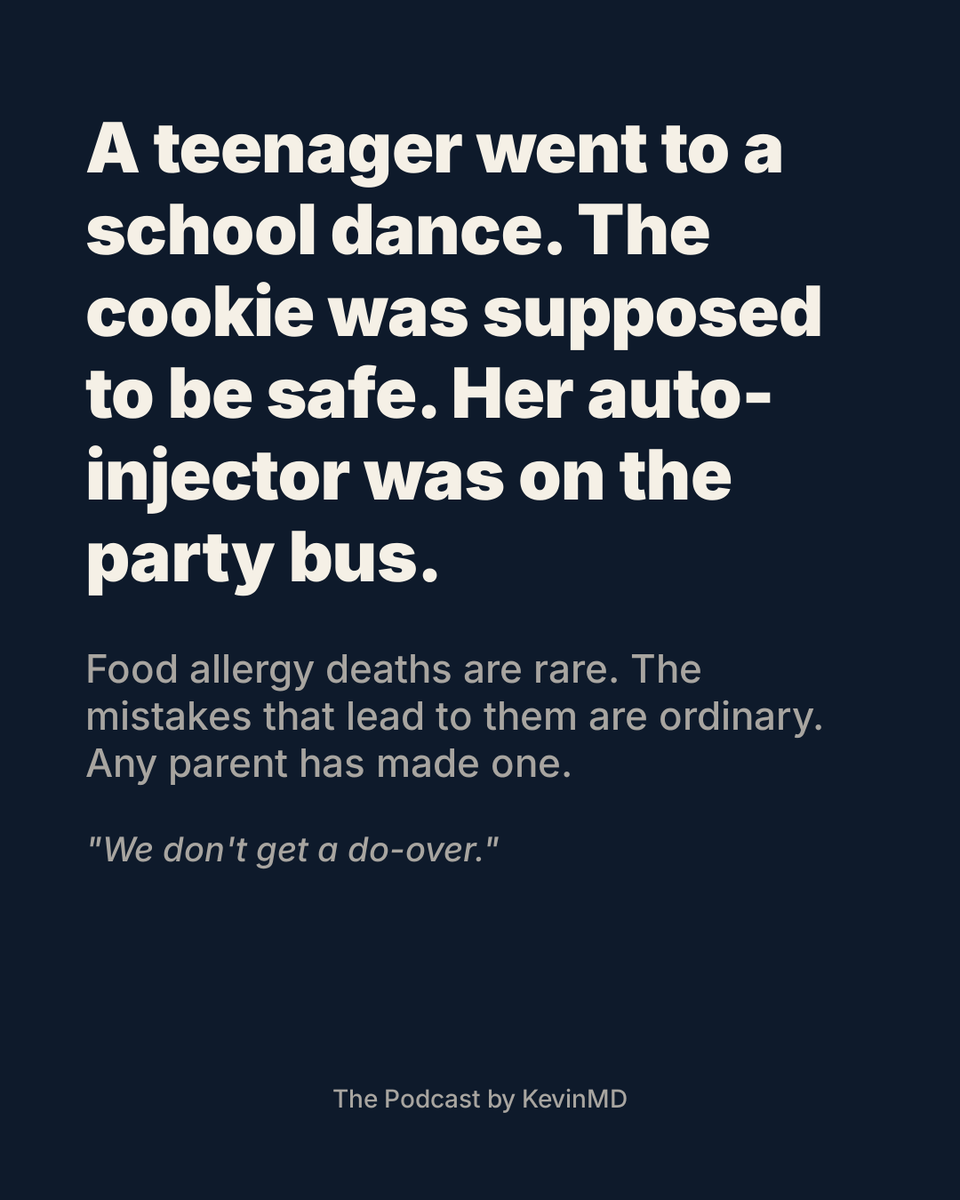
A teenager in California went to a school dance. She took a bite of a cookie that was said to be safe. It wasn't. Her auto-injector had allegedly been left on the party bus, and the bus was gone. Reports said the other kids were doing CPR on her in the parking lot.
A girl in Florida took a bite of the wrong chocolate chip cookie at a friend's house. Same brand. Same red packaging. Peeled back, so she couldn't see it was the peanut butter one. A parent offered it to her. Tragedy ensued.
Lianne Mandelbaum, founder of the No Nut Traveler, tells both stories. Then she tells one on herself. She is a diligent parent of a teenage son with a severe allergy, and she once clicked the wrong brand of ice cream cones in an online grocery order. Her husband called: "Are you trying to kill Josh on my watch?" The cones came studded with peanuts.
Her argument is aimed at how clinicians and journalists frame the risk. Comparing anaphylaxis deaths to a lightning strike sounds reassuring and reads as dismissive, because the comparison hides the denominator. Nobody encounters lightning all day, every day. Someone with a food allergy encounters food all day, every day, and every encounter carries the potential for a fatal error. The deaths are rare. The exposures are constant. The analogy erases exactly that.
The stigma compounds it. In a Northwestern study she co-authored, with almost 5,000 respondents, more than 13 percent of people reported hiding their food allergy from airline crews out of fear of repercussions or ridicule. Hiding the condition from the people who would treat you is the predictable product of being laughed at, doubted, and called hysterical.
And the tools lag behind the rhetoric. Every commercial flight carries a defibrillator. There is no requirement for epinephrine auto-injectors. A physician described her own life fading in front of her mid-flight because the emergency kit held only vials and, at first, no doctor could be found. Meanwhile, she notes, stock epinephrine in schools has mostly been used on kids who never knew they had an allergy. Nobody's first allergic reaction should be a fatal one.
Blaming the person who made the mistake is a cop-out. Nobody chooses a food allergy. Nobody chooses a fatal error. The families sharing these stories have just buried a child or an adult.
As she puts it: "We don't get a do-over."
Listen to the full conversation on The Podcast by KevinMD. Link in the replies.
What's the ordinary mistake you've caught yourself making with something high-stakes?
#ThePodcastbyKevinMD#FoodAllergy
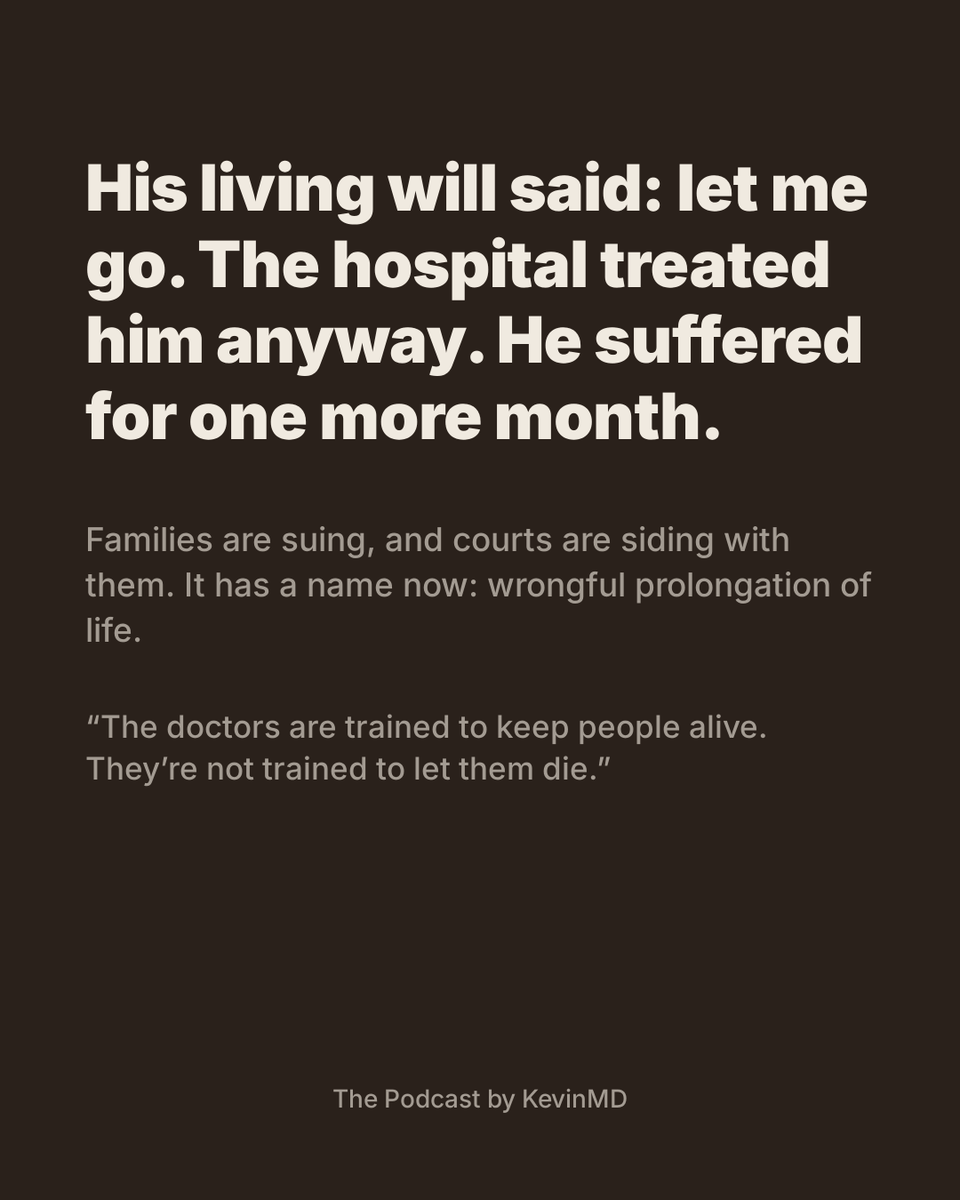
There is now a name for a growing kind of medical malpractice: wrongful prolongation of life. Keeping people alive against their clearly written wishes. Under the Patient Self-Determination Act of 1990, a patient has the legal right to refuse treatment. Hospitals are learning in court that a signed directive is an order, not a suggestion.
In 2011, a dentist in New Rochelle, New York was diagnosed with early-onset dementia in his fifties. He immediately wrote his advance directive with one clear provision: if he ever reached the point where he could not recognize anyone, comfort care only. No IV fluids. No antibiotics. Let him go peacefully.
Five years later he fell, did not recognize his wife or his two adult sons, and was brought to the hospital. His wife held his healthcare power of attorney. The family handed over the advance directive and the POLST. It said comfort care only. The doctor gave him antibiotics, a CT scan, and IV fluids anyway. The antibiotics kept him alive an extra month. His family had to witness the suffering.
For years, courts threw these cases out. Providers had a kind of blanket immunity. They kept the patient alive, so how could it be wrong? Plaintiff lawyers would not take them.
Then Georgia. A grandmother made it clear she never wanted to be intubated or put on life support. Her granddaughter, in her twenties, was her surrogate. They intubated the grandmother anyway. Years of appeals followed, and the courts in Georgia ultimately ruled the patient had the right to say no to treatment, even lifesaving treatment. The case settled for a million dollars, one of the first of its kind. The floodgates opened.
Why does it happen? A new doctor arrives in the ER and never asks the code status. Documents are inaccessible. And sometimes it is ego. As patient advocate Althea Halchuck, EJD puts it: the doctors are trained to keep people alive, they are not trained to let them die.
What protects a family: only about 30 percent of Americans have an advance directive, so choose a surrogate who will actually go to bat for you, not just the next closest relative.
The New York case has not settled. The defendants just exhausted their last appeal, which means it is heading to a jury.
Who in your life would actually go to bat for your wishes if you could not speak for yourself?
Listen to the full conversation on The Podcast by KevinMD. Link in the replies.
#ThePodcastbyKevinMD#PatientRights
The classic ADHD checklist had 59 questions. Seven were about inattention. That is most of the story of why a generation of women got missed.
It was built in the sixties, seventies, and nineties, around a picture of ADHD that looked like a boy who couldn't sit still. Very visible, impossible to ignore.
In girls it looks different. Not rambunctious, but restless. Fidgety, talkative, rapid speech, a mind that drifts mid-task. The inattentive kind is more common in women, and it is exactly what those old tools were worst at catching. So a lot of girls read as fine on paper while struggling their whole lives.
Then the recognition came from an unexpected place. During the pandemic, women started seeing themselves in each other's posts, and new diagnoses in adult women nearly doubled from 2020 to 2022. People named it for each other before the system named it for them.
Here is the part worth saving. Estrogen is made by the brain itself, not only the ovaries, and it helps regulate dopamine, serotonin, and norepinephrine. It rises and falls across the month. When it drops, in the days before a period, women with ADHD can hit real dips in attention, memory, and focus, and they appear to feel it more than women without ADHD. Same brain, different week. Researchers are only now studying what that means through perimenopause and beyond.
So a woman can spend years being told she is inconsistent, when the truth is that a neuromodulator of dopamine is cycling through her on a schedule and nobody ever charted it.
Arti Lal, a pediatrician who has spent 14 years diagnosing and treating ADHD, put the gap simply: hormones have been entirely left out in 50% of the population, and we are only coming to that now.
Even after 14 years of this work, she says: I wish I had known this before. ADHD has been trivialized and stigmatized for a long time, more so in women.
Recognition isn't a diagnosis. If this sounds like your life, that is a conversation for a real assessment with a clinician.
Listen to the full conversation on The Podcast by KevinMD. Link in the replies.
What did it look like in your life before anyone named it?
#ADHDinWomen#ThePodcastbyKevinMD
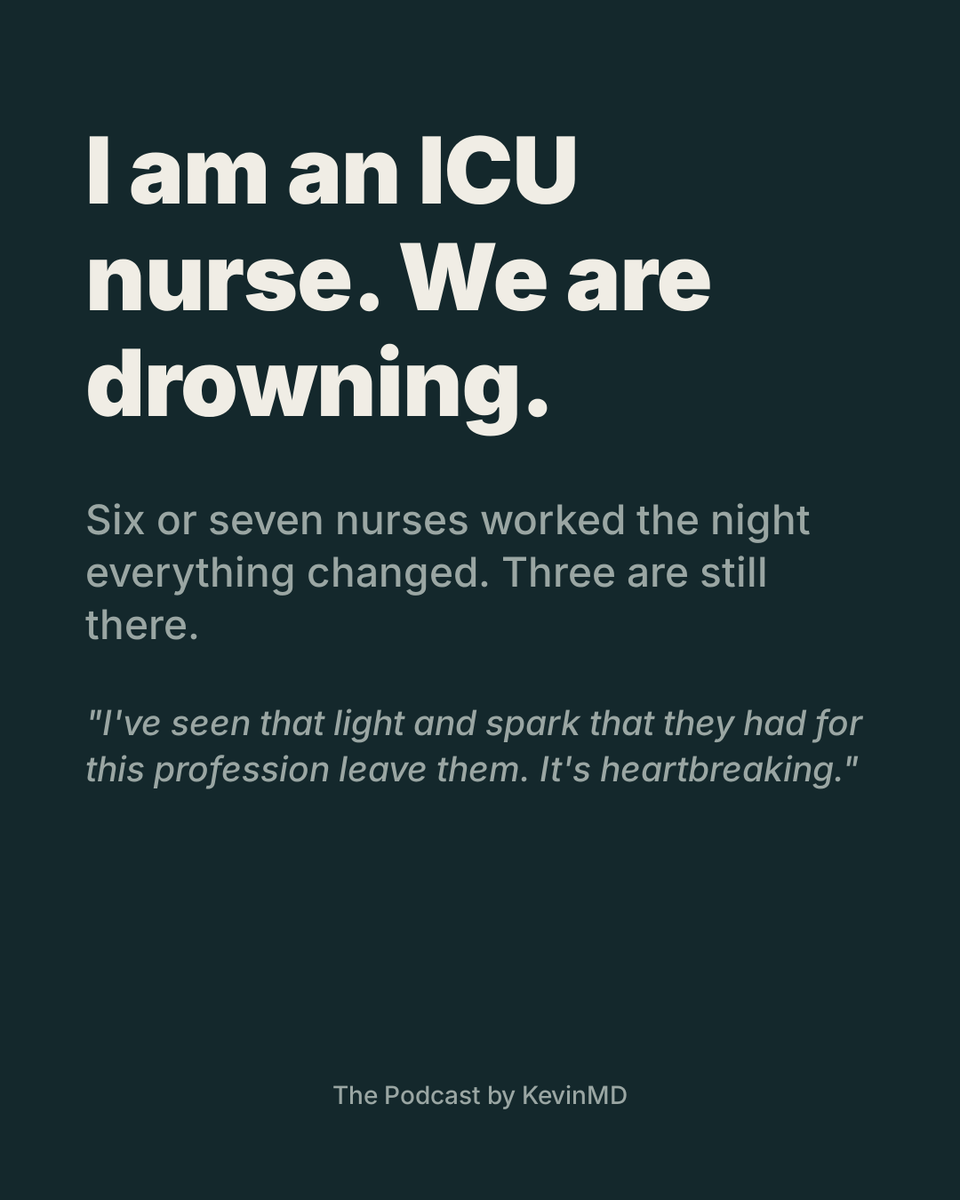
An ICU nurse wrote one sentence about her job and it was shared 59,000 times: "I am an ICU nurse. We are drowning."
What the essay never captured is what the years after it did to the nurses in it.
Lauren Powers is a critical care nurse at a small community hospital. At two in the morning there, she says, there is no perfusionist. The nurse is the perfusionist. Every medication and every device on the unit can save a patient or kill them, and she is the one managing all of it. There is no backup specialist to call down the hall at that hour. The judgment is hers, in real time, with a life on the other end of it.
She remembers a patient whose balloon pump, seated in his aorta, was supporting his failing heart. At shift change the alarm sounded that means the pump is seconds from powering down. A stopped balloon can shower clots. She wiped the line with alcohol swabs to read whether the blood was inside the device or outside it. Five nurses were already at the bed, each doing the next thing before she could say it. They FaceTimed the device rep at two a.m. The patient was okay.
Then the pandemic's first months arrived. Her unit surged to five ICUs with the staff for two. There is not 150 percent oxygen, she says, there is only 100, and some nights you watch that math play out and can do nothing about it.
Of the six or seven nurses who worked her unit's hardest night, three are still there. The unit is now, by her estimate, roughly 80 percent travel nurses. She has watched the light and the spark people had for this profession leave them, and calls it what it is: heartbreaking. What she holds onto is that she gave everything she had, and sometimes it still isn't enough.
The essay did something she never expected. Strangers wrote to tell her she had said the thing they could not: thank you for saying the words that I can't. That is the part a nursing-shortage chart never shows. Not just how many nurses left, but how many are still there carrying a night they will never put down. The number that went viral was five words on a hard shift. The number that matters is three of seven.
What kept her was never the staffing or the schedule. It was her coworkers. She says she could not have survived that night without them. You don't know how much your work family means to you until they start to leave, and no one will ever be able to replace that bond.
Listen to the full conversation on The Podcast by KevinMD. Link in the replies.
Nurses, and everyone who works a job like this: what is the one shift you know you will never forget?
#ThePodcastbyKevinMD#Nurses
Almost nobody knows this distinction, and elderly people die over it: a DNR refuses CPR. It does not refuse treatment.
Alan Lindemann, MD is a rural obstetrician in North Dakota who has spent a lot of time managing nursing homes. He says the two concepts get confused constantly: do not resuscitate quietly becomes do not treat. Once that happens, a piece of paper meant to prevent one specific intervention at the end of life starts functioning as a blanket decision to stop care.
Here is the mechanism, and it is worth reading slowly.
An elderly patient gets a bladder infection. Bladder infections in older people cause confusion. The people around the patient see the confusion and conclude the patient can no longer make decisions. So the infection that caused the confusion becomes the justification for not treating the infection. Lindemann says it directly: we can have people dying from bladder infections. Pneumonia too.
His prescription for clinicians is simple. Every time an elderly patient becomes suddenly confused, think sepsis first. Think bladder infection, kidney infection. Treat the confusion as a symptom to investigate, not a verdict on capacity.
He describes a case that shows the other side of the confusion. A woman in her eighties arrived in the middle of an asthma attack. She had a DNR. So no one would intubate her, and she could not be transferred anywhere. The document was written to refuse chest compressions when her heart stopped. It was read as refusing the treatment that would keep her heart from stopping.
And here is the detail that should bother you most: geography decides who gets caught in this. Lindemann says an 85-year-old presenting to an emergency room will probably get different care than the same person in a nursing home, because the ER does not automatically dismiss them based on age. Same patient, same infection, different building, different outcome.
Behind it all is a culture he names from the inside: "We get used to people dying... If we aren't bothered by it, we should go on to doing something else."
One patient of his, a 93-year-old man, told him he wanted to be treated like a 73-year-old. Sharp enough to say that, Lindemann notes, is sharp enough to consent to treatment or refuse it.
His own advance directive will not be ambiguous. He says he will go down fighting for the difference, and he knows exactly how he wants his own story to end: "I may sound selfish, but I want to die at home."
Listen to the full conversation on The Podcast by KevinMD. Link in the replies.
Clinicians: what would make the line between a DNR and do not treat unmistakable in the chart?
#ThePodcastbyKevinMD#ElderCare
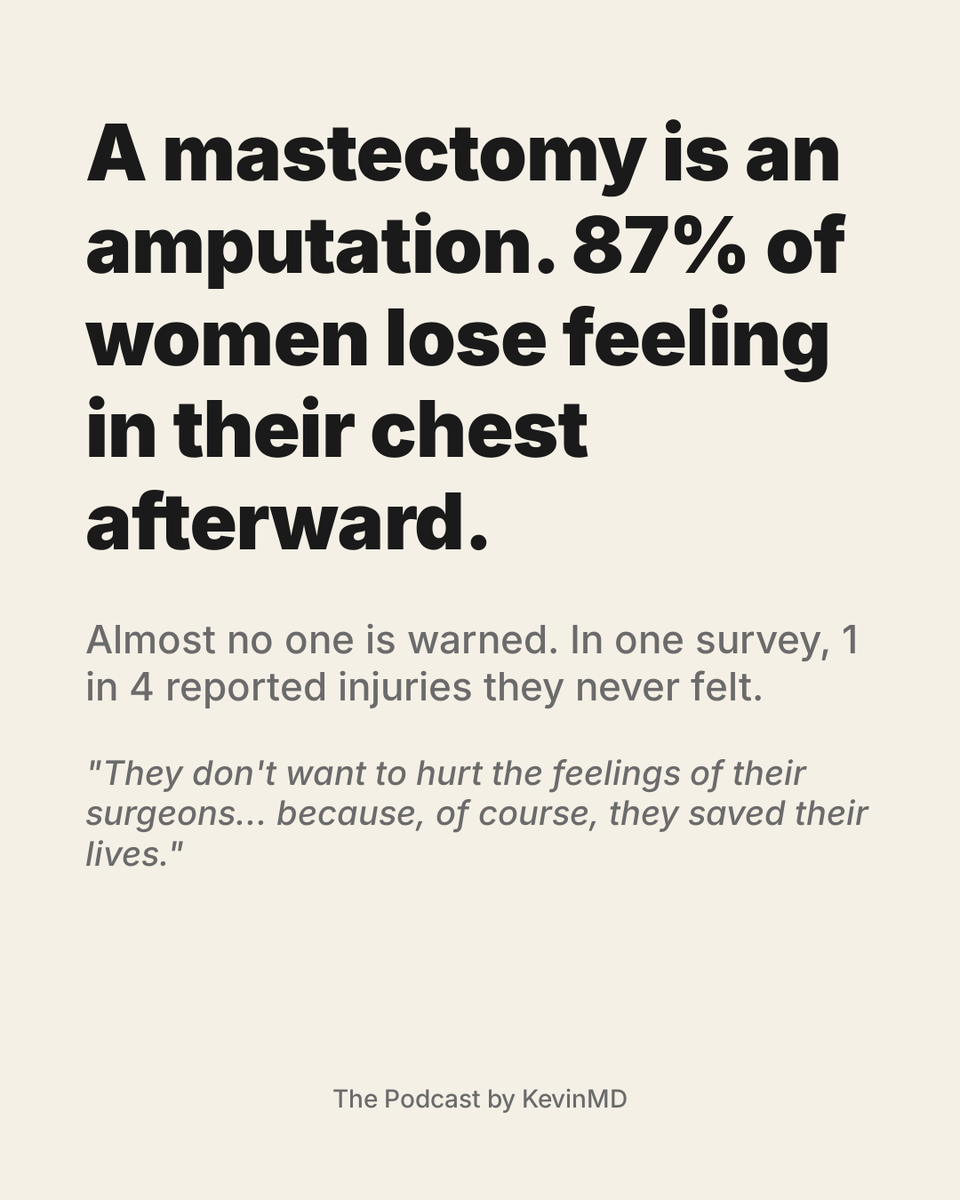
Almost nobody warns women that a mastectomy takes their sense of touch, not just their breast.
In a nationwide survey of women who had a mastectomy, 87 percent reported losing sensation. This is not the temporary numbness that fades after a bruise. For most of them it is a lasting loss of feeling across the chest, and it is nearly universal, not a rare complication that affects an unlucky few.
The consequence goes far beyond how it feels. Nerves are the body's first line of defense. You pull your hand off a hot stove before you consciously decide to, because sensation is warning you. A mastectomy is an amputation of the breast: the tissue and the nerves running through it are cut and removed. When those nerves are not surgically reconstructed, there is no pathway for the signal to travel, and the warning is simply gone.
So a reconstructed breast can look completely normal on the outside and register nothing at all. In the same research, 1 in 4 women reported an injury or a near miss they never felt: a burn from a curling iron, a cut while cooking, an underwire that pushed through the skin, discovered later when they undress. Sunburn at the beach becomes a real danger, because nothing signals the body to get out of the sun. Almost 75 percent reported that intimacy and their sex lives changed afterward, a cost that rarely gets asked about.
Two things make this harder to catch. First, it settles in slowly. Most women don't grasp the full impact until months after they've healed, long after the appointments where it might have been explained. Second, when sensation returns at all, it is not a switch flipping back on. Nerves are among the slowest-regenerating tissue in the body, recovery can take months to years, and there is a separate cognitive relearning step, because the brain can misread where a touch is coming from until it rewires. Even after nerve-repair surgery, this is measured in years, not weeks.
This is the part worth saving. The clinical frame optimizes for form, recreating a breast that looks normal. Emily Hansen, who has spent nearly two decades in health care communication and eight years working with surgeons and breast cancer survivors, argues the frame should include function: survivorship measured by how a person can live in their body, not only by whether the disease is gone.
Listen to the full conversation on The Podcast by KevinMD. Link in the replies.
What is one thing you wish someone had explained to you before a major surgery that no one did? #BreastCancer#ThePodcastbyKevinMD
A pediatrician spent a year staring down her own mortality and started writing everything down, so her three daughters would know who she was if she died.
Kelly Curtin-Hallinan, MD was told she had stage 4 renal cell cancer. It was later downgraded to stage 3, and she finishes treatment this month. But the part of her story that stays with me is not the diagnosis. It is what she decided the certainty-seeking part of every physician has to give up.
There is a wry detail worth sitting with first. She works in utilization review. When the hospital was reluctant to admit her, she called her own UR team and asked them to send the actual criteria for hypertensive emergency, which she clearly met, so she could get herself admitted. A physician had to invoke the system she works inside to be taken seriously as a patient. She is not bitter about it. She counts the people who eventually cared for her as a genuine gift.
We go into medicine to fix things. To solve the problem, deliver the answer, tie the bow. She wanted to do that with her own story too, to rush to the end and say "but I'm OK now."
She won't. Because it isn't true in the way we want it to be true. She has been downgraded to stage 3 and hopes it stays an observation, but she will be living with this for the rest of her life. There is no clean ending on offer.
What struck her most as a physician was how much care she received from people who never solved a single thing. Neighbors who brought her family dinner every night for two months. Colleagues who listened. People who could not change her prognosis and stayed anyway.
Here is the reframe worth saving. Care and cure are not the same act, and the second one is not always available. Sitting in that gap, without an answer, without an assurance, without knowing how the story ends, is not a failure of medicine. It is most of what medicine actually is.
She also learned to sit in the duality of it with her own children. Her youngest finally got the dog she had always wanted, then felt guilty because she only got it because her mom had cancer. A thing can be lucky and unlucky at the same time. You can feel joy after grief and both are allowed.
Her takeaway for other physicians: listen to your patients, and even when you cannot solve or cure the problem, that does not mean you cannot care for them and meet them where they are.
Listen to the full conversation on The Podcast by KevinMD. Link in the replies.
What is a moment you cared for a patient you could not cure? #ThePodcastbyKevinMD
We train doctors to be stoic before they ever see their first death. Then we act surprised when they can't grieve.
Humeira Badsha, MD is a rheumatologist. A year ago she stood at her mother's bedside in the ICU for a week and watched her organs shut down one by one. Ninety years old, feisty, sharp, dashing off angry letters to the newspaper right up until the fall that took everything.
What struck her was that the view from the bedside is not the view doctors are trained to hold. Doctors see the fight: the IV, the central line, the code. She saw the chaos, the noise, the code blue in the next room, the monitors beeping. Not peaceful at all. The struggle at the end of life, not the quiet goodbye everyone pictures.
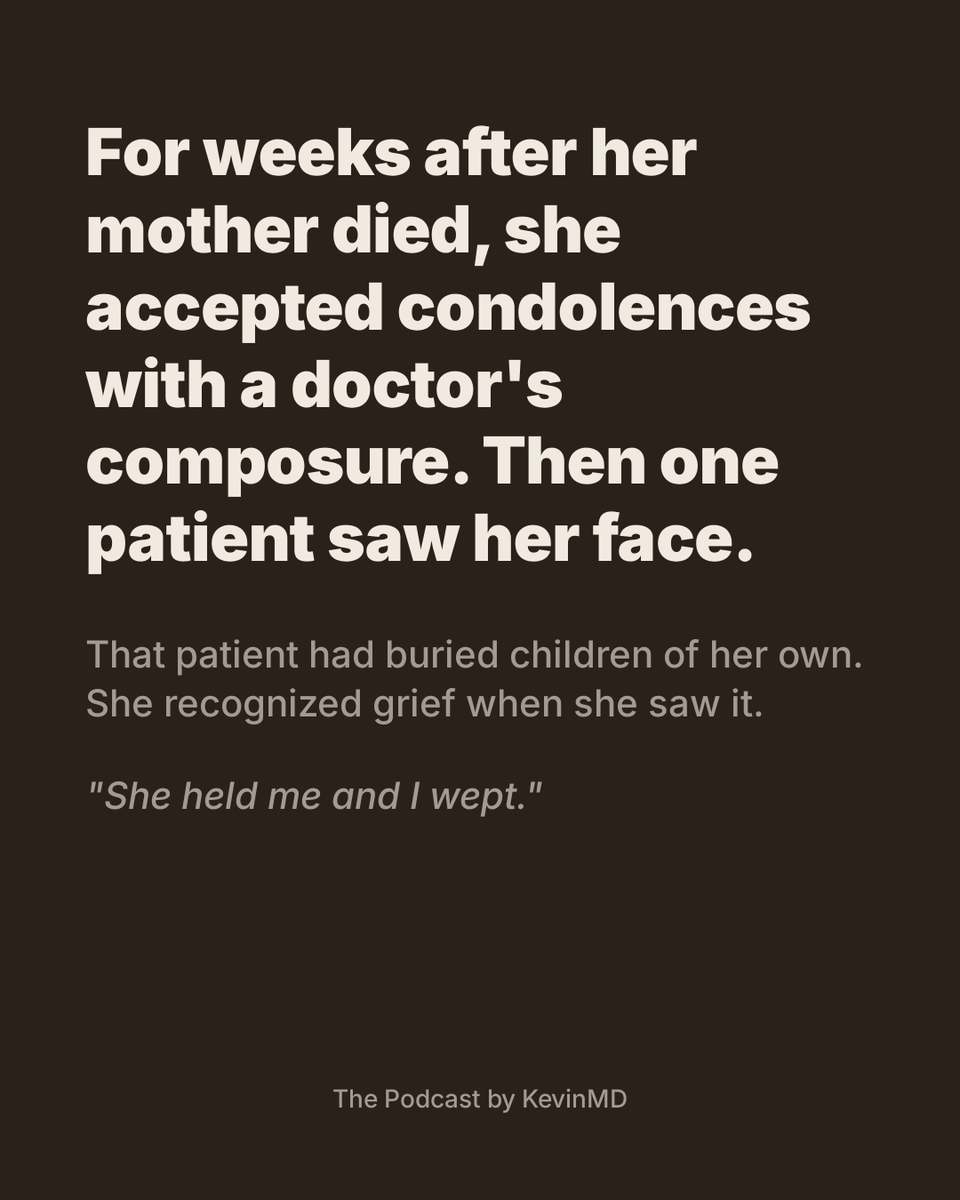
Then she went back to work and held it in, because that is the job. The condolences came from longtime patients and she absorbed them without flinching. Until one patient, a woman who had buried children of her own, looked at her face, recognized grief, and held her. And she wept.
There is a paradox here that anyone in a demanding job will recognize. She says going back to work is actually her therapy. When she is with a patient, she is focused on their problem, their story, their illness, and that is what saves her. The same profession that gave her no room to grieve is also the thing she runs toward to survive the grief.
Here is the part that should bother every one of us. When she wrote about this, doctors around the world wrote back. One, in another country, had lost her own mother and could not bring herself to return to work at all. Many were afraid to seek help. Afraid of looking damaged. Afraid their medical boards would treat self-care as a liability. So they carried it alone.
Bookmark this one: the profession that manages everyone else's mortality has almost no structure for processing its own grief. Support groups, counseling, permission to be human. We call it soft. It is infrastructure.
Listen to the full conversation on The Podcast by KevinMD. Link in the replies.
What did no one prepare you to carry from your own work?
#PhysicianGrief#ThePodcastbyKevinMD
A pediatric anesthesiologist will tell you the truth most people find surprising: it is safer for a child to have general anesthesia than to ride in the car to the appointment.
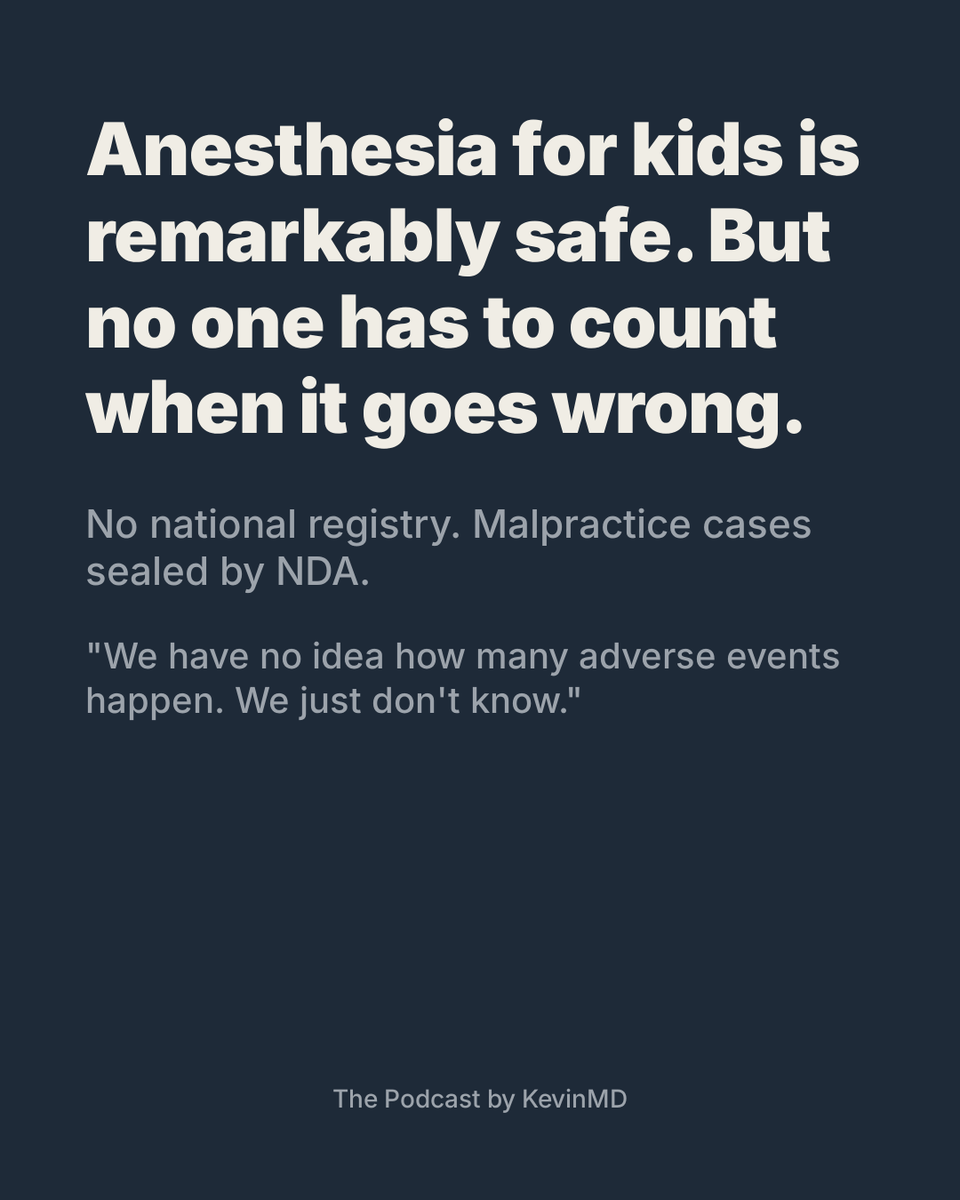
Anesthesia is exceptionally safe. These events are very, very rare. Hold onto that, because the real problem is not the risk. It is that nobody is counting it.
When a child is harmed or dies during sedation in a dental office, there is no national database that captures it. No record of how many of these anesthetics happen across the country. No record of how many go wrong. We learn about the tragedies from news reports, and when a case goes through a malpractice suit, it is often sealed by an NDA. The one document that might explain what happened gets locked away.
Irim Salik, MD, of Weill Cornell Medical Center, went looking for those answers and hit a wall.
Here is why the setting matters. In a hospital, the airway is secured and the backup systems are robust. In an office, that may or may not happen, depending on who is providing the anesthesia. The line between mild, moderate, and deep sedation is thin. The child takes too long to settle, so you give a little more, and a little more, and by the time you notice, the airway is obstructed. Someone in that room has to be able to manage it. Someone has to be able to do CPR. Salik is not sure someone always can.
Now contrast that with how anesthesia became safe in the first place. Every near miss, every death, gets a root cause analysis. National registries collect the data. Outcomes get benchmarked. The dental office side has none of it.
That is the argument worth saving: the fix here is not fewer procedures. It is a registry, mandatory reporting, and the same accountability the rest of medicine already accepts. A specialty that made itself safe by counting its failures is telling you another corner of medicine refuses to count at all.
Listen to the full conversation on The Podcast by KevinMD. Link in the replies.
If you have taken a child in for dental work under sedation, did anyone tell you who would be giving the anesthesia and what the emergency plan was?
#PatientSafety#ThePodcastbyKevinMD