
LIFE AI

903 posts

LIFE AI banner
LIFE AI

LIFE AI

@LifeNetwork_AI

The Intelligence Layer of Human Health, @avax Avalanche’s flagship L1 for Healthcare AI. https://t.co/K3oS6fhvZj | https://t.co/DVjbfufogS

Katılım Mart 2024
355 Takip Edilen65.6K Takipçiler
Sabitlenmiş Tweet
LIFE AI
LIFE AI@LifeNetwork_AI·
🩺 Community Question: Healthcare is a paradox: trillions spent and cutting-edge technology, why is humanity only getting sicker? Viewpoint A: The healthcare system is broken (reactive, wasteful, poorly coordinated). The system prioritizes treatment over prevention, carries massive administrative waste, and fails to use advanced technology efficiently. The result is high spending and weak outcomes. Viewpoint B: The real drivers lie outside healthcare (social factors, lifestyle, inequality). Healthcare accounts for only a small share of health outcomes. Poverty, obesity, unhealthy lifestyles, and inequality are the root causes. Increasing medical spending alone does not address the core problem. 👇 Drop A or B and share your perspective
English
13.3K
3.5K
4.5K
37.9M
LIFE AI
LIFE AI@LifeNetwork_AI·
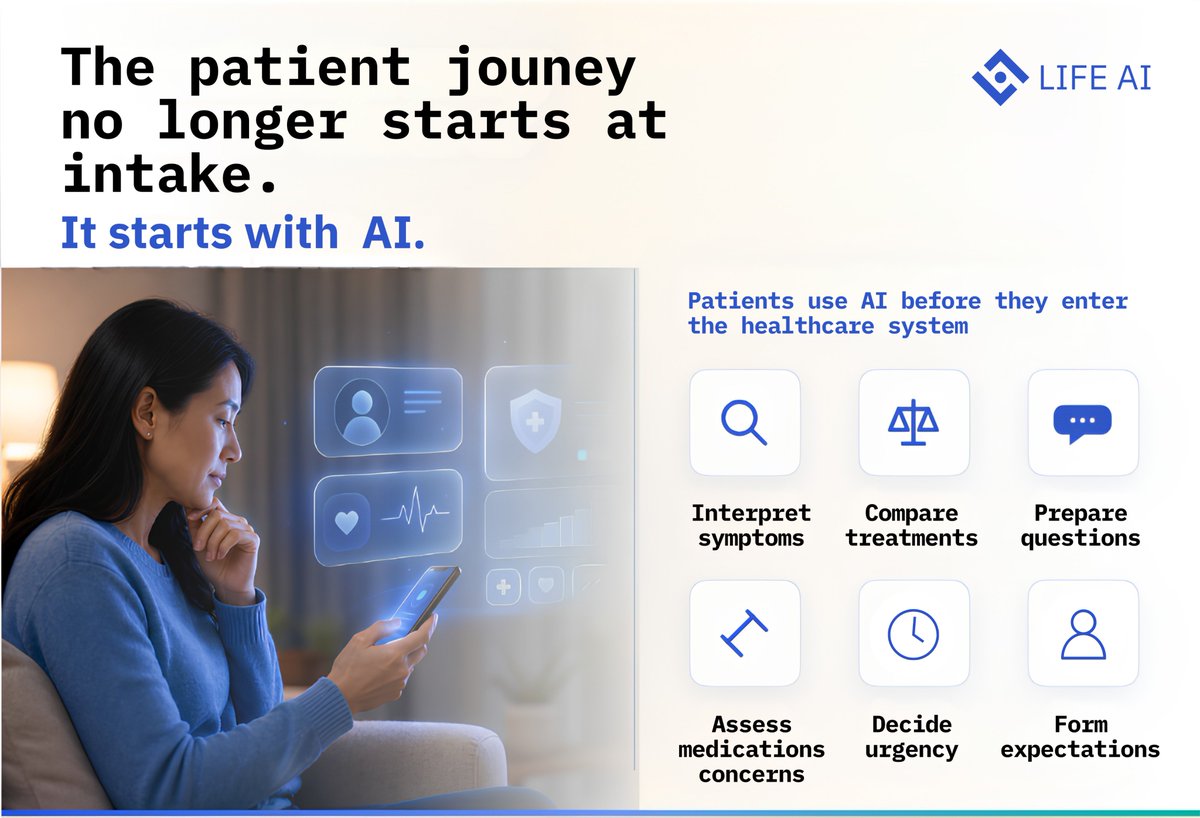
The patient journey no longer starts at intake. It starts with search, chat, and AI-generated health information. Patients now use AI before they enter the healthcare system: to interpret symptoms to compare treatments to prepare questions to assess medication concerns to decide whether care is urgent to form expectations before the visit This changes the clinical encounter. Clinicians are no longer only responding to symptoms. They are also responding to AI-shaped beliefs, fears, and assumptions that formed before the appointment. That creates a new responsibility for healthcare systems. They need to understand the pre-visit AI layer. Ignoring it leaves a blind spot in patient trust, adherence, shared decision-making, and diagnosis timing. Healthcare AI strategy cannot stop at EHR workflows. It must account for how patients use AI before care begins.
LIFE AI tweet media
English
37
72
166
4.6K
LIFE AI
LIFE AI@LifeNetwork_AI·
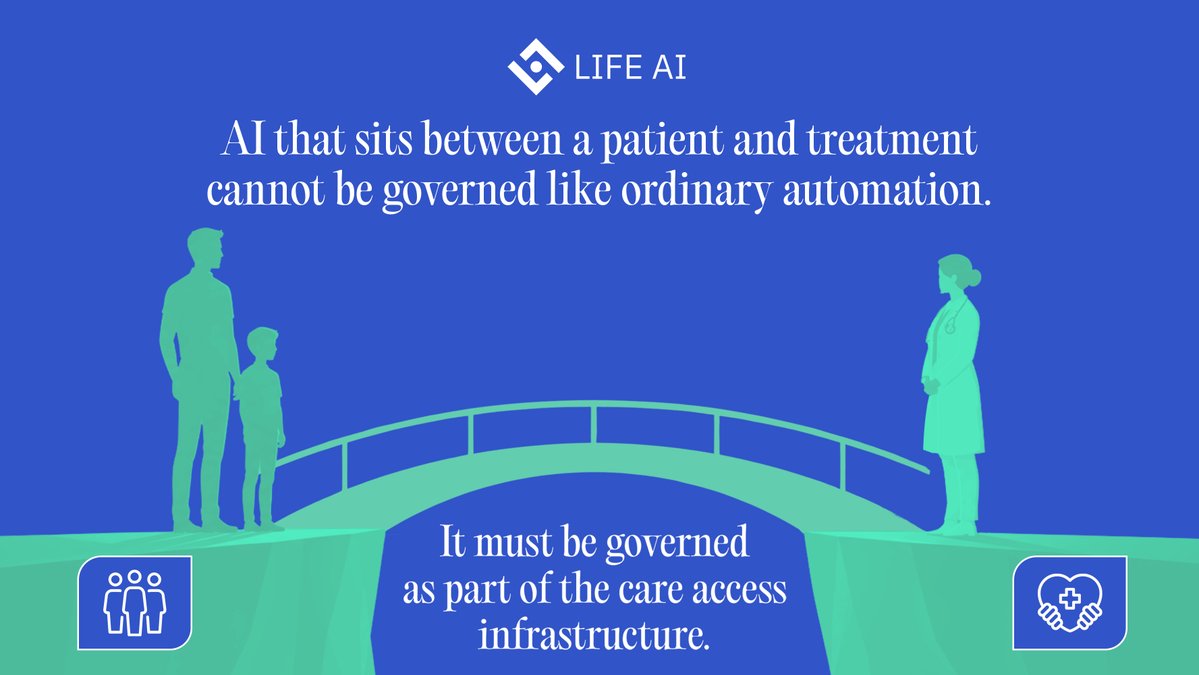
AI in prior authorization is not a productivity issue. It is an access-to-care issue. When automation is used to review, delay, or deny care, the stakes are different from ordinary back-office AI. The system is no longer just processing paperwork. It is influencing whether patients receive treatment, how long they wait, and how much administrative burden is pushed onto clinicians and families. This is where healthcare AI needs a higher governance standard. Speed is not enough. AI used in prior authorization must be transparent, appealable, auditable, and clinically accountable. Health systems and regulators should ask: Who reviews adverse decisions? Can patients and clinicians understand why care was delayed? Are denial patterns monitored? Is there human oversight when medical necessity is involved? Can the system prove it improves efficiency without restricting appropriate care? AI that sits between a patient and treatment cannot be governed like ordinary automation. It must be governed as part of the care access infrastructure.
LIFE AI tweet media
English
27
118
212
7.5K
LIFE AI
LIFE AI@LifeNetwork_AI·
Preventive care does not fail because people dislike prevention. It fails because healthcare systems are built around episodes. A visit. A claim. A lab result. A discharge. A diagnosis. But health risk builds continuously. Sleep changes. Biomarkers drift. Behavior shifts. Medication adherence changes. Inflammation rises. Symptoms appear before diagnosis. Preventive healthcare needs infrastructure that can detect trajectory changes before they become clinical events. That requires longitudinal data, feedback loops, and earlier intervention pathways.
LIFE AI tweet media
English
38
126
226
10.2K
LIFE AI
LIFE AI@LifeNetwork_AI·
How many words can you find? 👀 Drop the first one you spot ⬇️
LIFE AI tweet media
English
78
134
274
17.8K
LIFE AI
LIFE AI@LifeNetwork_AI·
Healthcare AI adoption is moving faster than healthcare AI governance. That gap is not theoretical. If a hospital deploys generative AI inside the EHR, it also needs capacity to monitor: ☑️ accuracy ☑️ bias ☑️ clinical safety ☑️ workflow impact ☑️ model drift ☑️ failure modes ☑️ patient trust Healthcare AI cannot be treated like ordinary SaaS. Deployment is not the finish line. In healthcare, deployment is when the monitoring obligation begins.
LIFE AI tweet media
English
41
136
237
15.6K
LIFE AI
LIFE AI@LifeNetwork_AI·
Healthcare was built around sickcare. Life AI BioHub is built around lifecare. Real-world learning. Early intervention. Integrated biology. A coordination layer for human health.
English
36
127
234
13.6K
LIFE AI
LIFE AI@LifeNetwork_AI·
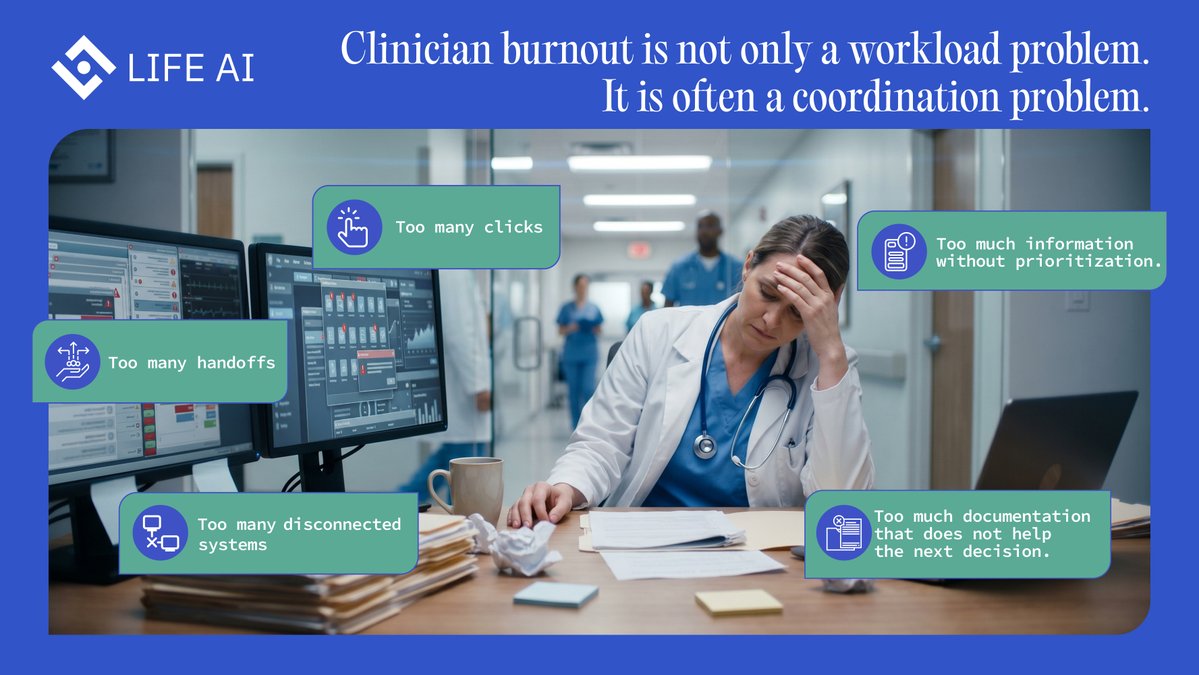
Clinician burnout is not only a workload problem. It is often a coordination problem. Too many clicks. Too many handoffs. Too many disconnected systems. Too much information without prioritization. Too much documentation that does not help the next decision. AI in healthcare should not simply add another screen, alert, or assistant. The real test is whether it reduces cognitive load inside the workflow. If AI gives clinicians more things to check, it has failed operationally. If it helps the system surface the right context at the right moment, it starts to matter.
LIFE AI tweet media
English
27
107
238
11.9K
LIFE AI
LIFE AI@LifeNetwork_AI·
Disco into a better life. 🪩
LIFE AI tweet media
English
44
126
254
12.1K
LIFE AI
LIFE AI@LifeNetwork_AI·
4/ Healthcare AI should be judged less like a feature demo and more like infrastructure. Not only by output accuracy. But by whether it improves the path from signal to decision to intervention.
English
0
3
31
339
LIFE AI
LIFE AI@LifeNetwork_AI·
3/ The better evaluation question is: What operational behavior changed because AI was introduced? Did it reduce delay? Did it improve escalation? Did it close a handoff gap? Did it make context available sooner? Did it improve learning from outcomes?
English
1
2
36
533
LIFE AI
LIFE AI@LifeNetwork_AI·
1/ Healthcare AI is often evaluated at the wrong layer. The question is usually: Did the model produce the right output? But in healthcare, a correct output is only useful if the system can act on it.
LIFE AI tweet media
English
35
27
128
2.8K
LIFE AI
LIFE AI@LifeNetwork_AI·
What was once reactive is now preventive. Life AI's mission is to build the infrastructure that keeps humans healthy before illness has a chance to take hold.
LIFE AI tweet media
English
53
131
285
14.1K
LIFE AI
LIFE AI@LifeNetwork_AI·
8/8 Worth reading in full: World Health Statistics 2026: Monitoring health for the SDGs — World Health Organization who.int/publications/i…
English
3
4
31
434
LIFE AI
LIFE AI@LifeNetwork_AI·
7/8 The future of healthcare may depend less on standalone healthcare apps and more on infrastructure that helps healthcare systems coordinate continuously at scale. Because many healthcare challenges today are no longer isolated medical problems. They are infrastructure and coordination problems.
English
1
1
25
472
LIFE AI
LIFE AI@LifeNetwork_AI·
🧵1/8 Healthcare systems are struggling not only because demand is rising but because most healthcare infrastructure was never designed for continuous coordination at scale. World Health Organization’s World Health Statistics 2026 makes that increasingly difficult to ignore. The report shows that global progress toward health-related SDGs remains too slow and uneven, with fewer than 5 years left before 2030. A few thoughts on what this reveals about the future of healthcare infrastructure ⬇️
English
37
122
234
10.9K