
Sabitlenmiş Tweet
Linsey Marr linseymarr.bsky.social
7K posts


Linsey Marr linseymarr.bsky.social
@linseymarr
Engineering professor @virginia_tech with expertise in airborne transmission of viruses and air quality. Avid recreational athlete.
Blacksburg, VA Katılım Şubat 2009
111 Takip Edilen67.1K Takipçiler
Clean water. Clean food. Clean air.
I'm leading one of four Performer teams for the @ARPA_H BREATHE program. We're building a system that ensures clean air in buildings. We're demonstrating this in child care centers to improve health for kids and their families.
ARPA-H@ARPA_H
Would you knowingly drink a glass of water filled with dangerous pathogens, bacteria, and pollutants? More than a century ago, water treatment and sewer systems transformed public health and saved countless lives. But we still have not done the same for the indoor air we breathe, where Americans spend roughly 90 percent of their time. Whether it is a school, office, hospital, or home, we often have no idea if the air around us contains harmful invisible particles that could be affecting our health. ARPA-H’s BREATHE program is working to change that by building technologies and systems that can monitor indoor air quality, detect potential health threats early, and help make indoor spaces healthier and safer. On this Asthma and Allergy Awareness Month and beyond, ARPA-H is working to make cleaner indoor air a standard of modern public health. Learn more about BREATHE: arpa-h.gov/explore-fundin… @MayoClinic @virginia_tech
English
@collins_daman It's a different hantavirus species in the US: the Sin Nombre hantavirus shows no evidence of human-to-human transmission. The cruise ship hantavirus is the Andes species.
English

@linseymarr Maybe because it ain’t a thing right? We have hantavirus in America every year. Gene Hackmans wife died of it. I didn’t see people working that scene wearing mask in the photos they published
English
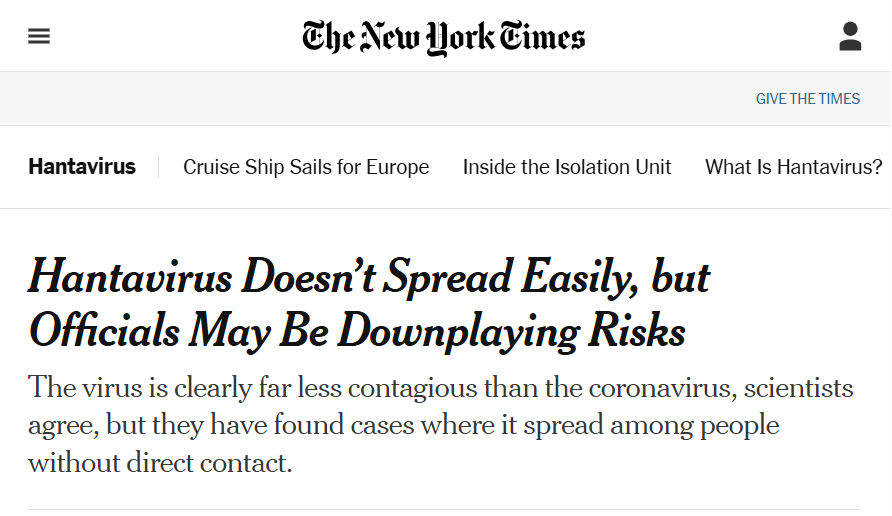
It's widely accepted that hantavirus transmits from rodent excreta to humans via inhalation of aerosolized virus, so I don't understand why we're so reluctant to acknowledge the inhalation route for human-to-human transmission.
nytimes.com/2026/05/14/hea…
English
Linsey Marr linseymarr.bsky.social retweetledi

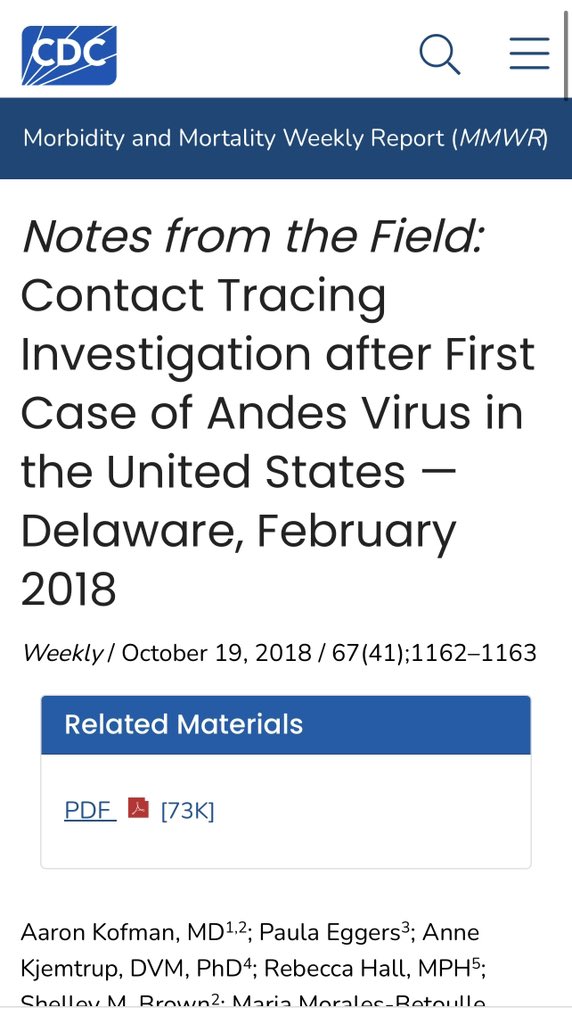
Another important investigation here from 2018 in a returned traveler to the US who contracted #AndesVirus after traveling to Argentina and Chile. She traveled on two commercial flights while symptomatic. Among the 51 contacts they monitored (from flight, healthcare settings & others), they found no additional infections including on PCR and antibody testing.
cdc.gov/mmwr/volumes/6…
English
Linsey Marr linseymarr.bsky.social retweetledi

Spot on, from @linseymarr, as always:
--> “I don’t understand why we are so reluctant to acknowledge the inhalation route when we’re talking about person-to-person transmission"
--> “Airborne transmission is certainly the simplest explanation in those cases,” she said of the Argentinians who had no direct contact with patients.
Link in thread
English
I spoke about the potential for airborne transmission of hantavirus, and Josh Santarpia talked about the National Quarantine Unit. I visited it last year; it's a critical resource for the country. @virginia_tech @VTEngineering
Scientific American@sciam
The Andes type of the hantavirus is spread by “close contact,” but it’s unclear how much of that transmission occurs by inhaling airborne droplets or other means spklr.io/6016EzcPi
English
Linsey Marr linseymarr.bsky.social retweetledi

Would you knowingly drink a glass of water filled with dangerous pathogens, bacteria, and pollutants?
More than a century ago, water treatment and sewer systems transformed public health and saved countless lives. But we still have not done the same for the indoor air we breathe, where Americans spend roughly 90 percent of their time.
Whether it is a school, office, hospital, or home, we often have no idea if the air around us contains harmful invisible particles that could be affecting our health.
ARPA-H’s BREATHE program is working to change that by building technologies and systems that can monitor indoor air quality, detect potential health threats early, and help make indoor spaces healthier and safer.
On this Asthma and Allergy Awareness Month and beyond, ARPA-H is working to make cleaner indoor air a standard of modern public health.
Learn more about BREATHE: arpa-h.gov/explore-fundin…
@MayoClinic @virginia_tech
English
I'm trying out some small CO2 monitors for an upcoming experiment. Aranet4 $190, Inkbird Plus $43, Vitalight $40, Airspot $163 (received free) agree, but I need to try at higher levels. NDIR sensors are good to within 50 ppm. Tradeoffs: price, size, battery life, connectivity.

English

@linseymarr Thank you. You said extended exposure is required, but if the person emitting virus is a "superspreader," then couldn't transmission happen rather quickly?
English
Does this mean that it's impossible to rule out airborne transmission for all recorded droplet/contact transmissions recorded in studies?
Essentially meaning that any listed contact/droplet transmission may have been airborne or both?
Linsey Marr linseymarr.bsky.social@linseymarr
Note that close contact behavior does not rule out transmission by inhalation of virus. Hantavirus load in exhaled respiratory particles may be low, or virus may not survive well, so extended exposure duration is required. onlinelibrary.wiley.com/doi/10.1111/in…
English
@JOHNJOHNSTONED Good question. We don't know enough details to say for sure. The NEJM article about an outbreak of Andes hantavirus in Argentina indicates that "close contact" is not required for transmission (Appendix 1 Table S7). nejm.org/doi/full/10.10…
English

@linseymarr Transmission is more likely the longer "close contact" continues for due to increased volume of air shared by rebreathing, but what evidence is there to say an "extended" or "prolonged" period is "required"???
English
Note that close contact behavior does not rule out transmission by inhalation of virus. Hantavirus load in exhaled respiratory particles may be low, or virus may not survive well, so extended exposure duration is required.
onlinelibrary.wiley.com/doi/10.1111/in…

Joseph Allen@j_g_allen
Earlier today I spoke with the doctor on the ship and he confirmed something. CDC messaging continues to say "prolonged, close contact" but that contradicts: 1) what's in the literature, and 2) what's happening on this ship. --> the doc told me a few who got infected/died DID have direct contact w/ very sick patient while treating them, but 3 who tested positive did NOT have direct physical or close contact - only shared time in a few spaces on the ship where people congregate (dining, lecture area)
English
Fully agree. "Close contact" describes behavior, but it does not describe how the virus gets from one person to the other. It could be through touch, inhalation of small particles in the air, or spray of large droplets.
Kristen K. Coleman@drkristenkc
Something I touch on repeatedly in my Airborne Infection course is that “close contact” is not a good way to describe how a virus is transmitted. It can be communicated as a risk factor for infection, but it does not say what the actual biological mechanism of transmission is.
English
@JeromeAdamsMD Airlines have become noticeably better about running the air filtration systems when parked at the gate.
English

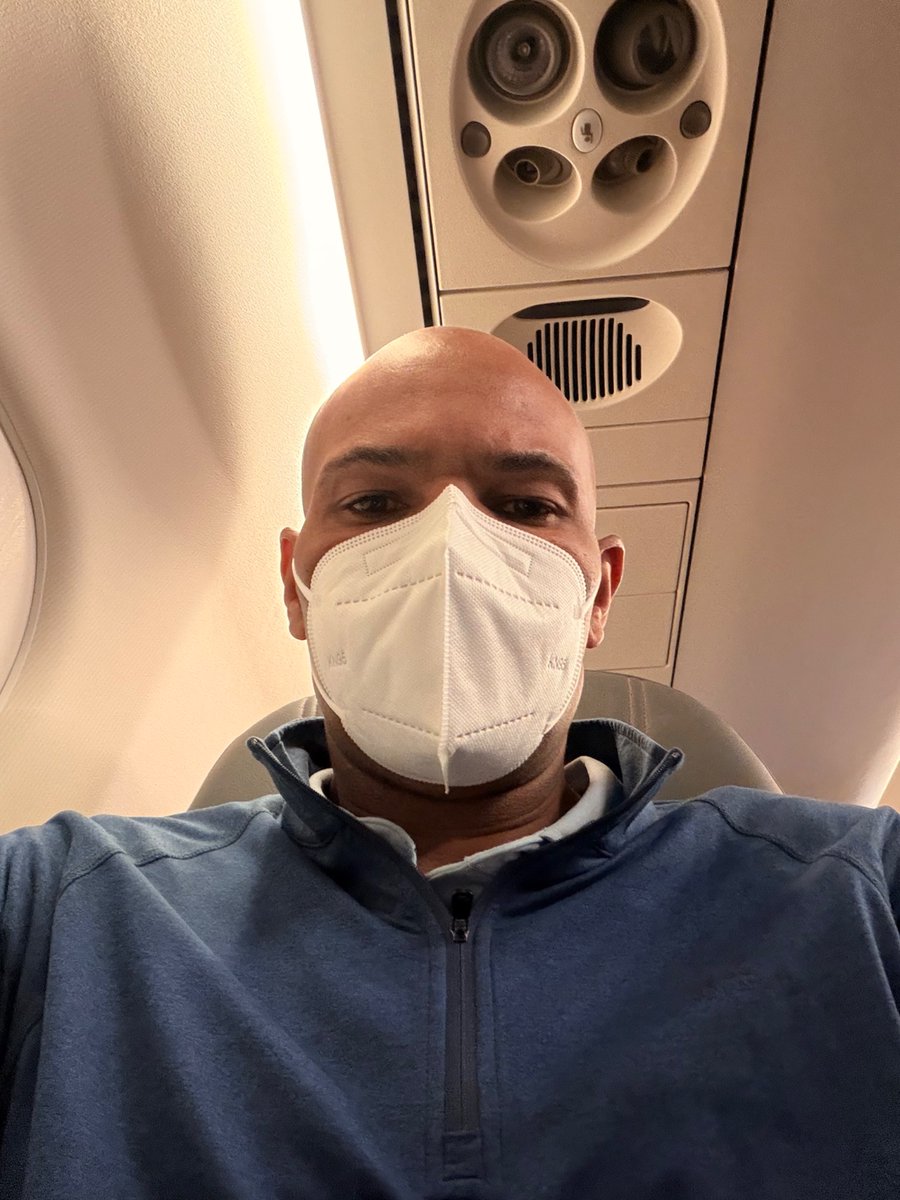
Flying today. ✈️
Still not panicking about #Hantavirus… yet… but you can never be too careful when exchanging air with people from everywhere - especially w/ asthma.
Riskiest moments? Boarding + takeoff/landing, when the plane filtration is off.
Stay safe out there. 😷
English
Review of biosensing technologies for detecting airborne pathogens, led by Rajan Chakrabarty with small contributions from me.
sciencedirect.com/science/articl…
Funded by @ARPA_H

English
Clean water. Clean food. Clean air.
ARPA-H@ARPA_H
We spend over 90% of our lives indoors. Yet the air inside our buildings was never built to protect human health. During National Asthma and Allergy Awareness Month, the gap is clear. Asthma affects 28 million Americans, and poor indoor air quality drives over $39B in healthcare costs each year. A century ago, we transformed public health with clean water. Now it is time to do the same for air. ARPA-H’s BREATHE program is building intelligent systems that can sense what is in the air, assess risk in real time, and respond to protect the people inside. Learn more about ARPA-H is transforming the air you breathe. arpa-h.gov/explore-fundin…
English
Linsey Marr linseymarr.bsky.social retweetledi
"It may be the biggest takeaway from the pandemic." Indoor Air. Airborne Transmission. Healthy Buildings. On @60Minutes. Sunday. (!)
@DrLaPook @linseymarr
60 Minutes@60Minutes
When COVID-19 surfaced in 2020, the medical field missed something, and it cost lives. Airborne viruses can travel much further than originally thought. To curb infection, we should have focused on indoor air systems. @DrLaPook reports, Sunday. 60Minutes.com
English
Why Threads? Anyone can sign up, it's easy to use, they have experience with content moderation.
Can we pick a day and everyone switches over, like when Sweden switched from driving on the left to driving on the right?
Linsey Marr linseymarr.bsky.social@linseymarr
#MacFellow This is mind-blowing. I'm posting at @linseycmarr" target="_blank" rel="nofollow noopener">threads.net/@linseycmarr
because I feel icky about supporting this platform and its owner by spending time and generating content here. English
#MacFellow This is mind-blowing.
I'm posting at @linseycmarr" target="_blank" rel="nofollow noopener">threads.net/@linseycmarr because I feel icky about supporting this platform and its owner by spending time and generating content here.
English