Mark Zandi

2.2K posts

Mark Zandi banner
Mark Zandi

Mark Zandi

@Markzandi

Chief Economist @economics_ma. Host of Inside Economics podcast https://t.co/ONmSCQ65Ib. Co-founder of https://t.co/ZAo6ME72qu. Views expressed here are my own.

Katılım Mart 2010
149 Takip Edilen48.4K Takipçiler
Mark Zandi
Mark Zandi@Markzandi·
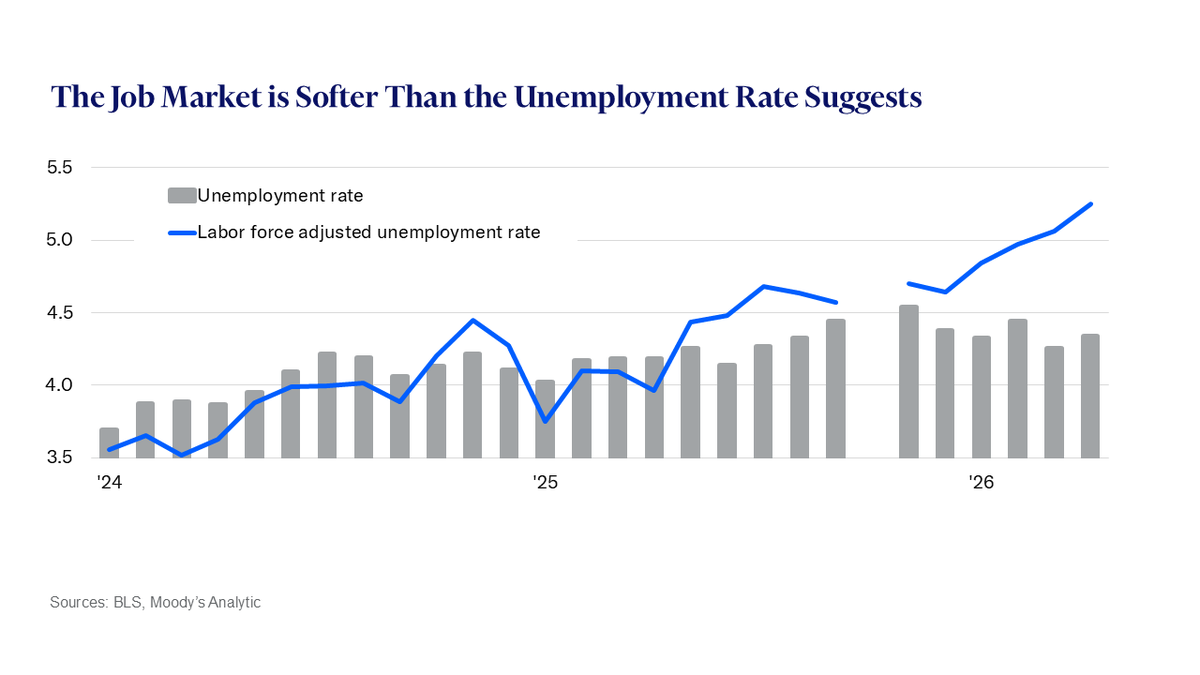
I wouldn’t take solace in the April employment numbers, despite the solid payroll employment gain in the month. There are a bunch of reasons why, but one particularly worth calling out is the slide in labor force participation. This is putting a lid on the unemployment rate, as more of the unemployed are leaving the workforce. To be sure, the aging of the population is putting downward pressure on participation, and the recent decline may be overstated due to various measurement issues, but even after accounting for all this, participation is still falling. If not for this decline, the unemployment rate would be a percentage point higher. That is, instead of 4.3%, the unemployment rate would be 5.3% and drifting higher. The job market is soft, and still getting softer.
Mark Zandi tweet media
English
13
53
143
9.8K
Mark Zandi
Mark Zandi@Markzandi·
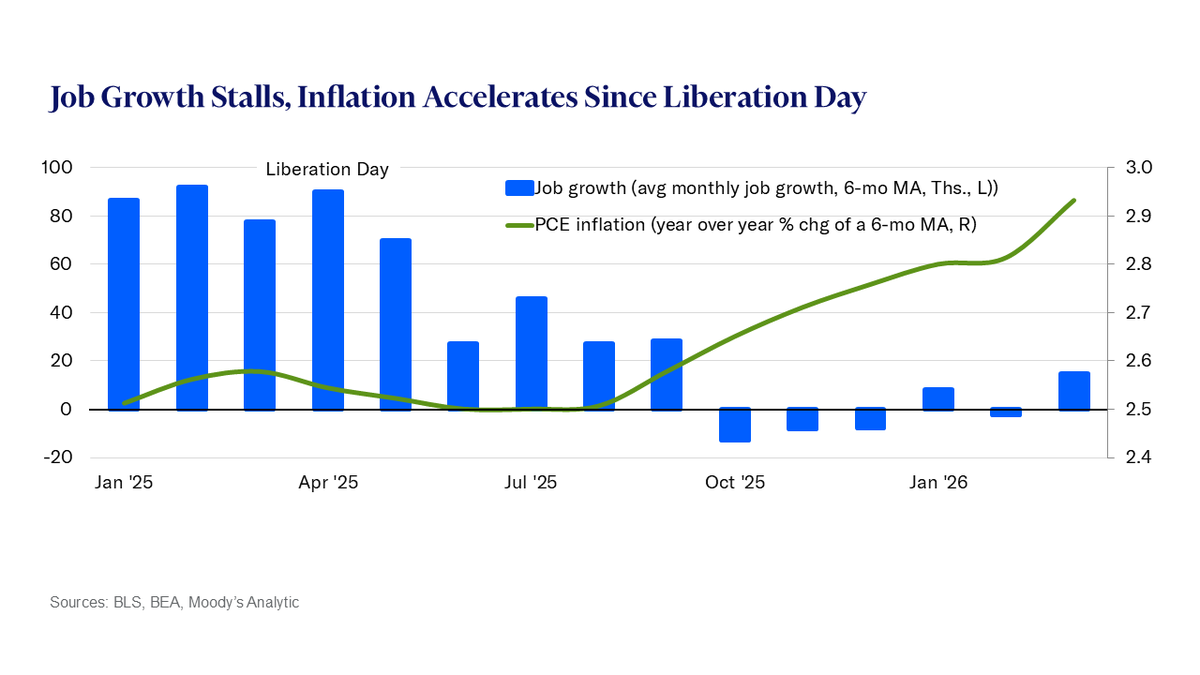
We have a year’s worth of economic data since Liberation Day, when President Trump announced much higher tariffs on most imported goods and countries, and the data are definitive; the tariffs have done significant damage to the economy. Since that day, job growth has come to a standstill, with only the non-traded healthcare industry adding meaningfully to payrolls. Also, since that day, inflation has accelerated, with the consumer expenditure deflator increasing at a 3% year-over-year pace, up from 2.5% before the tariffs and well above the Federal Reserve’s target of 2%. And the trend lines don’t look good, especially as the economic fallout from the Iran War hits with full force. The higher energy and other commodity prices caused by the war threaten to do even more economic damage than the tariffs, further undermining growth and pushing inflation higher. The U.S. economy is resilient, but just how resilient is set to be tested.
Mark Zandi tweet media
English
122
2.6K
4.5K
285.7K
Mark Zandi retweetledi
Yahoo Finance
Yahoo Finance@YahooFinance·
"We'd be likely in a recession already if not for the AI investment-driven boom," Moody's Analytics chief economist @Markzandi says.
English
8
26
95
14.7K
Mark Zandi
Mark Zandi@Markzandi·
At the start of the year, GDP was set to get a boost from deficit-financed fiscal stimulus and more Fed rate cuts. Job growth would resume, and unemployment would stabilize. Hard to see this happening now. Even if the Iran War winds down and oil prices recede quickly, the fallout will ensure there is no GDP pickup or job growth this year. Unemployment will rise further, and already considerable recession risks will worsen.
English
3
10
56
4.1K
Mark Zandi
Mark Zandi@Markzandi·
The economy is growing, but it is fragile growth. Looking through the vagaries of the quarterly data, real GDP is growing at a 2% pace. Growth, yes, but less than the economy’s potential growth rate, and not sufficient to support any meaningful job growth. Unemployment is still low, but it is steadily drifting higher, and the labor force participation rate is falling. Of course, this is not sustainable.
Mark Zandi tweet media
English
8
36
109
9.7K
Mark Zandi
Mark Zandi@Markzandi·
The economic damage from the war with Iran is mounting. Just the surge in gasoline prices has cost Americans an estimated additional $21.3 billion since the start of the war over 6 weeks ago. Fortunately, cushioning the financial blow are bigger tax refunds associated with the deficit-financed tax cuts provided by the One Big Beautiful Bill Act. To date, those bigger refunds have totaled $47.1 billion. Unfortunately, those refunds are set to tail off over the next few weeks, but it doesn’t look like gasoline prices will return to pre-war levels anytime soon. That’s even if the war ends soon, which looks iffy, to say the least. And this abstracts from what Americans will need to shell out for higher prices on everything from groceries to airfares in the coming weeks and months.  The financial pain caused by the war and its fallout on consumer spending and the economy is set to intensify.
Mark Zandi tweet media
English
20
60
209
22K
Mark Zandi
Mark Zandi@Markzandi·
Looking forward to joining this conversation. Global developments are continuing to shape the path of the U.S. economy and commercial real estate. We’ll be digging into how the evolving situation in the Middle East could ripple through economic conditions, capital flows, and investor sentiment—and what that means for the outlook ahead. Register: event.on24.com/wcc/r/5287473/…
Mark Zandi tweet media
English
2
3
21
3K
Mark Zandi retweetledi
Penn IUR
Penn IUR@PennIUR·
Breaking: Iran says #StraitofHormuz is “open,” but U.S. blockade puts markets on edge. Join top experts incl. @Markzandi, Julia Coronado, & Natalie Cohen at noon for real-time analysis on economic & fiscal impacts. 🗓 Apr 17 | 12 PM ET 🔗 bit.ly/4tLjWYA #publicfinance
English
1
3
8
2.1K
Mark Zandi
Mark Zandi@Markzandi·
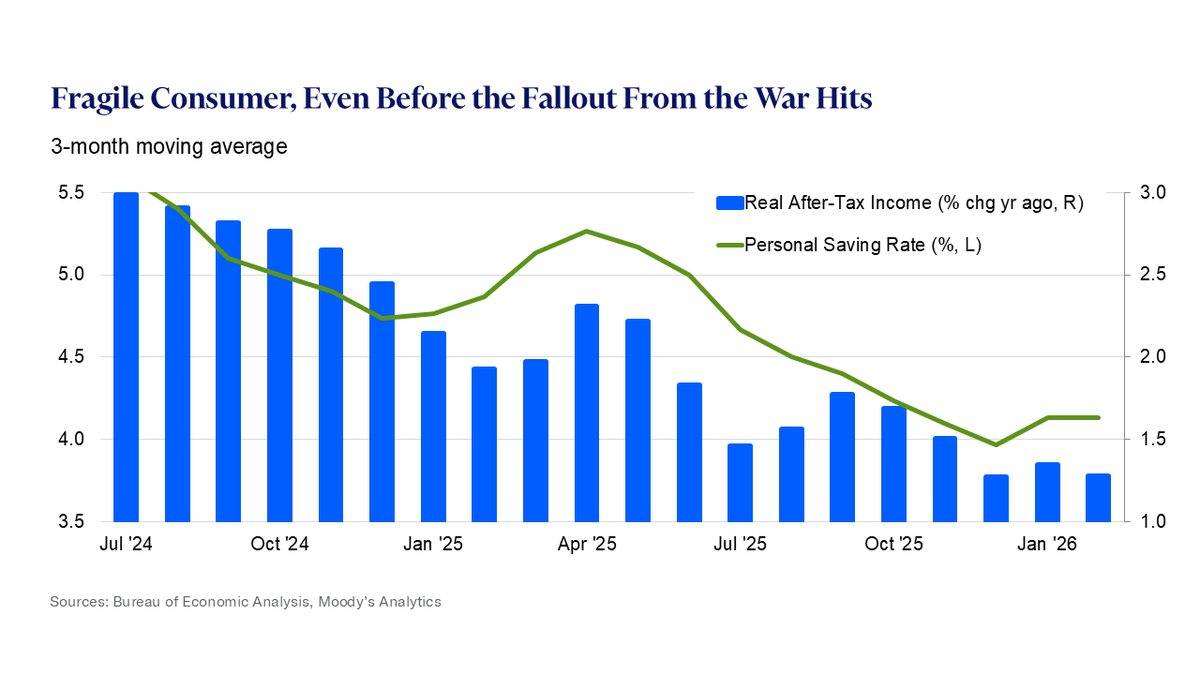
Last week’s economic data show just how fragile the economy is, even before the fallout from the Iran war hits with full force. Critical to whether the economy can avoid a recession is whether the consumer holds tough, and that looks increasingly iffy. Real consumer spending growth in recent months has been barely 1% annualized, and that’s despite a decline in the personal saving rate to a very low 4%. With job growth stalled, sentiment slumping, high and accelerating inflation cutting into real incomes, the stock market going sideways, and higher interest rates, it isn’t hard to see consumers pulling back. The only thing working in consumers’ favor has been the bigger tax refunds provided by the OBBBA, but that will fade quickly on the other side of April 15th. At the same time, the economic headwinds from the war are just beginning to blow. My angst around the possibility of a recession continues to rise.
Mark Zandi tweet media
English
18
76
209
27.1K
Mark Zandi retweetledi
Prof G Markets
Prof G Markets@ProfGMarkets·
‘The “Ceasefire” Won’t Save The Economy — ft. Mark Zandi’ Please subscribe to the NEW Prof G Markets Youtube channel via link below. @edels0n is joined by Mark Zandi to break down what the tenuous ceasefire in Iran means for the U.S. economy and investors. They discuss his forecast for inflation, what the Federal Reserve is likely to do next, and the probability of a recession. Mark Zandi (@Markzandi) is the chief economist of Moody’s, a leading provider of economic research, data and analytical tools. He also hosts the Inside Economics podcast. Ep available now in reply👇
Prof G Markets tweet media
English
4
4
11
3.1K
Mark Zandi
Mark Zandi@Markzandi·
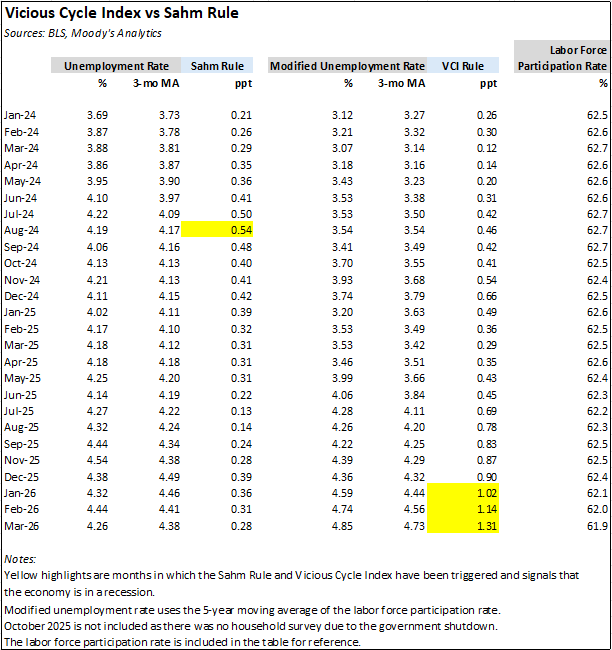
The VCI is a labor force–modified Sahm rule. To understand why it may be sending a stronger recession signal than the standard measure and what it says about today’s labor market read the short explainer in my latest newsletter: shorturl.at/nvelt
English
0
1
17
2.9K
Mark Zandi
Mark Zandi@Markzandi·
Recession risks thus remain uncomfortably high, with close to even odds of a downturn in the coming year. So says our leading recession indicator, which is based on a random forest model that I recently posted about. And so too says our new, tentatively dubbed Vicious Cycle Index (VCI).
Mark Zandi tweet media
English
1
5
45
4.7K
Mark Zandi
Mark Zandi@Markzandi·
Don’t take solace in the big March payroll employment gain. It comes after a big decline in February, when brutal winter weather and a labor strike at Kaiser Permanente weighed heavily on jobs. Abstracting from the vagaries of the monthly data, few jobs have been added since Liberation Day a year ago, and without healthcare, the economy would be losing jobs. And all of this before the economic fallout from the hostilities with Iran hits.
English
2
29
118
11.2K
Mark Zandi
Mark Zandi@Markzandi·
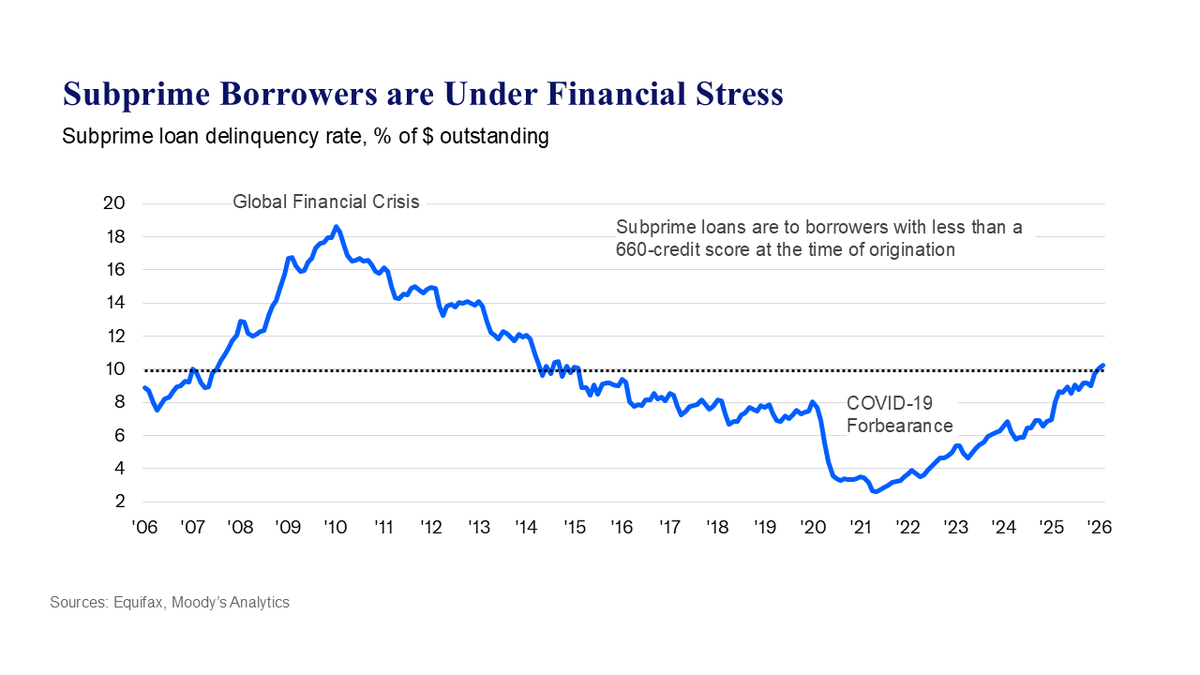
How subprime borrowers are faring is a reliable leading economic indicator, signaling troubled times even before the economic fallout from events in the Middle East hits.
English
1
0
29
2.3K
Mark Zandi
Mark Zandi@Markzandi·
No, what I’m worried about is what this suggests about the financial wherewithal of lower and middle-income Americans. They are struggling to make their debt payments, and that’s with an unemployment rate that is 4.4%. What happens now that they have to pay $4 a gallon for regular unleaded, up a buck from a month ago, and face much higher interest rates and little prospect for refinancing their debts? I shudder to think what will happen if unemployment continues to rise.
English
2
3
38
3.3K
Mark Zandi
Mark Zandi@Markzandi·
Here’s one more reason to be worried about the economy’s prospects: subprime borrowers are having an increasingly tough time making good on their loan payments. And this even before the hostilities with Iran. As of February, more than 10% of the debt outstanding to borrowers with a credit score below 660 at origination was delinquent. This is the highest delinquency rate in more than a decade, and the direction of travel is disconcerting.
Mark Zandi tweet media
English
12
41
120
9.9K
Mark Zandi
Mark Zandi@Markzandi·
Good discussion here with CNBC on rising recession risks on Wall Street as the economy shows cracks beneath the surface cnb.cx/4bQtASD
English
3
9
35
3.7K
Mark Zandi
Mark Zandi@Markzandi·
The Inside Economics podcast was joined by @profgalloway, who noted he was rattled by how little financial markets seem to care outside of the oil market. Investors appear remarkably unfazed by the escalating tensions. Equities remain close to their highs despite the potential risks to global energy flows. Listen now: podcasts.apple.com/us/podcast/sco…
English
8
13
60
9.2K