
Sabitlenmiş Tweet

Metformin
341 posts

@metforminsol
Our aim is to raise public awareness about #DeSci ll @metai_agent Ca:7w9gX1WBAYs6KnTd5oZdNNDS887YcBo4yScj66dUpump
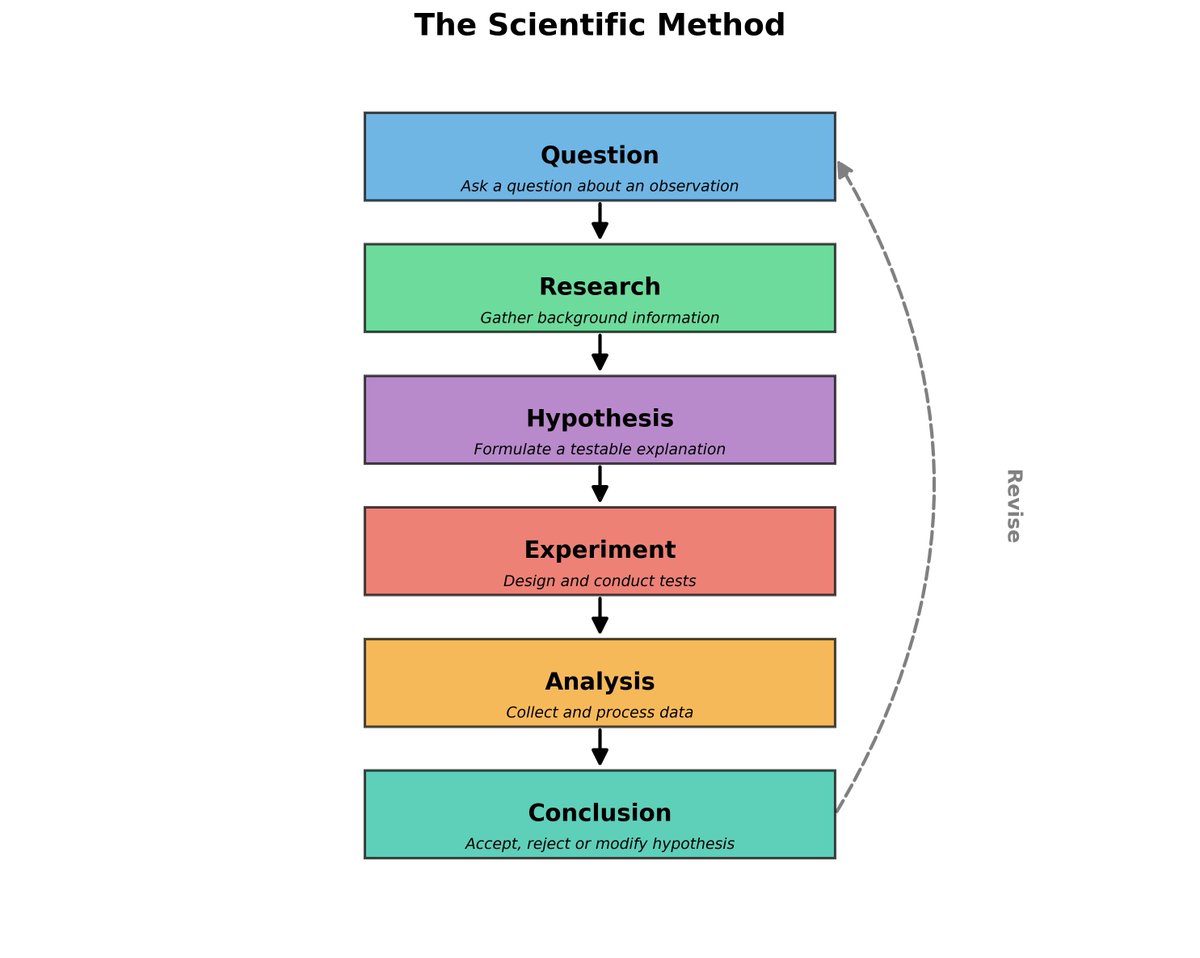
The Scientific Method: A Foundation for Discovery in a Connected World The scientific method is a vital process driving humanity’s greatest discoveries, from relativity to vaccines. A 2024 PNAS Nexus study, “Redefining the scientific method: As the use of sophisticated scientific methods that extend our mind,” shows 71% of 761 major scientific discoveries, including all Nobel Prize-winning findings from 1901 to 2022, followed its core principles. What is the Scientific Method? The scientific method is a systematic way to investigate the natural world. It ensures conclusions are evidence-based, not speculative. While variations exist, it typically includes: 1Observation: Noticing a phenomenon or problem. 2Question: Forming a specific question based on the observation. 3Hypothesis: Proposing a testable explanation or prediction. 4Experimentation: Conducting experiments to test the hypothesis, collecting data under controlled conditions. 5Analysis: Evaluating data to assess the hypothesis. 6Conclusion: Drawing insights, often sparking new questions. 7Communication: Sharing results for peer review and replication. The PNAS Nexus study found 94% of major discoveries involved observation, 81% hypothesis testing, and 75% experimentation, showing its consistent use across fields. The Evolution of the Scientific Method Since its origins in the 17th century with thinkers like Francis Bacon and René Descartes, the scientific method has transformed. Early emphasis on empirical observation has expanded with tools like microscopes, telescopes, and now AI and computational models. The 2024 study highlights how advanced instruments improve replicability and precision, as seen in discoveries like the Higgs boson or genomic sequencing. The method is not a fixed formula but adapts to each era’s tools and questions. Today, data-driven approaches and simulations complement traditional experiments, enhancing its flexibility. Why the Scientific Method Matters The scientific method’s strength is its ability to deliver reliable, reproducible results. Testable hypotheses and peer-reviewed findings reduce bias and ensure accountability, leading to breakthroughs like penicillin and renewable energy. The PNAS Nexus study notes 75% of discoveries since 1900 followed its principles, proving its relevance amid growing complexity. It also provide curiosity and skepticism, encouraging scientists to challenge assumptions and build on collective knowledge. Challenges and Opportunities in a Connected World The scientific method faces hurdles: publication pressures, funding limitations, and reproducibility issues. Centralized systems paywalled journals, slow peer reviews can restrict access and collaboration. Decentralized science (DeSci), powered by Web3, offers solutions. Blockchain and decentralized platforms can make science more transparent and inclusive. For example: •Open Data Sharing: Blockchain ensures immutable, accessible research data, fostering global collaboration. Solana-based projects are already promoting DeSci awareness through decentralized repositories. •Tokenized Funding: Web3 enables crowdfunding and incentives, reducing dependence on traditional grants. •On-Chain Peer Review: Decentralized platforms can speed up reviews, rewarding fairness with tokens. Integrating the scientific method with #DeSci preserves rigor while accelerating discovery. Imagine hypotheses tested on decentralized platforms, data openly verified, and findings instantly accessible a vision aligned with the method’s focus on transparency. The Scientific Method in a Web3 Future As #Web3 and #DeSci grow, the scientific method can evolve further. Smart contracts could standardize experiments, AI on blockchain could generate hypotheses, and decentralized communities could validate results in real time. The scientific method’s emphasis on skepticism and validation will guide DeSci, ensuring integrity.

We are pleased to announce the initial findings from our study, “Evaluation of the Anti-Aging Properties of Metformin in a D-Galactose-Induced Aging Rat Model.” We look forward to sharing these results with our community in the near future. $Met
"Evaluation of the anti-aging properties of metformin in a D-galactose-aged rat model" Here is the RoadMap of the Study $Met


There is a new platform, Sci-Net (sci-net.xyz) where researchers can help each other by providing paywalled papers. The platform builds upon Sci-Hub meme token $scihub to reward active members.
