Muon

2.9K posts

Muon banner
Muon

Muon

@muon_net

General-Purpose, Request-Based Validation Layer. Powering the intent-centric economy of tomorrow.

web3 Katılım Nisan 2021
354 Takip Edilen23.8K Takipçiler
Sabitlenmiş Tweet
Muon
Muon@muon_net·
We keep running into the same gap across APIs, crypto, AI, and infrastructure: systems can verify things, but there’s no standard way to require verification as a precondition for execution. Verification without enforcement is just observability. If a request can still run when proof is missing, correctness is assumed — not guaranteed. This shows up in many forms: ▫️APIs trusting responses ▫️Oracles assumed correct ▫️Audits that happen after damage is done Different domains. Same problem. What’s missing isn’t better cryptography or faster systems. It’s a first-class way for an interface to say: “This action cannot run unless a requirement is met.” HTTP already encodes important preconditions: ▫️ 401 — identity required ▫️402 — payment required But there’s no native way to say: Verification Required. We’re exploring this gap as a proposed HTTP standard called x442 — Verification Required. The idea is simple: make verifiable proof a precondition for execution, not something checked after the fact. This isn’t about refusal for its own sake. It’s about making verification enforceable at the interface, so correctness moves from “assumed” to “required.”
Muon tweet media
English
4
14
34
2K
𖤍 𝖋𝖊𝖊𝖟🇳🇬
Quick one: Looking for alternative oracles besides @chainlink for price feeds not yet supported. Specifically need a reliable **USD/NGN** feed on @arc testnet. What are you using and what’s the best way to get this? Any recommendations?
English
2
0
6
278
Muon
Muon@muon_net·
Most oracle networks give you a price feed and call it a day. Muon gives you control. Write your own validation logic. Deploy it as a MuonApp. Any data source, any chain, sub-second response. The infrastructure adapts to you — not the other way around.
Muon tweet media
English
1
11
22
358
Muon
Muon@muon_net·
Most validator networks need enterprise hardware and six-figure stakes. Muon micro-validators run on commodity machines. No data center required. Decentralization isn't a slogan if only 50 nodes can afford to participate.
English
3
9
24
342
Muon
Muon@muon_net·
Every on-chain computation costs gas. Every gas cost limits scale. If you want Web3 to handle real workloads, most of the work has to happen off-chain. The hard part is proving it happened correctly without trusting anyone. Muon fixes this.
Muon tweet media
English
3
10
26
579
Muon
Muon@muon_net·
The oracle trilemma: fast, decentralized, cheap — pick two. Most networks sacrifice decentralization for speed. Others sacrifice speed for security. Muon's trick is moving computation off-chain while keeping verification distributed. Then you don't have to pick.
GIF
English
1
12
25
499
Muon
Muon@muon_net·
Smart contracts can't call APIs. Not a limitation — a design constraint. Every node must produce identical output. One timeout breaks consensus, so Web3 ignores external data or trusts a middleman. MuonApps compute off-chain, verify on-chain.
Muon tweet media
English
4
7
25
398
Muon
Muon@muon_net·
@qubetics Bridge exploits happen due to compromised validators and flawed cross-chain verification. Muon tackles both with app-specific micro-validators and threshold signatures. Each dApp runs its own validation logic on a decentralized node network.
English
0
0
0
119
Muon
Muon@muon_net·
Most cross-chain messaging still routes through a single operator. One compromised node, and every message across every chain is at risk. Muon's DVN distributes verification across independent validators. No single key. No single server. No single failure point.
Muon tweet media
English
1
7
20
422
Muon
Muon@muon_net·
@0xGraciee Application-specific oracles solve this. With Muon, each market defines its own verification logic via MuonApps — TSS-validated across decentralized nodes. No single feed to manipulate.
English
0
0
0
7
Gracee
Gracee@0xGraciee·
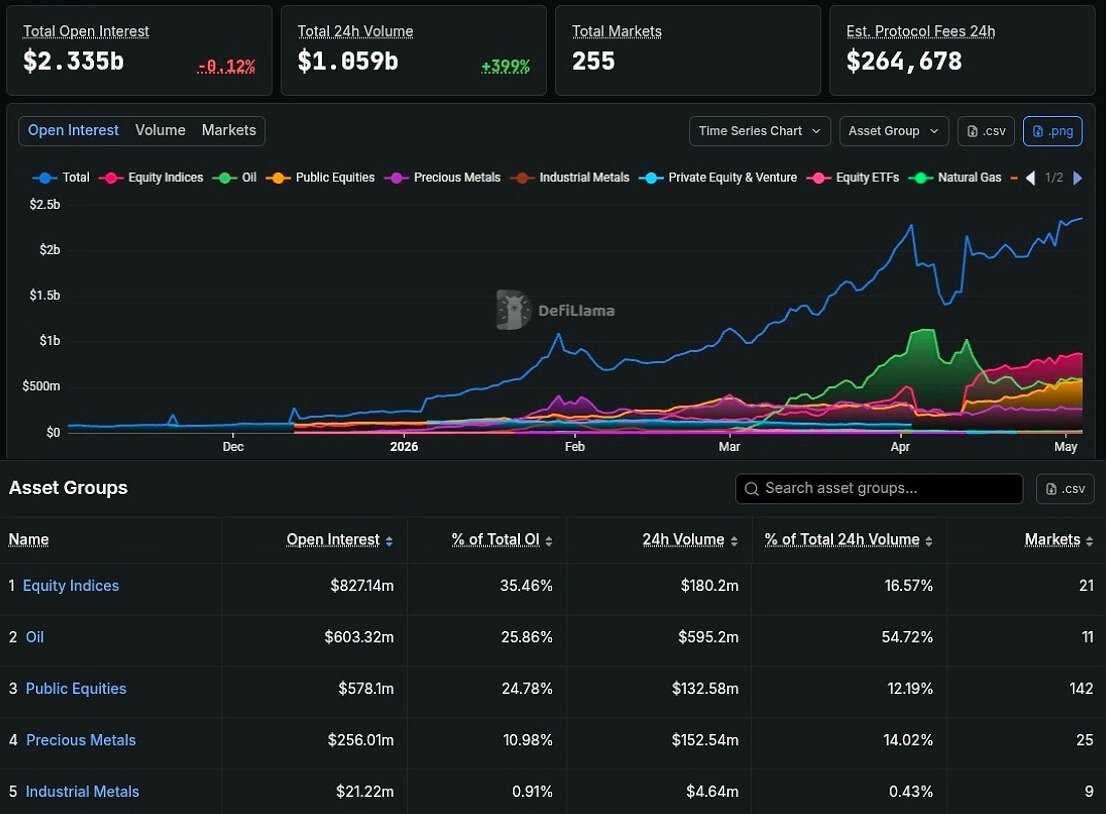
If you are trading a synthetic perp for an illiquid RWA like niche real estate, the basis risk, and potential for oracle manipulation are much higher than holding the actual tokenized deed. A Perp is only as good as its price feed; RWAs perps are light because they only carry the weight of data. ​ Let me elaborate more with these points. >> The onboarding chokepoint: ​ A perp protocol doesn't care who you are; it only cares about your collateral. Compared to tokenized assets, you aren't just interacting with a smart contract; you are interacting with a legal entity. Perps allow global, permissionless access to price action that would otherwise be locked behind a regional legal wall. ​>> Settlement vs. Math: ​Perps usually use synthetic settlement; With this, there is no underlying house or gold bar to move. The profit and loss are settled purely through math and smart contracts; It is a closed loop system that operates at the speed of the block time. ​ >> The custody paradox: Most traders want price exposure. Perps allow you to go long on U.S. treasury yields or London real estate without ever having to worry about the legal accounting or the custody of a security. Investors especially in crypto don't always want to own a share of a London apartment or a barrel of oil. >> Perps allow users to capture the macro trade; let's take for example I can say: I think Japanese real estate is undervalued, without ever needing to understand Japanese property law. >> When it comes to leverage, we all know that crypto natives thrive on volatility. A perp market on gold or crude oil allows for high leverage plays on global events. You cannot easily leverage up a tokenized T-bill without a complex lending protocol; but you can do it instantly with a perp. >> On the side of regulatory arbitrage, RWA Perps can be settled in $USDC or $ETH. As long as there is a reliable oracle like @chainlink or even @PythNetwork and the others providing the price feed, the trade exists entirely in the DeFi ether, making it harder to censor and faster to scale across borders. According to @DefiLlama, the RWAs Perp currently has $2.3B in open Interest, $1.19B in volume, and 255 markets. >> Equity indices is at the top>> open interest: $827.14M, $180.2M in volume. >> Oil >> $603M in open Interest, and $525M in volume. >> Public equities>> $578.1M in open Interest, and 132.5M in volume. >> Precious metals>> $256M in open Interest, and $152.5M in volume. >> Industrial metals>> $21.2M in open Interest, and $4,6M in volume Public equities has the highest market traders rn.
Gracee tweet media
Gracee@0xGraciee

According to @DefiLlama, the RWA Perp market has surpassed $2B in open Interest, with a significant spike in activity today. 24 hour trading volume surged by nearly 200%, reaching $1.8B. Equity Indices and commodities like oil now represent over 64% of the total market share. >> Equity Indices: 34.5% of OI $691M. >> Oil: 30.1% of OI $602M. >> Public Equities: 16.9% of OI $337M. Oil alone saw $1.07B in volume today, more than double its total open interest. The volatility is bringing the traders in droves.

English
4
4
43
888
Muon
Muon@muon_net·
@yaircleper @magmadevs @lavanetxyz When 47% of apps never change the 1/1 default, 'freedom to configure' = freedom to be vulnerable. Muon's DVN uses TSS — validators must reach cryptographic consensus. No single node can forge a valid signature.
English
1
4
9
97
Cleper 🌋
Cleper 🌋@yaircleper·
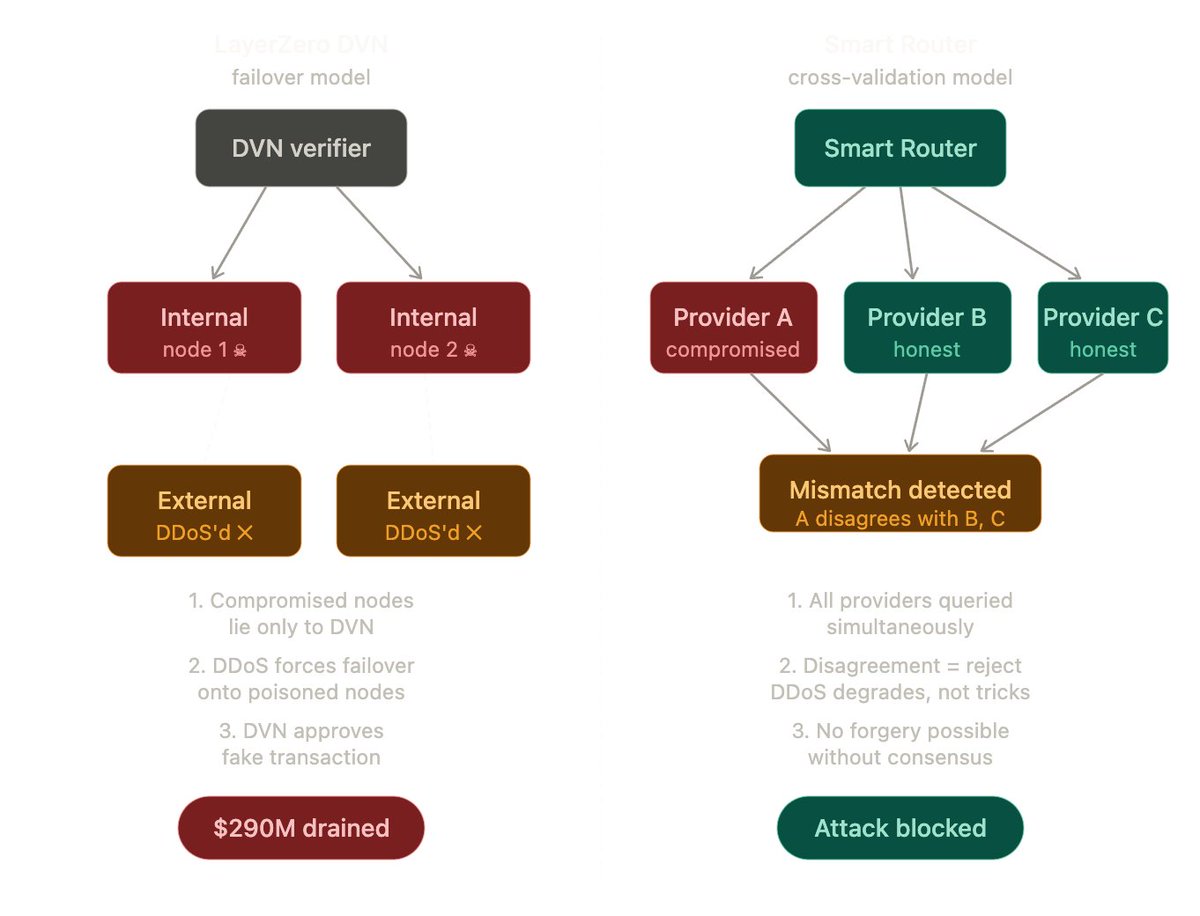
The $290m KelpDAO hack wasn't just a config failure. It exposed a fundamental architectural gap in how cross-chain RPCs work. Here's what actually happened and why it matters for every protocol relying on LayerZero-style infrastructure 🧵 LayerZero's DVN did have external providers. That's not the issue. The issue: the architecture uses failover. So when the attacker DDoS'd the external nodes, traffic rotated to the two internal nodes they'd already compromised. No mechanism required multiple providers to agree in parallel. Just rotate and trust. Have you ever heard about secured RPC? Concurrent reads across independent providers. Disagreement = reject. Period. DDoS a subset? You degrade latency. In this way, you never push bad data through- the honest providers still respond. Failover is not redundancy. Cross-validation is.
Cleper 🌋 tweet media
English
1
3
9
1.9K
Muon
Muon@muon_net·
@battista212 1-of-1 multisigs are a centralization time bomb. Distributed validator networks using threshold signatures eliminate this single point of failure. Cross-chain verification needs decentralization at the proof layer, not just messaging.
English
1
0
4
134
Michael Martino
Michael Martino@battista212·
DeFi United rescued Kelp DAO's rsETH after a North Korean exploit drained Aave — but the fix exposed a bigger problem: over 40% of LayerZero bridges run on 1-of-1 multisigs. Heroic bailouts can't replace actual infrastructure. #DeFi #crypto
Michael Martino tweet media
English
2
0
0
161
Muon
Muon@muon_net·
@hodlturk Agreed on atomicity. Muon TSS-based cross-chain verification delivers chain-agnostic proofs without relying on off-chain observers as trusted intermediaries. The validation layer itself needs to be decentralized, not just the bridge.
English
0
1
9
104
Muon
Muon@muon_net·
@arbitrum Congrats to the cohort! @CarbonTerminal's 750+ markets are powered by Muon's decentralized validation, securing every trade on Arbitrum 🫡
English
7
5
16
717
Arbitrum
Arbitrum@arbitrum·
Welcome the 1st Cohort of the Arbitrum Mentorship Program. Out of 900+ applicants, 13 teams across AI, payments, RWAs and emerging DeFi were selected for an 8-week program to launch new products on the Arbitrum Platform. Meet the teams building the programmable economy. 👇
Arbitrum tweet media
English
35
57
336
49.1K
Muon
Muon@muon_net·
@Altcoinbuzzio $270T in RWAs won't run on raw price feeds alone. NAV calcs, audit proofs, compliance checks — all need verified off-chain logic. Muon micro-validators enable custom validation with chain-agnostic cryptographic proofs. One integration, every chain.
English
0
0
2
69
Altcoin Buzz
Altcoin Buzz@Altcoinbuzzio·
$270 TRILLION OF REAL-WORLD ASSETS ARE MOVING ONCHAIN THIS DECADE. The question isn't if. It's which protocol gets the lion's share. Pick ONE to hold for 5 years. No hedges. No "I'd buy a basket." One answer. $LINK : the oracle monopoly, Big-4 audited, powers 70% of DeFi $ONDO : 80% of tokenized stocks, first mover, Treasury rails $HBAR : 31 Fortune 500 council, #1 RWA dev activity $PLUME : native compliance, 3,000x cleaner than average $AVAX : BlackRock, Citi, JPM, Franklin Templeton already building $XLM : Société Générale, MoneyGram, Franklin Templeton live Drop your pick below and defend it in one sentence.
Altcoin Buzz tweet mediaAltcoin Buzz tweet mediaAltcoin Buzz tweet mediaAltcoin Buzz tweet media
English
61
88
480
20K
Muon
Muon@muon_net·
@goatv_bk Exactly this. The attack surface exists because most oracles share a single validation layer. Muon flips that — each dApp gets its own oracle (MuonApp) with custom validation logic, backed by threshold signatures from a decentralized node network.
English
0
0
5
104
Gauthier | Zyfai ⬆️🇨🇭
Smart contract exploits, admin key compromises, oracle manipulation. The attack surface is massive. This is why institutions usually won’t touch DeFi yield at scale. One exploit can wipe out everything. You need infra that monitors risk in real-time, verifies execution, and pulls capital before disaster strikes.
Gauthier | Zyfai ⬆️🇨🇭@goatv_bk

Every DeFi hack this cycle reinforces @Zyfai_ core differentiation. Yield is easy. Secure yield? Not so much. Most yield in DeFi comes with hidden risk.

English
1
4
18
433
Muon
Muon@muon_net·
Hot take: if your protocol's risk model depends on a single oracle operator not making a mistake, you don't have a risk model. Threshold signatures exist for a reason.
English
1
8
25
1.1K
Muon
Muon@muon_net·
Web3 has a trustless frontend. A trustless database. But the backend? You're still trusting someone. That's the gap.
English
2
7
24
908
Muon
Muon@muon_net·
Web3 infrastructure is inefficient by design. Why maintain separate oracle networks for separate chains when one validation layer could serve them all? Universal infrastructure vs. fragmented networks: medium.com/p/5883833ec596…
English
1
13
30
1.5K
Muon
Muon@muon_net·
Every dApp hits the same wall: Smart contracts can't make API calls. You need weather data? Price feeds? Verification? You're stuck between decentralized OR functional. Never both. Until now. How Muon Micro-Validators solve web3's biggest problem: medium.com/p/8f133dfe2735…
English
1
15
28
740
Muon
Muon@muon_net·
One oracle network. Every blockchain. While others build separate integrations for each chain, Muon validators work universally. ✅ Ethereum ✅Polygon ✅BSC ✅Arbitrum ✅[Any EVM chain] Universal infrastructure > fragmented solutions.
English
2
10
33
543