
Nevernot🌱💙.one retweetledi

💫What if “spin-½” isn’t magic, but mechanics?
In mainstream physics, spin-½ is a quantum mystery. We’re told particles like the electron have this bizarre property—not because of any internal structure or motion, but because “that’s just how nature is.” The Standard Model treats it as an input, not an output.
Unified Spacetime Theory (UST) says that’s not enough.
In UST, everything—mass, charge, fields, even space itself—emerges from the dynamics of a real, elastic continuum. The only fundamental field is a 4D displacement field ξ^μ(x). Particles are not point-objects. They are localized, topologically stable vibration modes—solitons—in this underlying elastic spacetime fabric.
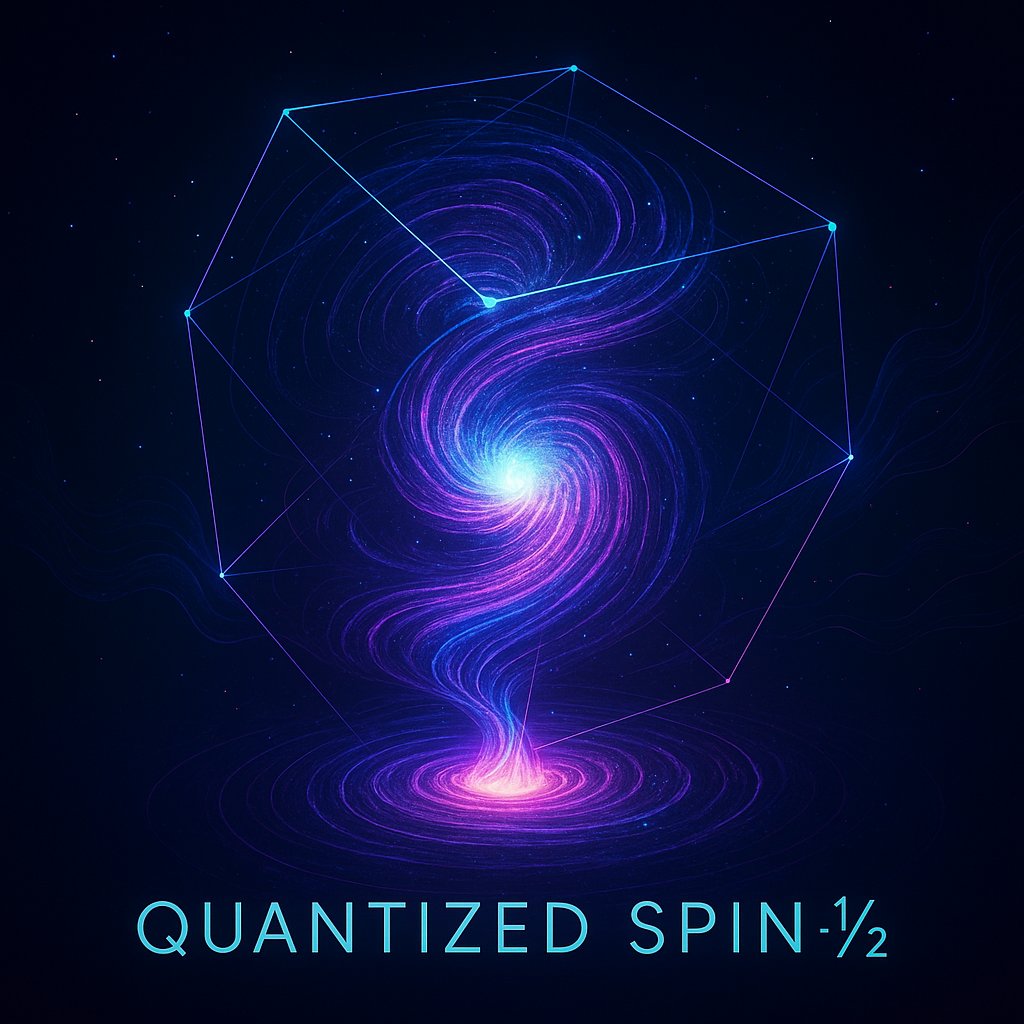
Here’s the wild part: in this model, torsional modes confined in 3D space (think standing waves with internal twist) naturally carry quantized angular momentum. When we apply the continuum’s spin tensor and integrate over the mode’s configuration, the result isn’t arbitrary—it’s exactly ħ/2.
No hand-waving. No assumptions about "quantum-ness." Just nonlinear continuum mechanics + topological constraint = quantized spin.
This is not a metaphor. It’s a calculation. Spin-½ isn’t put in—it comes out.
What’s more: the stability of these solitons, their discrete energy spectra, and the emergence of fundamental constants (like ħ and α) all arise from the same principle: the strain-dependent softening of spacetime, governed by UST’s Saturation Constant Γ.
This isn't an analogy for spin. It’s a mechanical origin for it. The first fully physical explanation for why nature chooses this strange, beautiful half-integer behavior.
UST doesn’t just unify forces—it aims to explain the very quantization of matter itself.
— #UnifiedSpacetimeTheory #SpinHalf #Physics #QuantumFoundations #ElasticSpacetime #FirstPrinciples
English