Onchain Culture

35 posts

Onchain Culture banner
Onchain Culture

Onchain Culture

@onchainculture_

Systemic risk starts with cultural drift. We measure it first.

Katılım Eylül 2025
0 Takip Edilen2 Takipçiler
Sabitlenmiş Tweet
Onchain Culture
Onchain Culture@onchainculture_·
Culture Protocol is a risk intelligence system that analyzes governance behavior, decision-making patterns and organizational signals to detect technical, financial & cultural failure conditions early. Onchain culture is the consultancy implementing it.
English
1
0
3
977
Onchain Culture retweetledi
Swati
Swati@0xswaeth·
Why do projects with good fundamentals still fail ? Why does an industry moving trillions have no risk intelligence framework? Why does crypto promise trust & privacy but deliver almost none ? Why does the industry want adoption but doesn't understand its own users ? I may not know what works. But I definitely know what doesn't. A year ago, I started digging , the gold mine of crypto is its failed projects. 20 of them .Funded, real teams, working products ,hundreds of millions lost . The industry runs the same autopsy every time - UX, tokenomics , regulations, market conditions. But those problems existed 5 years ago. They're still here . The excuse isn't the reason. So I looked for what was actually constant . Across every failed project "mission" was a constant variable, & how it works is a pattern to study. Mission acts like an anchor & the most fascinating thing about culture is that it forms around your mission naturally , without you even realising it. A project built to extract , its culture serves the outcome . Everytime without anyone planning it. The ones that failed didn't collapse overnight . They drifted .Slowly . Then all at once . Teams lost alignment, decisions stopped matching the original mission .Communities fragmented and that drift didn't stay contained ,it spread . Team first, then capital and then product. At some point culture stops being an abstract layer & becomes systemic risk .It has cascading effects once it drifts from the mission . I ran culture audits on @ethereum , @solana ,@Bitcoin..to test if the pattern is real. Published the Ethereum audit in August 2025. Called out fragmention , narrative drift , a weakening center. 2 months later @VitalikButerin went on stage and said almost the same thing at Devconnect. No crazy claims here, I'm saying the signals were there in the culture before it became a technical conversation. That's what Culture Protocol is built to measure . Everyone said you can't quantify culture - it's too abstract . So I focused only on what's constant . Mission alignment .how drift spreads . Where it shows up first . Most people find out their project is dying when it's already dead. Culture shows the mirror before the market does. That's what I'm building - @onchainculture_ , a consultancy running these audits and culture protocol is the framework underneath it.
English
1
1
3
605
Onchain Culture
Onchain Culture@onchainculture_·
@VitalikButerin Interesting framing.When you step back & look at protocols from first principles,the mission tends to shape culture around it & that culture eventually influences governance,engineering & economic design.Over time system simply reflect what its mission-led culture prioritizes
English
0
0
0
305
vitalik.eth
vitalik.eth@VitalikButerin·
I was recently at Real World Crypto (that's crypto as in cryptography) and the associated side events, and one thing that struck me was that it was a clarifying experience in terms of understanding *what blockchains are for*. We blockchain people (myself included) often have a tendency to start off from the perspective that we are Ethereum, and therefore we need to go around and find use cases for Ethereum - and generate arguments for why sticking Ethereum into all kinds of places is beneficial. But recently I have been thinking from a different perspective. For a moment, let us forget that we are "the Ethereum community". Rather, we are maintainers of the Ethereum tool, and members of the {CROPS (censorship-resistant, open-source, private, secure) tech | sanctuary tech | non-corposlop tech | d/acc | ...} community. Going in with zero attachment to Ethereum specifically, and entering a context (like RWC) where there are people with in-principle aligned values but no blockchain baggage, can we re-derive from zero in what places Ethereum adds the most value? From attending the events, the first answer that comes up is actually not what you think. It's not smart contracts, it's not even payments. It's what cryptographers call a "public bulletin board". See, lots of cryptographic protocols - including secure online voting, secure software and website version control, certificate revocation... - all require some publicly writable and readable place where people can post blobs of data. This does not require any computation functionality. In fact, it does not directly require money - though it does _indirectly_ require money, because if you want permissionless anti-spam it has to be economic. The only thing it _fundamentally_ requires is data availability. And it just so happened that Ethereum recently did an upgrade (PeerDAS) to increase the amount of data availability it provides by 2.3x, with a path to going another 10-100x higher! Next, payments. Many protocols require payments for many reasons. Some things need to be charged for to reduce spam. Other things because they are services provided by someone who expends resources and needs to be compensated. If you want a permissionless API that does not get spammed to death, you need payments. And Ethereum + ZK payment channels (eg. ethresear.ch/t/zk-api-usage… ) is one of the best payment systems for APIs you can come up with. If you are making a private and secure application (eg. a messenger, or many other things), and you do not want to let people to spam the system by creating a million accounts and then uploading a gigabyte-sized video on each one, you need sybil resistance, and if you care about security and privacy, you really should care about permissionless participation (ie. don't have mandatory phone number dependency). ETH payment as anti-sybil tool is a natural backstop in such use cases. Finally, smart contracts. One major use case is _security deposits_: ETH put into lockboxes that provably get destroyed if a proof is submitted that the owner violated some protocol rule. Another is actually implementing things like ZK payment channels. A third is making it easy to have pointers to "digital objects" that represent some socially defined external entity (not necessarily an RWA!), and for those pointers to interact with each other. *Technically*, for every use case other than use cases handling ETH itself, the smart contracts are "just a convenience": you could just use the chain as a bulletin board, and use ZK-SNARKs to provide the results of any computations over it. But in practice, standardizing such things is hard, and you get the most interoperability if you just take the same mechanism that enables programs to control ETH, and let other digital objects use it too. And from here, we start getting into a huge number of potential applications, including all of the things happening in defi. --- So yes, Ethereum has a lot of value, that you can see from first principles if you take a step back and see it purely as a technical tool: global shared memory. I suspect that a big bottleneck to seeing more of this kind of usage is that the world has not yet updated to the fact that we are no longer in 2020-22, fees are now extremely low, and we have a much stronger scaling roadmap to make sure that they will continue to stay low, even if much higher levels of usage return. Infrastructure for not exposing fee volatility to users is much more mature (eg. one way to do this for many use cases is to just operate a blob publisher). Ethereum blobs as a bulletin board, ETH as an asset and universal-backup means of payment, and Ethereum smart contracts as a shared programming layer, all make total sense as part of a decentralized, private and secure open source software stack. But we should continue to improve the Ethereum protocol and infrastructure so that it's actually effective in all of these situations.
English
411
380
2K
298.4K
Onchain Culture
Onchain Culture@onchainculture_·
This is why designing protocols is also a cultural design problem. The mission shapes culture. And culture ultimately shapes the system. In the long run: Protocols become what their mission-led culture prioritizes.
English
0
0
2
39
Onchain Culture
Onchain Culture@onchainculture_·
If a mission attracts speculation ➡️ culture amplifies speculation. If a mission attracts builders ➡️ culture compounds innovation. Over time the system simply reflects what its mission-led culture optimizes for.
English
1
0
3
46
Onchain Culture
Onchain Culture@onchainculture_·
Most protocols try to design tokenomics first. But the real foundation of a protocol starts earlier with mission & the systems that survive long term are usually mission-led cultures.
English
1
1
3
71
Onchain Culture
Onchain Culture@onchainculture_·
How Systems Escape Cultural Lock-In There are a few ways. 1. Change incentives 2. Change participant composition 3. Structural safeguards
English
0
0
2
65
Onchain Culture
Onchain Culture@onchainculture_·
Why? Because the community identity is already formed. So misalignment becomes locked into the system making course correction difficult.
English
1
0
2
64
Onchain Culture
Onchain Culture@onchainculture_·
#4 Culture Momentum : Lock-in means a system becomes stuck in a pattern even when it is no longer optimal.Example: If a protocol becomes known for high yields, community likely attracts: ➡️yield farmers/ speculators Now even if governance tries to change direction: People resist
English
1
0
2
81
Onchain Culture
Onchain Culture@onchainculture_·
So: Culture determines which amplifiers exist.Stress amplifiers are system features that make problems grow faster. Think of them like fuel on a fire. Example: leverage, if Small price drop then leverage ➡️liquidations /bigger price drop/more liquidations That’s cascade amplifier
English
0
0
2
77
Onchain Culture
Onchain Culture@onchainculture_·
#3 Culture's Role in Stress Amplifiers Culture decides whether amplifiers are introduced into the system. Example: If your culture rewards high yield then developers likely create: risky tokenomics + leverage incentives. Those become stress amplifiers.
English
1
1
2
145
Onchain Culture
Onchain Culture@onchainculture_·
If culture stays aligned with the mission, it acts like a stability layer. Misaligned behavior spreads into the next layers. Over time, small distortions compound across layers until the system becomes fragile. At that point, a single trigger can cause rapid cascading failure.
English
0
0
2
60
Onchain Culture
Onchain Culture@onchainculture_·
#2 How Culture Can Stop Cascading Losses In this model, culture sits right after mission. This means culture influences: the next layers. The outcomes a system produces eventually reflect what its mission-led culture prioritizes.
Onchain Culture@onchainculture_

SYSTEMIC RISK BEFORE SYSTEM FAILURE happens. Core insight of the diagram : System failures are the final outcome of earlier cultural & governance misalignments. Read The Culture Cascade Model👇

English
1
1
2
114
Onchain Culture
Onchain Culture@onchainculture_·
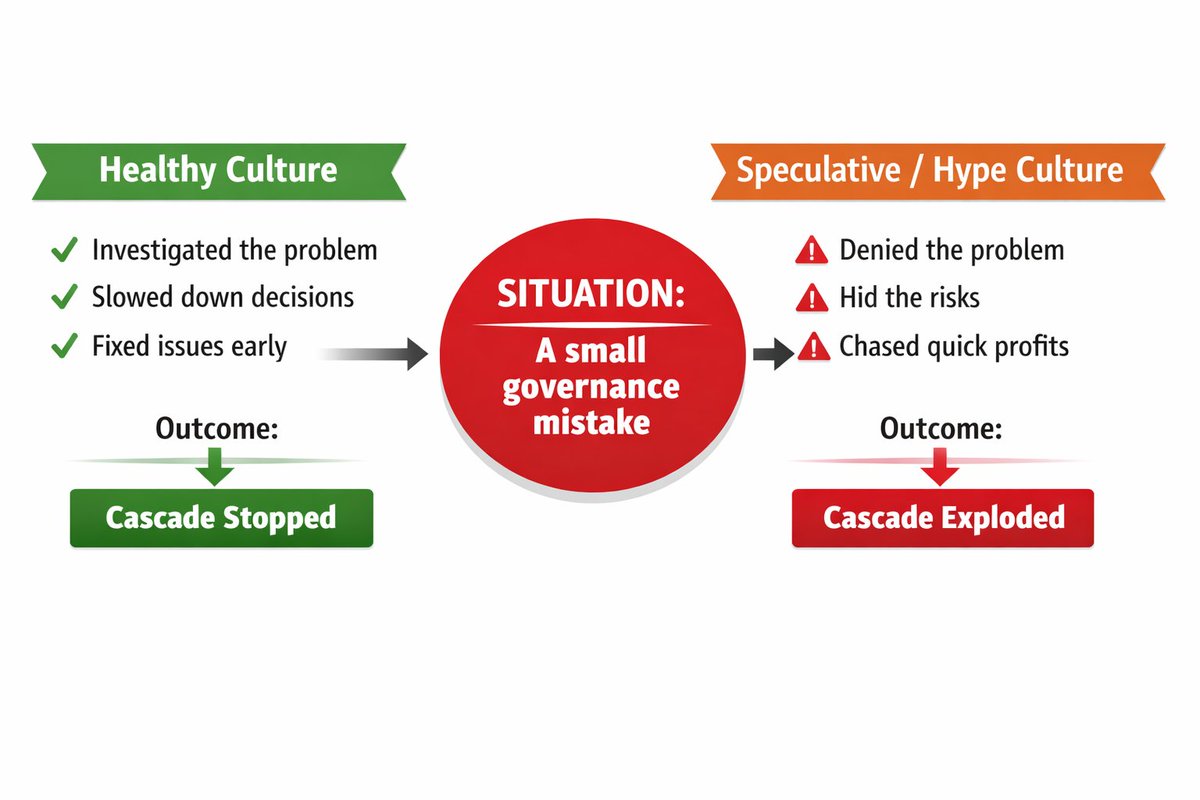
The catch: Same situation. Same mistake. But culture created completely different outcomes.
English
0
0
2
58
Onchain Culture
Onchain Culture@onchainculture_·
#1 The biggest losses are usually non-linear cascades. Think of it like this: The causes move layer-by-layer (linear path), but the effects interact (non-linear results). Small cause ➡️ huge effect. Culture controls whether cascades stop or explode.
Onchain Culture tweet media
Onchain Culture@onchainculture_

SYSTEMIC RISK BEFORE SYSTEM FAILURE happens. Core insight of the diagram : System failures are the final outcome of earlier cultural & governance misalignments. Read The Culture Cascade Model👇

English
1
1
2
93