
Sabitlenmiş Tweet
Priyanka
24.2K posts


Priyanka
@prinstaz
Sr. Advisor on Global Risks & Security, Geopolitics, Sustainability l Data & Tech-led Intelligence l Institutions & Boards l Independent Director
Global Katılım Mart 2019
394 Takip Edilen11.9K Takipçiler

Priyanka retweetledi

Iran’s Foreign Ministry spokesperson says: “I understand that the world economy is impacted by what is going on in our region, but this is not our fault. You are concerned about the price of oil, the price of groceries, but we are concerned about the life of our citizens.”
This framing by Iran is deeply disingenuous. Iran is being a ‘bad faith actor’ by deliberately leveraging the Strait of Hormuz – through threats, attacks, and harassment – to exert pressure on the global economy and inflict pain on millions of civilians and seafarers who have no role in the conflict. While targeting the war effort of parties to an armed conflict has a limited legal basis under the law of naval warfare, attacks on neutral merchant ships and crews are clearly illegal under international law.
Under the well‑established regime for straits used for international navigation, Iran has no legal right to “close” or otherwise block the Strait of Hormuz to foreign shipping. The Strait is an international chokepoint through which roughly a fifth of globally traded oil and a major share of LNG flows, including a substantial portion of India’s crude imports and energy lifeline. Any attempt to impede transit passage, especially by attacking neutral shipping, violates the law of the sea and the protections owed to neutral states and civilian mariners.
Indian citizens and seafarers are already being directly affected by these unlawful Iranian actions. Indian Govt has handled the crisis well till now through strategic restraint and quiet diplomacy. The measured approach has yielded short term results with Iran allowing passage of India bound energy supplies on case to case basis. However, India remains highly vulnerable to Iranian actions and conduct.
It is therefore entirely appropriate – indeed necessary – that Iran’s conduct is called out by the Government of India in behind the scene diplomacy and subjected to greater scrutiny by the Indian media. India must also maintain a strong, visible and sustained naval presence in and around the Strait of Hormuz to protect Indian lives, shipping, and energy flows.
This is not a short‑term irritant but a structural challenge to India’s energy security and economic stability. The “Hormuz Dilemma” for India cannot be left to ad‑hoc crisis management; it must be addressed now, through deft diplomacy, clear strategic red lines, robust maritime security posture, and long‑term diversification of energy routes and sources, to safeguard our interests for decades to come.
@DrSJaishankar @MEAIndia @indiannavy
English
Maj Gen Randy Manner is on point! 🎯
MAGA Cult Slayer🦅🇺🇸@MAGACult2
“Those are the words of a potential war criminal.”
English
Priyanka retweetledi
‘On our watch’ is incorrect. As long as the Iranian Naval ship was part of the International Fleet Review and in Indian territorial waters, it was our responsibility to take care of it. The moment the event was over and the ship left Indian territorial waters, it was in International waters with complete freedom of movement and responsibility for own security.
Calling international waters South of Sri Lanka as our ‘oceanic backyard’ is short-sighted and concedes South China Sea to be ‘Chinese Backyard’. This kind of mindset goes against the concept of ‘Freedom of Seas’ on which a stable International Maritime Law has been established under ‘United Nations Convention on Law of Seas 1982 (UNCLOS)’ after years of discussions.
The loss of lives on a ship which had visited India is certainly very sad but let’s not self inflict punishment where none is due.
Shiv Aroor@ShivAroor
A Feb 17 tweet by India’s Eastern Naval Command. 2 weeks later, IRIS Dena lies on the sea bed. On our watch, in our oceanic backyard. A 100 sailors who marched in Visakhapatnam on Feb 19, now at the bottom of the sea. On our watch, in our oceanic backyard.
English

"Its so unsafe!"
"Swimming in sea water is bad!"
"This is hazing ... all naval sea(wo)men are compulsorily trained swimmers. Why is this needed!"
Did the usual Indian handles start off their wailing yet? All to get the traction?
SILENT BRIEF@SilentBriefHQ
Rare video of Indian submariners undertaking compulsory ocean swimming! Instructor ensuring everyone jumps
English


BREAKING: Iran fired ballistic missiles at Tel Aviv overnight using cluster munitions. Process what that means.
A conventional warhead hits one point. A cluster warhead releases dozens of submunitions, each weighing 2 to 5 kilograms of high-explosive fragmentation, scattering across a wide area after re-entry. One missile becomes dozens of weapons. The fire rate has collapsed from 90 missiles per day on Day 1 to approximately 10 on Day 24. Iran has 140 launchers remaining. The mathematics of 10 missiles per day sounds manageable until each missile contains a warhead that multiplies into dozens of independent kill zones across a city.
Overnight impacts confirmed in the Tel Aviv and Ramat Gan area. Sirens across central Israel. Kiryat Shmona hit again in the north. Damage to buildings. Injuries reported. Magen David Adom responding. The IDF confirms cluster submunitions were deployed. Footage shows dispersal patterns consistent with Khorramshahr-4 warheads, each carrying 1,500 kilograms at Mach 8 to 16 with MIRV-capable cluster dispensers.
Israel’s multi-layered defence is designed to intercept the parent missile before dispersal. Iron Dome handles short and medium range. David’s Sling covers the intermediate gap. Arrow-2 and Arrow-3 engage ballistic threats at altitude. The strategy works when the intercept happens above the dispersal altitude. When it does not, when a missile penetrates the outer layers and reaches its terminal phase, the submunitions scatter and no system can intercept dozens of 2-kilogram bomblets falling across a residential area simultaneously.
Iran has lost 70 percent of its launchers. Its fire rate is 89 percent lower than Day 1. Its navy is destroyed. Its air force is gone. And it is still putting cluster munitions over Tel Aviv. That is not desperation. That is adaptation. Iran cannot match the volume of Day 1. So it changed the payload. Fewer missiles, each one carrying more weapons inside it. The fire rate declined. The lethality per round increased. The shift from conventional to cluster warheads is Iran compensating for launcher attrition with warhead complexity. The arithmetic of the war just changed from “how many missiles” to “how many submunitions per missile.”
This is what makes the electricity ledger so dangerous. Iran has publicly absorbed strikes on hospitals, schools, and emergency centres without reciprocating against equivalent Israeli civilian infrastructure. It is conserving its 140 remaining launchers for the one target category it has reserved: electricity. If the 5-day power-plant pause collapses Saturday and Trump executes his threat, those 140 launchers will fire cluster-armed Khorramshahr-4s at Gulf and Israeli power stations, desalination plants, and grid nodes. A single cluster warhead detonating over a transformer yard does not damage it. It saturates it with dozens of bomblets that destroy equipment across the entire facility footprint. Cluster munitions are not designed for military targets. They are designed for area denial. And a power grid is the ultimate area target.
Saturday is four days away. The launchers are armed with cluster warheads. The ledger is open. The targets are named. The only thing standing between the cluster munitions and the grid is a 5-day pause announced on a social media platform that Iran says does not correspond to any agreement it has made.
open.substack.com/pub/shanakaans…
English
Here’s another jaw-dropping 500-word AI-generated thriller post on defence!
This reads nothing short of a rejected Sri Lankan cinema script where the bad guys have perfect intel on exact launcher counts, submunition weights, and a dreamy magical warfare “pause” that only exists on social media for some reason!
Shanaka Anslem Perera ⚡@shanaka86
BREAKING: Iran fired ballistic missiles at Tel Aviv overnight using cluster munitions. Process what that means. A conventional warhead hits one point. A cluster warhead releases dozens of submunitions, each weighing 2 to 5 kilograms of high-explosive fragmentation, scattering across a wide area after re-entry. One missile becomes dozens of weapons. The fire rate has collapsed from 90 missiles per day on Day 1 to approximately 10 on Day 24. Iran has 140 launchers remaining. The mathematics of 10 missiles per day sounds manageable until each missile contains a warhead that multiplies into dozens of independent kill zones across a city. Overnight impacts confirmed in the Tel Aviv and Ramat Gan area. Sirens across central Israel. Kiryat Shmona hit again in the north. Damage to buildings. Injuries reported. Magen David Adom responding. The IDF confirms cluster submunitions were deployed. Footage shows dispersal patterns consistent with Khorramshahr-4 warheads, each carrying 1,500 kilograms at Mach 8 to 16 with MIRV-capable cluster dispensers. Israel’s multi-layered defence is designed to intercept the parent missile before dispersal. Iron Dome handles short and medium range. David’s Sling covers the intermediate gap. Arrow-2 and Arrow-3 engage ballistic threats at altitude. The strategy works when the intercept happens above the dispersal altitude. When it does not, when a missile penetrates the outer layers and reaches its terminal phase, the submunitions scatter and no system can intercept dozens of 2-kilogram bomblets falling across a residential area simultaneously. Iran has lost 70 percent of its launchers. Its fire rate is 89 percent lower than Day 1. Its navy is destroyed. Its air force is gone. And it is still putting cluster munitions over Tel Aviv. That is not desperation. That is adaptation. Iran cannot match the volume of Day 1. So it changed the payload. Fewer missiles, each one carrying more weapons inside it. The fire rate declined. The lethality per round increased. The shift from conventional to cluster warheads is Iran compensating for launcher attrition with warhead complexity. The arithmetic of the war just changed from “how many missiles” to “how many submunitions per missile.” This is what makes the electricity ledger so dangerous. Iran has publicly absorbed strikes on hospitals, schools, and emergency centres without reciprocating against equivalent Israeli civilian infrastructure. It is conserving its 140 remaining launchers for the one target category it has reserved: electricity. If the 5-day power-plant pause collapses Saturday and Trump executes his threat, those 140 launchers will fire cluster-armed Khorramshahr-4s at Gulf and Israeli power stations, desalination plants, and grid nodes. A single cluster warhead detonating over a transformer yard does not damage it. It saturates it with dozens of bomblets that destroy equipment across the entire facility footprint. Cluster munitions are not designed for military targets. They are designed for area denial. And a power grid is the ultimate area target. Saturday is four days away. The launchers are armed with cluster warheads. The ledger is open. The targets are named. The only thing standing between the cluster munitions and the grid is a 5-day pause announced on a social media platform that Iran says does not correspond to any agreement it has made. open.substack.com/pub/shanakaans…
English

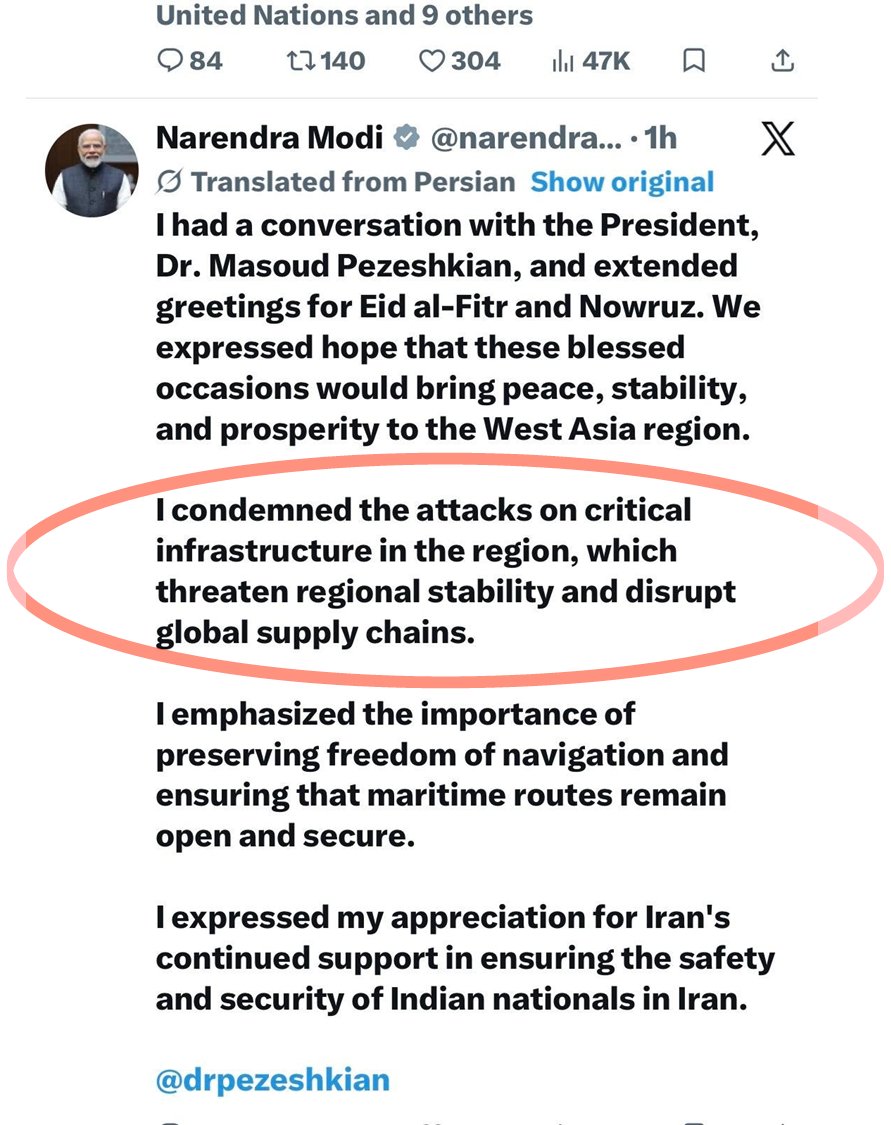
Playing it both ways. The irony is that both sides know he is playing it both ways.
English
There’s only one side PM MODI is taking. That side is called INDIA!
Anas Alhajji@anasalhajji
Playing it both ways. The irony is that both sides know he is playing it both ways.
English


@prinstaz hey say confession is good for the soul ;p
speak your mind
English

President Trump never had control over this war.
Piers Morgan@piersmorgan
Trump is losing control of this war.
English

I like how Narendra Modi's social media feed continues to exist in like a parallel, more normal universe.
Narendra Modi@narendramodi
The Union Cabinet has approved the Small Hydro Power Development Scheme, which will boost clean energy, attract investments and create employment across rural and remote regions. The Northeast in particular will gain significantly from the scheme. pib.gov.in/PressReleasePa…
English