Pundit100 retweetledi
Pundit100
1.4K posts

Pundit100 retweetledi

Ezekiel was asked by God, “Can these dry bones live again?”
He didn’t argue. He simply said, “Sovereign Lord, You alone know.”
Then God told him: “Prophesy to them.”
Truly, words are seeds.
What you speak over your life matters.
Speak life into your goals.
Speak peace into your mind.
Speak hope into your future.
Even dry bones can rise again.
Don’t just survive, prophesy to your own life.
English
Pundit100 retweetledi

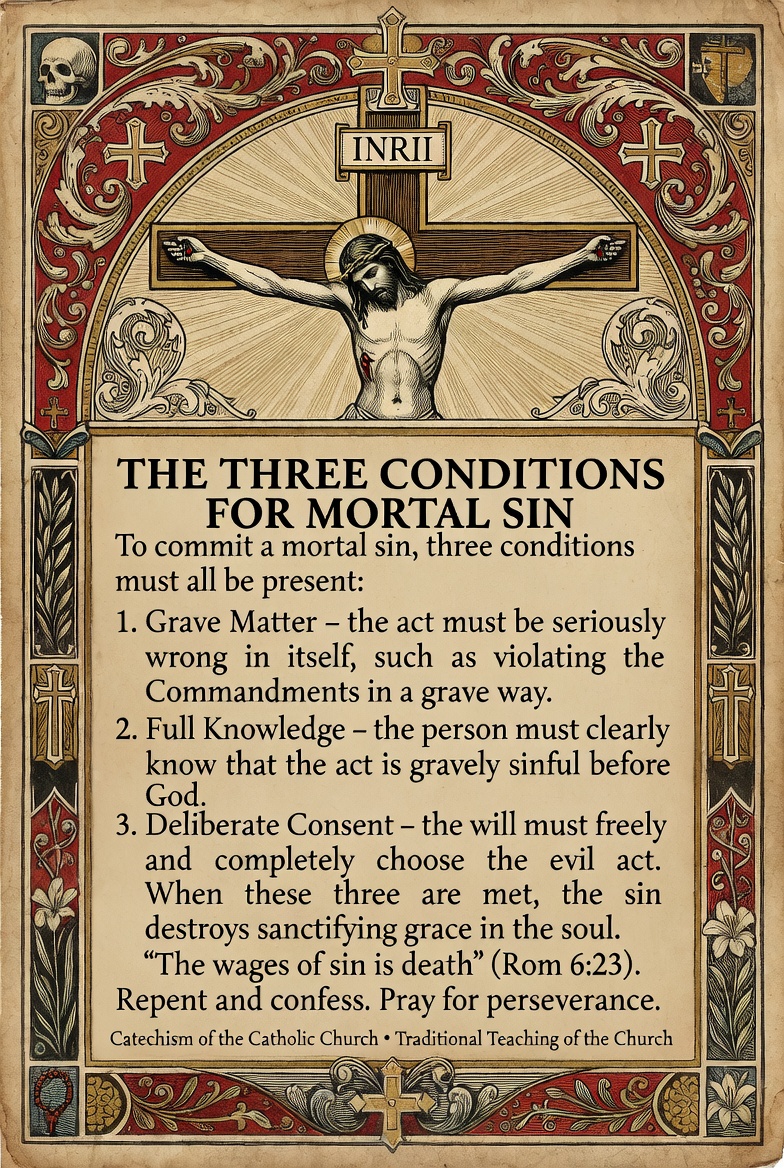
To commit a mortal sin, three precise conditions must all be present at the same time. The absence of even one of these conditions reduces the act to a venial sin or renders it no sin at all. These conditions are drawn from the longstanding moral theology of the Church, rooted in Scripture, Tradition, and the Catechism of the Catholic Church.
The first condition is that the matter of the act must be gravely wrong in itself, that is, it must concern something that is seriously contrary to the moral law. Grave matter includes actions such as deliberate homicide, adultery, fornication, blasphemy, perjury, serious theft, deliberate hatred of God or neighbor, missing Mass on Sundays and holy days of obligation without a serious reason, and other acts that directly violate the Ten Commandments in a significant way. The gravity is determined by the object of the act—what the person is choosing to do—not merely by the consequences or the subjective feelings involved. The Church teaches that some actions are intrinsically evil, meaning they are wrong by their very nature regardless of circumstances or intentions. When a person freely chooses such a grave matter, the first requirement for mortal sin is met.
The second condition is full knowledge. The person must have a clear awareness that what he or she is about to do is gravely sinful. This means the individual must know both the moral wrongness of the act and its serious character before God. Ignorance can diminish or even remove culpability, but the ignorance in question must be invincible—that is, the person could not reasonably have known better despite sincere effort. Feigned ignorance, where someone deliberately avoids learning the truth to excuse wrongdoing, does not lessen guilt; in fact, it can increase it. Similarly, affected ignorance, chosen to escape responsibility, fails to excuse. True full knowledge requires that the intellect clearly perceives the grave moral evil before the will consents to it.
The third and final condition is deliberate consent of the will. The person must freely and completely choose to perform the gravely wrong act with full awareness. This consent must be free from substantial external coercion or internal compulsion that destroys freedom. While strong emotions, habits, fear, or psychological pressures can lessen freedom and therefore culpability, they do not automatically remove it unless they render the act involuntary. For mortal sin, the will must give its complete and unreserved assent to the evil proposed. A half-hearted or reluctant agreement, where the person is still struggling against the temptation and would prefer not to sin, does not meet the threshold of full consent. Mortal sin requires that the person says “yes” to the grave evil with the whole heart, deliberately turning away from God in a fundamental way.
When all three conditions—grave matter, full knowledge, and deliberate consent—are simultaneously verified, the sin is mortal. Mortal sin is called “mortal” because it destroys the supernatural life of grace in the soul, severing the relationship with God and making one worthy of eternal separation from Him if one dies unrepentant. It is a radical rejection of God’s love and friendship. Venial sins, by contrast, wound charity but do not destroy it; they weaken the soul’s union with God without breaking it entirely. Even venial sins should be taken seriously, as they dispose the soul toward more serious falls and hinder growth in holiness.
Catholic moral theology emphasizes that these conditions must be evaluated with prudence and honesty before God. No one can judge the interior state of another with certainty, but each person is called to examine his or her own conscience carefully, especially before receiving any of the sacraments of the living, especially Holy Communion.
The remedy for mortal sin is sincere repentance and sacramental confession, through which the grace of justification is restored. The Church offers, by the direct will of Christ, the Sacrament of Penance precisely because human beings fall and need God’s mercy, which is always greater than any sin when received with humble and contrite hearts.
In daily life, the faithful are encouraged to cultivate a well-formed conscience through prayer, study of Scripture and Church teaching, frequent reception of the sacraments, and spiritual direction when needed. Regular self-examination helps one recognize when an act might approach grave matter and guards against the subtle erosion of freedom or knowledge that can lead to serious sin.
Ultimately, the Church's teaching on mortal sin underscores both the dignity of human freedom and the gravity of our choices: we are capable of truly choosing for or against God, and our eternal destiny depends on the direction of that freedom, sustained by His grace.

English
Pundit100 retweetledi

If the Eucharist is just a symbol, then Aquinas wasted his life.
So did Augustine. Francis. Thérèse. John Paul II. Mother Teresa.
The entire Catholic intellectual and spiritual tradition is built on a single claim:
This is really Him.
Either it's true, or the brightest minds in Western history were fooled by bread.
There is no third option.

English
Pundit100 retweetledi