Computational linguist & AI expert Shalom Lappin presents a brief but substantive history of Zionism (no, it was not "settler colonialism"), and an analysis of the only contemporary movement to extinguish an existing nation-state (with a likely ethnic cleansing or genocide of its citizens). | Anti-Zionism as Redemptive Racism open.substack.com/pub/quillette/…
Commas, Common Sense and Justice | @JohnHMcWhorter. citing a forthcoming book on the history of punctuation, analyzes the 2nd Amendment (mispunctuated by today's standards), its obvious interpretation, and Scalia's partisan (mis)interpretation. nytimes.com/2026/05/28/opi…
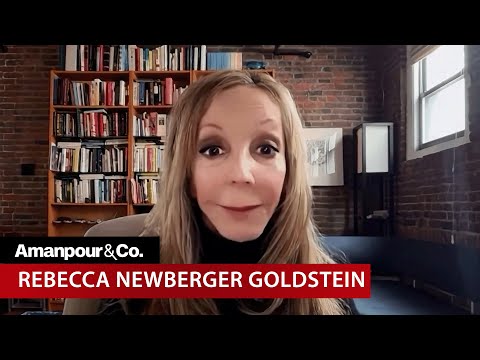
Brian Keating (@Briankeating) and Rebecca Newberger Goldstein (@platobooktour) discuss "The Physics of Mattering: Do AI Agents Have a Soul"
Rebecca Newberger Goldstein: God forbid if these AI agents begin to have a longing to matter, we have our non-carbon-based humans. We’re going to have to think about their rights.
Brian Keating: She is a philosopher who trained in physics, and she just told me that AI might deserve human rights. Here is her argument.
Rebecca Newberger Goldstein: The other obsession with this verb “matter,” that we are creatures of matter who long to matter — you can only say that in English. But I’m so glad you could say that in English because it’s, again, incredibly poignant.
We’re creatures of matter who are subject to the laws of physics, the second law of thermodynamics, but we long to matter. And so much of the book is trying to explain that, how that transformation within us, within our species, happens. That’s a normative transformation, an ethical transformation, and it’s really what distinguishes us: that we, in some sense, want to justify the fact that we matter so much to ourselves, that we pay so much attention to ourselves.
We actually can pinpoint the place in human history where this emerged, during the period when all the religions emerged that are still extant, which is so interesting. Also, Western philosophy emerged during the period of history that’s called the Axial Age.
Brian Keating: I do think things have changed for the better, as far as, you know, paternity leave. I’ve taken advantage of that. But I guess the ultimate expression — and I don’t think there’s anything wrong with it — I mean, I think that women sacrifice a lot more. I think also we have a crisis with men and boys and so forth, and now you have grandsons, and you can appreciate it. You probably appreciated this even before you had daughters.
But the book is full of these things ranging, as you said, from Aristotle to the Chinese one-child policy that you talk about at the end of the book. It’s heart-wrenching, Rebecca.
But I guess, as we come in for a landing, the fear that a lot of people have nowadays is about artificial intelligence replacing what we derive our sense of mattering from. And you quote Freud in the book. Freud said all of life is work and love. And if AI can replace the work of knowledge workers like you and me, and it can replace the love because of things like Character AI and all these artificial relationships that don’t require me to go out and ask a woman on a date — or nowadays, for men — I want to ask you the question: can AI have a mattering instinct, or is it encoded in this wet supercomputer that we carry on our shoulders? Is it possible that AI is making everyone feel that redundancy is threatening to us? Will AI rob us of our mattering?
Rebecca Newberger Goldstein: Yeah, so there are two different questions there. One is really, I think, already upon us, maybe already here: that some of the most creative ways of appeasing our mattering instinct will be superseded by what AI can do. It can prove math theorems faster, make discoveries in science, write novels, write music, paint pictures. Some of the most creative things that have led to flourishing and led to great achievements that we can all take pride in.
I take great pride in our species producing Bach and Shakespeare and Michael Jordan — I’m a big basketball fan. I mean, we mere mortals, and look what we can do. But they’ll be able to do it better. I think this is going to be a real problem.
Here’s one thing I would say: heroic strivers — what I call heroic strivers — it’s really going to threaten them. I think the socializers are going to look to AI to some extent, maybe for romantic partners. But mothers are not going to have little AI agents acting like their babies. I don’t think that’s going to happen. But I think heroic strivers are going to be severely threatened.
Well, one thing I can say is that one of the ways to be a heroic striver is ethically. And that will still remain to us: these ethical projects of trying to minister to others, to other creatures, to the planet itself. AI will not be able to do that. They can write our novels or our poetry or our music or improve our math theorems, but they’re not going to be able to do that for us.
Wouldn’t that be a wonderful turn of events if somehow there were an incredible ethical transformation and that’s how we got our status — from how much good we’re actually doing in the world, how much counter-entropic good we’re doing in the world?
This is a big thing that’s upon us, is all I can say. I can’t think of anything else — not the Industrial Revolution, not the Enlightenment — that has the possibility of so changing what we are and what we see our lives as being about as AI.
Brian Keating: Even the very name of our species — Homo habilis meant “toolmaker” or “handyman.”
Rebecca Newberger Goldstein: Yeah.
Brian Keating: And Homo sapiens means “man who knows,” right?
Rebecca Newberger Goldstein: Exactly, exactly. We’re not the only things that know.
And your other question: God forbid if these AI agents begin to have a longing to matter, wanting to justify their own existence — it would take self-reflection of the sort that we have, being able to step outside themselves and say, “Oh my God, I pay so much attention to myself. Am I worth it? Do I deserve this?”
If they do this, then what we have are non-carbon-based humans. These will be humans. And that means we’re going to have to think about their rights, and we’re going to have to have a whole new way of thinking about ethics, because we will have created humans in a new way.
So this is big. This is so big.
I’ll tell you something: I think this is the moment for philosophers, because these are philosophical problems. Philosophers have been at it for over 2,000 years since the ancient Greeks. So show us what you’ve got, philosophers. You’ve been thinking about this for 2,000 years. Show us what you’ve got.
Brian Keating: It’s amazing. You take some matter and shoot some electrons through it, and suddenly you start wondering: is it okay to turn it off? Can I turn off my chat companion? Is it okay to have it answer questions on ethics for my children?
Rebecca, this has been such a wonderful conversation. This book is incredible. It reminds me of a famous quote by John Archibald Wheeler. Wheeler said, “Matter tells space-time how to curve, and space-time tells matter how to move.”
And this book, The Mattering Instinct, was one of the most moving books to me.
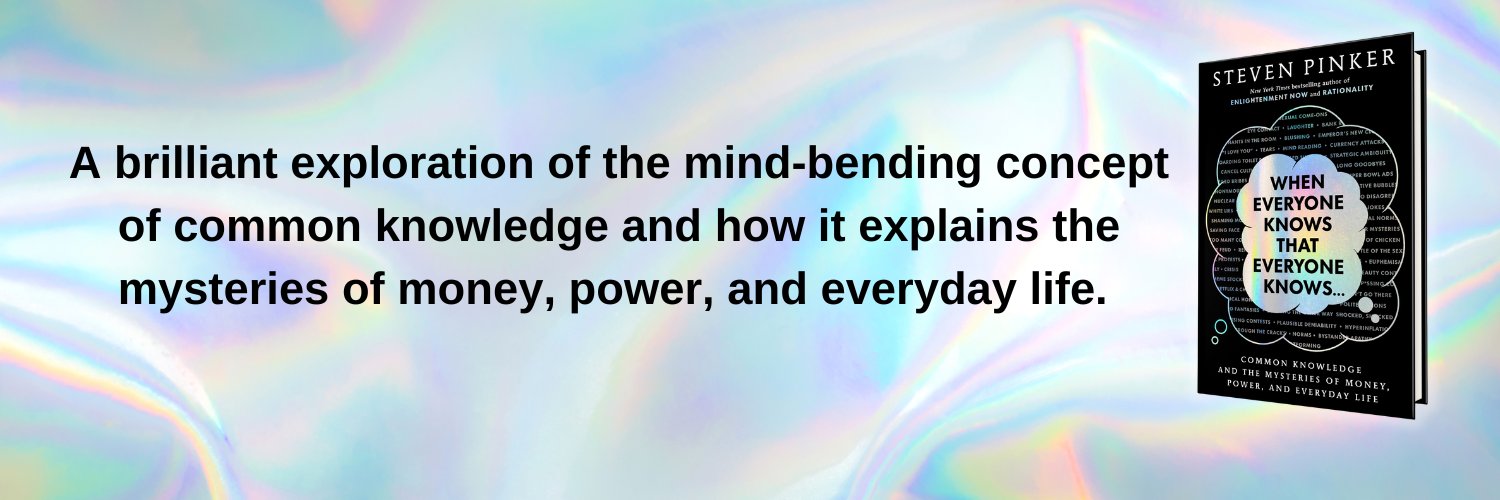
For more on Common knowledge and the mysteries of money, power, and everyday life, see my new book When Everyone Knows That Everyone Knows... amazon.com/When-Everyone-…
Reagan, Schwarzenegger, Ventura, Franken, Eastwood, Bono (Sonny, not U2), and of course our current president. Many in other countries, too, most notably the former comedian Volodymyr Zelensky.
JFK's grandson Jack Schlossberg seems like a putz, but NYT columnist misses why celebrities often have an edge in electability: Voters seek a "focal point," a candidate they feel other voters know about, and know that others know that others know, etc., so they aren't "wasting their vote" on a worthier but idiosyncratic alternative. | He’s Entitled and Nepotistic. This Is Not What Democrats Need. nytimes.com/2026/05/28/opi…
Boston murders in 2026 | Each one is horrifying, but there have been only 5 so far this year, compared to 31 in 2025 and 24 in 2024 - a reprise of the "Boston miracle" of the 1990s, this one reversing the post-Floyd spike of 2020-2022. universalhub.com/crime/murder/2…
Lots of interesting stuff in this interview, including why AI may be a force for truth. Yuval Noah Harari on the Mistake Strongmen Keep Making nytimes.com/2026/05/26/opi…
Good fences make good neighbors (because the focal point of an unambiguous border, however arbitrary, pre-empts self-serving arguments that the borderlands "rightfully" belong to one or the other). As I argue in Better Angels, the grandfathering of national borders deserves some of the credit for the post-WWII Long Peace, now threatened by you-know-who. Stephen Hanson & Jeffrey Kopstein explain. nytimes.com/2026/05/27/opi…
The Truth Is Still Out There - Excellent article by Adam Kirsch in The Atlantic, echoing points that skeptic (and Skeptic editor) @michaelshermer has been making for decades. theatlantic.com/magazine/2026/…
Join me in supporting The Ocean Cleanup (effective technology from Boyan Slat) to help tackle ocean plastic! Please help the artist and gallery director Nicholas Cueva reach his goal of 8584 USD. Your support and sharing this page would mean a lot to him! 🌊 fund.theoceancleanup.com/s/3646/3891/t
60 Percent of Grades at Harvard Were A’s. Enough Is Enough, say my colleagues David Laibson and @jasonfurman (and I couldn't agree more). nytimes.com/2026/05/21/opi…
This and other examples of the surprising role of "common knowledge" (belief about belief) in When Everyone Knows That Everyone Knows...: Common Knowledge and the Mysteries of Money, Power, and Everyday Life. amazon.com/When-Everyone-…
Nobel laureate and co-founder of behavioral economics Richard Thaler advises Democrats on how to select a successful nominee. Another factor: In WEKTEK, I suggested that the primary process is a "Keynesian beauty contest," where the goal is to select not the prettiest contestant but the one picked by the majority of other voters, each voting with the same goal. This higher-order guessing about guessing means that anything that makes a candidate stand out as a "focal point" for winning or losing has an outsize influence, so trivial "gaffes" and capricious signs of "momentum" can determine losers or winners (e.g., Muskie's tears, Dean's scream, Biden's endorsement by Clyburn). If so, then primaries should not be sequential, beginning with NH and IA. nytimes.com/2026/05/24/opi…