
文脈なしセファ retweetledi

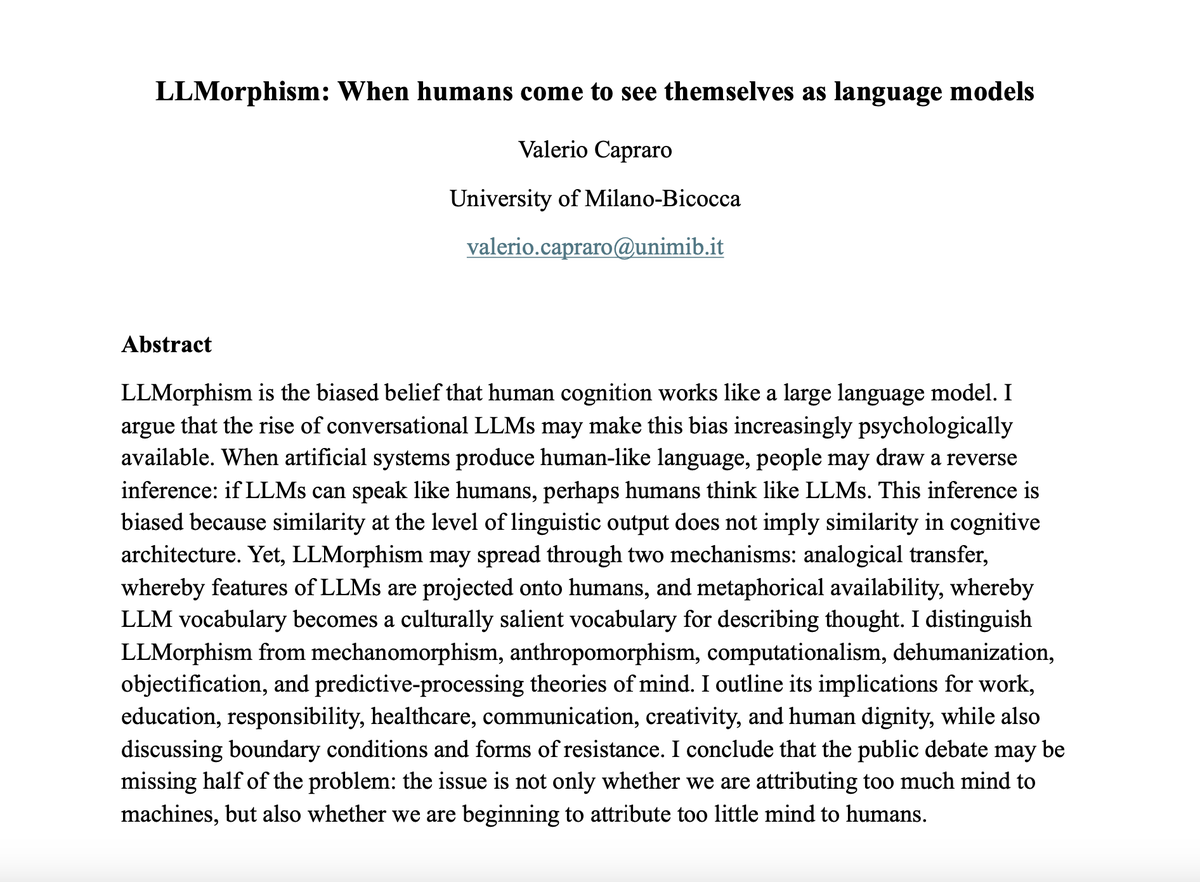
I think it's time to define a new bias: LLMorphism is the belief that humans work like large language models.
Since I started writing about the differences between human and artificial intelligence, I have received hundreds of messages from people who truly believe that humans are just LLMs.
That human language is just next-token prediction.
That creativity is just recombination of linguistic input.
That humans always hallucinate and never really aim at truth.
These people are not anthropomorphizing LLMs. They're doing the opposite: they're LLMorphizing humans.
Over the past months, I have been thinking about this phenomenon. I argue that it emerges from two mutually reinforcing psychological mechanisms:
Analogical transfer, whereby features of LLMs are projected onto humans due to output alignment;
Metaphorical availability, whereby the vocabulary of LLMs becomes a culturally salient way of describing human thought.
LLMorphism is a bias because it is based on an invalid inference: that similarity in linguistic outputs implies similarity in underlying processes.
In this new paper, I define LLMorphism, describe its psychological basis, distinguish it from related constructs, and discuss its possible social consequences.
My worry is that LLMorphism may badly impact various sectors of society by taking mind, agency, and understanding away from humans.
The public debate may be missing half of the problem. The issue is not only whether we are attributing too much mind to machines.
It is also whether we are beginning to attribute too little mind to humans.
Article in the first reply.
English