Andrew Smith

1K posts

Andrew Smith banner
Andrew Smith

Andrew Smith

@ShawHighAPSmith

I am the assistant principal of curriculum and instruction at Shaw High School. I am also the magnet coordinator. Let’s go Raiders! ShawU

Georgia, USA Katılım Ağustos 2015
429 Takip Edilen137 Takipçiler
Andrew Smith retweetledi
Barack Obama
Barack Obama@BarackObama·
March Madness won’t be the same without Sister Jean. Thinking about the Loyola University Chicago community and everyone who loved this remarkable woman. nytimes.com/2025/10/10/spo…
English
2.8K
9.6K
101.8K
12.5M
Andrew Smith retweetledi
Reads with Ravi
Reads with Ravi@readswithravi·
Reads with Ravi tweet media
ZXX
193
21.7K
98.2K
3.9M
Andrew Smith retweetledi
Trevor Packer
Trevor Packer@AP_Trevor·
The 2025 AP Calculus BC Exam scores: 5: 44%; 4: 22%; 3: 13%; 2: 15%; 1: 6% Multiple-Choice Questions As is typical, Calculus BC students scored extremely well across the units that are shared with Calculus AB, especially Unit 1, where 55% of students answered every question right, and Units 2-3, where 41% did so. The most challenging Calculus BC questions were from Units 9 and 10, which don’t overlap with Calculus AB. As usual, students found questions about infinite sequences and series most difficult: 4% answered all of these questions right. Free-Response Questions spr.ly/60124eEkg Setting aside the three FRQs shared with Calculus AB, which Calc BC students typically find easier than the BC-specific FRQs, students scored highest on Q5, the differential equation question that requires understanding of the second-degree Taylor polynomial, the Lagrange error bound, and Euler’s method. By far the most difficult question on this year’s BC exam was Q2, polar area, which served to differentiate among BC students, who are qualifying for AP 4s and 5s. Polar area is a good instructional focus for next year. All subjects’ AP score distributions for 2025 will be posted here when available: spr.ly/60134eEk9
Trevor Packer tweet media
English
30
38
436
163.5K
Andrew Smith retweetledi
Trevor Packer
Trevor Packer@AP_Trevor·
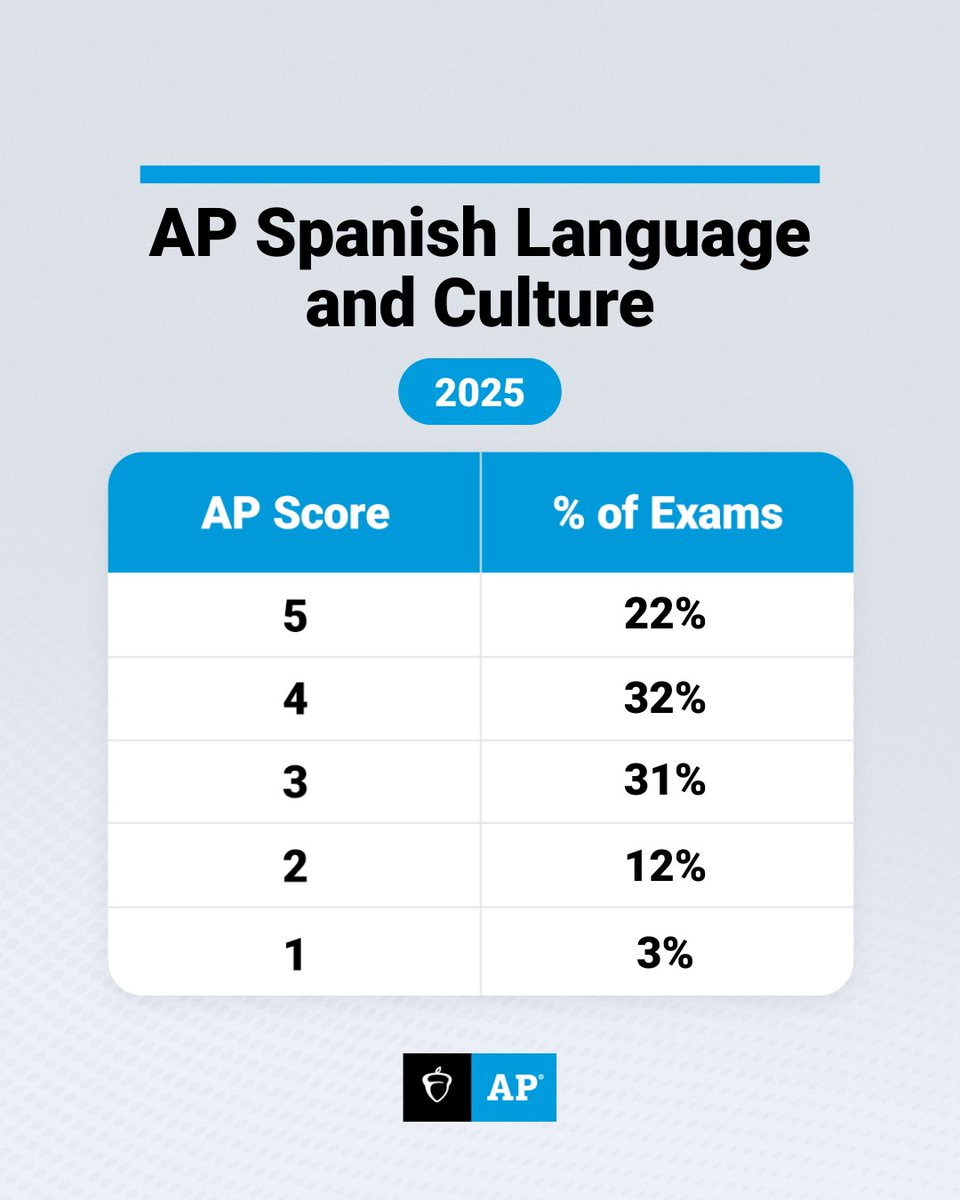
The 2025 AP Spanish Language and Culture Exam scores: 5: 22%; 4: 32%; 3: 31%; 2: 12%; 1: 3% ¡Buen trabajo AP Spanish Language and Culture students and teachers! The percentage of students scoring 3 or higher increased by 2% compared to 2024, and 1,987 more students earned a top score of 5. Multiple-Choice Questions: Students performed exceptionally well on Unit 5: Factors That Impact Quality of Life; 64% earned most or all of the available points. In contrast to 2024, Unit 3: Influences of Beauty and Art proved the most challenging, with 21% of students earning most or all points. Free-Response Questions: spr.ly/60104cB4r Students demonstrated a strong understanding of concepts and skills across all four free response questions. The highest-scoring question was Q3, a conversation task about organizing a talent show to raise funds for a school; an impressive 47% earned all of the 5 points possible on this task. Question 4, a presentation about the role of public spaces in communities across two settings, was the most challenging task, yet 23% of students earned all 5 possible points. All subjects’ AP score distributions for 2025 will be posted here when available: spr.ly/60124cB4p
Trevor Packer tweet media
English
36
36
252
121.8K
Andrew Smith retweetledi
Trevor Packer
Trevor Packer@AP_Trevor·
The 2025 AP World History: Modern Exam scores: 5: 14%; 4: 33%; 3: 17%; 2: 27%; 1: 9% Multiple-Choice Questions: Students performed very well across all 9 units, but two units in particular stood out, those focused on 1750-1900 CE: Unit 5 (Revolutions) and Unit 6 (Consequences of Industrialization). 51% of students earned most or all of the points on these questions. Students scored least well on questions focused on 1450-1750 CE: Unit 3 (Land-Based Empires) and 4 (Transoceanic Interconnections). 41% of students earned most or all of the points on these questions. Free-Response Questions: The following commentary on Free Response Questions (FRQ) focuses on FRQ Set 1, which was the version taken by most AP World History students. spr.ly/60104cKB0 AP World History students demonstrated strong knowledge and skills on Short Answer #1, where they analyzed the effect of the discovery of the Americas on Africa. 52% of students earned all points possible on this question. The most difficult question on this year’s AP World History Exam was Short Answer #4 , about factors that contributed to the outbreak of revolutions between 1750 CE to 1900 CE; 30% of students achieved all available points on this task. Students showed stronger performance on this year's Document-Based Question than in recent years, and that’s true of the DBQ in Set 2 as well. In this year's DBQ, students evaluated the impact of new transportation and/or communication technologies on African societies from 1850 CE to 1960 CE: 80% of students earned the thesis point 54% earned the contextualization point 71% earned both evidence from the documents points 19% earned the evidence beyond the documents point 29% earned the analysis and reasoning: sourcing point 17% earned the analysis and reasoning: complexity point The highest scoring Long Essay was Question 2, which prompted students to write about the extent to which Buddhism, Hinduism, and/or Confucianism influenced Asian societies and political systems between 1200 CE and 1450 CE. 30% of students received 5+ of the 6 possible points on this task, a job well done. FRQ Set 2 can be found here: spr.ly/60114cKBF All subjects’ AP score distributions for 2025 will be posted here when available: spr.ly/60124cKB2
Trevor Packer tweet media
English
91
67
654
178K
Andrew Smith retweetledi
Trevor Packer
Trevor Packer@AP_Trevor·
The 2025 AP Psychology Exam scores: 5: 15%; 4: 32%; 3: 25%; 2: 19%; 1: 9% Multiple-Choice Questions Students scored quite evenly and well across all topics, especially on “Cognition” (Unit 2); on those questions, 15% answered each of these items right. Free-Response Questions These comments will focus on the questions in Set 1, the exam version taken by most students. apcentral.collegeboard.org/media/pdf/ap25… Both of these free-response questions were new question types, focused on something different from what the multiple-choice section measures. The multiple-choice section measures whether students have learned and retained a wide array of foundational concepts, terms, and definitions. The free-response section now measures whether, when provided with psychological research studies, students can derive such understandings for themselves, a highly relevant skill for those who will proceed to major in psychology, and for a wide range of careers. Students scored very well on FRQ 1, the Research Analysis Question, in which they examined research on the effects of misinformation on memory. Here are the results: 23% of students earned each of the 7 points possible. 75% of students accurately identified the research method. 69% of students understood the research variable. 65% of students accurately interpreted the statistics. 86% of students identified one or more ethical guidelines the researchers applied. 78% of students explained the generalizability of the findings. 48% of students earned 2 points for argumentation by explaining how the results supported or refuted the misinformation effect, and 26% of students earned 1 point. FRQ 2, The Evidence-Based Question, measures whether students can evaluate three different psychological research studies and draw upon evidence from those studies to develop and support an argument with psychological evidence. The Set 1 psychological studies focused on whether the presence of others improves performance. 7% of students earned each of the 7 points possible. 94% of students proposed a specific and defensible claim based in psychological science. 86% of students were able to support that claim with evidence from one of the studies. 22% of students were able to explain very effectively the relationship between the evidence and their argument, earning 2 of the 2 reasoning points, while 34% were able to explain this somewhat effectively, earning 1 of the 2 points. 84% of students were able to support their claim with evidence from a second study. 14% of students were able to explain very effectively the relationship between the evidence and their argument, earning 2 of the 2 reasoning points, while 36% were able to explain this somewhat effectively, earning 1 of the 2 points. AP Psychology teachers will receive on their Instructional Planning Reports a point-by-point breakdown of their students’ performance on these free-response questions, enabling them to identify ways to further support students in learning and demonstrating these skills. AP Psychology had an Evidence-Based Standard Setting this year, utilizing more data from more college professors than ever before to identify the performance levels most fair and appropriate for receiving college credit and placement. An overview detailing this process, with specific information about the findings for this year’s students, will be available at around 4 pm ET today at allaccess.collegeboard.org All subjects’ AP score distributions for 2025 will be posted here when available: apstudents.org/score-distribu…
Trevor Packer tweet media
English
13
25
228
78.2K
Andrew Smith retweetledi
Trevor Packer
Trevor Packer@AP_Trevor·
The 2025 AP Environmental Science Exam scores: 5: 12%; 4: 28%; 3: 29%; 2: 15%; 1: 16% Multiple-Choice Questions Students earned the highest average scores across questions about Energy Resources and Consumption (Unit 6); 44% of students answered all or all but one of these questions right. As in prior years, the first unit of the course, Ecosystems, was most challenging for students, suggesting that further focus and practice on this content would continue to improve scores in this subject. Free-Response Questions These comments will focus on the Set 1 FRQs, since this was the exam version taken by most students. apcentral.collegeboard.org/media/pdf/ap25… The varying difficulty levels of the 10 different points on Q1 make it the best question overall for determining which of the five AP scores each exam will receive; students able to earn 5–6 of these points are generally receiving AP 3s; students able to earn 7–8 of these points are generally receiving AP 4s; and students able to earn 9–10 of these points are generally receiving AP 5s. The most challenging question on this year’s exam was Q2 (the effects of sea surface conditions and the polar jet stream); 1% of students answered all 10 parts of this question right. Students performed best on the math portion of FRQ 3, which comprises 6 of the question’s 10 total points. Point-by-point data indicates scores were strongest for both the setup of mathematical operations and for reporting the correct answer. Given some concerns about students’ ability to enter mathematical operations digitally, the strong performance on the math components of this question suggests that students adapted well to the Bluebook digital testing app. AP Environmental Science had an Evidence-Based Standard Setting this year, utilizing more data from more college professors than ever before to identify the performance levels most fair and appropriate for receiving college credit and placement. An overview detailing this process, with specific information about the findings for this year’s students, will be available at around 4 pm ET today at allaccess.collegeboard.org All subjects’ AP score distributions for 2025 will be posted here when available: apstudents.org/score-distribu…
Trevor Packer tweet media
English
22
29
208
92.9K
Andrew Smith retweetledi
Trevor Packer
Trevor Packer@AP_Trevor·
The 2025 AP Human Geography Exam scores: 5: 17%; 4: 25%; 3: 23%; 2: 25%; 1: 10% Multiple-Choice Questions Students scored exceptionally well on questions about “Agriculture and Rural Land Use Patterns and Processes” (Unit 5). Approximately 25% of students answered every question about these topics right. “Industrial and Economic Development Patterns and Processes” (Unit 7) was the most challenging unit for students; 5% of students earned all possible points among these questions. Free-Response Questions This commentary will focus on the Set 1 FRQs, since that was the version taken by most students. apcentral.collegeboard.org/media/pdf/ap25… The highest mean score was on Q2, a population pyramid. 32% of students achieved 6 or 7 of the 7 points possible. The most challenging question was Q3, which focused on agricultural patterns. 10% of students earned 6 or 7 of the 7 points possible. AP Human Geography had an Evidence-Based Standard Setting this year, utilizing more data from more college professors than ever before to identify the performance levels most fair and appropriate for receiving college credit and placement. An overview detailing this process, with specific information about the findings for this year’s students, will be available at around 4 pm ET today at allaccess.collegeboard.org All subjects’ AP score distributions for 2025 will be posted here when available: apstudents.org/score-distribu…
Trevor Packer tweet media
English
27
35
253
105.9K
Andrew Smith retweetledi
Trevor Packer
Trevor Packer@AP_Trevor·
The 2025 AP English Language and Composition Exam scores: 5: 13%; 4: 28%; 3: 33%; 2: 16%: 1: 10% Multiple-Choice Section Students performed well across the range of skills this section measures, but especially on Skill Category 8: Style – Writing. An impressive 37% of students answered all of these questions right. The most challenging MCQs were related to Skill Category 5, understanding the line of reasoning and organization within a text. 7% of students answered each of these questions correctly. Free-Response Section Set 1: apcentral.collegeboard.org/media/pdf/ap25… Set 2: apcentral.collegeboard.org/media/pdf/ap25… In the Set 1 essay questions, students scored highest on Q3, the evidence-based argument on the present moment, with 22% of students earning 5+ points. On the Set 2 essay questions, students scored highest on Q1, the synthesis of sources related to mapping software / GPS devices, on which 24% of students earned 5+ points. The most difficult essay question on both Set 1 and Set 2 was Q2, the rhetorical analysis. ~17% of students earned 5+ points. AP English Language and Composition had an Evidence-Based Standard Setting this year to determine more precisely than in the past which AP students are demonstrating the content knowledge and skills that meet expectations for college credit and placement. The 2021 standard setting used a panel-based approach, with 15 professors estimating what the AP “pass rate” should be. The 2025 standard setting utilized technology to gather input from an exponentially larger set of experts: 773 professors from 524 colleges. An overview detailing this process, with specific information about the findings for this year’s students, will be available at around 4 pm ET today at allaccess.collegeboard.org All subjects’ AP score distributions for 2025 will be posted here when available: apstudents.org/score-distribu…
Trevor Packer tweet media
English
49
60
515
112.3K
Andrew Smith retweetledi
Trevor Packer
Trevor Packer@AP_Trevor·
The 2025 AP English Literature & Composition Exam scores: 5: 16%; 4: 27%; 3: 31%; 2: 16%; 1: 10% Multiple-Choice Questions Students scored extremely well across all topics, but especially on questions about the Function of Word Choice, Imagery, and Symbols (Skill Category 5); 27% of students answered all of these questions right. The most challenging skill for AP English Lit students seems to be Skill Category 6, explaining the function of comparisons (similes, metaphors, personification, allusions); 7% of students answered all such questions correctly. As is typical, students scored significantly higher on questions about prose passages than on those about poetry. Free-Response Questions Set 1: apcentral.collegeboard.org/media/pdf/ap25… Set 2: apcentral.collegeboard.org/media/pdf/ap25… In both the Set 1 and Set 2 essay questions, students scored better on the poetry analysis essay (Q1) than on the prose analysis (Q2) essay, which was the most challenging of this year’s essays. On Q3, the literary argument about a work of long fiction / drama: ~22% of students earned 5+ points ~31% earned 4 points ~28% earned 3 points ~9% earned 2 points ~4% earned 1 point ~6% earned 0 points AP English Literature and Composition had an Evidence-Based Standard Setting this year that affirmed the standards in place since 2022, standards that were validated by research on the 2022 student cohort’s performance in college, available here: research.collegeboard.org/media/pdf/MAR-… An overview detailing the standard setting process, with specific information about the findings for this year’s students, will be available at around 4 pm ET today at allaccess.collegeboard.org All subjects’ AP score distributions for 2025 will be posted here when available: apstudents.org/score-distribu…
Trevor Packer tweet media
English
29
42
408
105.3K
Andrew Smith retweetledi
Trevor Packer
Trevor Packer@AP_Trevor·
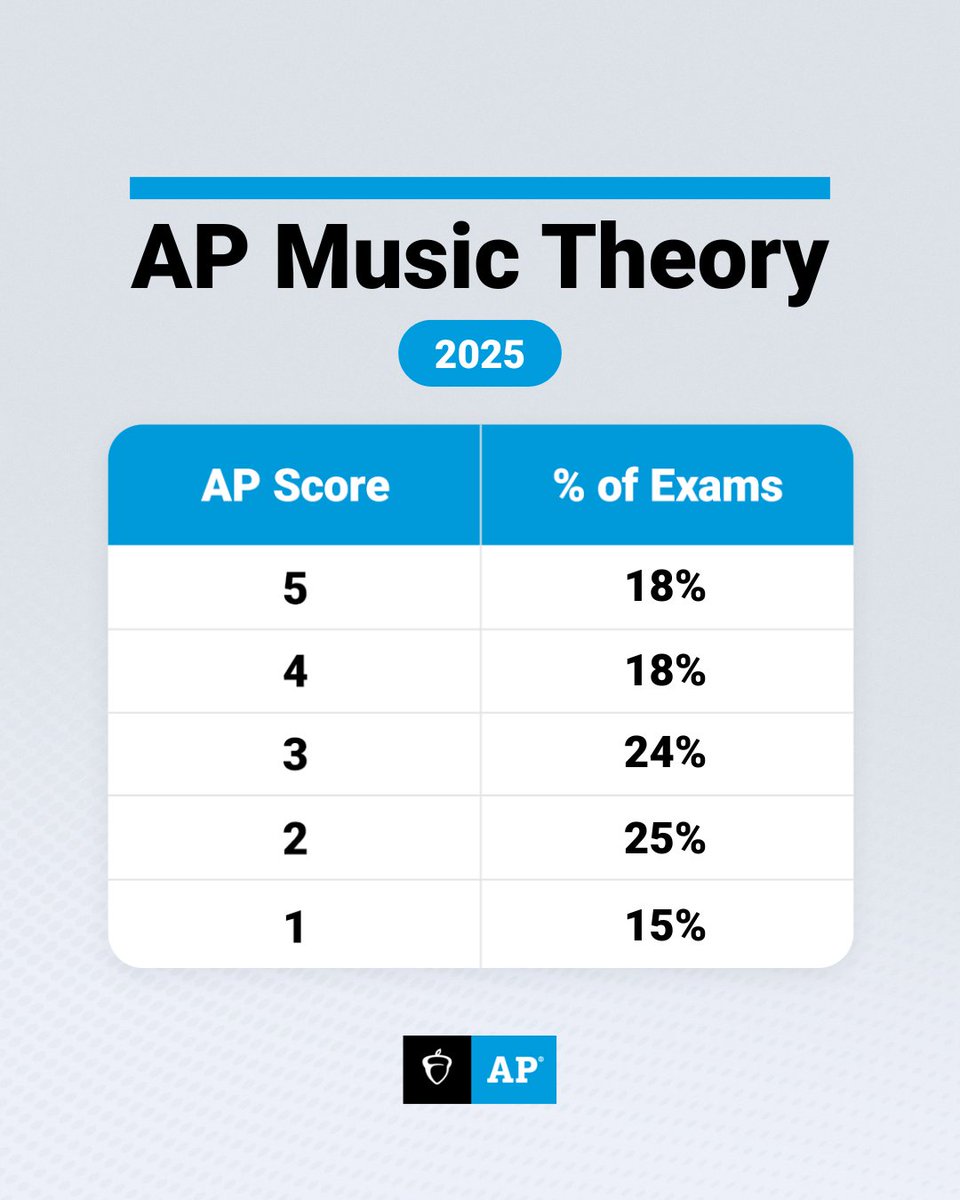
The 2025 AP Music Theory Exam scores: 5: 18%; 4: 18%; 3: 24%; 2: 25%; 1: 15% AP Music Theory Multiple Choice Questions: Consistent with last year’s results, students performed best on foundational topics from Unit 1—including pitch, major scales and key signatures, rhythm, meter, and expressive elements. 82% of students scored more than 50% of the available points on these questions. The most difficult area was Unit 7—Secondary Function. 32% of students earned more than 50% of the available points in this section. AP Music Theory Free Response Questions: Similar to 2024, the highest-performing question was Question 5: Part Writing from Figured Bass, which required traditional 18th-century voice-leading techniques. 29% of students earned most or all of the 25 points. spr.ly/60194gknf The most challenging was Question 2: Melodic Dictation, with 14% of students earning most or all of the 9 available points. spr.ly/60194gknf All subjects’ AP score distributions for 2025 will be posted here when available: spr.ly/60104gknA
Trevor Packer tweet media
English
54
15
148
182.6K
Andrew Smith retweetledi
Trevor Packer
Trevor Packer@AP_Trevor·
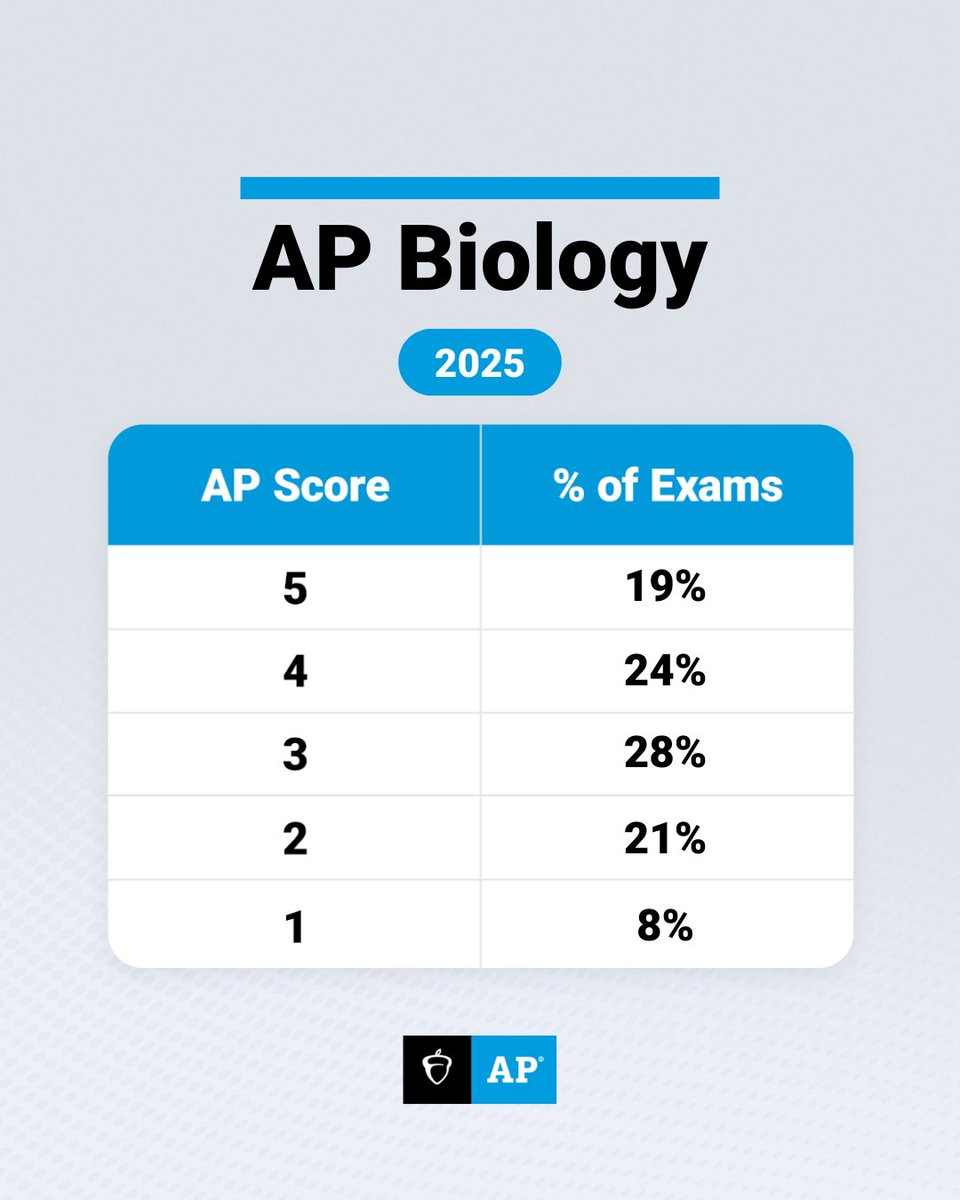
The 2025 AP Biology Exam scores: 5: 19%; 4: 24%; 3: 28%; 2: 21%; 1: 8% This year’s data finds a very impressive showing among AP Biology students: the psychometric analyses found strong increases in content and skill mastery over 2024, such that the percentage of 5s increases from 16% to 19% and the overall rate of 3+ scores increases from 68% to 71%. This is all the more impressive when looking at how well educators expanded access to this course this year, with 26,000 more students participating than in 2024. Multiple-Choice Questions AP Biology students scored especially well on questions about Natural Selection (Unit 7), as well as Cellular Energetics (Unit 3). The most challenging topics were related to Heredity (Unit 5) and Gene Expression and Regulation (Unit 6). Free-Response Questions spr.ly/60174gXtX Students generally scored highest on Q2 on insect pheromones and gene expression. Students earning 3s were generally able to earn at least 5 of these points, and students earning 5s typically proved able to earn all or all but one of the points possible. The most challenging part of this year’s exam was Q6, the analysis of data related to fruit fly mutations. Students earning AP 1s and 2s could typically only answer Part A of this question, which focused on measuring the abilities of the more advanced students in the class. All subjects’ AP score distributions for 2025 will be posted here when available: spr.ly/60194gXtZ
Trevor Packer tweet media
English
49
51
532
182.5K
Andrew Smith retweetledi
Trevor Packer
Trevor Packer@AP_Trevor·
The 2025 AP Art and Design: 2D Portfolio scores: 5: 12%; 4: 29%; 3: 42%; 2: 14%; 1: 3% 20% of AP 2-D Art and Design students earned all or most of the available points for their Selected Works. Students received highest ratings, overall, on the “Skills” component of their Sustained Investigations; 10% earned all points possible for this category of the scoring guidelines. Students received lowest ratings, overall, on the “Practice, Experimentation, and Revision” component of their Sustained Investigations; 6% earned all points possible for that category of the scoring guidelines. All subjects’ AP score distributions for 2025 will be posted here when available: apstudents.org/score-distribu…
Trevor Packer tweet media
English
5
17
94
118.6K
Andrew Smith retweetledi
Trevor Packer
Trevor Packer@AP_Trevor·
The 2025 AP Computer Science Principles scores: 5: 11%; 4: 20%; 3: 32%; 2: 22%; 1: 15% Multiple-Choice Questions Students scored highest on questions about the impact of computing; 44% answered 14+ correct of the 16 total questions on this topic. The most challenging questions were about algorithms without code; the average score on these items was 59% correct. The “Create” Performance Task 98% of students earned the point for their project video, and 86% earned the point about their program’s design, function, and purpose (Written Response 1). The most challenging point to earn was the point for algorithm development (Written Response 2a), which 45% of students earned. All subjects’ AP score distributions for 2025 will be posted here when available: spr.ly/60174jwiP
Trevor Packer tweet media
English
16
29
216
146.9K
Andrew Smith retweetledi
Trevor Packer
Trevor Packer@AP_Trevor·
The 2025 AP Calculus AB Exam scores: 5: 20%; 4: 29%; 3: 15%; 2: 23%; 1: 13% Multiple-Choice Questions AP Calculus AB students scored highest on questions related to Unit 2: Differentiation: Definition and Fundamental Properties. 50% of students answered all or all but one of these questions right. The most challenging questions were from Unit 6: Integration and Accumulation of Change. 7% of students answered correctly all or all but one of these questions. Free-Response Questions spr.ly/60104eEKm Students generally scored highest on Q3, in which they modeled reading rates for a student and a teacher. And this was the best question, psychometrically, of the exam, since its points varied significantly in difficulty, enabling good measurement of student abilities across the 1-5 AP scale. The question was worth 9 points total, and students unable to answer at least 2 of those points correctly are generally receiving AP 1s and 2s, while students who could answer 8-9 of the points are typically receiving AP 5s. The most challenging FRQ for AB students was Q1, the modeling of an invasive plant species’ spread within a fruit grove. (Who says farmers don’t need calculus?) Students earning 6-9 points on this question tended to receive AP 5s. Writing justifications for global maxima and minima is a good instructional focus for next year. All subjects’ AP score distributions for 2025 will be posted here when available: spr.ly/60114eEKW
Trevor Packer tweet media
English
26
52
471
156.8K
Andrew Smith retweetledi
Trevor Packer
Trevor Packer@AP_Trevor·
The 2025 AP Precalculus Exam scores: 5: 28%; 4: 26%; 3: 27%; 2: 11%; 1: 8% The common-item equating psychometricians use to gauge changes in student mastery year over year found that this year’s AP Precalculus students had higher content mastery than last year’s, resulting in an overall increase of ~3% in students scoring a 5, part of an overall 5% increase in scores of 3+. AP Precalculus grew more significantly than any AP subject this year, with ~70,000 more students participating than in 2024. An increased volume in participation and higher content mastery means more students are accessing higher level math and are positioning themselves for future success. In part, these impressive scores reflect the far larger number of instructional hours that precalculus courses typically provide high school students, in contrast to the hours provided such students in college, where this is generally a one-semester class. Many of these excellent students will enter colleges and majors that consider precalculus “advanced math” and will thus allow this AP credit to fulfill their college math requirement; for others who attend colleges or enroll in majors that require calculus, it’s great to see this strong preparation for further advanced mathematics. AP Precalculus Multiple-Choice Questions: Overall, students performed well across most function types. General Functions (non-analytical) stood out, with 53% of students earning all or most of the available points on these questions. In contrast, Trigonometric and Polar Functions proved most challenging: 20% of students earned all or most of the available points on these questions. This is a good instructional focus next year. AP Precalculus Free-Response Questions: spr.ly/60164jSxY Students performed best on Question 1 (Function Concepts), whereas Question 3 (Modeling a Periodic Context) was the single best question on this year’s exam, psychometrically, since it had the best mix of difficulty levels across the 6 points available. Students who can earn just 1 point are typically receiving an AP 1 overall; students who can earn 2 points are typically receiving an AP 2, overall, and students earning 5-6 points are typically receiving an AP 5, overall. Question 4 (Symbolic Manipulations) was the most difficult, and served to differentiate the 3s, 4s, and 5s, as starting this question requires an understanding of algebraic manipulation that is beyond the proficiency of students who receive 1s and 2s. Students able to begin this question successfully are generally receiving an AP 3, and those able to earn multiple points on it receive 4s and 5s. All subjects’ AP score distributions for 2025 will be posted here when available: spr.ly/60174jSxl
Trevor Packer tweet media
English
34
57
384
169.2K
Andrew Smith retweetledi
Trevor Packer
Trevor Packer@AP_Trevor·
The 2025 AP US Government and Politics Exam scores: 5: 24%; 4: 25%; 3: 23%; 2: 18%; 1: 10% Multiple-Choice Questions Students are learning the SCOTUS cases exceptionally well; 42% earned every one of those possible points. Students performed well across all units, but especially “Civil Rights and Civil Liberties” (Unit 3); an impressive 32% answered every such question correctly. “Interactions among Branches of Government” (Unit 2) was most challenging; 5% of students answered each of these questions right. Free-Response Questions spr.ly/60194w2eJ This commentary will focus on the Set 1 questions, the version taken by most students. The mean scores were highest on Q4, the argumentative essay in which students utilized foundational documents like the First Amendment, Federalist No. 10, and/or “Letter from a Birmingham Jail” to develop and support their argument about participatory democracy. Students who earned all 6/6 points possible on their essays are typically receiving AP 5s this year. The SCOTUS question, Q3, on Wickard V. Filburn (1942) and United States v. Lopez (1995) was the single best question on this year’s exam, psychometrically speaking, because it contained an effective mix of difficulty across parts A, B, and C for measuring a range of knowledge and skill levels among the hundreds of thousands of students who took this version. Generally, if a student is able to answer all parts of this question well, they’re on track for a 5. All subjects’ AP score distributions for 2025 will be posted here when available: spr.ly/60174TpA3
Trevor Packer tweet media
English
14
53
482
139.4K
Andrew Smith retweetledi
Trevor Packer
Trevor Packer@AP_Trevor·
The 2025 AP US History Exam scores: 5: 14%; 4: 36%; 3: 23%; 2: 19%; 1: 8%. Congrats to this year’s cohort of AP US History teachers and students; common item equating shows that this year’s students developed stronger content knowledge and skills than last year’s, raising the percentage of 4s and 5s by 4%. In parallel, APUSH teachers provided 25,000 more students than in 2024 with this opportunity to learn at an advanced level, making AP US History the course with the largest increase in performance and participation of any subject so far this year. Multiple-Choice Questions: AP US History students, as is often the case, developed a strong understanding of Period 2, 1607-1754; 36% of students answered all questions about this historical period accurately. The lowest mean score in the multiple-choice section was on Period 9 questions (1980 to present). 10% of students answered each such question correctly. Short Answer Questions: spr.ly/60104byX6 This commentary will focus on the Set 1 questions, since that was the version taken by most students. The most challenging of all this year’s AP US History free-response questions was the first short answer question, the comparison of secondary sources about early American democracy. 15% of students earned all points possible on it. Students scored highest on the third short answer question, about British North America and the Seven Years’ War. 33% of students earned all points possible here. Document-Based Question: The DBQ on the US economy from 1932 to 1980: 79% of students earned the thesis point; 62% earned the contextualization point; 39% earned 1 evidence point and 47% earned 2 evidence points; 47% earned the evidence-beyond-the-documents point; 39% earned the analysis and reasoning: sourcing point, and 15% earned the analysis and reasoning: complex understanding point. Long Essay Questions: Q2: Native American societies’ adaptations from 1500-1754. 10% of students earned all 6 points possible. Q3: Reform movements’ responses to industrialization from 1820-1900. 12% of students earned all 6 points possible. Q4: US foreign policy from 1890-1930. 22% of students earned all 6 points possible. All subjects’ AP score distributions for 2025 will be posted here when available: spr.ly/60114byXB
Trevor Packer tweet media
English
46
114
826
197.8K