
Pradeep

618 posts

Pradeep banner
Pradeep

Pradeep

@Sym_biologist

Insect Microbe Symbiosis 🐞 🔁 🦠

Katılım Eylül 2019
551 Takip Edilen204 Takipçiler
Pradeep retweetledi
Harry Low’s Lab
Harry Low’s Lab@thelowlab·
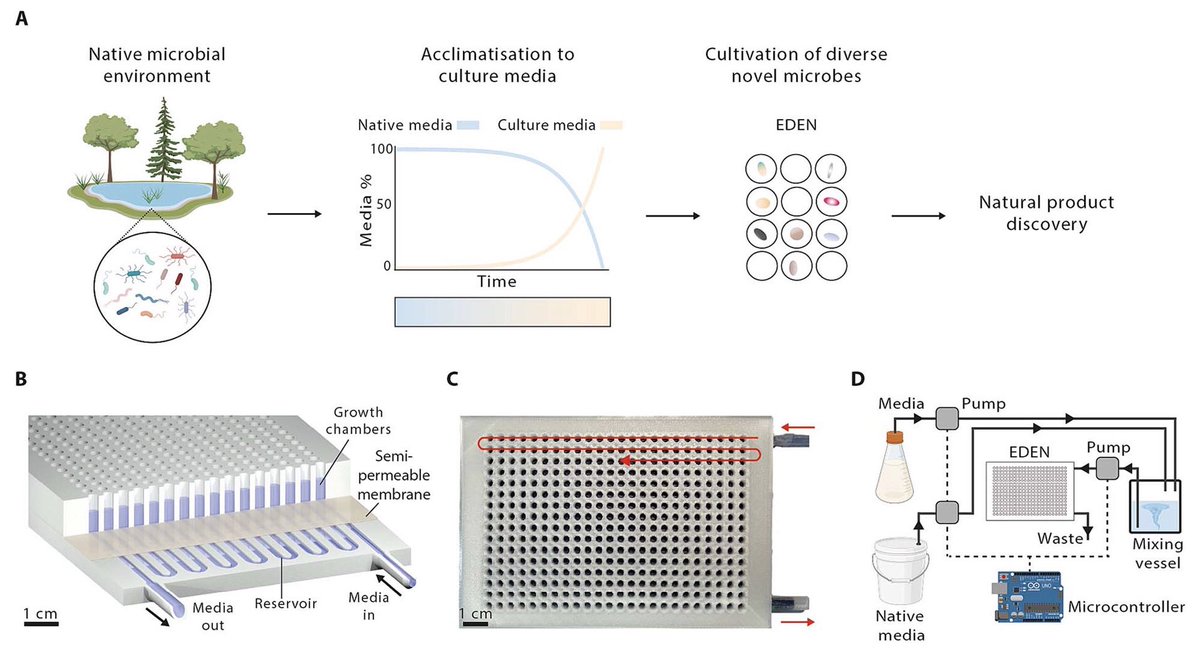
Most bacteria remain uncultured and don’t grow in the lab.. to address this am excited to share EDEN - an enhanced domestication method to grow uncultured bacteria & new diversity. Using EDEN we isolate a new species active against MDR pathogens.. doi.org/10.1093/ismeco…
Harry Low’s Lab tweet media
English
6
72
298
18.1K
Pradeep retweetledi
Dr. Melanie Blokesch
Dr. Melanie Blokesch@MBlokesch·
Excited to share that our latest paper is published @ScienceMagazine We show that HGT via natural competence drives diversification of chromosomal integrons in V. cholerae. Thanks to Laurie, Sandrine, Loriane & Alexandre for their help with this study🥳 science.org/doi/10.1126/sc…
English
0
29
77
29.8K
Pradeep retweetledi
Prof Brajesh Singh
Prof Brajesh Singh@Prof_Braj_Singh·
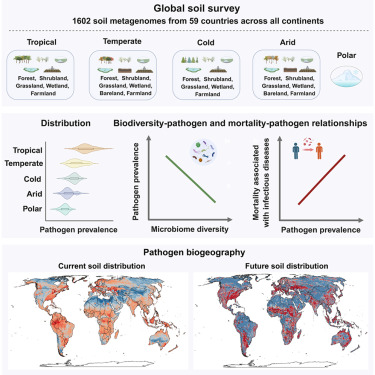
Our new paper in @cellhostmicrobe include 1. a global atlas of human bacterial pathogens in soils 2. Soil biodiversity negatively linked with human pathogens 3. Many pathogens to increase in future climates 4. Positive link between pathogens & mortality authors.elsevier.com/a/1msNK6t8JEyQ…
Prof Brajesh Singh tweet mediaProf Brajesh Singh tweet mediaProf Brajesh Singh tweet media
English
4
39
105
4.6K
Pradeep retweetledi
Prof Brajesh Singh
Prof Brajesh Singh@Prof_Braj_Singh·
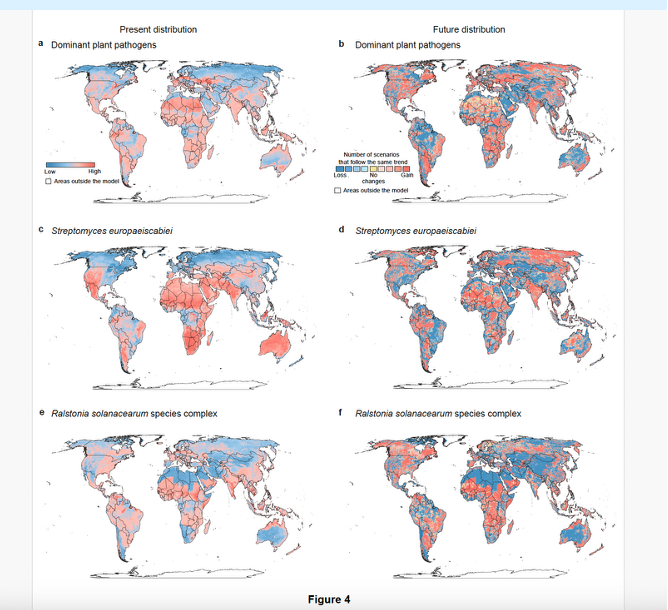
In a new paper in @NatureComms we 1. provide first global map of dominant bacterial plant pathogens 2. show microbial diversity, SOC, some Streptomyces, AM fungi linked to low pathogen prevalence 3. Many pathogens to increase under future climates #peer-review" target="_blank" rel="nofollow noopener">nature.com/articles/s4146…
Prof Brajesh Singh tweet mediaProf Brajesh Singh tweet media
English
3
28
70
3.1K
Pradeep retweetledi
Takema Fukatsu
Takema Fukatsu@fkttkm·
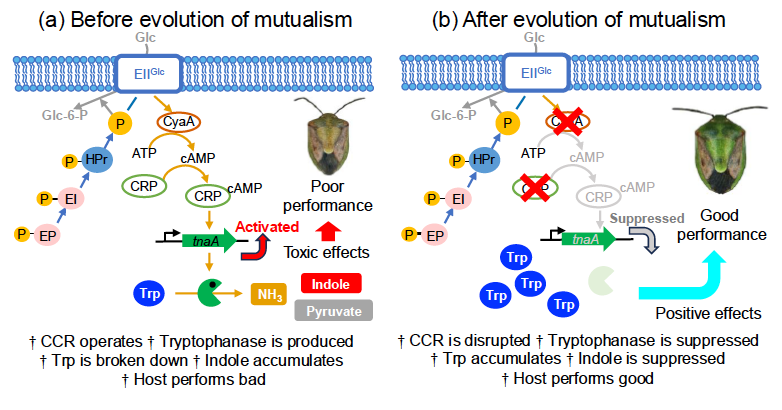
Yayun Wang, Minoru Moriyama, Ryuichi Koga and colleagues' fantastic work, uncovering that disruption of a single enzyme gene, tnaA encoding tryptophanase, makes E. coli and other bacteria mutualistic to stinkbugs, just comes out in Nature Microbiology! doi.org/10.1038/s41564…
Takema Fukatsu tweet media
English
0
18
55
4.2K
Pradeep retweetledi
Panagiotis Sarris
Panagiotis Sarris@PanosSarris·
Meloidogyne nematodes reprogram rhizosphere metabolism to suppress antagonistic microbiota and enable bacterial pathogen co-infection. cell.com/cell-reports/f…
English
0
4
17
727
Pradeep retweetledi
Prof Brajesh Singh
Prof Brajesh Singh@Prof_Braj_Singh·
New paper from lab- Leaf microbiome assembly is linked to plant phylogeny in @plantandsoil led by Dr Pankaj Singh Results advances fundamental knowledge of plant–microbe interactions and their co-evolutionary relationships. link.springer.com/article/10.100…
English
1
12
33
1.4K
Pradeep retweetledi
Niko McCarty.
Niko McCarty.@NikoMcCarty·
There's a bacteriophage that turns bacteria into “liquid crystals.” Specifically, Pseudomonas aeruginosa bacteria make Pf phages, which are rod-shaped, negatively-charged, and measure about 2 micrometers in length (roughly the length of an E. coli cell). These phages leave the cells and enter their surroundings. There, they mix with polymers, also secreted by the cells, to form a crystalline matrix. Surprisingly, this is good for the cells. Although the phages kill some of them, it also makes their biofilms stickier and able to withstand certain antibiotics. These bacteria + phages are prevalent in cystic fibrosis patients; they've formed a sort of symbiotic relationship. The Pf phages are made from thousands of repeating copies of a coat protein, called CoaB, which wraps around a single-stranded, circular DNA genome. These genes are integrated directly on the bacterial chromosome. The bacteria “turn on” these phage genes when placed in a viscous environment with low oxygen levels. This is like a trigger to start forming a biofilm. And the cells make a lot of phages; about 100 billion per milliliter. These liquid crystals form because of a physics principle called “depletion attraction.” If you just mix a bunch of loose or flexible polymers together (such as long carbon chains) they will not form a liquid crystal. But if you mix stiff rods (the phages) with loose polymers at a high enough concentration, the polymers will force the phages close together to create a material that flows like a liquid despite being ordered like a crystal. See the video below. These liquid crystal biofilms are hard to get rid of. The negatively-charged phages block many antibiotics (like aminoglycosides, which are positively-charged) from entering cells. Liquid crystals also retain water, so these biofilms can survive on drier surfaces. I first heard about this from Malmesbury’s excellent newsletter, called “Telescopic Turnip.”
English
15
107
596
50K
Pradeep retweetledi
Akos T. Kovacs
Akos T. Kovacs@EvolvedBiofilm·
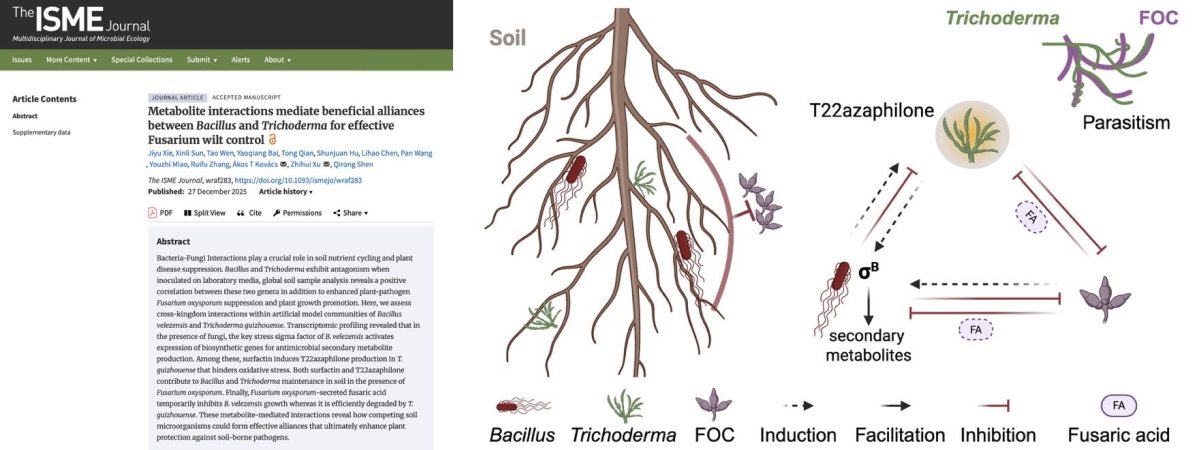
Our new publication in @ISMEJournal describes how Bacillus and Trichoderma works together to fight against the plant pathogen Fusarium, a superb collaboration with @ZhihuiXu2 at Nanjing Agricultural University, including the experiments by @JiyuXie_ at @LeidenBiology 1/7👇
Akos T. Kovacs tweet media
English
1
10
47
2.5K