Edgy - The DeFi Edge 🗡️
13.8K posts

Edgy - The DeFi Edge 🗡️
@thedefiedge
Crypto without the noise. Systems-driven research on DeFi, narratives, and what's actually worth your attention. Partner @Stacks
Get an Edge → Katılım Ocak 2022
208 Takip Edilen302.9K Takipçiler

The robotics x crypto narrative is quietly getting built on Base.
Not the robots themselves. The rails around them: data, ownership, payments, identity, teleoperation, and deployment.
If robotics scales, that's where the value accrues.
Here are some projects on my watchlist:
• @virtuals_io ($VIRTUAL): Virtuals is becoming the main launchpad for robotics on Base. The key piece is Eastworld Labs, a robotics track focused on humanoid fleets, teleoperation data, and physical-world task experiments. Their ecosystem already has 30+ Unitree robots and a robotics market cap around $45M.
• @caspius_ai ($CAS): Caspius is focused on embodied AI data. Robots need real-world movement, perception, and environment data before they become useful. Their recent Genesis NFT drop is tied to this data network, with contributors helping build structured training data for physical AI.
• @StrikeRobot_ai ($SR): Strike is direct humanoid robotics exposure. The project focuses on industrial/security environments and has published paper, teleoperation revenue, Eastworld Labs backing, and incoming x402 integration for enterprise simulation access.
• @FabricFND ($ROBO): Fabric is building rails for the robot economy: identity, wallets, payments, and task coordination for autonomous machines. If robots eventually earn and transact, this is the backend layer they're trying to build.
• @shadowcleague ($SCL): Shadow is the entertainment angle: humanoid robot combat with livestreams, prediction markets, and fan-driven participation. Their first combat stream is scheduled around May 23.
• @AukiLabs ($AUKI): Auki is the spatial intelligence layer. Its Posemesh helps machines understand physical space, which matters for retail, agriculture, AR, navigation, and robotics.
Unreleased Token Projects:
• @xmaquina ($DEUS) is the ownership angle. It is building a DAO around robotics exposure, with treasury links to companies like Figure AI, Apptronik, 1X, Agility, and Neura. The $DEUS TGE is expected on May 27.
• @OrionX_Robotics ($ORION) is expected to launch on Virtuals, focused on autonomous humanoids for industrial and defense-style environments. Base is quietly becoming the center of robotics x crypto.
The sector is still early, but the reason robotics is worth tracking is that projects here are trying to solve actual robotics problems.
I'm pretty sure I'm missing a few projects so please lemme know!
English

If you like reads like these, you'll love the free weekly newsletter.
Every Thursday: new strategies, narratives, and the latest in DeFi. No fluff or b.s.
thedefiedge.com/join/
English


@jonwu_ Reggie's Portra or Classic Cuban Neg. Love bringing the camera out to random hangout with friends. Brings me happiness when I send people their pics and they update their profiles with em.
English

idk who needs to hear this but stop trying to get into film
just buy a fujifilm camera
it's cute to tote around a vintage nikon. it's not cute to spend $2 or $3 a shot when you're just getting into photography
get a fujifilm. it doesn't matter which one, if you like it you can upgrade later
x100
x-t5
x-t50
target $1,000 for camera + lens. sounds like a lot but that's only 300 shots on a film camera. 10 rolls.
add a few film simulation recipes. start with "Reggie's Portra" (google it). follow the steps. punch it into the camera.
set it to auto and just blast away. you'll see immediately that it's vastly superior to the iPhone camera
fujis are especially good for people photos, the color rendering on skin is magical
your wife will especially appreciate this purchase. this is an approved hobby
good luck


English

@PhiloSourabh Thanks bro, will try to write more off the cuff posts
English

Most business books are a blog post stretched to 200 pages.
I read hundreds of them in my 20s. 3 made a huge impact in my life.
Here they are:
1. Problem Solving 101 by Ken Watanabe
A McKinsey consultant wrote this to teach Japanese kids the basics of problem solving.
Sounds simple, but it's the most useful book on thinking I've ever read.
He walks you through real scenarios, gets you to work out the solutions, then shows you the frameworks pros actually use.
It taught me that problem solving is a skill, and something worth the effort to improve.
2. Smart Cuts by Shane Snow
The word "hack" gets thrown around so much it's basically meaningless now, but real leverage points do exist.
Two lessons I still use:
• Catch waves early. Everything's easier when you ride the wave instead of fighting it. Making money in crypto in 2020 was on easy mode compared to now.
The obvious wave right now is AI.
Reminds me of Marc Andreessen's point that picking the right market matters more than the product or the team.
• Hack the ladder. We're taught to grind our way up one ladder for decades. But once you're at the top of one ladder, you can jump to a completely different one.
And can be way better than just climbing a ladder from scratch.
Logan Paul used his YouTube following to become a top-paid boxer and WWE star. Trump skipped politics entirely and went straight to president.
3. The Goal by Eliyahu Goldratt
One of the 3 books Bezos makes his top managers read.
The big idea is every system has one bottleneck holding it back. Most people try to fix everything at once and get nowhere. You're better off finding the constraint, fixing that, then going to look for the next one.
Last year I got into powerlifting and wanted to bring up my squat numbers.
Naturally I just kept squatting and adding weight. I hit a plateau and was stuck.
Did a form check with a friend and he told me my ankle mobility was shit. I spent 10 minutes a day working on dorsiflexion. Two months later my squat was flying.
Anytime you're trying to level up, there's ONE bottleneck holding you back.
Figure out what it is and attack it relentlessly. Way more efficient than just "grinding" it out.
Lemme know if you have any recommendations
English

Institutions have already bought Bitcoin.
ETFs, public companies, and treasuries solved the exposure problem.
The next question is what do they do with that $BTC once it’s sitting on the balance sheet?
That’s where Stacks’ Bitcoin staking design gets interesting.
Why? Because it's built around BTC staying on Bitcoin L1, under the holder’s own keys, while earning BTC-denominated yield.
STX acts as the capacity asset in the system, with a proposed 3% BTC APY, and early exit built into the design.
That matters because staking could become the entry point into the stacks ecosystem.
Once BTC capital starts earning natively, the app layer around it gets more useful too:
• @ZestProtocol for BTC lending.
• @GraniteBTC for BTC-backed borrowing.
• @bitflow for liquidity.
• @HermeticaFi for BTC yield products.
• $sBTC and $USDCx as the core rails.
So institutions are finally getting a cleaner path from passive BTC exposure into Bitcoin-native finance.
Pleased to partner with @Stacks on this one.
stacks.btc@Stacks
How Bitcoin Staking works in four steps: 1. Acquire STX 2. Lock BTC + STX 3. Earn BTC yield every cycle 4. Unlock and repeat
English

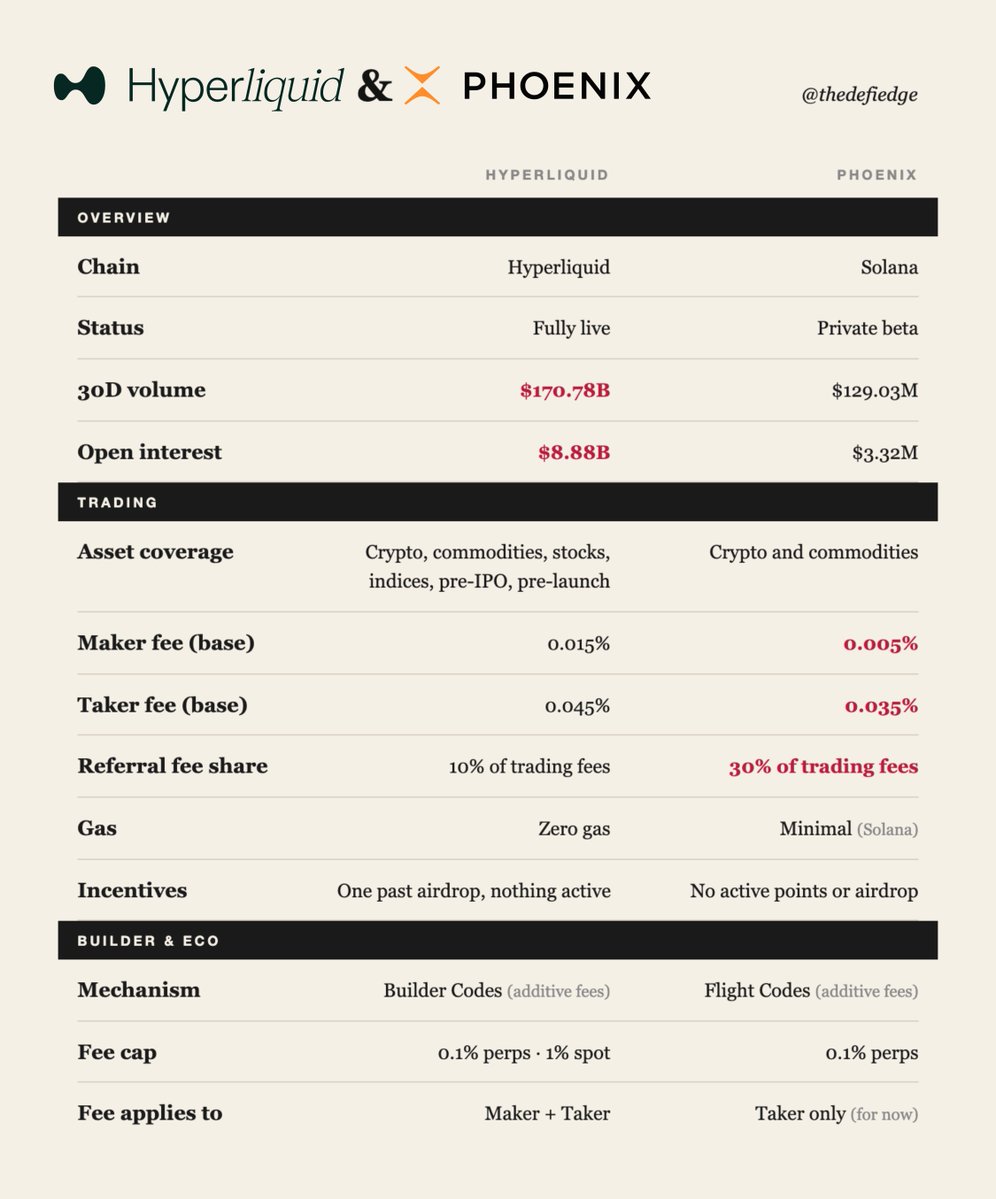
A bunch of large Solana accounts have been shilling @PhoenixTrade lately.
So I went digging to see what's actually different about it vs Hyperliquid.
Background
Drift got drained for $285M a few months ago. A lot of that volume migrated over to Hyperliquid, and there's a real void in Solana perps. So the OG Solana crew is pushing Phoenix to take over.
Phoenix is a perp DEX built by Ellipsis Labs. And they raised $44M from Paradigm, Electric Capital, and Toly personally
The orderbook
The piece that caught my eye is how the orderbook works. Phoenix combines a standard FIFO orderbook with something they call Spline Liquidity, where market makers publish a midpoint and a curve and Phoenix turns it into orderbook levels automatically.
A quote update costs 600 compute units. On a traditional perp DEX model it costs around 300,000.
So MMs can refresh quotes way more often without paying for it, which in theory means tighter spreads at scale.
Fees
Phoenix is roughly 6x cheaper across the board:
• Maker: 0.005% vs 0.03%
• Taker: 0.035% vs 0.09%
• Referral share: 30% vs 10%
If you're shilling a referral link, Phoenix pays 3x more for it.
Volume
Hyperliquid is way out ahead:
Hyperliquid: $170B 30D volume, $8.7B OI
Phoenix: ~$20M daily volume, $3.6M OI
Under 1% on both. Keep in mind it’s not really a fair comparison as Phoenix is still in beta.
Distribution
Hyperliquid airdropped 310M HYPE to 94,000 wallets with no vesting and no insiders. Which led to their hardcore community.
Phoenix has said there’s no points and no airdrops coming. So I’m not really sure if the cheaper fees will be enough incentives for people to move over.
Will test Phoenix once I get access.
What do you guys think?

English

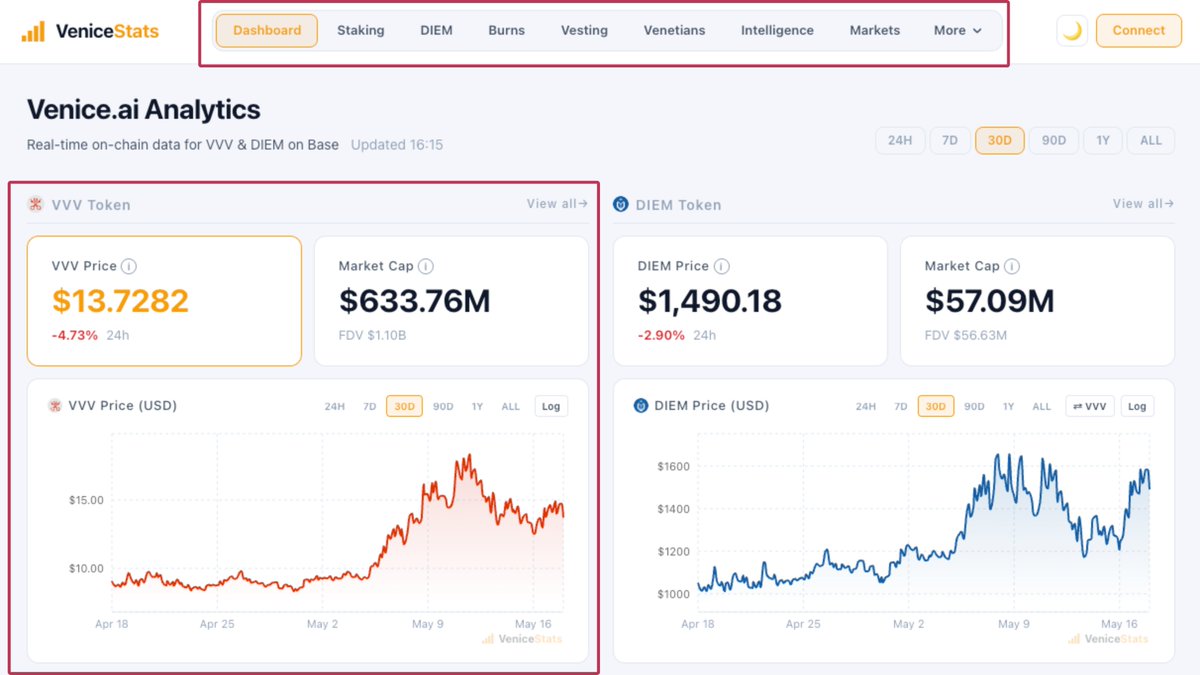
$VVV is up from $1.75 to ~$18 since January.
What I’m curious about is if the activity and fundamentals are keeping up.
For example, how much VVV is getting staked, locked, and burned. How $DIEM is being used. And what unlock pressure looks like from here.
I came across a tool called @venicestats that makes it simple. It’s a community-built dashboard that pulls the whole Venice ecosystem into one view.
My favorite part is the burn section. Venice runs discretionary monthly buybacks plus Pro subscription burns.
So you can watch how much $VVV is actually getting pulled out of circulation and whether the pace is picking up or slowing down.
Think this is the breakout token of the year and this tool makes it easy to keep up with the ecosystem

English

If you like reads like these, you'll love the free weekly newsletter.
Every Thursday: new strategies, narratives, and the latest in DeFi. No fluff or b.s.
thedefiedge.com/join/
English

Robinhood's Prediction Market
Everyone talks about HIP-4 vs Polymarket & Kalshi.
But Robinhood has also entered the prediction market race as well. This article dives into the competitive advantages of Robinhood over standalone prediction markets.
DCo@Decentralisedco
English