Theo Argitis
4.2K posts

Theo Argitis
@theoargitis
SVP Policy, The Business Council of Canada

Ottawa Katılım Ağustos 2010
1.8K Takip Edilen4.3K Takipçiler

@btaplatt @ErikHertzberg @ldhillonkane Congratulations Brian. Well deserved. Bureau is in good hands.
English

I'm thrilled to say I'll be taking on a new position as Bloomberg's Ottawa bureau chief, though also daunted at having to succeed the indefatigable @ldhillonkane. This bureau is such a strong team and I can't wait to keep elevating our work higher.
English

Canadian inflation is on the rise again thanks to the war in Iran. Gasoline prices jumped by 21% on the month, according to Statistics Canada, the largest one-month increase on record. Underlying inflation (what are known as core measures) was little changed, which suggests spillover effects remain contained for now.
bloomberg.com/news/articles/…
English

Faced with the option of an approximately $30 billion pipeline, tied to a $20 billion carbon capture project, with entrenched political opposition, and a ban on oil tankers, rational economic actors did what anyone could have predicted they would do, which was to find cheaper and easier sources of egress.
Heather Exner-Pirot@ExnerPirot
There’s no doubt in my mind that Canada’s strategic interests would be best served by a new NW BC pipeline. Inexplicably, we made it the most expensive, contentious, and risky. The result? We’re getting a private proponent-led pipeline but it’s sending more barrels to the USA. thehub.ca/2026/04/10/can…
English

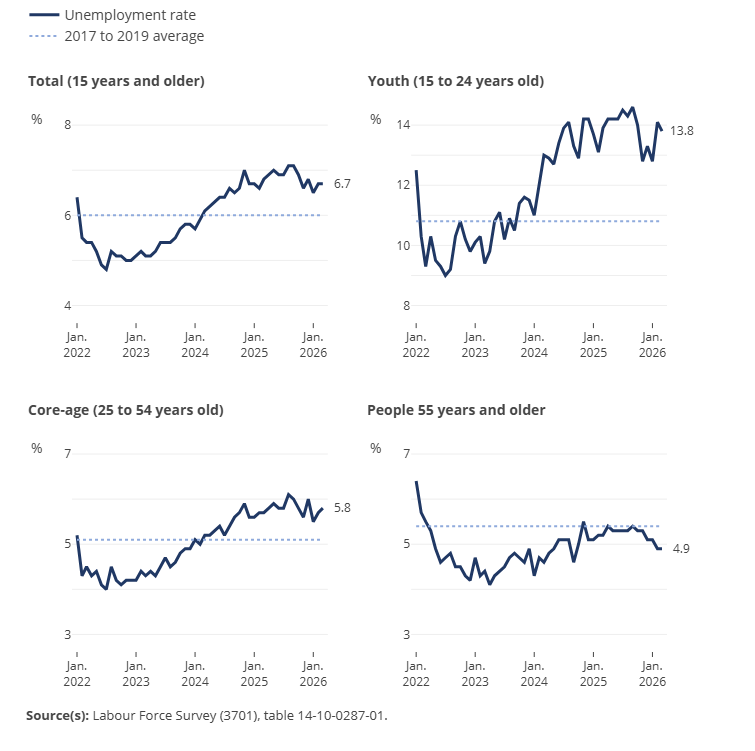
BREAKING NEWS: Canada added a net 14.1k jobs in March, in line with expectations. The unemployment rate was unchanged at 6.7%. It's the first employment gain in three months and partly offsets a decline of 109k jobs in the first two months of the year. Still, it's a small gain and all the gains last month were part-time. Full-time employment was little changed. Labour demand remains anemic.
www150.statcan.gc.ca/n1/daily-quoti…

English

Canada's financial sector has a long history of doing business in China. And Finance Minister Francois-Philippe Champagne's trip to the Asian country, along with Bank of Canada Governor Tiff Macklem and financial sector executives, is not the first such delegation.
In the summer of 2009, Finance Minister Jim Flaherty took Mark Carney, then Bank of Canada Governor, and a swath of bank and insurance executives to China to tout the stability of Canada's financial system and do some business. That too was a time of relationship rebuilding between Canada and China.
Flaherty was one of five ministers who traveled to China that year. Others included Trade Minister Stockwell Day, Foreign Affairs Minister Lawrence Cannon and Transport Minister John Baird. They paved the way for a trip to China for Prime Minister Stephen Harper.
The only difference this time is that the prime minister went first.

English

There's been much discussion about whether Canada could actually benefit from the recent war-induced spike in oil prices. It's a compelling idea, but Canadians should be wary of it.
In fact, I would argue it's unambiguously negative overall, and the costs to us will rise the longer the shock persists.
Higher oil prices will boost export income, profits, and government revenues, particularly in energy‑producing regions. But they will squeeze consumers and non‑energy businesses. They will reduce real disposable income and raise costs economy‑wide. And there are serious distributional and regional impacts, which will create social cohesion and other political challenges.
It will tilt increasingly negative over time as higher energy prices act as a net drag on global growth, even as it drives global inflation and interest rates higher.
Which is why the Bank of Canada has been cautious about highlighting the positive aspects of the crisis.
To be sure, we'll probably be relatively less worse off than the rest of the world. But still worse off.
Of course, one potential longer-term benefit is for the crisis to strengthen the investment case for Canadian energy. But the key factors holding back investment haven't suddenly disappeared: long project timelines, massive lump-sum nature of investment and construction; regulatory and policy uncertainty; as well as uncertainty about long‑term global demand given the potential for a major global downturn.
bloomberg.com/news/articles/…
English

My latest piece for @TheHubCanada. A taking stock on the state of Canada's economy. I write how:
1) The recent data flow has tilted negative. And now with war in the Middle East, the near-term outlook has clearly worsened further
2) We’re facing multiple headwinds at once: probably weaker-than-expected growth to start in 2026; risk of renewed inflation pressures; elevated geopolitical and economic uncertainty
3) But it’s easy to overstate the weakness. The picture is more nuanced than the headlines suggest
4) This is an economy being pulled in different directions. A true “crosswinds” moment. On the downside: trade tensions with the U.S. are weighing on exports and hitting business confidence and investment. On the upside: past interest rate cuts are starting to support households; financial markets (until recently) have boosted wealth and spending; higher commodity prices are lifting incomes and profits; government spending continues to underpin demand
5) The base case hasn’t collapsed. Most economists still expect growth to return to about 2% in the second half of the year, assuming uncertainty eases
6) But risks are rising again. The Middle East conflict is a reminder of how fragile that outlook is
7) The deeper issue remains unchanged: Weak business investment is undermining the fundamentals.
The bottom line:
Canada’s economy is holding up, but is fragile. We’re stuck in a low-velocity economy. Not in recession. Not in a real growth cycle. Just waiting for some certainty.
thehub.ca/2026/03/23/can…
English

News on the Canadian economic front this morning is on the sobering side for the near-term outlook.
The Bank of Canada held its policy rate at 2.25% today, as expected, but struck a notably cautious tone. It flagged downside risks for growth but also upside risks for inflation tied to higher energy prices amid war in the Middle East. In other words, an uncomfortable setup: slowing growth alongside renewed inflation pressures.
Separately, new data from Statistics Canada points to a meaningful shift in another key driver of growth: population.
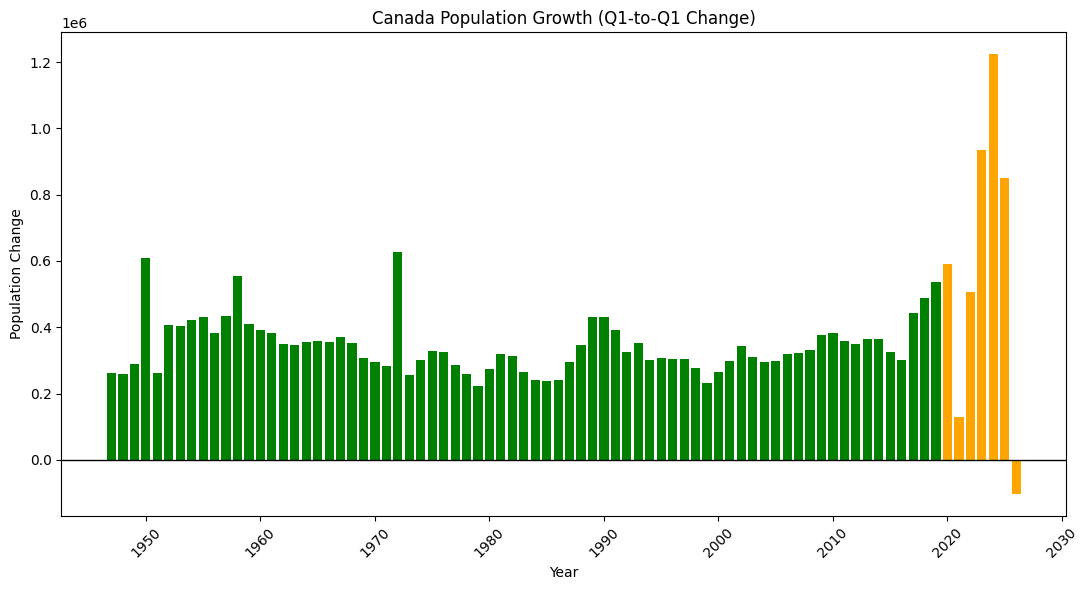
Canada’s population declined in 2025 for the first time on record, falling by just over 100,000.
The government’s effort to scale back immigration is clearly having an effect. That should help ease pressure on housing and tighten labour markets, the intended objective.
But it also removes an important source of economic momentum.
Put it together, and the picture is one of an economy facing multiple headwinds: weaker growth in the near term, renewed inflation risks, heightened uncertainty, and a structural slowdown in population growth.
The margin for error for policymakers is narrowing.

English

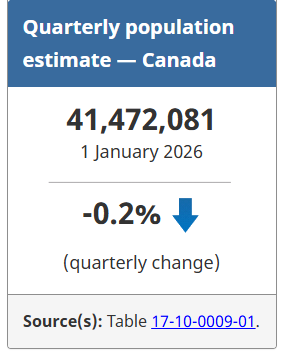
It's official. Canada's population fell for the first time on record in a calendar year. Statistics Canada estimates population declined by just over 100k in 2025, to just under 41.47 million on Jan. 1. Canada took in 394k permanent residents last year, the lowest number since 2020. The population of non-permanent residents dropped by 462k last year.
www150.statcan.gc.ca/n1/daily-quoti…

English

BREAKING NEWS: Bank of Canada leaves its overnight policy rate unchanged at 2.25%. Central bank warns of short-term inflation and growth risks from Middle East conflict. It also acknowledges the higher inflation/lower growth dynamic puts it in a bit of a bind. Key excerpt from the rate statement:
"Relative to our January forecast, risks to economic growth are tilted to the downside. Near-term growth looks weaker than expected and the review of the Canada-United States-Mexico Agreement is a big unknown. At the same time, risks to inflation are tilted to the upside, because of the sharp increase in energy prices. Economic weakness combined with rising inflation is a dilemma for central banks. Raising interest rates to slow inflation could further weaken the economy. Easing interest rates to support growth risks pushing inflation well above target."
English

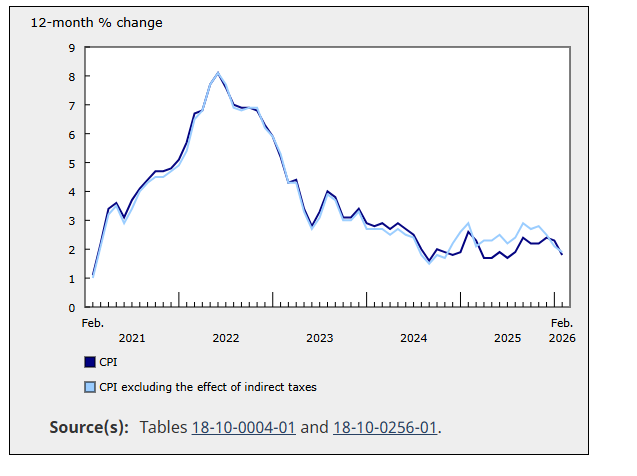
BREAKING NEWS: Canadian inflation continued to ease in February, with consumer prices up 1.8% from year ago. That's down from an annual rate of 2.3% in January. Core price metrics - a better gauge of inflation pressures - also eased and are hovering at just over 2%. All-in-all a benign inflation picture before war erupted in the Middle East.
www150.statcan.gc.ca/n1/daily-quoti…

English

BREAKING NEWS: Canada's economy lost net 83,900 jobs in February, driving Canada's unemployment rate up to 6.7%. Economists were expecting a 10k gain, according to Bloomberg survey.
www150.statcan.gc.ca/n1/daily-quoti…
English

A couple of quick notes on the Canadian GDP numbers out this morning. I’ll focus more on overall 2025 numbers.
But one quick observation on the specifics of the fourth quarter numbers, which showed a drop in GDP in the final three months of the year. Despite the Q4 economic contraction, consumption spending was healthy in the final stretch of 2025. This is good. Less good, businesses chose to meet the demand by drawing down inventories rather than producing more, which is a sign of weak business confidence.
Overall for 2025, real GDP increased 1.7%, which is the slowest pace of annual growth since the pandemic. Lower exports, particularly to the United States, were the main contributor to the slowdown. Growth has averaged 1.9 percent over the past three years. Not off the charts weak, but historically very slow outside of recession.
In real terms (adjusted for inflation), total investment increased 1.4% last year, which is actually the strongest growth in investment since 2021. But investment continues to lag overall growth, which means as a share of the economy, investment continues to decline.
Plus, the total investment numbers this year are inflated by a surge in government spending on weapons systems. The Canadian government spent $29 billion on weapon systems last year, up from $19 billion in 2024. Canada had spent a total of $85 billion during the nine years of the Trudeau government, or just under $10 billion a year. While the weapon spending inflates the investment numbers, they are not exactly growth accretive. We import most of our weapons.
Removing government spending, business investment was little changed last year, after declining the previous two years. In fact, business investment has declined for 12 of the last 15 quarters in real terms – not a good sign.
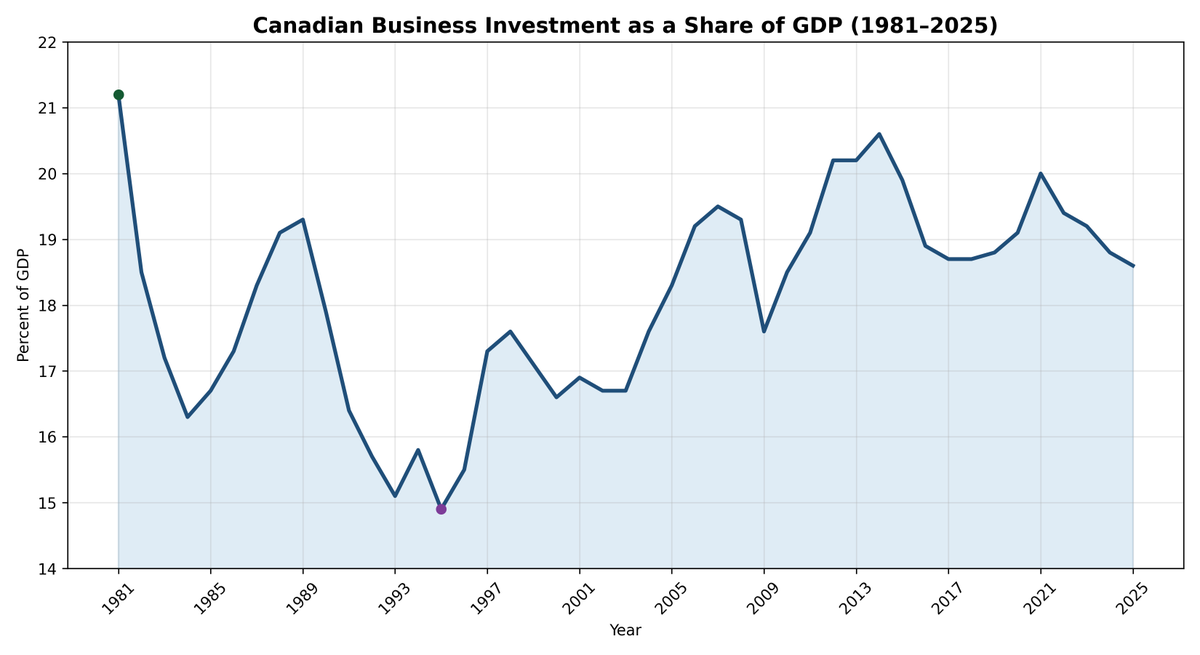
As a share of nominal GDP, business investment dropped two basis points to 18.6%, levels not seen since the early 2000s. (Outside of 2009 and 2010, which were impacted by the crisis at the time.)
In nominal terms, total investment in the economy last year (including business and government) increased by $31 billion to $743 billion. That represents 3 percent of Carney’s target of increasing investment levels in the economy by an additional $1 trillion over five years.
Our goods trade sector continues to shrink as a share of the economy. Two-way merchandise trade totaled $1.58 trillion last year, a small increase from $1.56 billion in 2024. But the increase reflected higher prices. Trade volumes actually shrank last year. As a share of GDP, two-way merchandise trade flows fell below 50% in 2025, the first time that’s happened outside of a recessionary environment since the early 2000s.

English
Theo Argitis retweetledi

I used AI and dozens of subagents to read the Alberta budget docs and I produced an extensive data-rich website with
- analysis for 25 sectors of the economy
- guides for 26 different audiences
- 40 lobbyist stakeholder notes
Done in 30 minutes.
albertabudget.ca
English