10 WEBSITES EVERY STUDENT SHOULD USE BEFORE GRADUATION.
Bookmark every single one. Your university will never tell you about most of these.
1. notebooklm.google
Upload every textbook, lecture, and PDF for a course. Ask questions across all of them. Built by Google DeepMind.
2. sci-bot.ru
Search scientific research fast. Ask any question and get answers with links to relevant papers in seconds.
3. annas-archive.gl
The world's largest open library. Almost any textbook your professor assigned is on here for free.
4. perplexity.ai
Research assistant that cites every source. Replaces 90% of Google searches for academic work.
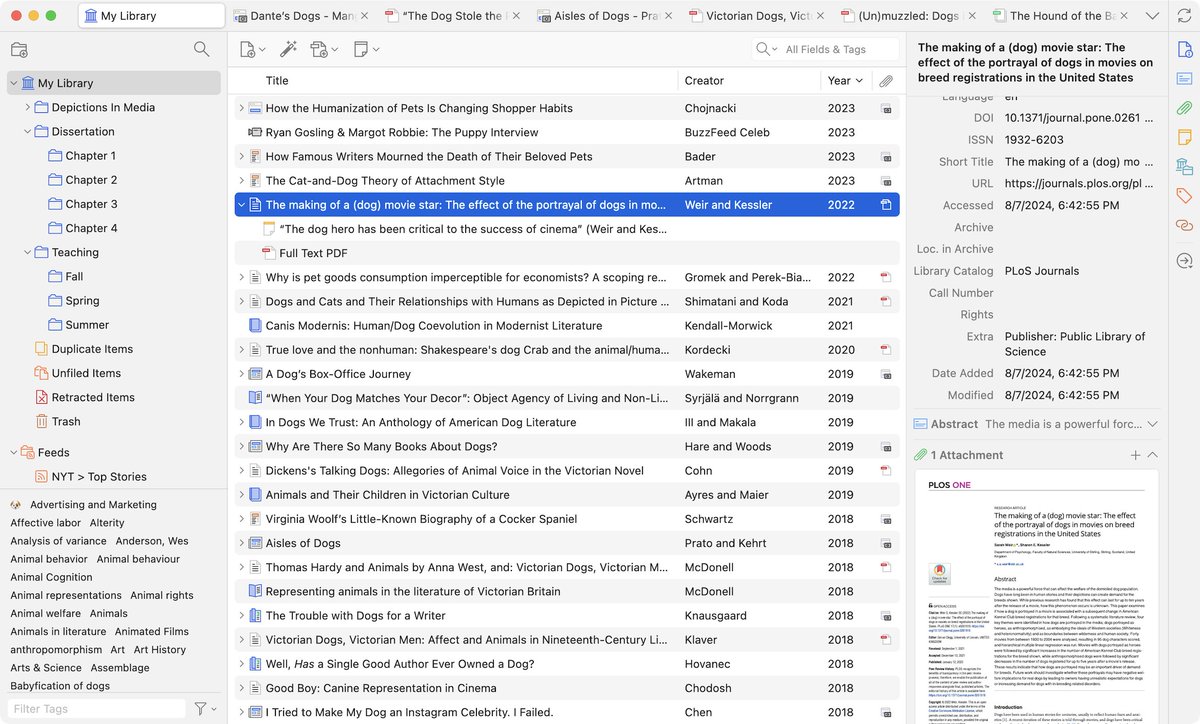
5. zotero.org
Free reference manager that builds your bibliography automatically. Saves 20+ hours per semester.
6. wolframalpha.com
Solves math, physics, chemistry, and engineering problems step by step. Shows the full working.
7. handshake.com
The job platform built specifically for students. 1.4 million employers actively recruiting on it right now.
8. fastweb.com
Matches you to scholarships you actually qualify for. Over $3.4 billion awarded to students every year.
9. coursera.org/learn/learning…
Free Barbara Oakley course taken by 4 million people. The science of how to actually study and remember.
10. linkedin.com/learning
Free with most university logins. 16,000+ courses on everything from Excel to AI engineering.
The students who graduate with the biggest head start are not smarter. They just found the right tools earlier.
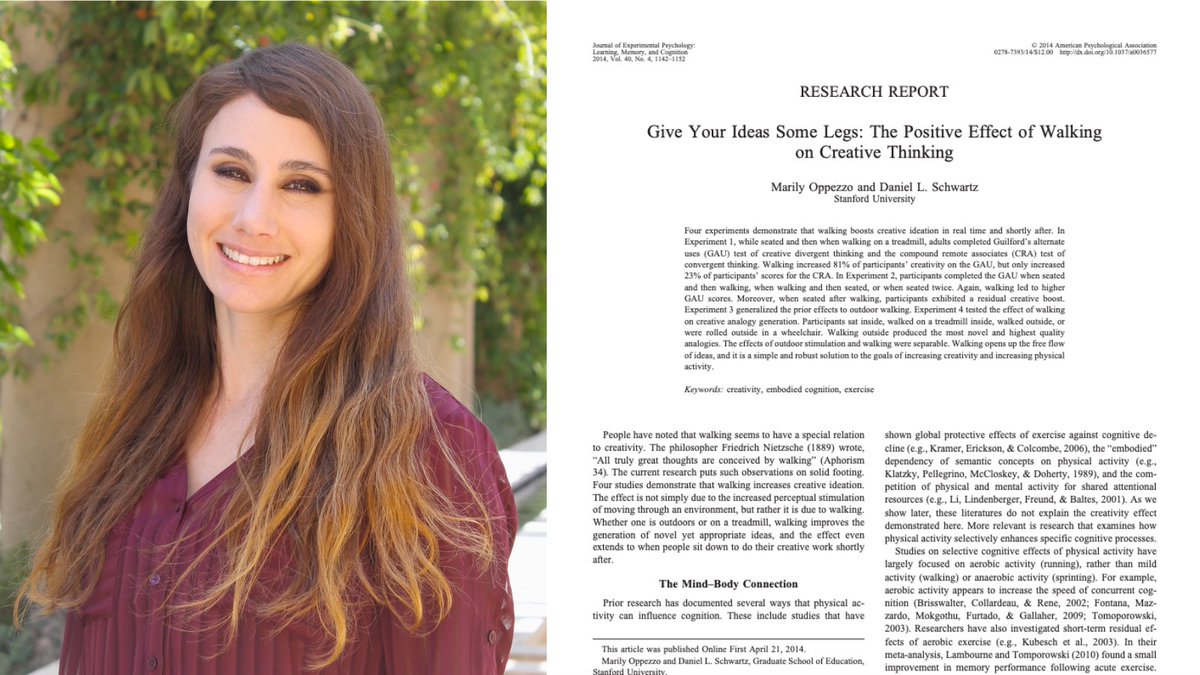
A Stanford psychologist spent 4 years proving that the simple act of walking generates 60% more creative ideas than sitting, and the experiment she designed to kill every alternative explanation is one of the most decisive findings in modern psychology.
Her name is Marily Oppezzo.
She got the idea for the study while walking with her advisor at Stanford to discuss her thesis topic, and the paper she eventually published in the Journal of Experimental Psychology in 2014 is sharp enough that it should have ended the seated meeting on the day it came out.
She ran 4 experiments on 176 people. Same person tested twice. Once sitting, once walking. The creativity tasks were the standard ones psychologists have used for decades to measure how good a brain is at generating novel useful ideas.
The result was almost too clean to publish.
81% of participants in the first experiment produced more creative ideas while walking than while sitting. In the second experiment, 88%. In the third, 100%. Every single person walked into a more creative version of themselves.
On average, people generated 60% more novel useful ideas the moment their legs started moving.
The skeptical question is the obvious one. Maybe it was the fresh air. Maybe it was the scenery passing by. Maybe it was the change of environment doing the work, not the walking itself.
Oppezzo killed every one of those explanations with one experimental decision.
She put people on a treadmill facing a blank wall. No scenery. No fresh air. No environmental change. Just legs moving in place while staring at white drywall. The 60% boost held.
Then she ran the experiment that closed the case completely. She took participants outside in two conditions. Half of them walked through a Stanford courtyard. The other half were pushed through the exact same courtyard in a wheelchair. Same outdoor stimulation. Same scenery passing at the same speed. The only difference was whether the legs were moving.
The walkers produced dramatically more novel high-quality ideas than the wheelchair group. The outdoors did almost nothing on its own. The walking did everything.
This is the part of the study that hit hardest when I read it the first time.
She also tested the opposite kind of thinking. Convergent thinking. The kind where there is one right answer and you have to narrow down to it.
Word puzzles where 3 words share a hidden fourth word that connects them. The seated participants did slightly better on these. Walkers got slightly worse.
Walking is not a general intelligence enhancer. It does one specific thing. It opens up the divergent search inside your brain. The part that generates options. The part that produces unexpected connections. The part that takes a problem and finds five ways into it instead of one.
When you need to converge on the single right answer, sit down. When you need to find the answer in the first place, get up.
The mechanism is now well understood. Walking selectively activates what neuroscientists call the default mode network, the system inside your brain that runs when you are not consciously focused on anything. The DMN is where mind-wandering happens. Where memories cross-reference each other. Where ideas that have been sitting in separate folders inside your head finally bump into each other.
When you sit at a desk and force yourself to concentrate, you suppress the DMN. When you walk at a natural pace, the executive part of your brain gets just busy enough handling the walking that the DMN comes online and starts doing the work that focus was blocking.
The most useful finding in the entire paper is the one almost nobody quotes.
The boost did not turn off the moment people stopped walking. Participants who walked first and then sat back down stayed elevated. Their next round of seated creativity work was still significantly better than people who had been sitting the whole time. The rest lingered for at least several minutes after the legs stopped moving.
You do not need to do creative work while walking. You need to walk before the creative work. The brain holds the state.
The history of this is the part that should haunt anyone who still does meetings in chairs.
Charles Darwin built a gravel loop behind his house in Kent called the Sandwalk and walked it 3 times a day for the rest of his life. The theory of evolution was developed one lap at a time on that path.
Nietzsche walked up to 10 hours a day during the years he wrote his most important books and openly said the work was conceived on his feet.
Beethoven composed for the morning and walked for 5 hours every afternoon with a pencil in his pocket for when something landed.
Kahneman said the best thinking of his Nobel Prize-winning career happened on leisurely walks with Amos Tversky. Steve Jobs refused to take important conversations sitting down. He held them on foot.
Every one of them was using the system Oppezzo would not measure until 2014. They just did not know what to call it.
The question worth sitting with is the one almost nobody asks.
Every meeting you have ever attended sitting around a table was a meeting held at a fraction of the brain power that was actually available to the people in the room. Every brainstorm that got stuck inside a conference room. Every problem you tried to solve at a desk and gave up on. Every idea you could not quite get to.
The intervention is the easiest one in modern science. No supplement. No app. No subscription. No training program. Just a pair of legs and 15 minutes.
The Stanford lab proved it. The philosophers knew it. The neuroscience explains it.
And almost everyone reading this is still trying to think their way out of problems sitting completely still.
A Turkish developer quietly built the best screenshot tool on Windows alone for almost two decades, and the wildest part is that Steam offered to let him charge for it and he said no.
It's called ShareX.
It does everything Snagit charges $63 a year for, everything Lightshot does, everything Greenshot does, plus things neither of them have ever attempted.
Here's the story.
The developer goes by Jaex. He shipped the first version of ShareX on October 15, 2007. He has been actively developing it ever since.
18 years of one person showing up to maintain free software that millions of people use every day.
When ShareX launched on Steam, Jaex made a decision that goes against every instinct in the software industry. He listed it for $0. No paid tier. No premium features. No donation tier even though Steam allowed it. The only way to support him is a donate button buried on the website that he barely promotes.
The software itself is absurd.
You press a hotkey. You capture any region, scrolling webpage, window, or monitor. The built-in image editor opens with annotation tools that look like Photoshop. Arrows, text, blur, pixelate, step numbers, speech balloons, smart eraser, crop, cutout. All free.
It records video. It records GIFs. It runs OCR on any image. It auto-uploads to 80+ destinations including your own server. It has a color picker, ruler, QR generator, image combiner, video converter, and hash checker built into the same app.
The install is 4.6MB. Snagit is 600MB and costs $63.
ShareX has been on GitHub since 2013 and the codebase is still maintained by the same one person who started it. 37K stars. GPL license.
The most powerful screenshot tool ever made on Windows was built by one person in Turkey who decided money was not the point.
getsharex.com
GPL License. 100% Opensource.
@ihtesham2005 “Torches of freedom” is still one of the darkest marketing lessons ever.
Take a harmful product, attach it to a noble identity, let the audience defend it for you.
Sigmund Freud's nephew wrote a 168-page book in 1928 that taught American corporations how to manufacture desire, and almost every advertising campaign and political messaging strategy you have ever seen still runs on the playbook he wrote a century ago.
His name was Edward Bernays. The book is called Propaganda. And the strangest thing about it is that he was completely open about what he was doing.
He opened with one of the most chilling sentences ever published in a non-fiction book: “The conscious and intelligent manipulation of the organized habits and opinions of the masses is an important element in democratic society. Those who manipulate this unseen mechanism of society constitute an invisible government which is the true ruling power of our country.”
He was not warning you about this. He was advertising his services.
Bernays had figured something out that nobody else in the early 20th century had put into words.
The old model of selling things to people was broken. You could not just describe a product and expect people to buy it. Humans do not make decisions based on information. They make decisions based on emotion, identity, and social pressure, then construct a rational story afterward to explain what they already wanted to do.
His uncle Sigmund Freud had spent decades documenting this in clinical psychology. Bernays took that work and pointed it at consumer markets and political campaigns.
The case study that made him famous is the one almost nobody knows the full story of.
In 1929, the American Tobacco Company hired him because women were not buying cigarettes. Smoking in public was considered scandalous for women at the time. The market was cut in half by social taboo and the company could not figure out how to break through.
Bernays did not run an ad campaign. He hired a psychoanalyst to figure out what cigarettes symbolically meant to women. The answer that came back was that cigarettes represented male power, and the taboo against women smoking was a symbol of male dominance over female freedom.
So he staged an event. He recruited a group of fashionable young women to march in the 1929 New York Easter Parade and light cigarettes in public at a coordinated moment. He tipped off the press in advance and told them to expect a feminist demonstration. He named the cigarettes "torches of freedom."
The photographs ran on the front page of newspapers across the country. Within a few years, female smoking rates had jumped. He had not sold cigarettes. He had sold liberation, and the cigarette came along for the ride.
The mechanism underneath every move he ever made is the part you should not forget.
He never sold the product. He sold the identity the product represented. He never argued with the audience. He restructured the environment until the conclusion he wanted felt like the audience's own idea. He never appealed to reason. He appealed to the unconscious associations people already had and quietly attached his client's product to those associations.
Every influencer marketing campaign, every political ad, every Super Bowl commercial that makes you feel something without telling you why, every news segment that frames a story before you have time to think about it, is running a version of his original system.
He died in 1995 at the age of 103. He gave interviews in his final years admitting that he had helped overthrow a democratically elected government in Guatemala in 1954 by manipulating American public opinion against it. He said it without regret. He was proud of the work.
The book is 168 pages. It is in the public domain. You can read it in one evening.
Almost nobody who is being manipulated by his methods has ever opened it.
@ihtesham2005 The real flex at 50 might not be money, status, or abs.
It might be having three people who know the unedited version of you and still pick up the phone...
In 1938, Harvard started tracking 724 men including a future president. The study ran 85 years. They proved loneliness kills faster than smoking. The variable doctors still are not measuring.
His name is Robert Waldinger.
He is a psychiatrist at Harvard Medical School and the fourth director of the Harvard Study of Adult Development, the longest in-depth study of adult life ever conducted.
He did not start the study. He inherited it.
When Waldinger took over, the data was already decades deep. Medical records. Blood tests. Brain scans. Questionnaires answered every two years by men who had watched their own lives unfold from college to old age.
He had access to something almost no scientist ever gets. A complete picture of what a human life actually looks like from the beginning to the end.
The original 268 participants were Harvard sophomores from the classes of 1939 to 1944. Among them was a young man named John F. Kennedy. The second cohort was 456 men from Boston's inner-city neighborhoods, added to balance out the privilege of the first group.Two completely different starting points. Same study. Same questions. Same eighty-plus years of follow-up.
Researchers tracked everything they thought might matter like Cholesterol, exercise habits, income, IQ, social class, and genetics. Every variable medicine said was the key to a long and healthy life.
None of them was the strongest predictor. So, what it is?
The finding that Waldinger kept coming back to, the one that runs through every paper the study has produced, is this: relationship satisfaction at age 50 predicted physical health at age 80 better than cholesterol levels did.
Not the number of relationships. The QUALITY of them.
The men who reported being most satisfied in their close relationships at midlife were the healthiest at 80. The men who were isolated, or who were surrounded by people but trapped in conflict and disconnection, declined faster. Their bodies broke down earlier. Their memory slipped sooner. They died younger.
Loneliness kills.
It is as powerful as smoking or alcoholism. Chronic disconnection hits the body the way smoking fifteen cigarettes a day does. Not as a metaphor. As a measurable biological fact.
The detail that should stop you is the one about the brain.
The men who were more isolated than they wanted to be did not just report being unhappy. Their brain functioning declined measurably sooner than the men who felt genuinely connected. Memory. Cognitive speed. Processing. All of it degraded faster in men who felt alone. The social deprivation was not just emotional. It was neurological.
The most unsettling part of the dataset is what it says about the difference between being alone and feeling alone.
You can feel lonely in a room full of people. You can feel lonely inside a marriage. Waldinger emphasized this repeatedly because the number most people optimize for, their headcount of friends, their relationship status, their social calendar, is almost entirely the wrong metric.
What the data actually tracked was whether people felt known. Whether they had someone they could call at 2am. Whether the people around them were genuinely safe.
Living inside chronic conflict, even with someone you love, produced the same physiological damage as isolation. The presence of another person is not the protection. The quality of the connection is.
The data is not subtle. It is one of the largest, longest, and most carefully documented longitudinal studies ever run on human beings. It followed men from their twenties through their deaths.
It collected blood and brain scans and questionnaires and interviews across eight decades. It started when Franklin Roosevelt was president and is still running today, now tracking over 1,300 descendants of the original participants.
Relationships are better predictors of a long life than social class, IQ, or genes. That finding held across both cohorts. The Harvard men and the Boston inner-city men. Two completely different lives. Exactly the same answer.
After 85 years and thousands of medical records, the answer is the same one your grandmother probably already knew.
The question it leaves you with is not complicated. It is just uncomfortable.
At 50, when the researchers looked back at the men who aged best, they were not asking what those men had achieved. They were asking how deeply those men had let other people in.
Most people spend the middle of their lives optimizing for things the data says almost do not matter. And they spend almost no time on the single variable that the longest study of human life ever run says matters more than any of them.
The study is still ongoing. The answer has not changed.
@ihtesham2005 Publishers hate it because it does the one thing academia keeps pretending is impossible:
makes research easier without charging the student again.
Every academic publisher on Earth has lobbied to keep this software off university recommendation lists for the last 15 years.
It's called Zotero, and it is the one citation manager Elsevier, Springer, and Wiley cannot acquire, paywall, or kill.
A non-profit organization built it in 2006 and gave it away.
The browser extension rips the full metadata, PDF, and DOI off any paper on JSTOR, Elsevier, ScienceDirect, or Wiley in one click.
You can annotate inside the reader. Cite into Word, Google Docs, LibreOffice, or OnlyOffice in 10,000+ styles.
100% Opensource.
zotero.org
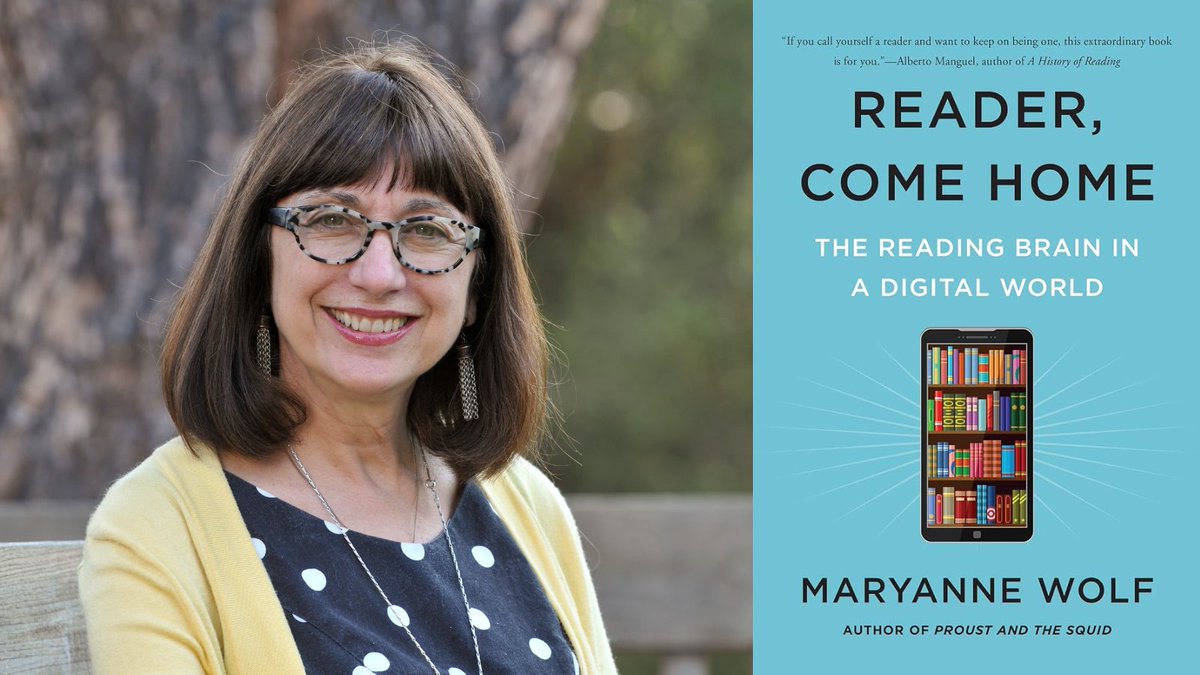
A neuroscientist who spent 20 years proving that reading on screens damages your brain sat down to read her favorite novel and discovered that the damage had already happened to her.
Her name is Maryanne Wolf.
She runs the Center for Dyslexia at UCLA and is one of the most cited reading scientists alive. The experiment she ran on herself is sitting inside a book she published in 2018.
Here is the one fact that breaks how most people think about reading.
Humans were never born to read. Yes, you read that right. There is no reading center in the brain. There is no gene for literacy. Every reader builds a custom circuit inside their own skull by repurposing brain regions that originally evolved for vision, language, and recognizing objects.
Wolf calls it the reading brain circuit. The circuit is not a given. It is built by use. And because it is built by use, it can be unbuilt by disuse.
The circuit she spent her career mapping is not the one that just turns letters into sounds. Sitting on top of that is something she calls the deep reading circuit. Both hemispheres firing. Multiple lobes coordinating.
The visual system, the language regions, the memory centers, the emotional and motor systems all firing in a choreographed sequence that takes the brain a few seconds longer to run than skimming does.
Those few extra seconds are where everything important happens. Background knowledge pulls up. Analogies form. Inferences fire. The mind takes the perspective of the character. Critical analysis runs in the background while emotion runs in the foreground. New thoughts get generated on top of the author's thoughts. The decoding is the entry ticket. The deep circuit is the show.
Skimming does not fire this circuit. There is no time.
In 2018 Wolf ran a private experiment on herself. She decided to reread Hermann Hesse's Magister Ludi, a dense novel she had loved as a young woman. She was the world's leading expert on the reading brain. She assumed her own circuit was intact.
It was not.
She opened the book and could not get through it. Her words, not mine. She wrote that she hated the book. The sentences felt like snakelike constructions that confuse meaning instead of revealing it. 6She described the experience as someone pouring thick molasses over her brain every time she picked it up. She wrote one sentence that should haunt anyone who reads it. "I now read on the surface and very quickly, in fact, I read too fast to comprehend deeper levels."
The woman who built her entire career on the deep reading circuit had quietly lost access to her own.
The mechanism is brutal in how simple it is. Eye-tracking research from Ziming Liu at San Jose State shows that when people read on screens, almost all of them fall into the same pattern. They read the first line. Then their eyes word-spot down the page in an F shape. They sample. They do not read. Whatever you stop using, your brain stops maintaining.
The data is the part most people have never seen. In 2018 Pablo Delgado ran a meta-analysis of 54 studies covering more than 170,000 participants. Same text. Half on paper. Half on screen. The screen group lost by 0.21 standard deviations. Replicated by Clinton at 0.25. Replicated by Kong at 0.21. Researchers gave it a name. They call it the screen inferiority effect.
The worst part is what happened over time. The gap has grown larger in studies done after 2010, not smaller. Digital natives do not outperform older readers. They underperform them on the same texts. More exposure makes it worse, not better.
Screen readers are also more confident they understood than paper readers. They think they got more out of the text than they actually did. The skimmer does not know they are skimming. They believe they are reading.
The stakes Wolf keeps coming back to are not academic. The deep reading circuit is the same circuit your brain uses to take another person's perspective. To weigh complex civic information. To read a contract, a ballot question, a medical disclosure and notice what is actually being said underneath what is written.
If the circuit atrophies, those capacities go with it. Not metaphorically. Structurally.
You are not getting dumber. You are not losing intelligence. You are quietly losing access to a specific circuit that takes longer to fire than your phone is willing to wait for.
The expert who spent 20 years warning the world ran the experiment on herself and barely made it back.
Most people are not running the experiment at all.
So here's the real question:
If the nonprofit that was supposed to save humanity from AI became a trillion-dollar company instead...
Was the mission ever real? Or was it just the origin story?
The trial runs 3-4 weeks. Up next:
Musk continues Wednesday. Then Altman, Brockman, Nadella, Sutskever, Murati.
Every major AI figure, under oath, in one courtroom.
OpenAI is projected to lose $14B this year despite a $122B round. Florida's AG is separately investigating them.
Musk's most striking testimony wasn't about money. It was about belief.
He recounted an argument with Google co-founder Larry Page, who called him a "speciesist" for caring about humans over AI supremacy.
That, Musk said, is why he built OpenAI. To protect humanity.
Then Musk took the stand.
"I came up with the idea, name, recruited the key people, provided the funding," he testified.
He recounted recruiting Ilya Sutskever personally. Said Nadella once told him: "the only reason he's in this thing is because of me."
Inside the courtroom, the tension was immediate.
Musk's attorney opened with a grenade: "We are here because the defendants stole a charity."
He compared OpenAI's for-profit pivot to a museum store that "sold the Picassos."
The jury leaned in.
The numbers are staggering.
Musk donated ~$38-44 million to a nonprofit. OpenAI is now worth $852 billion. Planning a Q4 IPO at ~$1 trillion.
Musk wants the for-profit conversion rolled back, Altman removed, and $134-150 billion disgorged.
OpenAI fired back just as hard.
"We are here because Mr. Musk didn't get his way," said their attorney William Savitt.
He called the whole lawsuit a "pageant of hypocrisy."
Savitt revealed Musk wanted >50% equity and tried to merge OpenAI with Tesla.
The most important trial in tech history just began.
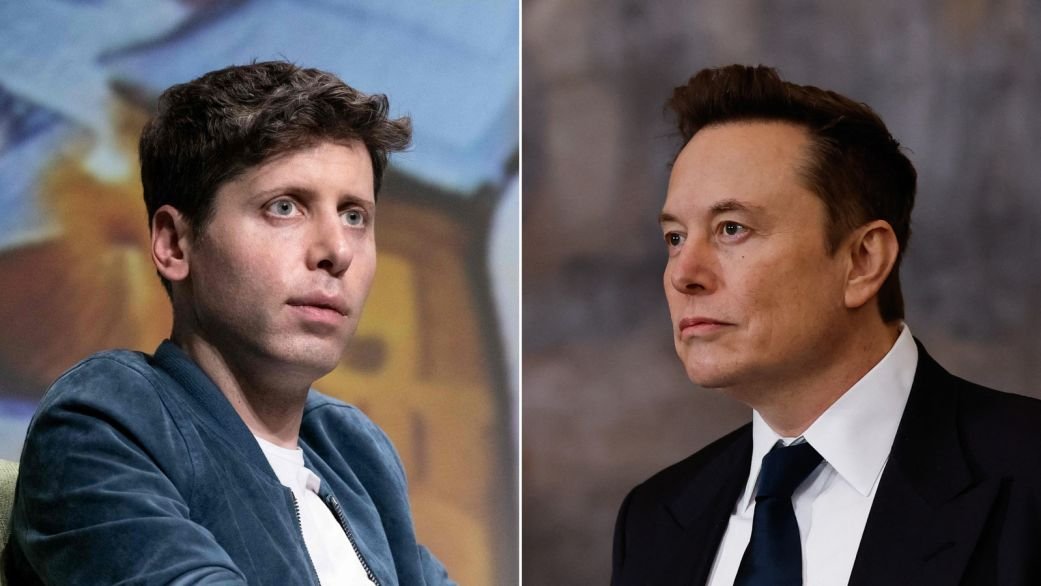
Elon Musk. Sam Altman. A courtroom in Oakland. $150 billion on the line.
And one question: Can you steal a charity?
A thread