5xTippet

7 posts

5xTippet

5xTippet

@TippetRing

Trying very hard. Husband. Father. Neurosurgeon. Flyfisherman. Amateur radio operator. Contrarian investor. Always learning.

United States Katılım Kasım 2012
221 Takip Edilen62 Takipçiler
5xTippet retweetledi
EndGame Macro
EndGame Macro@onechancefreedm·
What BlackRock Just Did Suggests Credit Stress Is Starting To Spread The only economically serious reason BlackRock does this is to avoid turning a redemption wave into forced price discovery inside an illiquid loan book. The 5% quarterly repurchase cap was already built into the fund, but the fact that requests jumped to about 9.3% of NAV and management chose to hold the line tells you that they do not want to sell assets fast enough to satisfy everyone at once. The current tender documents say the fund is offering to repurchase only about 5% of shares, that excess tenders are handled pro rata, and that meeting repurchases can impair liquidity, force earlier asset sales, and potentially create losses. It has also been reported that HPS told investors it wanted to preserve available capital while staying within the fund’s designed liquidity terms. That is not a solvency confession. It is a liquidity defense move. That is why I do not think the real story is the headline cap itself. The cap is structural. The real story is that BlackRock chose not to stretch beyond it the way Blackstone just did. Blackstone raised its usual 5% limit to 7% and added $400 million of firm and employee capital to meet requests. BlackRock did the opposite. That tells me management thinks preserving liquidity and optionality is worth more right now than demonstrating generosity to exiting investors. In plain English, they are defending the book. My inference is that they do not want to discover, in size and under pressure, what the true clearing price of those loans would be in this tape. Why That Matters For The U.S. Economy This matters because HPS Corporate Lending Fund is not some niche side vehicle. It is a business development company built to lend primarily to private U.S. upper middle market companies through senior secured and other private credit investments. When a lender like that shifts from deployment mode to liquidity preservation mode, the real economy eventually feels it. Credit gets more selective. Refinancing gets harder. Spreads widen. Terms tighten. Borrowers that looked fine when money was abundant suddenly have to operate in a world where capital is slower, more expensive, and more conditional. That usually shows up first in deal activity and capex, then in hiring, then in defaults. So the macro signal here is not that consumers wake up tomorrow to a 2008 style banking panic. It is subtler than that, and in some ways more dangerous because it hides longer. Private credit has become a major credit channel outside the banking system, and regulators have been warning that the risks are centered on opacity, credit risk, liquidity risk, and growing connections to banks and insurers. FSOC said banks loan commitments to private credit funds were about $445 billion as of Q2 2025, while the IMF has warned that semiliquid private credit vehicles can create procyclical inflows and outflows and that their liquidity buffers can fail in stress. Once that channel tightens, the economy feels a form of shadow monetary tightening even if the Fed does nothing. The Bigger Macro Read BlackRock is signaling that price and liquidity are not the same thing in private credit. In boom times, investors treat marked NAV as if it were cash adjacent. In stress, managers remind them it is not. If more investors keep testing that distinction, the next phase is reflexive where redemptions pressure liquidity, liquidity pressure weakens marks, weaker marks hurt confidence, and tighter credit hits the real economy with a lag. This is absolutely a late cycle warning that the private credit machine is moving from yield extraction to capital preservation. And when the biggest players start protecting liquidity instead of maximizing growth, that usually means the underlying economy is weaker than the public narrative still assumes.
zerohedge@zerohedge

*BLACKROCK’S $26 BILLION PRIVATE CREDIT FUND LIMITS WITHDRAWALS *BLACKROCK FALLS 4% AT THE OPEN

English
14
46
221
64.2K
5xTippet retweetledi
tern
tern@1goodtern·
I don't think enough people understand the significance of the difference *and* connection between *dysregulation* and *deficiency*.
English
11
50
241
48.3K
5xTippet retweetledi
Pink Floyd 💎
Pink Floyd 💎@Just_pinkfloyd·
So, so you think you can tell Heaven from Hell, blue skies from pain Can you tell a green field from a cold steel rail? A smile from a veil? Do you think you can tell? Did they get you to trade your heroes for ghosts? Hot ashes for trees? Hot air for a cool breeze? Cold comfort for change? Did you exchange A walk-on part in the war for a lead role in a cage? How I wish, how I wish you were here We're just two lost souls swimming in a fishbowl, year after year Running over the same old ground What have we found? The same old fears Wish you were here
English
59
669
2.7K
48.3K
5xTippet retweetledi
Shanaka Anslem Perera ⚡
Shanaka Anslem Perera ⚡@shanaka86·
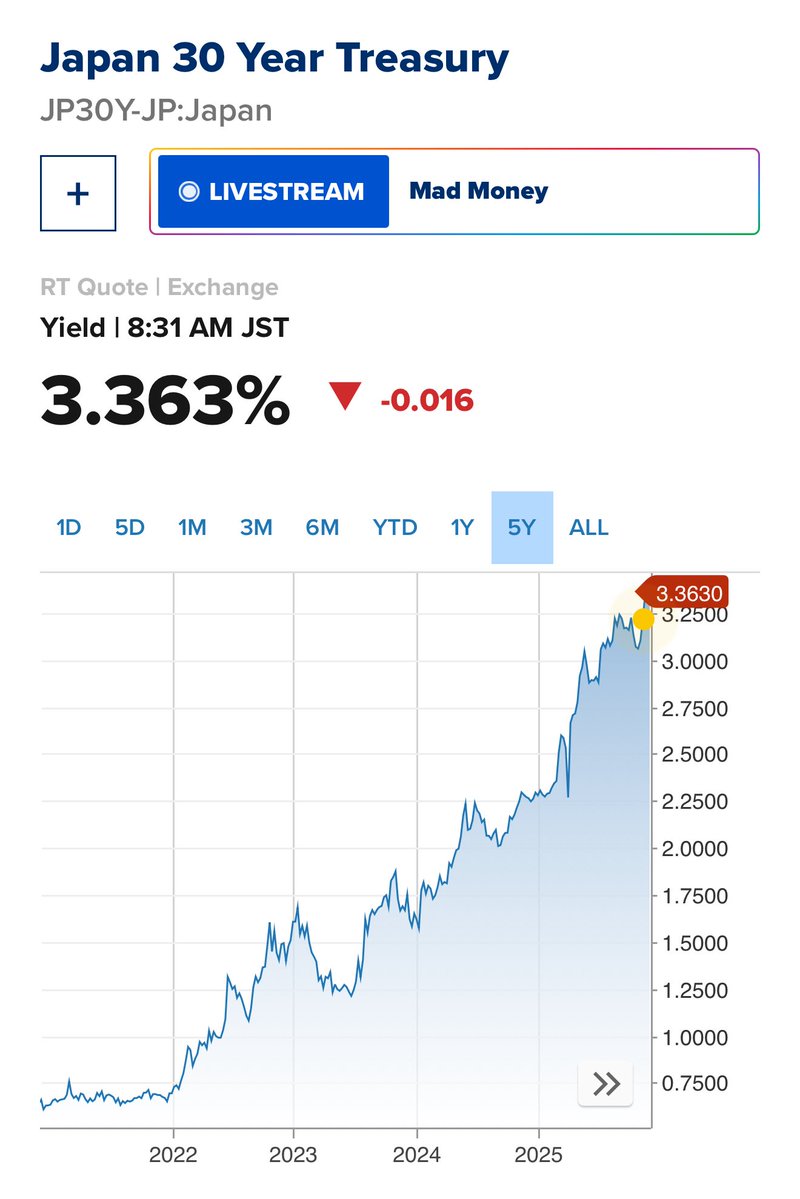
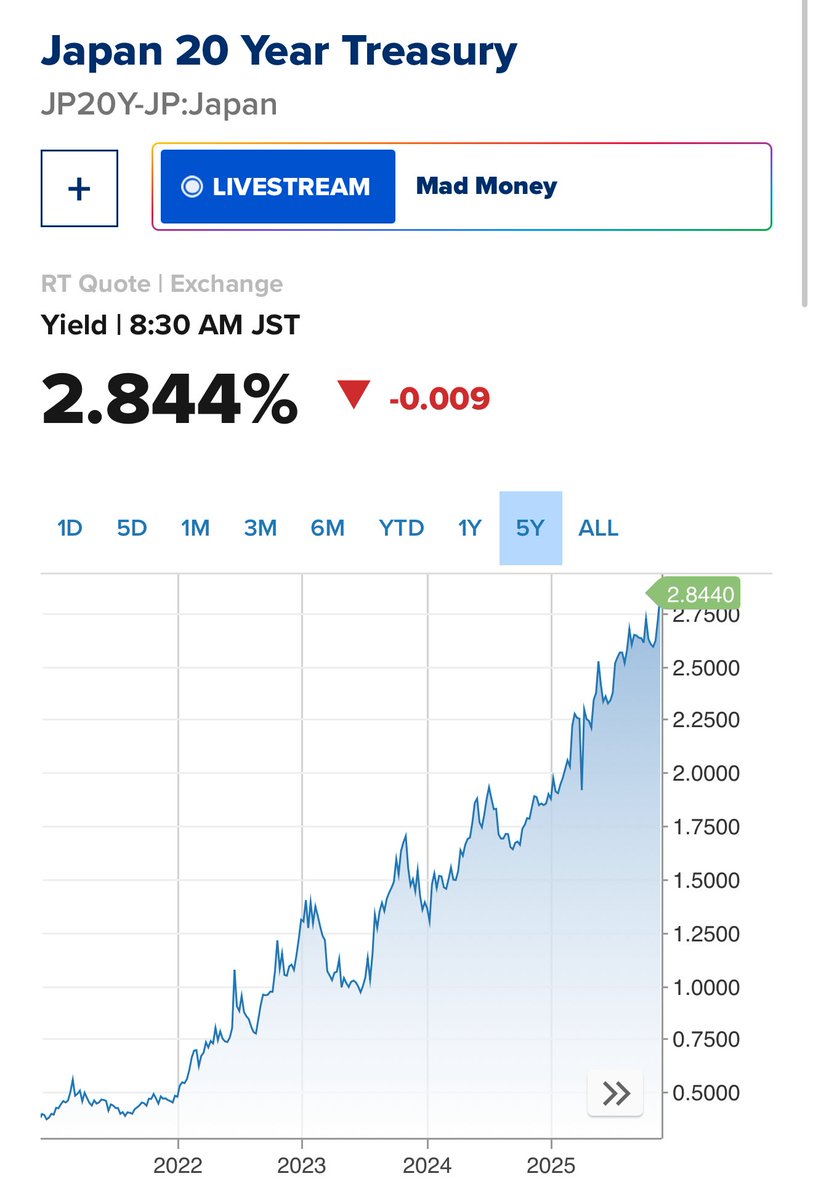
THE GLOBAL FINANCIAL SYSTEM JUST BROKE IN TOKYO Japan’s 30-year bond yield hit 3.41% today. That number means nothing to you. Here’s why it should terrify you. Japan owes 230% of everything it produces. It’s the most indebted nation in human history. For 35 years, they kept the lights on by borrowing at near-zero rates. That era ended this morning. Here’s What Just Happened Core inflation is running at 3.0%. Government bond yields are spiking to levels not seen since 1999. China just conducted its 25th military incursion near Japanese waters this year. Japan is now forced to spend 2% of GDP on defense … nearly 9 trillion yen annually. The Bank of Japan is trapped between two impossible choices: raise rates and trigger a debt collapse, or keep rates low and watch inflation destroy savings. They chose door number two. Why You Should Care Every major bank, hedge fund, and institution on Earth has borrowed yen at cheap rates and invested it elsewhere for 30 years. This “carry trade” could be worth anywhere from $350 billion to $4 trillion. Nobody knows the real number because it’s hidden in derivatives. When Japan’s system breaks, this money unwinds. Fast. The last time we saw a preview … July 2024 … the Nikkei dropped 12.4% in a single day. The Nasdaq fell 13%. That was a small tremor. The earthquake is coming. The Math Is Simple! Japan’s government pays interest on $9 trillion in debt. Every 0.5% increase in rates costs them $45 billion annually. At current yields, debt service will consume 10% of all tax revenue. That’s the death spiral threshold. The yen is trading at 157 to the dollar. If it strengthens to 152, the entire carry trade becomes unprofitable. Unwinding begins. Emerging market currencies could drop 10-15%. The Nasdaq could fall 12-20% as funds are forced to sell. What Happens Next December 18-19, the Bank of Japan meets. Markets are pricing 51% odds they raise rates another 0.25%. If they do, volatility explodes. If they don’t, inflation accelerates and the problem gets worse. There is no way out. Japan’s fiscal dominance is now permanent. They must keep the yen weak to service their debt. This means the free money that powered global markets since 1990 is ending. The Bottom Line Interest rates worldwide are going up 0.5-1.0% permanently. Not because of inflation. Because the world’s largest creditor nation can no longer subsidize global growth. Your mortgage, your car loan, your credit card … all repricing higher. Stock valuations built on cheap money … all compressing. The everything bubble … all deflating. This is not a recession. This is a regime change. The largest liquidity engine in financial history just seized up, and most people won’t understand what happened until their portfolios are down 30%. Tokyo broke the world today. You’ll feel it tomorrow.​​​​​​​​​​​​​​​​ Read the full data driven deep dive article - open.substack.com/pub/shanakaans…
Shanaka Anslem Perera ⚡ tweet mediaShanaka Anslem Perera ⚡ tweet mediaShanaka Anslem Perera ⚡ tweet media
English
535
3.2K
12.8K
3.5M
5xTippet retweetledi
John P. Hussman, Ph.D.
John P. Hussman, Ph.D.@hussmanjp·
Trump's crypto isn't just grift. It's emolument. People ask why my criticism of this regime goes so far beyond any other administration. Honest view - it's because this regime poses a malignant threat to democratic institutions, U.S. allies, the economy, and the most vulnerable.
Chris Murphy 🟧@ChrisMurphyCT

So it’s really important you understand the Trump Coin grift. It hasn’t gotten enough attention, but it’s maybe the biggest White House corruption in a century. Right out in the open for all to see. I’m going to explain how the grift works. Only takes 3 minutes.

English
18
27
197
31.9K
5xTippet retweetledi
Marina Purkiss
Marina Purkiss@MarinaPurkiss·
Not one sane, genuine, thinking person can watch this video… And come to any other conclusion Than Trump appears not to be America first… But Russia first. How compromised is he?!
English
709
2.4K
7.8K
243.7K