UMich Ecology and Evolutionary Biology

5.5K posts

UMich Ecology and Evolutionary Biology banner
UMich Ecology and Evolutionary Biology

UMich Ecology and Evolutionary Biology

@UMichEEB

We study & teach about the causes & consequences of biodiversity. Ecology & evolution are central to key issues in the world today! BSB image ©Bruce Damonte

Ann Arbor, MI Katılım Ekim 2018
979 Takip Edilen2.3K Takipçiler
UMich Ecology and Evolutionary Biology retweetledi
University of Michigan
With morel mushroom season underway in Michigan, @UMichEEB professor and curator of fungi Timothy James joins @CBSDetroit to demonstrate how to search for morels, and shares the best time and places to find them and what to pack when searching. myumi.ch/kZr5p @UMichLSA
University of Michigan tweet media
English
0
3
15
5.8K
UMich Ecology and Evolutionary Biology retweetledi
Matt Friedman
Matt Friedman@Friedman_Lab·
#NAPC2024 conference program proofs just dropped!
Matt Friedman tweet mediaMatt Friedman tweet mediaMatt Friedman tweet mediaMatt Friedman tweet media
English
0
3
43
2.2K
UMich Ecology and Evolutionary Biology retweetledi
Matt Friedman
Matt Friedman@Friedman_Lab·
With two weeks to go, I'm working on the really important details of #NAPC2024 organization: researching dinosaur cookies available from the @umich bakery.
Matt Friedman tweet media
English
1
3
62
2K
UMich Ecology and Evolutionary Biology
“In general, howler monkeys are very resilient to those conditions and can survive for long periods of time,” said Liliana Cortés Ortiz, a primatologist at the University of Michigan. bit.ly/3KkuUjl
English
0
0
2
260
UMich Ecology and Evolutionary Biology retweetledi
Michigan News
Michigan News@UMichiganNews·
The deaths of dozens of howler monkeys in Mexico may be the latest sign of the danger extreme temperatures pose to wildlife worldwide. “Howler monkeys are very resilient to those conditions and can survive for long periods of time,” but things are changing “so fast that it’s going to be very difficult for many species to adapt,” said Liliana Cortés Ortiz, research associate professor of ecology and evolutionary biology with @umichLSA's @UMichEEB via nytimes.com/2024/05/22/cli…
Michigan News tweet media
English
0
4
7
701
UMich Ecology and Evolutionary Biology
A warm Wolverine welcome to our newest team member, Rory Walsh! As Master’s Graduate Coordinator and DEI Liaison for #UMEEB, Rory is ready to champion our Master's students and drive DEI initiatives to new heights. Welcome aboard! bit.ly/3WYyIhK 🎓🔬
English
0
0
4
337
UMich Ecology and Evolutionary Biology retweetledi
Michigan News
Michigan News@UMichiganNews·
Freshwater mussels: Investigating the remarkable reproductive cycle of Michigan's threatened mollusks Michigan is home to 43 species of native freshwater mussels, 30 of which are considered to be at risk of extinction. Among the many factors that threaten the hard-shelled bottom dwellers are competition from invasive zebra and quagga mussels, water pollution, and—especially—dams. The Huron River in Southeast Michigan, for example, has 19 dams on its main stem and at least 96 across its entire drainage. Damming completely transforms a river’s ecology, replacing native mussel-rich shoal, riffle, and pool habitats with less suitable lake-like reservoirs. Two University of Michigan biologists led a recent freshwater mussel study based on fieldwork along the Huron River and the River Raisin, also in Southeast Michigan. The study, published May 24 in the journal @thePeerJ, investigates freshwater mussels’ remarkable reproductive cycle, which includes the use of fleshy “mantle lures” by pregnant females to attract nearby fish and “infect” them with mussel larvae. The study’s lead author, Trevor Hewitt, conducted the fieldwork for his doctoral dissertation in the U-M Department of Ecology and Evolutionary Biology. The senior author, Diarmaid Ó Foighil, is a professor in the department and was Hewitt’s adviser. What background information would someone who is completely unfamiliar with your field need to know to understand the findings of your study? Hewitt: Freshwater mussels undergo an obligate parasitic larval development in which pregnant females must infect a suitable fish host with her young. The mussel larvae typically attach to the host fish’s gills, and after two to four weeks they metamorphose into juveniles and drop to the riverbed. Many mussel species are host specialists, infecting just one or a few species of fish, and utilizing distinct host infection strategies. One of the most striking strategies involves use of a mantle lure. This is a pigmented tissue flap displayed by pregnant females to mimic a host prey item (a small fish, an invertebrate, etc.), eliciting an attack by the host fish and resulting in its infection. Mantle lure displays are a remarkable and understudied example of mimicry in nature that occurs in many of our streams and rivers each spring and summer. What exact research question did you set out to answer, and what methods did you use? Hewitt: Our research focused on the mantle-lure diversity present in one mussel species, the wavy-rayed lampmussel, which is found from Michigan to Alabama. This mussel uses smallmouth bass as its primary fish host and, most unusually, it has two highly distinctive types of mantle lures. One, previously termed “darter-like,” resembles a small fish called a darter, complete with eye spots, mottled body coloration and prominent marginal extensions including a tail. The other, previously termed “worm-like,” is uniformly bright orange underlain with black. Both lure forms, or morphs, co-occur throughout the animal’s range. Our research aims were to: 1) confirm that the mantle lure diversity represents a true polymorphism, meaning a clearly different form within a population of the species; 2) investigate its ecological persistence through time; 3) identify the range of putative model species targeted by this mimicry system in a natural population; and 4) determine whether the two mantle lure morphs differ in their display behavior in addition to their pigmentation and morphology. What are the most important findings of your study, and how do they go beyond previous studies of this topic? Ó Foighil: We were able to demonstrate that the mantle lure morph diversity in this species is a true polymorphism using two independent criteria: evolutionary trees based on genomic data and inheritance of both morphs within a captive-raised brood—the first such record in freshwater mussels. Using museum specimens from a River Raisin population, we found that the polymorphism appears stable over ecological time frames. The ratio of the two lure morphs in 2017 was consistent with that of museum samples collected at the same site six decades earlier. We were able to identify likely model species for the mantle lure variants—meaning the species of fish or invertebrates the mantle lures mimic—within the River Raisin mussel population. Four main darter-like lure motifs visually approximated four co-occurring darter fish species, and the worm-like lure resembled the North American medicinal leech. Darters and leeches are typical prey of smallmouth bass. Using a GoPro camera, field recordings were made of the darter and leech lure display behaviors in the River Raisin and the Huron River. The displays were largely similar despite the pronounced difference in lure appearance and in model species, implying that the mimicry is only skin deep. Were there any big surprises? Hewitt: There were several big surprises. Most important was the unexpected discovery of within-brood mantle lure polymorphism, meaning that different forms of the mantle lure were found within a single group of offspring laid by a female mussel. This critical result was hard-earned, requiring infection of fish hosts and two years of juvenile mussel culture at the Alabama Aquatic Biodiversity Center. Another surprise was the discovery of 1950s mussel samples from our River Raisin study site in the U-M Museum of Zoology’s mollusk collection. The mantle lures on these old specimens were still intact, and they enabled us to compare the ratio of the leech lure morph to the darter lure morph over a 60-plus-year period. What are the main implications or potential applications of these findings? Ó Foighil: Discovery of discrete within-brood inheritance of the mantle lure polymorphism is particularly exciting because it implies potential control by a single genetic locus. Virtually nothing is known about the regulatory genes that control mantle lures, representing a significant knowledge gap. Our results identify the wavy-rayed lampmussel as a promising study system to identify the regulatory genes controlling a key adaptive trait of North American endangered freshwater mussels. The other authors of the PeerJ study are Paul Johnson and Michael Buntin of the Alabama Aquatic Biodiversity Center and Talia Moore of the University of Michigan. The work was financially supported with block grant funding through U-M’s Rackham School of Graduate Studies, the Dr. Nancy Williams Walls award for field research, and the State Wildlife Grant Program.
Michigan News tweet mediaMichigan News tweet mediaMichigan News tweet media
English
0
4
5
832
UMich Ecology and Evolutionary Biology
University of Michigan scientists, including Vincent Denef, #UMEEB associate professor, will be among the more than 700 researchers to present their findings this week at the 67th annual conference of the International Association for Great Lakes Research! bit.ly/3yoC57j
English
0
1
6
539
UMich Ecology and Evolutionary Biology
Alexa White, #UMEEB PhD student, says her journey into the world of science policy started when she earned her undergraduate degree. She says the gulf between her scientific studies and her lived experience began to gnaw at her more and more. myumi.ch/RmVZX
English
0
0
1
214
UMich Ecology and Evolutionary Biology
"The virus might have a depressive effect on the growth of the fungus in the lab, when tested for its effects on the fungus' ability to attack frogs, it seemed to increase the virulence of the fungus against the frog," said Tim James, professor at #UMEEB. myumi.ch/N6VZz
English
0
0
0
168
UMich Ecology and Evolutionary Biology retweetledi
University of Michigan
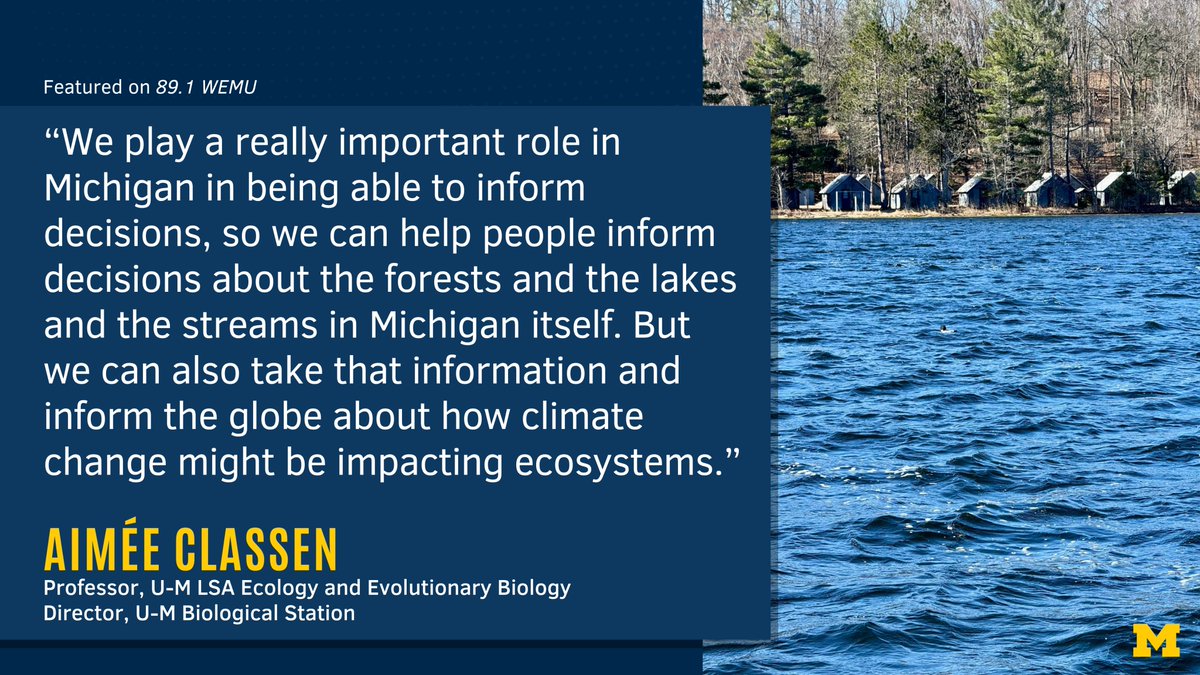
As part of its free summer lecture series, @UMBS will host distinguished scientists, artists and authors from across the U.S. @UMichEEB professor Aimée Classen joined @WEMU891 to discuss how the series will extend U-M's community reach across the state. myumi.ch/M6z8A
University of Michigan tweet media
English
12
6
9
5.1K
UMich Ecology and Evolutionary Biology
Congrats to Lynn Carpenter, lecturer IV in #UMEEB and #UMMCDB, has received the Excellence in Departmental Advising Award, which recognizes LSA departmental advisers who exert consistent, positive contact with undergraduates in their classes or programs. myumi.ch/7P2QD
English
0
0
1
245
UMich Ecology and Evolutionary Biology
Museum Studies Program Student Christiana Sinacola provides insight to her semester work at the herbarium digitizing and databasing specimens as part of the NSF fundes "All Asia" project. myumi.ch/ypVzQ
English
0
0
0
283
UMich Ecology and Evolutionary Biology retweetledi
University of Michigan Complex Systems
npj Complexity features a fabulous editorial team including CSCS and @UMichEEB Professor @LuisZaman nature.com/npjcomplex/edi…
Vermont Complex Systems Institute @ UVM@uvmcomplexity

Great interview by @JoshBVT with @LHDnets talking about npj Complexity, the new journal he is editing, for "great papers that make an impact but are having a hard time getting published because they're weird" uvm.edu/news/story/hon…

English
0
1
1
498