
Vickybm retweetledi
Vickybm
1.9K posts

Vickybm retweetledi

Les persones de la primera onada tenen més riscos en certes patologies.
#covidpersistent
Manu Bañuelos.@manubanuelos
Una nueva investigación del NIH revela que las personas que contrajeron Covid-19 al comienzo de la pandemia tuvieron el doble de riesgo de sufrir un ataque cardíaco, accidente cerebrovascular o muerte hasta tres años después de la infección. scitechdaily.com/infection-afte…
Català
Vickybm retweetledi
📍📍Guardeu la data
📍📍Save the date
#congrès #DemystifyingLong COVID2024
🗓 21-22 de novembre 2024
📢 Barcelona
➡️ Format: Híbrid (Presencial i en línia)
👉 RECERCA en #CovidPersistent #LongCovid
🔗Programa: academicmedicaleducation.com/meeting/demyst…
#DEMYSTIFYINGLONGCOVID #longcovid
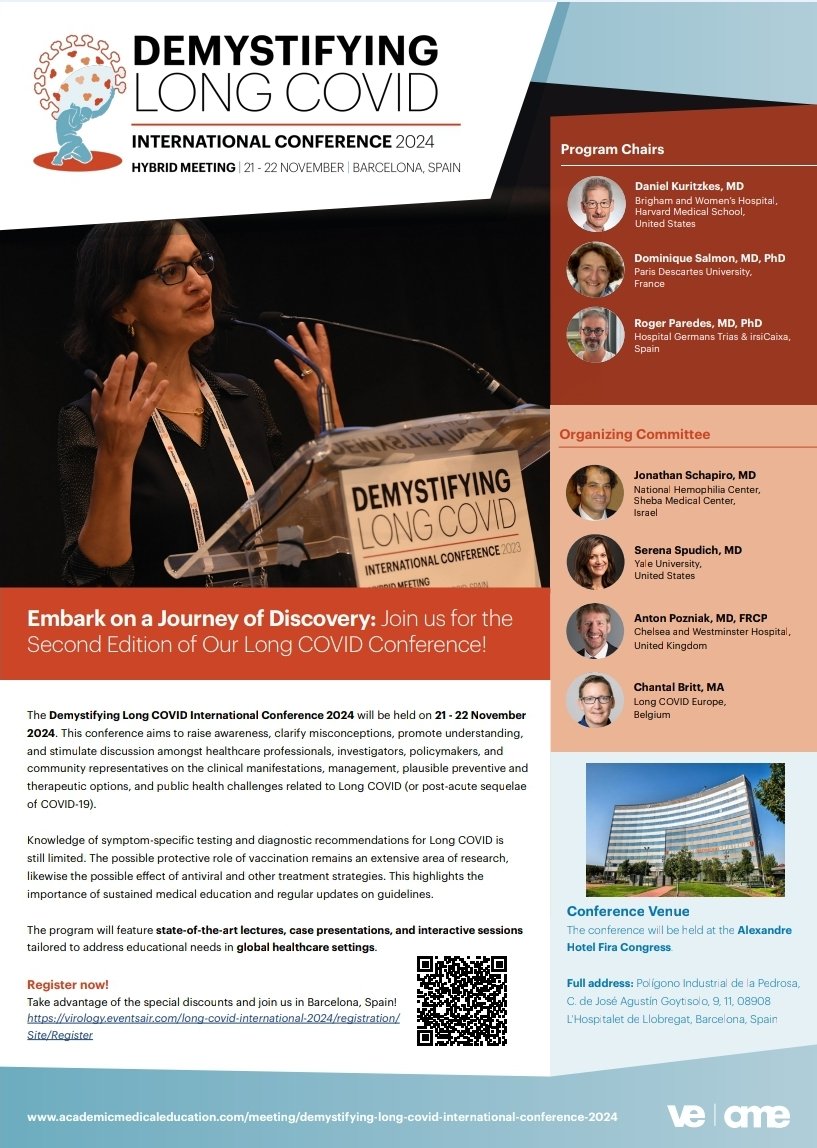
Barcelona, Spain 🇪🇸 Català
Vickybm retweetledi
Vickybm retweetledi
Encara hi ha molta gent malalta.
Mireu el reportatge,🫶
Repor TVE (canal 24h)@reportve
🔴El miedo al COVID disminuye con el paso del tiempo. Todos hemos bajado la guardia. Pero un 5% de los pacientes contagiados por COVID, desarrollará poco después, alguno de los 200 síntomas del COVID persistente. @rtvenoticias @COVID19persist1 @covid_madrid
Català
Vickybm retweetledi
Vickybm retweetledi
El #covidpersistent aquella malaltia que molts metges encara desconeixen i que els governs no volen afrontar.
Repor TVE (canal 24h)@reportve
🔴El miedo al COVID disminuye con el paso del tiempo. Todos hemos bajado la guardia. Pero un 5% de los pacientes contagiados por COVID, desarrollará poco después, alguno de los 200 síntomas del COVID persistente. @rtvenoticias @COVID19persist1 @covid_madrid
Català
Vickybm retweetledi
Vickybm retweetledi
Recerca a Canadà. Poc a poc els estudis donen la raó als pacients de #LongCovid #covidpersistent.
#nothoinventes
Tom Kindlon@TomKindlon
#LongCovid research from Canada: Brain hypoxia, neurocognitive impairment, and quality of life in people #postCOVID19 Free: link.springer.com/article/10.100… Study using near-infrared spectroscopy. 1/
Català
Vickybm retweetledi
El 24% de les persones tenen nivells baixos d'oxigen en el cervell post-COVID-19. Aquesta hipoxia es relaciona amb una funció neurològica i qualitat de vida reduïda.
Es medeix amb espectroscòpia d'infraroig proper fdNIRS.
link.springer.com/article/10.100…
Català
Vickybm retweetledi
Formació, formació i formació @salutcat
Danielle Beckman@DaniBeckman
Preparing to give another talk about NeuroCovid this afternoon at @ucdavis for freshmen and sophomores. My favorite slide has always been the one below. May some fresh minds help us learn what we can do to prepare for the future. #neuroCovid
Català
Vickybm retweetledi
Quan i com fer-se un test de #covid. 👇
Vipin M. Vashishtha@vipintukur
When symptoms arise, so do questions: When should I test? How accurate is it really? And what should I do if I test positive? ➡️ Researchers unveil a new model to quickly answer such questions, not only for COVID but also for emerging rapid tests for RSV, flu & other bugs 1/
Català
Vickybm retweetledi
El sistema nerviós, un dels problemes principals en la #CovidPersistent
Billy Hanlon@bhanlon15
CBS News: 'POTS and COVID-19. How are they linked?' "Doctors are blaming long-haul COVID for some cases of the postural orthostatic tachycardia syndrome. Experts said POTS is a dysfunction of the nervous system.." cbsnews.com/detroit/video/…
Català
Vickybm retweetledi
Un nou estudi de @VirusesImmunity descobreix que els autoanticossos poden provocar símptomes neurològics greus en persones amb Covid llarg
#nothoinventes
solvecfs.org/new-study-by-d…
Català
Vickybm retweetledi
Vickybm retweetledi
Repensar la rehabilitació. Un tema recurrent i que molts malalts reporten malestar post esforç.
👇
Tom Kindlon@TomKindlon
“The idea of rehabilitation will have to be completely rethought for this illness” – Qualitative results of an online survey on patients’ experiences with inpatient rehabilitation for #postCOVID19 condition (#longCOVID) zefq-journal.com/article/S1865-… In German with English abstract 1/
Català
Vickybm retweetledi
Inflamació dels galglis linfàtics.
Poc ens queixem els #covidpersistents
#nothoinventes
David It Up!@Dave_it_up
Lymphatic Turmoil: COVID-19's Hidden War on The Lymph Nodes COVID-19, is associated with a range of symptoms and damage, including effects on the lymphatic system. The lymph nodes, which are integral to the immune system, can be significantly impacted by both the infection and the vaccination against it. Today , let’s explores the ways COVID-19 can damage lymph nodes, highlight the mechanisms, symptoms, and implications of such damage. Swollen Lymph Nodes as a Symptom of COVID-19 Mechanism of Swelling Swollen lymph nodes, or lymphadenopathy, can occur as a direct result of the body's immune response to the SARS-CoV-2 virus. The lymphatic system, which includes lymph nodes, plays a crucial role in filtering out pathogens and facilitating an immune response. When the body detects an infection, lymph nodes can become swollen as they produce more white blood cells to fight off the virus[1][3]. Clinical Manifestations Swollen lymph nodes due to COVID-19 are typically found in the neck, armpits, and sometimes the groin. This swelling is often accompanied by other symptoms such as fatigue, fever, sore throat, and general malaise[1][3]. In severe cases, particularly in children, COVID-19 can lead to multisystem inflammatory syndrome (MIS-C), which includes significant lymph node swelling among other symptoms[1][5]. Impact of COVID-19 on Lymph Node Structure Microscopic Changes Research has shown that SARS-CoV-2 can directly infect macrophages within the lymph nodes, leading to structural changes. Microscopic examination of lymph nodes from COVID-19 patients has revealed vascular dilatation, congestion, and a lack of corticomedullary differentiation. There is also evidence of localized necrosis and lymphocyte apoptosis, indicating significant damage to the lymphatic tissue[2]. Long-term Effects The damage to lymph nodes can have long-term implications, including a reduced ability to mount an effective immune response. This can lead to prolonged lymphadenopathy and potentially contribute to the phenomenon known as "long COVID," where patients experience lingering symptoms long after the acute phase of the infection has resolved[5]. Lymph Node Swelling Post-Vaccination Immune Response to Vaccination Swollen lymph nodes are also a common side effect of COVID-19 vaccinations, particularly those using mRNA technology such as the Pfizer-BioNTech and Moderna vaccines. This swelling is typically a sign of the immune system responding to the vaccine and is usually temporary[1][4][6]. Clinical Observations Studies have reported that lymphadenopathy occurs in about 3-16% of patients following COVID-19 vaccination. The swelling is generally observed in the axillary (armpit) and supraclavicular (above the collarbone) lymph nodes on the same side as the injection site. While this can sometimes cause concern, especially in cancer patients undergoing imaging, it is usually benign and resolves on its own within a few weeks[4][6][9]. Severe Complications and Rare Cases Mediastinal Lymphadenopathy In some severe cases, COVID-19 can lead to mediastinal lymphadenopathy, which involves the lymph nodes in the central part of the chest. This condition can be indicative of more serious underlying issues such as lung infections or even malignancies. Imaging studies are crucial for diagnosing and managing this condition in critically ill COVID-19 patients[2]. Eosinophilic Lymph Node Abscesses There have also been rare reports of eosinophilic lymph node abscesses following COVID-19 vaccination. These abscesses are characterized by an accumulation of eosinophils, a type of white blood cell, leading to inflammation and abscess formation. Such cases are rare and typically respond well to steroid treatment[4]. COVID-19 can cause significant damage to lymph nodes through both direct infection and the body's immune response. While swollen lymph nodes are a common symptom of the infection and a side effect of vaccination, they usually resolve on their own. However, in severe cases, the damage can be extensive, leading to long-term health implications. Understanding the impact of COVID-19 on the lymphatic system is crucial for managing and mitigating these effects. By recognizing the signs and symptoms of lymph node involvement in COVID-19, healthcare providers can better diagnose and treat affected patients, ensuring a more comprehensive approach to managing this complex disease. What are Lymph Nodes and What do They do? Lymph nodes are small, bean-shaped structures that are part of the lymphatic system, which plays a crucial role in the body's immune response. They are distributed throughout the body and are connected by lymphatic vessels. Here are the primary locations where lymph nodes are found: Major Locations of Lymph Nodes 1. Neck (Cervical Lymph Nodes): - Located in the neck and back of the head. - These nodes drain lymph from the head and neck regions. 2. Armpits (Axillary Lymph Nodes): - Found in the armpits. - They drain lymph from the arms, chest, and upper abdomen. 3. Groin (Inguinal Lymph Nodes): - Located in the groin area. - These nodes drain lymph from the lower abdomen, external genitalia, and legs. 4. Chest (Mediastinal Lymph Nodes): - Situated in the chest, around the trachea, esophagus, heart, and lungs. - These nodes help drain lymph from the lungs and other thoracic structures. 5. Abdomen (Mesenteric and Retroperitoneal Lymph Nodes): - Found deep within the abdomen. - Mesenteric nodes are located in the membrane that connects the intestines to the abdominal wall, while retroperitoneal nodes are around the kidneys and major blood vessels. Functions of Lymph Nodes - Filtration: Lymph nodes filter lymphatic fluid, trapping bacteria, viruses, and other foreign substances, which are then destroyed by specialized immune cells within the nodes. - Immune Response: They contain lymphocytes (a type of white blood cell) that help fight infections by attacking and destroying pathogens. - Waste Removal: Lymph nodes help remove waste products from the lymphatic fluid before it is returned to the bloodstream.
Català
Vickybm retweetledi
Català
Vickybm retweetledi
Una molt bons campanya. Els drets dels #covidpersistents
Long Covid SOS @longcovidsos.bsky.social@LongCovidSOS
The #GeneralElection2024 is now less than a week away We need #LongCovid to be on the agenda for whoever is in power Please write to your constituency candidates and ask them to support our #BillOfRights You can download our template letter here: longcovidsos.org/_files/ugd/8bd…
Català
Vickybm retweetledi
És un despropòsit de campanya. Deu ser als protocols de @salutcat, no @manelbalcells? 🤕
Salut@salutcat
👨🏻⚕️👩🏼⚕️ Catalunya té un sistema de salut de primer nivell, format per 150.000 professionals. 🏥 És universal, equitatiu, sostenible, referent i líder europeu en recerca, assajos clínics i teràpies avançades. 🤝🏻 La teva salut, en les millors mans. ➕ info canalsalut.gencat.cat/teva-salut-mil…
Català