Aizada Marat

4.2K posts

Aizada Marat banner
Aizada Marat

Aizada Marat

@Aizada

Founder of @AlmaImmigration. Ex-@McKinsey, ex-@CooleyLLP, and Harvard Law School alum. Host @SV_Icons

Menlo Park, CA Katılım Temmuz 2009
539 Takip Edilen4.9K Takipçiler
Sabitlenmiş Tweet
Aizada Marat
Aizada Marat@Aizada·
Today, I’m excited to announce: tryalma.com Immigration is complex and we want to be helpful on this path! That’s why we’ve rebuilt our website as we want individuals and businesses navigating immigration feel the confidence, stability, and relief of having a true partner. From clear visa guides to blogs written by attorneys, our new site is designed to be your go-to resource for all things immigration! We built this for you - check it out!
English
18
16
161
29K
Dara Tumenbayeva
Dara Tumenbayeva@_okdara_·
Everyone's trying to fix sleep. But insomnia isn't the problem. It's the bill. Burnout, anxiety, panic - they all start the same way: you stop hearing yourself. Today we're launching Aora. The first device that hears it for you. @AoraBCI
English
23
14
98
10.4K
Julien Rosilio
Julien Rosilio@julienverse·
it's official: we're moving to california 🇺🇸 i've been accepted as a "special skill individual" under o-1 visa. oriane is hiring and growing in the us this year. anzhelika & baby jacob will discover the us for the first time 💙 6 years away was long enough. If you’re thinking of doing the same move, dm and I ll intro the best legal team @Aizada at @AlmaImmigration let's go 🚀 #ThinkVideo
Julien Rosilio tweet media
English
3
0
5
450
Aizada Marat
Aizada Marat@Aizada·
p.s. If you're a researcher, founder, or engineer exploring US visa options like the O-1, EB-1A, or EB-2 NIW, feel free to reach out to @AlmaImmigration.
English
0
0
1
117
Aizada Marat
Aizada Marat@Aizada·
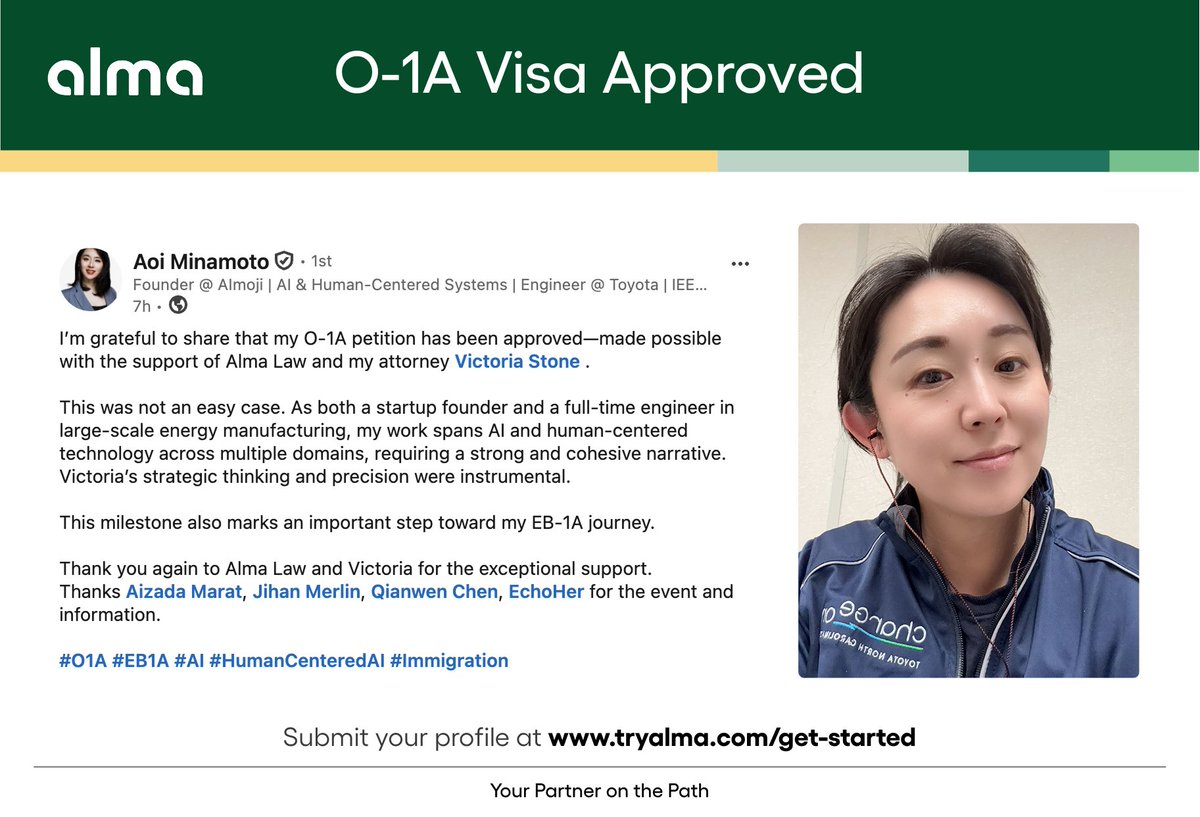
O-1A approved for engineer, founder, and AI builder! 🇺🇸 Aoi Minamoto wears 2 hats: full-time engineer at Toyota and founder of AImoji, an AI company building cognitive analytics tools for early awareness of cognitive change. When someone's work spans two very different domains, the challenge is building a single, cohesive narrative that USCIS can clearly evaluate against the O-1A criteria. That's the kind of case we love working on. Congratulations Aoi! Excited to see where AImoji goes next and to support you on the EB-1A journey ahead.
Aizada Marat tweet media
English
1
0
4
267
Aizada Marat
Aizada Marat@Aizada·
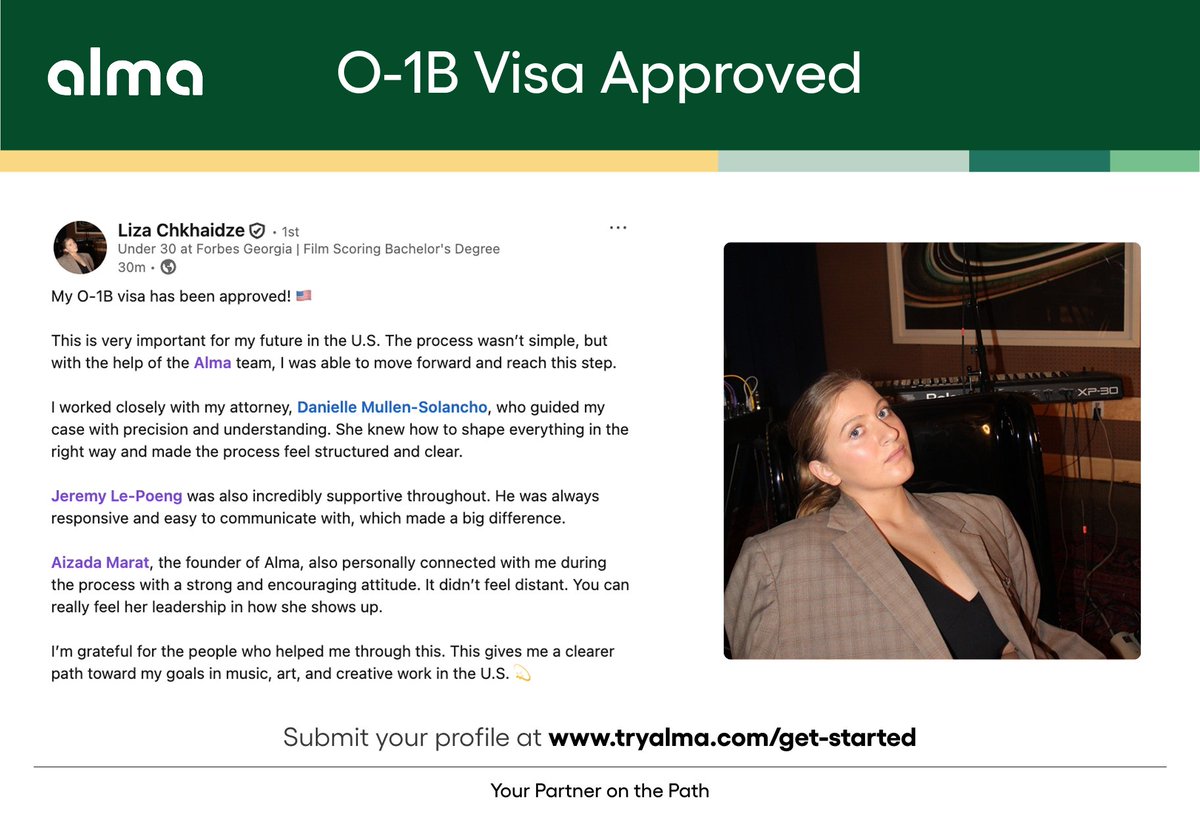
O-1B visa approved for composer and pianist from Georgia! 🇺🇸 Liza Chkhaidze grew up in Tbilisi and studied at Berklee College of Music for Film Scoring. She has been releasing her own music since she was 14, and was recognized on the Forbes Georgia 30 Under 30 list in culture and arts. The O-1B is designed for individuals with extraordinary ability in the arts, and cases like Liza's are a reminder that it can look like a decade of work across piano, composition, songwriting, and performance. Congratulations Liza! Excited to see where your music takes you next. p.s. If you're an artist, researcher, or founder exploring US visa options like the O-1, reach out to us at Alma - we'll give you an honest assessment of what's possible.
Aizada Marat tweet media
English
1
1
1
205
Aizada Marat
Aizada Marat@Aizada·
O-1 approved for a doctor-turned-founder 🇺🇸 @LutfiFadil went from medicine in Malaysia to doctoral research at Harvard. Today, he's building Valiance Health, a unified data platform that turns raw clinical data into secure, standardized, AI-ready infrastructure. His O-1 case wasn't simple. It required multiple rounds of back-and-forth with USCIS. But that's what strong cases often look like, collecting the right evidence and putting it together in a way that tells the full story. We're proud Alma could play a small part in this journey. p.s. If you're a founder or researcher exploring visa options like O-1, EB-1, or EB-2 NIW, reach out to @AlmaImmigration. We'll give you an honest assessment of what's possible.
Aizada Marat tweet media
English
0
0
2
369
Aizada Marat
Aizada Marat@Aizada·
The Alma Ascent Finale brought together 10 immigrant-led startups and top investors in San Francisco for a live pitch competition with $100,000 in non-dilutive funding on the line. Every founder in that room was a reminder of what makes immigrant entrepreneurship so powerful: resilience, ambition, and the willingness to keep building even when the path has been anything but easy. This year's winners: 🥇 Docket (YC P25) ($60k) - a vision-first AI test automation platform that lets companies write and maintain end-to-end tests at scale. Congrats to @nishanthooda_ and @boriskurikhin 🥈 Vectorial AI ($40k) - a human behavior simulation layer for product teams, helping founders understand how users will actually behave before building. Congrats to Rahul Garg, Taranveer Singh, and Jasmine Kaur. Ascent was built on a simple belief that immigrant founders are an outsized force in the startup ecosystem, and more capital should flow to them without strings attached. A huge thank you to our judges @alysaaco, @AnnaPinol_, Alexander Li, and Brady Berg for sharing their time and expertise. And special thanks to our sponsor, @DLA_Piper, for supporting this competition and helping make it possible.
English
0
4
7
462
Aizada Marat retweetledi
Hetarth Chopra
Hetarth Chopra@HetarthVader·
My O1 visa just got approved. Here's the journey that got me here. 🧵
English
25
8
263
118.8K
Aizada Marat
Aizada Marat@Aizada·
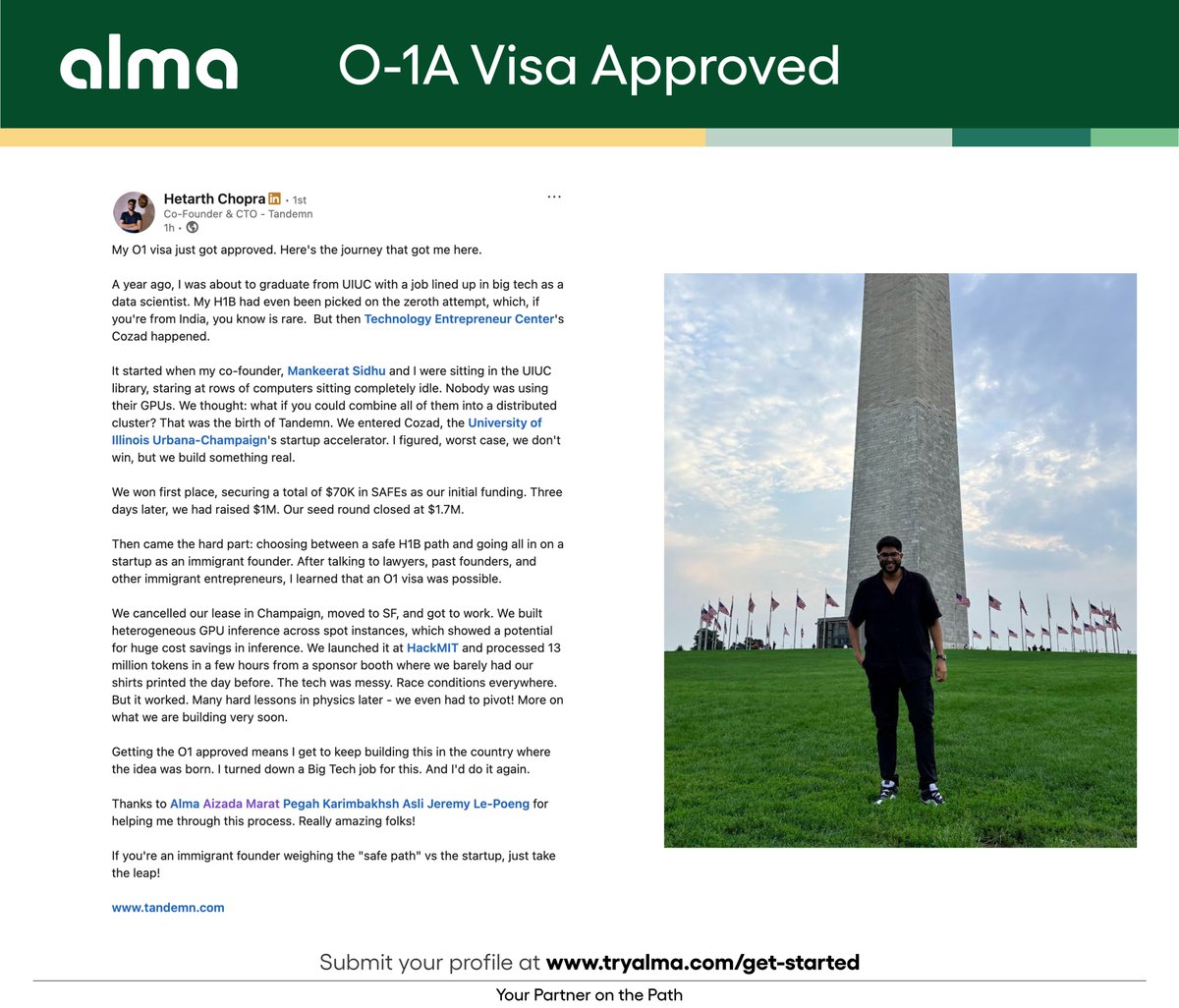
O-1 visa approved for immigrant founder! 🇺🇸 This one's special. @HetarthVader had an H1B already picked and a big tech job lined up - choosing the O-1 path would mean giving up a lot of certainty. He walked away from all of it to build something he believed in. Tandemn started with a simple question: what if you could turn idle GPUs into a distributed cluster? That question became a company, a Cozad win, and a $1.7M seed round. Getting his O-1 approved means he gets to keep building in the country where the idea was born. Congratulations Hetarth! We're rooting for everything that comes next with Tandemn. p.s If you're an immigrant founder exploring the O-1, feel free to reach out to @AlmaImmigration. We'll give you an honest assessment of what's possible.
Aizada Marat tweet media
English
1
0
2
371
Aizada Marat
Aizada Marat@Aizada·
From Red Bull & Motorola to founding his own company in the US, O-1 approved! 🇺🇸 Serkan Yel spent years leading licensing businesses at some of the world's most iconic brands. He saw how broken the industry was from the inside - so he decided to fix it with Pazar. Congratulations Serkan - next stop LA, NY, and beyond! P.S. If you're a founder or operator exploring U.S. visa options like O-1, EB-1A, or EB-2 NIW, reach out to @AlmaImmigration. We'll give you an honest assessment of what's possible.
Aizada Marat tweet media
English
1
0
4
449
Aizada Marat
Aizada Marat@Aizada·
p.s. If you're exploring visa options like the O-1, EB-1, or EB-2 NIW, reach out to @AlmaImmigration. We'll give you an honest assessment of what's possible.
English
0
0
0
177
Aizada Marat
Aizada Marat@Aizada·
Current engineers 2-3 years out of school now have two options: - Anthropic: $570k/yr - Your 20-person startup: $140k/yr We've experienced this at Alma. We were the final contender for an AI engineer, a U.S. citizen, with four offers. He loved our mission. In the end, he went to OpenAI. Most startups know that story well. So how do smaller companies compete? 1/ Work with immigration counsel that takes cases big firms won't. Anthropic and OpenAI typically work with large, traditional law firms. Those firms tend to be conservative, often declining cases that aren't guaranteed because denials affect their approval metrics. That leaves a pool of strong international candidates who don't clear the bar at a major firm, but absolutely qualify with the right legal approach. 2/ Offer what big companies structurally can't. Ownership, scope, and speed. At a startup, an engineer touches every important project. At a large company, they own one piece. For candidates who want career acceleration, that trade-off is important. 3/ Sponsor green cards early. Many large companies require one to two years of employment before sponsoring a green card. At Alma, I can identify strong performers within two months. If someone is performing, I'm open to starting the green card process right away - that signals long-term investment in a way salary alone can't. 4/ Move faster on the visa itself. Startups that work with firms experienced in high-growth hiring can move through the immigration process significantly faster than enterprise clients waiting in queue at a big firm. The U.S. is competing globally for the engineers and researchers who will define the next decade of technology. When startups assume international hiring is out of reach, the talent goes elsewhere.
English
1
0
3
484
Aizada Marat
Aizada Marat@Aizada·
If you're an immigrant founder, hiring from your country of origin is one of the smartest talent strategies right now. Here’s a simple playbook you can use: 1/ Fly to your country and partner directly with universities. Build a formal partnership with a university you know well, ideally one you graduated from. Run a competitive internship program that feeds directly into your hiring pipeline. Give talks, host events, make working at your startup feel like an elite opportunity. I know founders who did this and now have a continuous pipeline of top engineering talent that no recruiter in SF has access to. 2/ Run hackathons. Not one - but a series. Watch who shows up repeatedly. Who builds things that work. Who is relentless. Then hire from that pool. This was our playbook at @AlmaImmigration too. Tracking who is winning hackathons and building impressive projects in their spare time. 3/ Scout competition winners systematically. ICPC participants, international math and science Olympiad winners, top graduates from specific programs. Build a list and go after them directly. One founder I work with hired an engineer who had competed in ICPC. That engineer had five friends who also competed - the pipeline later built itself. One company I work with churned through roughly 50 Bay Area engineers over two and a half years before they built a pipeline from their founders' home country. Undiscovered talent is how you win the hiring war against companies with 10x the budget. The playbook is simple - but it requires getting on a plane. p.s. If you’re exploring visa options like the O-1, EB-1, or EB-2 NIW for international hires, reach out to Alma. We’ll give you an honest assessment of what is possible.
English
1
0
2
378
Aizada Marat
Aizada Marat@Aizada·
There's one thing I tell every YC founder I meet: forget about the visa. I know that sounds counterintuitive coming from the CEO of an immigration startup. But the best hiring decisions start with the person. When we hired one of our best engineers at Alma, his immigration status was not part of the initial conversation. I heard about a 22-year-old in Lebanon who was winning every hackathon he entered. So I asked for an introduction. He started as a contractor. Once we saw how exceptional he was, we sponsored his H-1B, he won the lottery, and we moved him to the U.S. At no point did we lead with, "What is his immigration situation?" Our main question was, "Is this person an A-player?" What should founders actually do? 1/ Evaluate talent first, visa second. Immigration conversations happen after you have decided this is the right person, not during the initial interview. 2/ Don't limit yourself to H-1B. Visas like the O-1, E-3, and TN don't have caps or lotteries. The right visa depends entirely on the candidate's profile. 3/ Work with counsel that builds cases strategically. Traditional firms say no to candidates who could get approved with the right legal strategy. Find a firm that evaluates the full picture. The founders who are hiring the strongest teams right now are not asking "can we sponsor this person?" They are asking "how do we get this person?" and figuring out the rest from there. p.s. If you are exploring visa options like the O-1, EB-1, or EB-2 NIW, reach out to @AlmaImmigration. We will give you an honest assessment of what is possible.
English
1
0
6
390
Aizada Marat
Aizada Marat@Aizada·
If your visa petition gets denied, your case is over. That's one of the most damaging misconceptions in immigration, and one that costs companies exceptional hires every year. We regularly work with candidates who were told by previous counsel that their profile doesn't qualify for an O-1 or EB-1. In many of those cases, the issue wasn't the candidate - it was the legal strategy. Here's what most people don't understand about denials: Traditional law firms often operate on conservative risk thresholds. If a case isn't clearly winnable, they may decline it rather than invest time building a more complex strategy. As a result, many nuanced cases that could succeed with the right approach never get filed. One life sciences company came to us after two O-1 denials with a major firm and hadn't attempted another unique visa petition in 3 years. For a company where candidates typically hold PhDs with published research, that's an enormous amount of talent left on the table. The O-1 isn't evaluated the way most people assume. USCIS looks at specific criteria: - Publications in your field of expertise - Original contributions like patents, open-source projects with documented adoption, or novel methodologies in your field - Memberships in selective, invitation-only organizations in your field - Evidence of judging others' work or serving on expert panels in your field - High salary relative to others in your field - A critical role at a distinguished organization These criteria don't always map to conventional markers of success. For instance, while winning a competitive scholarship at Harvard is incredibly impressive, this often doesn't help your O-1 case because this award is institution-specific. USCIS wants national or international-level recognition that's open to the broader field, so if you were presented with an award of national or international acclaim recognizing your contributions to your field, that could help your O-1 case. If you've been told you don't qualify for an extraordinary ability visa category, the real question is whether the firm evaluated all available criteria and built the strongest possible case, or simply decided the case wasn't worth pursuing. A second opinion from counsel that handles cases across diverse profiles can change the outcome entirely. p.s. If you're exploring visa options like the O-1, EB-1, or EB-2 NIW, reach out to @AlmaImmigration. We'll give you an honest assessment of what’s possible.
English
0
1
2
353