
Anindo Chakraborty

6.5K posts

Anindo Chakraborty banner
Anindo Chakraborty

Anindo Chakraborty

@anindo78

Bangalore is home 💜 Data Analytics. Here to Learn. Love Music🎸 Sports , Quizzing, Technology. Dog 🐕 Father. I love beer 🍻and traveling! ✈️

Bengaluru, India Katılım Eylül 2012
3.1K Takip Edilen337 Takipçiler
Anindo Chakraborty retweetledi
Clash Report
Clash Report@clashreport·
The Telegraph: Trump was meant to help India rise by taking a tougher line on China. Instead, his wars and unpredictability are hurting Narendra Modi’s ambitions of turning India into a global superpower. The conflict in Iran has hit India hard. The country relies on imported oil, much of it through the Strait of Hormuz, so rising energy prices are weakening growth, fuelling inflation and scaring off investors. Moody’s has already cut India’s growth forecast to 6pc — well below the 8pc Modi says is needed to make India a developed nation by 2047. At the same time, Trump has moved closer to China and Pakistan, two of India’s main rivals, undermining years of efforts by Modi to build stronger ties with Washington. Modi is now scrambling to limit the damage by seeking new energy deals abroad, cutting spending pressures at home and even discouraging Indians from buying gold and travelling overseas. The crisis has exposed a deeper problem: despite rapid growth, India still lacks the manufacturing power, infrastructure and economic influence to rival China.
Clash Report tweet media
English
58
146
663
93.4K
Anindo Chakraborty retweetledi
Rimsha Bhardwaj
Rimsha Bhardwaj@heyrimsha·
A Wharton economist ran a randomized controlled trial on almost a thousand high school students in Turkey. The result was so brutal for the AI-in-education narrative that it had to be peer-reviewed by PNAS before people would believe it. Her name is Hamsa Bastani. She teaches operations and information at the Wharton School at the University of Pennsylvania, and the study she published in 2025 alongside her co-authors is one of the cleanest experiments anyone has run on what AI actually does to learning when you remove it from the equation and check what is left. The setup was a randomized controlled trial, the same methodology used in clinical drug trials. Nearly a thousand high school math students in Turkey were split into three groups and put through four sessions of ninety minutes each. One group practiced with GPT Base, a standard ChatGPT-4 interface that could answer any question directly. One group practiced with GPT Tutor, a version of the same model that had been prompted to guide students with hints rather than hand them the answer. One group practiced with nothing but their textbook and their own head. During the practice sessions, the AI groups looked like a miracle. The GPT Base group solved 48% more problems than the students working alone. The GPT Tutor group solved 127% more. Every administrator looking at those numbers would have written a press release about the transformative power of AI in education and moved on. Then the actual exam came, and AI was not allowed. The students who had practiced with GPT Base scored 17% worse than the students who had practiced alone. Seventeen percent worse, despite having solved nearly half again as many problems in the sessions leading up to it. The students who had struggled the most, who had sat with the confusion and worked through it without a tool to rescue them, were now the only ones who could actually do the math when it counted. Bastani's team read through the chat logs to understand what had actually been happening during the practice sessions, and the answer was exactly what the exam results had already implied. The GPT Base group had not been learning. They had been extracting answers and moving on, and every moment that felt like understanding was actually the model doing the cognitive work while the student's brain waited for the next problem to arrive. The paper describes it precisely: without guardrails, students attempt to use GPT-4 as a crutch during practice, and subsequently perform worse on their own. The detail that should follow every conversation about AI in education is the one buried in the post-test survey results. The students who had relied on AI the most during practice were also the most confident they had understood the material. The tool had not just failed to teach them. It had convinced them they had learned something they had not, which is a different kind of failure entirely and a much harder one to correct because the student has no idea it is happening. The crutch had made them confident and weak at the same time.
Rimsha Bhardwaj tweet media
English
139
1.2K
2.5K
324.3K
Anindo Chakraborty retweetledi
Jeremy Bernier
Jeremy Bernier@jeremybernier·
Meta was easily the most toxic company I've worked for. There's a reason the Chinese call it "Squid Game". Others refer to it as "Hunger Games" or "Lord of the Flies". I think they're all accurate. The company culture is basically every man/woman for themselves. The performance review process (PSC) not only doesn't incentivize helping others, if anything it actually discourages it since everyone is stack ranked against each other. Imagine working on a team where every 6 months, one of you is going to get axed. Of course it's going to become toxic. "Bottoms up" culture is a complete farce - it's just a way for leadership to offload accountability. The Tech Leads (TLs) have all the power - owning the relationships and tribal knowledge to gatekeep projects to their buddies. Managers are "people managers" with limited technical understanding, who basically aggregate TL feedback and create performance review packets to calibrate with other managers and IC7+. The takeaway is that your destiny is in the hands of the TLs, and TLs unlike managers have no responsibility for your career. There are no repercussions for unethical behavior. I've seen managers and TLs throw others under the bus and get away with it. The only mission bonding the company together is individual self-preservation. Save your own ass to survive for another stock vesting, and throw someone else under the bus if you need to. That's why layoffs rarely impact directors/VPs or tenured IC7+ despite the fact that they're paid by far the most. Even this recent mass layoff that was supposed to "flatten" managers layers barely affected directors/VPs/IC7+, and fell predominantly on M1s - the lowest rung of the management chain. The culture is extremely performative and focused on box ticking and optics. Everything is about PSC (the performance review system) and perception. This means tons of meetings, useless AI slop posts, and top-down initiatives that don't benefit anyone but maybe help tick off the impact box of some go-getter at the top. Impact is not enough - it has to have sufficient complexity. So complexity is added for complexity's sake. The org I was in (Facebook ads) is 90% Chinese, and the entire leadership chain up to the VP level is Chinese. Mandarin is the primary language at the office, except in official meetings with non-speakers. Chinese work culture is very different from American work culture, with 996 (9am-9pm, 6 days/week), top-down nature, emphasis on saving face (eg. don't question your superiors), and toxicity being quite common. Naturally when an org is completely dominated by a single ethnicity that's notorious for not integrating, elements from their work culture seep in. Of the layoffs I witnessed in this org, 3/4 were not Chinese (just to be clear, most Chinese are very kind so don't take this as an attack. But it is a reality that I think most people outside this company are completely unaware of, and I question if leadership is even aware despite the fact that we're talking about the company HQ) I had the most toxic manager of my life here. I watched him deliberately set up a new hire to fail, driving them to needing to see a psychiatrist for anxiety + depression, and getting them fired. Then he suddenly disappeared for 8 months, before leaving the company. I could go on and on, but this is already pretty long and I think you get the point. Yes there are a lot of great, kind people here. I managed to transfer out of my first team into a new team with a great manager where everyone was very smart, supportive, and hardworking. But the company has its Squid Game reputation for a reason. Company culture comes from the top. It seems leadership is either too removed to notice, or maybe don't really care anymore because I guess they already made their billions and us plebs are expendable these days.
English
406
682
7.4K
2.1M
Anindo Chakraborty retweetledi
Nathan Clark
Nathan Clark@nathanclark_·
it’s in gemini, just create it in ai studio. oh, that’s for your personal google one account. for workspace you need gemini business. no, not gemini advanced, that’s ai pro now. unless you need ai ultra. oh agents? you do that in spark actually. no, not gemini api managed agents, that’s different. for coding use jules. unless you mean the agentic ide, that’s antigravity. no, that’s the old antigravity, download the new one. actually gemini cli is being deprecated, use antigravity cli. no the flash model is smarter than the pro model. unless you need pro. if it’s video, use flow. no, flow uses veo. no, nano banana is images. actually that’s in gemini now. unless you’re in search, then it’s ai mode. no, research is notebooklm. anyway it’s all very simple.
English
513
2.1K
19K
1.6M
Anindo Chakraborty retweetledi
Sakshi Narula
Sakshi Narula@mssakshinarula·
Photo of the decade.
Sakshi Narula tweet media
English
255
6K
39.1K
475.8K
Anindo Chakraborty retweetledi
Mr Sharma
Mr Sharma@sharma_views·
THIS IS BRUTAL TRUTH 🔥 AVADH OJHA 🎯: In this country, people who spoke wisdom were just pushed out. Buddha, Osho, Gandhi. All pushed away, all criticised. HOST: So knowledge is just not respected here? AVADH SIR ⚡️: No. Only Bakaiti works. Look at UP, where BJP won. Then Bihar. And now Bengal. People don’t reward truth. They just reward verbal showmanship.
English
133
1.8K
7.9K
202.3K
Anindo Chakraborty retweetledi
Pragnya Gupta
Pragnya Gupta@GuptaPragnya·
USD-INR is now officially the worst performing currency in entire World. The rupee didn’t collapse overnight — it was slowly buried under a decade of headlines, hate campaigns and hollow economics.
Pragnya Gupta tweet media
English
42
588
1.2K
33.9K
Anindo Chakraborty retweetledi
Akki Rotti
Akki Rotti@Theshashank_p·
Simple 1. Doesn't matter if your only investor is your mother's cousin, but behave like you are getting funded by Mr. Buffet himself. 2. Qoute Dale Carnegie & Naval in every sentence. Use the word "productive" once every 10 mins. 3. Own an espresso machine, but practically live in Third wave. 4. Your Kannada/Hindi must have a LA accent albeit you've never stepped out side Murgeshpalya. 5. Speaking of Murgeshpalya, if you live there, always tell people that you live "off" 100ft road. 6. Believe that Bengaluru ends at MG Road. 7. Go to Bob's and call it an authentic Bengaluru experience. 8. Go to Pizza 4 P's and talk about how you had the best pizza at 4 P's in Vietnam 9. Call Dating as "interacting with like minded people" 10. For god sake, it's not making friends, it's NETWORKING...
Urvashi Gormat@takeiteasyUrvy

how to make friends in indirangar

English
10
11
268
19.1K
Anindo Chakraborty retweetledi
Parimal
Parimal@Fintech03·
1987. A room in New Delhi is thick with the smell of old files & cold tea. The United States has just delivered a stinging slap to the face of the Indian Republic. They have officially refused to sell India the 'Cray X-MP' Supercomputer, the most powerful machine on Earth, claiming that India would use it for nuclear weapons. The American officials mockingly suggest that India does not even have the electricity to keep such a machine running. In the middle of this national humiliation, a young, soft-spoken engineer named Vijay Bhatkar is asked by then Prime Minister Rajiv Gandhi: "Can we build our own?" Bhatkar does not hesitate. He looks at the No of the West & says: "We will not just build it; we will build it faster than you can ship it." The Americans did not just stop at refusing the sale; they actively lobbied other nations to ensure India remained digitally blind. They believed that w/o their Logic Gates, India would remain a 3rd world backwater. Bhatkar realized he could not replicate the Single-Processor behemoth of the Cray. Instead, he turned to Parallel Processing. He decided to stitch together 1000s of low-cost, off-the-shelf microprocessors. It was like building a giant's brain out of the neurons of ants. In 1991, while the West was still celebrating its monopoly, Bhatkar unveiled the PARAM 8000. It was not just a computer; it was a Gigaflop monster. To prove the PARAM was real, Bhatkar ran a standard global benchmark test. The results were sent to an international conference in Zurich. The PARAM 8000 was ranked as the 2nd most powerful supercomputer in the world, behind only the American machines. But there was a twist: the PARAM cost a fraction of the Cray, performed better in tropical heat, & was built in just 3 years. When the PARAM 8000 was 1st turned on, the team did not have a high-tech cooling system like the Americans. They used industrial-grade desert coolers & adjusted the airflow manually. It was the ultimate Jugaad that defeated the most sophisticated tech embargo in history. A major US newspaper ran a story with the headline: "Denied supercomputer, Angry India does it!" The ghost of the Native Engineer had officially entered the silicon temple. Vijay Bhatkar’s history is the story of how India became the IT Capital of the world. Bhatkar founded the Centre for Development of Advanced Computing (C-DAC). He did not just build a machine; he built an ecosystem. Every software engineer in India today stands on the shoulders of the man who proved we did not need the West's permission to compute. Bhatkar was the 1 who realized that if computers only spoke English, 90% of India would be left behind. He led the development of GIST (Graphics & Intelligence Based Script Technology), allowing computers to work in Indian languages. He gave the Machine a local tongue. Today, Bhatkar is a Padma Bhushan awardee, but he lives a life of deep spirituality & simplicity. He vanished from the corporate headlines to become a philosopher of the digital age. The West thought they could freeze India’s future by withholding a single machine. They forgot that the Indian mind does not need a 'Cray' to think; it only needs a 'No' to ignite. Forget building a supercomputer; Bhatkar built a mirror, & for the 1st time, the West had to look into it & see that the primitive colony had become the master of the code.
Parimal tweet mediaParimal tweet media
English
149
1.8K
5.4K
193.7K
Anindo Chakraborty retweetledi
Sann
Sann@san_x_m·
Her name was Priya Rajvansh. She was born Veera Sunder Singh on December 30 1936 in Shimla. Her father was a Forest Department officer. She was the sister of Waheeda Rehman’s husband. After her graduation she joined the Royal Academy of Dramatic Art in London. While she was in London a photograph of hers reached Bombay. Filmmaker Chetan Anand, the brother of Dev Anand, saw it and cast her in his 1964 war film Haqeeqat. It is still counted among the finest war films in Indian cinema. During filming she and Chetan Anand fell in love. He was separated from his wife but not divorced. She chose to stay. For the next two decades she acted only in his films. She contributed to their scripting, lyrics and post production. He never made a film without her. When Chetan Anand stopped directing she stopped acting. They lived quietly in Bombay. In 1997 Chetan Anand died. He left part of his estate to Priya, valued at around Rs 10 crore, alongside his two sons from his first marriage, Ketan and Vivek. A property dispute followed. In her final years Priya wrote handwritten notes and a letter to Chetan’s brother Vijay Anand describing her fear and anxiety. Those letters were later produced as evidence in court. On March 27 2000 she was found murdered at Chetan Anand’s bungalow in Ruia Park, Juhu. The cause of death was strangulation. She was 63 years old. All four accused were convicted in July 2002. Ketan and Vivek Anand were convicted for criminal conspiracy. The domestic staff who carried out the act were convicted for murder. All four were sentenced to life imprisonment. They were granted bail in November 2002. In 2011 the Bombay High Court overturned the convictions of Ketan and Vivek Anand. The case remains pending. She spent 35 years devoted to one man and his work. She was killed for his property. The men convicted of conspiracy in her murder have not spent a single full year behind bars. Follow for stories India deserves to remember.
Sann tweet media
English
37
309
1.1K
74K
Anindo Chakraborty retweetledi
Mihir Vasavda
Mihir Vasavda@mihirsv·
Express Investigation: A fund meant for India’s top athletes was used to upgrade sports facilities for bureaucrats - by bureaucrats. 🏊 Heated swimming pools 🎾 Tennis courts 🏸 Officers’ clubs All funded through National Sports Development Fund (NSDF). indianexpress.com/article/expres…
English
65
1.3K
3K
382.9K
Anindo Chakraborty retweetledi
Nav Toor
Nav Toor@heynavtoor·
THIS GUY BUILT AN ENTIRE WIKIPEDIA THAT IS 100% AI HALLUCINATIONS AND IT'S OPEN SOURCE ON GITHUB it's called Halupedia. nothing on the site existed before you clicked. every article was generated the second you arrived. the site has one rule: the universe only exists when you visit it. it looks exactly like wikipedia. same fonts. same layout. same scholarly citations. same "stumble" button for random articles. the only difference is none of it is real. here are some actual articles currently in the encyclopedia: > the great pigeon census of 1887 > the ministry of slightly wrong maps > chaldic arithmetic — a branch of mathematics where subtraction is forbidden > armund the river mapper — a cartographer who mapped 14,000 leagues of river without leaving his chair > the society for the prevention of unnecessary tuesdays every article page also tells you how many people are reading it right now. it says: "you alone are consulting this folio at present." the creator's own tagline for the site is the most unhinged sentence i've read this year: "an encyclopedia of a universe that does not exist until you visit it" the entire backend is a single open source repo called vibeserver. one guy. one description on github: "a little webserver making things up just in time." we built the largest knowledge base in human history and the very first thing a guy did with it was make a hallucinated mirror universe and put it on the open web. the internet is healing.
Nav Toor tweet media
English
361
1.6K
9.7K
1.6M
Anindo Chakraborty retweetledi
B. Kolappan
B. Kolappan@kolappan·
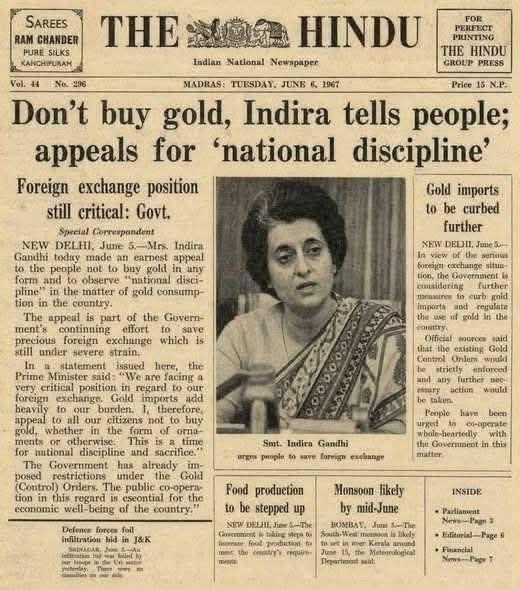
The first one is a digitally altered page being wrongly presented as the front page of The Hindu on June 6, 1967. The second is the actual page released that day. This is what social media is capable of; it can even alter the front page of India's national English daily.
B. Kolappan tweet mediaB. Kolappan tweet media
English
228
2.8K
6.5K
296.3K
Anindo Chakraborty retweetledi
Sarayu Pani
Sarayu Pani@sarayupani·
Where is the BJP’s “Nari Shakti” spirit when it comes to this case? Perhaps the most shameful episode in Indian sports history. Vinesh and all the wrestlers who came forward have been put through hell.
English
0
354
1.5K
12.1K
Anindo Chakraborty retweetledi
Kapil Choudhary
Kapil Choudhary@kapil857·
One day, far FAR into the future, @Phogat_Vinesh will be as revered in India as Muhammad Ali was revered in US Well, at least that's the hope...highly unlikely, but not impossible Stay strong champ 💪🏾 You are already a great hero for millions, one day it will be billions 🇮🇳
English
15
60
372
5.5K
Anindo Chakraborty retweetledi
Preeti Choudhry
Preeti Choudhry@PreetiChoudhry·
Good day to re-up what Abhinav Bindra wrote for Vinesh - when he spoke for the country - today the WFI. Says she shamed the nation …
Preeti Choudhry tweet media
English
13
212
1.1K
51.5K
Anindo Chakraborty retweetledi
Mr Melancholy
Mr Melancholy@chakravartiiin·
> Sister's wedding got cancelled because I refused to buy gold > Boss fired me because I insisted on WFH > Wife called she's leaving for her parents because I refuse to take her on foreign trip > Got run over by Neta ji's 50 vehicle convoy while peddling home on my cycle to conserve fuel > Now eating boiled vegetables and rice to conserve oil For Nation
Mr Melancholy tweet media
Indian Tech & Infra@IndianTechGuide

🚨 Prime Minister Narendra Modi today: - Stop buying gold. - Bring back the work-from-home culture. - Save petrol and diesel. - Avoid foreign trips and destination weddings. - Stop importing foreign products.

English
275
2.8K
21.9K
814.5K
Anindo Chakraborty retweetledi
Mr PitBull Stories
Mr PitBull Stories@MrPitbull07·
May 15, 1963. Astronaut Gordon Cooper climbed into a capsule barely larger than a phone booth and launched into space aboard Faith 7. The mission was simple on paper: Orbit Earth 22 times. Stay in space for a full day. Come home alive. For most of the flight, everything worked perfectly. Then, on the 19th orbit, the warning lights came on. First, a faulty sensor falsely reported reentry. Then the electrical system failed. One by one, the automated controls died. Guidance system: dead. Orientation system: dead. Reentry calculations: dead. At 165 miles above Earth, Gordon Cooper suddenly had no functioning instruments to bring him home. And reentry is unforgiving. Too shallow, and the capsule skips off the atmosphere into space forever. Too steep, and friction turns it into a fireball. The difference between life and death was fractions of a degree. Mission Control could only watch. So Cooper became the computer. He drew reference marks on the capsule window with a pen. He stared at the stars he had memorized before launch and used them to orient the spacecraft by eye. He strapped a wristwatch to his arm and timed everything manually. Then he did the math in his head. No autopilot. No navigation system. No backup computer. Just a man, a watch, and the stars. At exactly the right second, Cooper fired the retrorockets manually. The capsule dropped into Earth’s atmosphere. For several minutes, communication vanished as plasma wrapped the spacecraft in fire. Nobody on Earth could contact him. Then the parachutes opened. Faith 7 splashed down just 4.4 miles from the recovery ship USS Kearsarge — the most accurate splashdown of the entire Mercury program. Later, Cooper described it simply: “I used my wristwatch for time, my eyeballs out the window for attitude.” That’s it. In one of the most dangerous moments in early spaceflight history, a human being outperformed the machines. We live in a world obsessed with automation and software. But Gordon Cooper’s flight is a reminder that when everything breaks, the final backup system is still the human mind. Calm under pressure. Thinking clearly. Making the call when nobody else can. It was true in 1963. It still is.
Mr PitBull Stories tweet media
English
207
1.7K
7.8K
201K