Bitcoin est devenu un enjeu géopolitique mondial.
C’est une bataille pour le contrôle des rails financiers du futur.
Nouveau podcast avec @Oliver_Yates 👉youtu.be/jg9kVoOC5Po
Ensemble, on décrypte la guerre silencieuse USA – Europe – Asie autour de Bitcoin !
Our CEO @Oliver_Yates will be attending @TheTIEIO's The Bridge in NYC.
The market's framework has shifted from hype to institutional "plumbing."
Looking forward to discussing the build-out.
The digital asset market is a $350T opportunity. But what's the right crypto strategy for financial institutions? Our guide compares the white-label, build, and hybrid models.
Find your path: bit.ly/3Im44tL#DigitalAssets#Fintech
We have entered into an agreement to join forces with @coincheckjp. This marks a new chapter for Aplo and a massive boost to our mission of building superior infrastructure for institutional crypto investors. Read more here: coindesk.com/business/2025/…
Stablecoins work brilliantly inside closed-loop systems, but what happens when you take it to the “external” world that is outside of your platform?
Sending a stablecoin to someone else on the same platform is fast and incredibly cheap. That’s a closed-loop system, and for that specific job, it’s a great piece of tech.
But what happens when you want to use that stablecoin to pay for your groceries, and your supermarket's bank doesn't speak 'crypto'?
This is a point of friction. For a payment to work in the open-loop world, the stablecoin has to be seamlessly converted back into traditional money and cleared through the banking system.
Typically, an off-ramp solution provider buys the stablecoin back from the user and either redeems it with the stablecoin issuer or sells it on secondary markets. The banks are only involved in passing the fiat through during the trades; they never touch the crypto directly.
This brings up old-school financial problems:
Does the receiving bank trust the off-ramp service provider?
Can a service provider convert from stablecoins to commercial bank money instantly and reliably?
Would a bank have capital requirements to become an on/off-ramp service provider themselves, and would that be worth the investment?
The foundational work to build those answers is already being laid.
We're seeing payment giants like Visa and Mastercard move beyond pilots to build the very settlement bridges needed for merchants to accept stablecoins as easily as dollars or euros.
Major banks like J.P.Morgan are rolling out their own "tokenized deposits" as a regulated, on-chain alternative.
The likes of ANZ Bank and BNY Mellon are actively piloting the use of Chainlink’s Cross-Chain Interoperability Protocol (CCIP). They are proving that you can use existing, universal standards to instruct the transfer of tokenized assets across different blockchains (both public and private.)
To me this is a kind of practical work that connects multi-trillion dollar capital markets to the on-chain world.
So the question is less about if or when this bridge to mainstream payments will be built, but who will ultimately control the infrastructure.
France, Brazil, Japan or Nigeria, your crypto is still priced in USD. Your stablecoins are USD-backed, and your exchanges settle in USD or USDT/USDC too.
This forces most non-US users to cross a fiat bridge twice:
Local fiat to USD and then USD to Crypto.
Each step involves FX costs.
So however borderless, crypto is still walled by USD.
For retail users FX markups can be 1.5–4% roundtrip on Coinbase, Revolut, or Binance.
You might pay twice: once via the FX rate, again via inflated spread
All because custodians and brokers would use internal FX desks to “process” conversions with built-in markup.
NAV reporting gets skewed when USD weakens, especially for euro- or yen-denominated ETFs
Let’s say BTC rises 13% in USD.
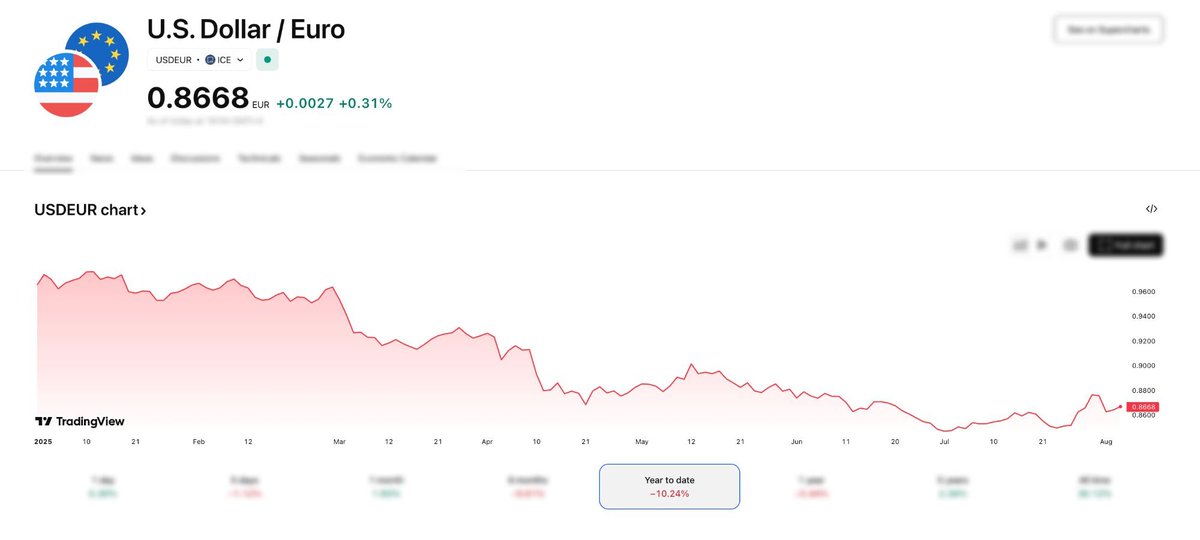
If the EUR/USD moves 10% the other way, like it did this year, your euro portfolio just shrunk.
The same principle is applicable to other currencies.
Let’s also not discard the fact that dollar-based infrastructure may auto-convert your deposits, report gains in USD, while your liabilities are in EUR, and even сreate phantom tax events in your local currency.
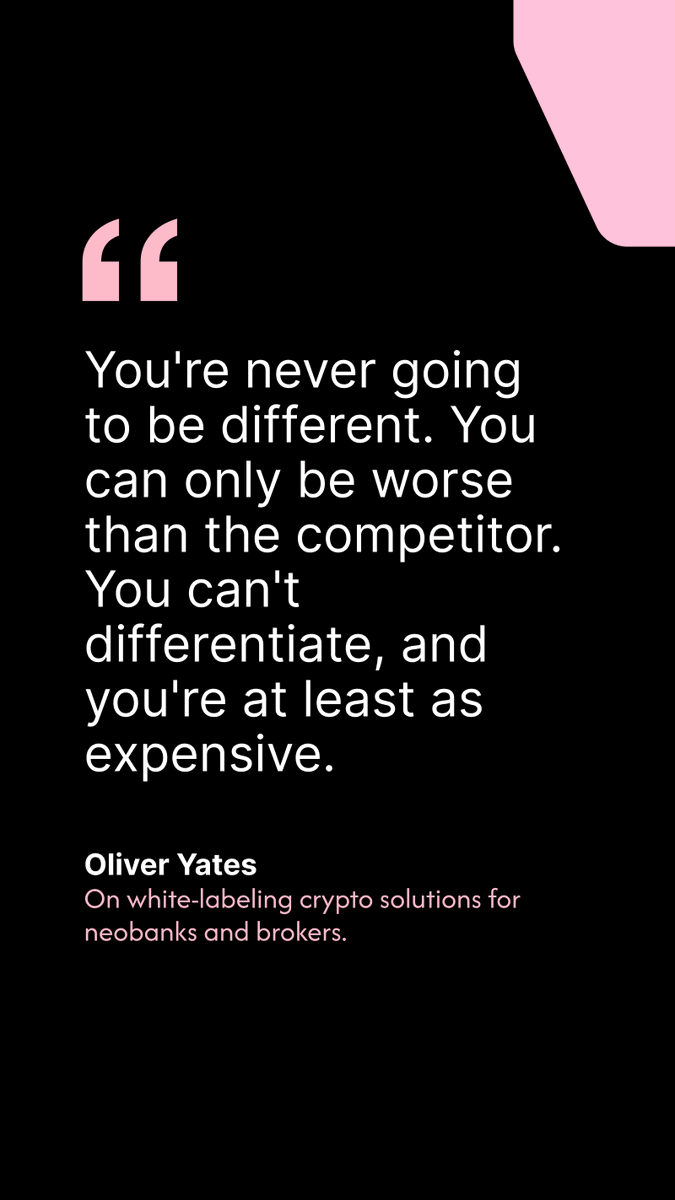
I have a recurring conversation with European neobanks and brokers who default to white-labeling under the weight of unprecedented client demand for digital assets.
Small and mid-market banks, in particular, have to make a difficult choice: either they do costly internalization or risk losing clients to retail-facing brokerages like Bitpanda and Trade Republic.
Many banks default to what appears to be the path of least resistance, also known as white-labeling.
Although nothing is inherently wrong with white-labeling as a model, from my perspective, this is often a strategic miscalculation for neobanks and brokers.
The fundamental issue always comes back to a misalignment of incentives.
In most white-label arrangements, the provider itself controls the end-client pricing. The broker providing the crypto infrastructure is often a direct-to-consumer brand that is actively competing with the bank for the same client pool. This means the provider, not the bank, makes the money from the trading spread.
If the bank wants to generate revenue, they can choose to bill the client extra on top of typically 1.5% to 3% wider spreads and the fees their broker may charge. Banks also face explicit costs like a licensing fee, which is either a fixed fee or a % of volume.
Lack of customization is another drawback of white-labeling.
A retail brokerage is naturally serving a mass-market audience, which forces them to make design choices where they cannot afford to be flexible. It’s always the end client who is more important to them from an operational point of view. So, banks inherit the product decisions, limitations, and workflow of their white-label partner.
If you are a neobank, think about this:
How can you compete if you’re offering the exact same service, with less flexibility, at a higher price? What, then, is your value proposition?
I should clarify that white-labeling is sometimes a good choice.
For anyone curious when, I'm currently drafting an in-depth article on the trade-offs between white-label, full internalization, and hybrid models.
If you’re interested in getting a copy, please express your interest in the comments or drop me a message, and I'll send it to you.
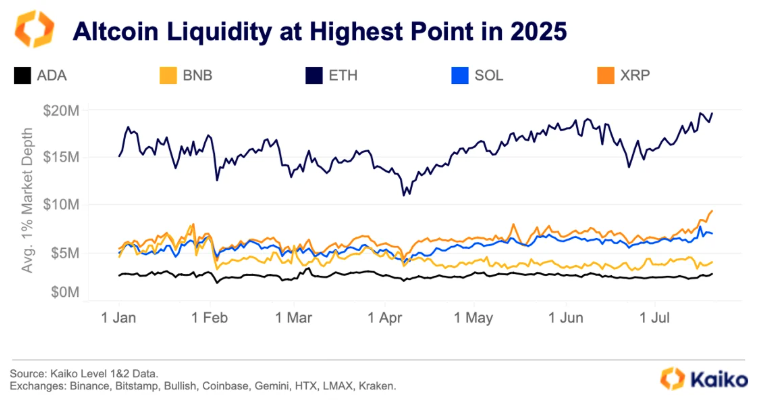
What happens when both Wall Street and public companies start hoarding beyond Bitcoin? You get an alt season.
ETH price surged 27% last week, and +52% in July.
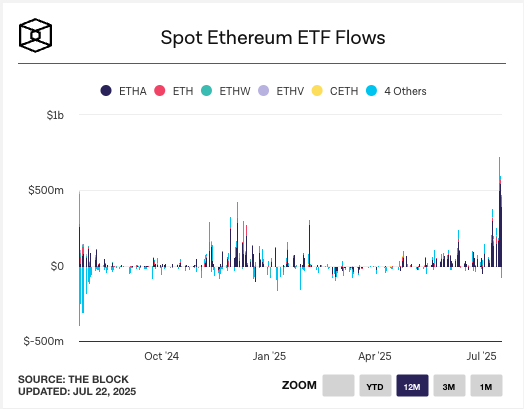
ETF assets under management reached a record $15.5B
Why?
One interesting theory suggests that institutional demand is gradually rotating from Bitcoin (an asset with no native yield) toward Ethereum, Solana and other alternatives.
Corporate ETH treasuries are ginning up this assumption:
- Sharplink Gaming (SBET): Bought ~280,706 ETH ($840M) in 9 days. Now the largest corporate ETH holder, surpassing the Ethereum Foundation. Funded via a $1B equity shelf in May, and filed to expand the program to $6B, with more ETH buys pledged
- BitMine Immersion (BMNR): Raised $250M, holds ~163K ETH
- Bit Digital (BTBT): Raised $172M, holds 100K ETH after divesting BTC
Liquidity flowing into ETH comes at a condition of so-called “recycling” programs:
1. launch a vehicle to attract capital, dress it up as an “active Ether generation company’ to amplify appeal.
2. get listed publicly
3. sell to retail at a premium
One stellar example is Ether Machine.
The company has attracted $1.5bn in committed capital, of which $700m is the personal contribution of its chief executive, Andrew Keys.
Not to be outdone by SBET, who plans to raise a further $5bn for a similar exercise in financial repackaging.
If demand for these corporate wrappers cools, the collapse could echo GBTC, when Bitcoin fell from $69K to $16K.
For now enthusiasm is ablaze.
So apace, in fact, that XRP and DOGE treasuries seem like a matter of when, not if.
But for how long?
Institutions just made their largest-ever bet on Ethereum.
Let’s break down last week’s numbers:
– 677,000 ETH of net inflows into spot ETFs
– Over $2.18 billion in fresh capital
– A new all-time high: 5.15M ETH held on-chain by ETF products
– $15.5B in AUM, up sharply in just weeks
– Trading volumes averaging $2.1B per day
– ETHA (iShares Ethereum Trust) captured 80%+ of inflows
In the span of a week, Ethereum has undergone a reputational facelift.
A new wave of institutional momentum is reinforcing the narrative, one already buoyed by internal moves at the Ethereum Foundation, supply/demand dynamics and positive news.
ETF demand is breaking records as BlackRock is openly flirting with staking.
OTC desks report growing scarcity, as treasuries continue aggressive ETH accumulation amid whispers of multi-billion-dollar inflows.
Even Capitol Hill seems unusually aligned: key legislation explicitly favors EVM infrastructure.
Together, these developments have punctured the long-held bear case.
No longer is sentiment defined by short squeezes.
ETH, some say, is being methodically siphoned from the market. Prices at these levels may never return.
The options market tells a revealing story, too:
The most popular institutional bet last week was $3,800–4,000 calls for August and September. Retail isn’t far behind, clustering around $3,500 for July and the same $3,800 for September. Put interest remains minimal, which simply means only a few bets on a correction.
Open interest on ETH options continues to climb ($10.7B), nearing the $12.5B peak from March 2024, at similar spot levels.
Dealers remain net short ITM calls, so covering may be inevitable.
Yet this doesn’t appear to be a classic gamma squeeze.
Contained volatility with current levels at 69 (from a low of 29 and a high of 209).
Notably, ETH has overtaken BTC in short-term implied vol, perhaps suggesting Ethereum is the preferred vehicle for directional exposure.
I personally think optimism may be premature given a 50% rally in under three weeks for the second-largest digital asset.
“Too good to be true,” as my barber puts it.
Especially with August 1st on the horizon.
Our own Rémi Genet took the stage at Bridging Rough Paths and Deep Learning: New Frontiers, an event hosted by The Alan Turing Institute.
His presentation on Signature-Weighted Kolmogorov-Arnold Networks (SigKAN) introduced a breakthrough in time series analysis
Pushing Boundaries in Algorithmic Research
At Aplo, innovation is what drives our execution algorithms and delivers real advantages for institutional traders.
That is why we actively contribute to research.
(cont.)
To give some context, this was a comparison/research made by the good folks at Counterparty Catalogue.
Several crypto prime brokers were selected for this comprehensive breakdown of prime brokerage solutions.
You have a link to the original comparison research in our blog article
Hey, hey 👋
Great news to share:
Aplo was named a Top Crypto Prime Broker solution for 2025 🎉🎉🎉
We are very thrilled (but not surprised 😆😆)
Read all about it 👇
blog.aplo.io/aplo-named-a-t…
It was an honor to attend and represent Aplo at Satoshi Roundtable XI.
If you were there, let’s continue the conversation.
If not—well, maybe we’ll see you next year.
From AI’s growing impact on our industry to liquidity, counterparty risk, and the evolution of trust, every conversation challenged perspectives and sparked ideas.
A private, invitation-only event where unexpected encounters turned into some of the most insightful discussions.
🤫 The first rule of Satoshi Roundtable?
You do not talk about the Satoshi Roundtable.
Four days.
No monologues.
No pitches.
Just high-caliber discussions with some of the brightest minds in crypto, finance, and beyond.
(cont.)