Aptori

140 posts

Aptori banner
Aptori

Aptori

@AptoriDev

Developer-First Application Security for the Shift-Left Revolution!

Katılım Ekim 2020
21 Takip Edilen6 Takipçiler
Aptori
Aptori@AptoriDev·
Myth: Clean scan = secure application. Reality: Clean scan = scanner found nothing it was built to find, in paths it was told to check, at the moment it ran. Runtime was not included in that sentence. It never is. The breach happens at runtime. #AppSec #DevSecOps #Aptori
Aptori tweet media
English
0
0
0
89
Aptori
Aptori@AptoriDev·
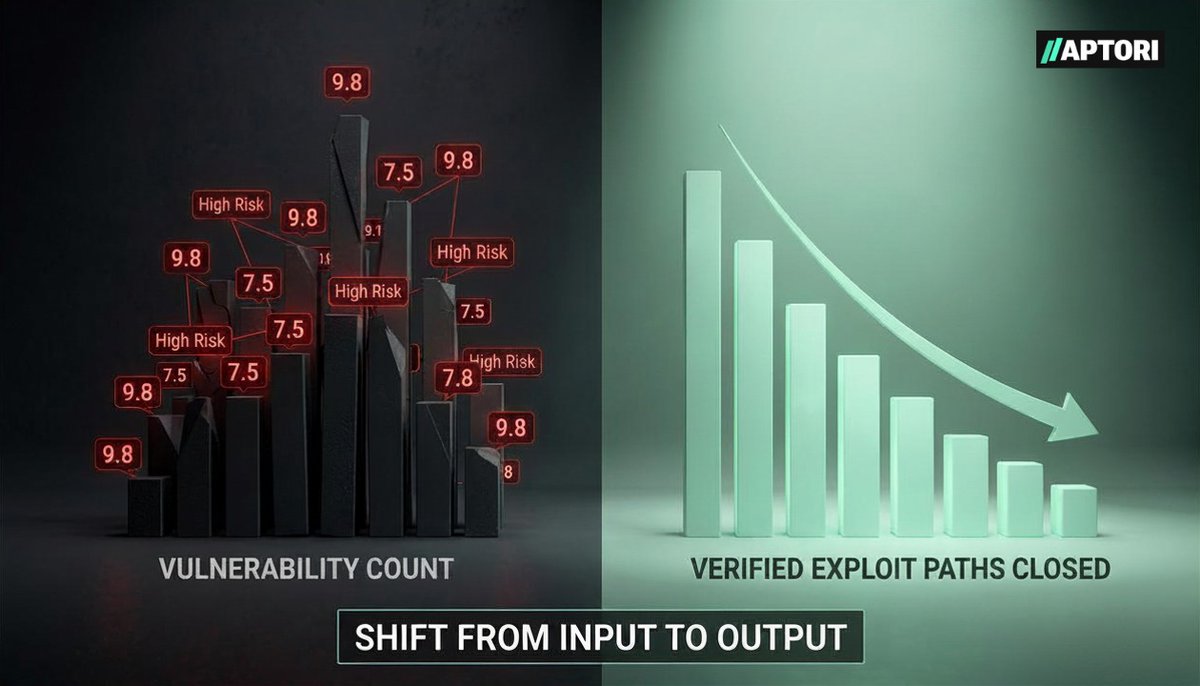
The only metric that maps directly to risk reduction: verified exploitable paths closed. Most programmes track the first two and just guess at the third. That gap is where risk lives. #AppSec #CISO #DevSecOps #Aptori
English
0
0
0
22
Aptori
Aptori@AptoriDev·
Vulnerability count tells you how much code you scanned. MTTR tells you how fast your team works. These are input metrics. They measure activity. They do not measure security. 🧵👇
Aptori tweet media
English
1
0
0
37
Aptori
Aptori@AptoriDev·
Modern applications are distributed systems. Security is determined by how components interact, not just the correctness of individual code blocks. The tools were built for an old problem. The problem has moved. It's time our tooling moved with it. #AppSec #DevSecOps #Aptori
English
0
0
0
16
Aptori
Aptori@AptoriDev·
SAST finds what it was taught. DAST tests what it is told. Neither knows what your system does at runtime under real conditions. That is not a gap in implementation. It is a gap in design. 🧵👇
English
1
0
0
17
Aptori
Aptori@AptoriDev·
Security leaders: How many open findings in your backlog have a proof-of-exploit attached? ​Not a CVSS score. A reproducible attack path. ​If the answer is close to zero, your backlog is a list, not a programme. What's that number for your team? ​#AppSec #CISO #Aptori
English
0
0
0
21
Aptori
Aptori@AptoriDev·
The rational response to a list where 90% is noise is to deprioritize the whole list. That is engineering judgment operating correctly. Runtime reachability changes this. If a vulnerability is in dead code, it's just a theory. Treat it differently. #AppSec #DevSecOps #Aptori
English

0
0
0
31
Aptori
Aptori@AptoriDev·
If 90% of your code never runs, 90% of your static analysis findings are chasing ghosts. The backlog grows because the input is wrong, not because your engineering team is slow. Most of what scanners flag are paths the app never uses. 🧵👇
English
1
0
0
10
Aptori
Aptori@AptoriDev·
@endurasecurity The scariest part is an SBOM gives a static ingredient list, completely blind to execution context. When that install hook fires and grabs credentials, only runtime validation sees it. Static inventory without runtime ground truth is a massive blind spot.
English
0
0
1
17
Endura Security
Endura Security@endurasecurity·
Modern dev boxes are credential aggregators. LLM keys, registry tokens, kube configs, cloud creds - all in the same process tree. One install hook ships the whole bundle. Your SBOM never saw any of that. #DevSecOps #SupplyChainSecurity
English
1
0
0
12
Aptori
Aptori@AptoriDev·
@jfrog The speed of these supply chain attacks shows why catching packages early is critical. But as static evasion gets easier, the ultimate fail-safe is observing actual runtime behavior. If a compromised dependency executes, runtime validation is what stops the breach.
English
0
0
0
28
JFrog
JFrog@jfrog·
Your automated pipelines are a feature, but for attackers, they're an opportunity. A new wave of software library attacks hit #npm and #PyPI packages in the last week, silently merging malware into #dev environments in minutes. The Bitwarden CLI compromise alone reaches 70K downloads a week. Get the full breakdown: bit.ly/4mU2EGs #CyberSecurity #SupplyChainAttack #AppSec #OpenSource
English
1
0
3
255
Aptori
Aptori@AptoriDev·
The boundary between findings and proof is the most important line in security. On one side: patterns and noise. On the other: a reproducible sequence demonstrating real exploitability. Attackers operate on the right side of that line. It's time we join them #AppSec #DevSecOps
English
0
0
0
12
Aptori
Aptori@AptoriDev·
A finding without proof is a hypothesis. Developers do not fix hypotheses. This is the real reason your AppSec backlog exists. Not a lack of headcount. Not sprint planning. Security tools produce probabilistic signals. Engineers need certainty. 🧵👇 #Aptori
English
1
0
0
5
Aptori
Aptori@AptoriDev·
If your security dashboard is optimized for findings count, you are measuring activity. Not security. Findings without proof of exploitability are just hypotheses. And engineers don't patch hypotheses. #AppSec #DevSecOps
English
0
0
0
22
Aptori
Aptori@AptoriDev·
Most tools measure what happens before a breach. Almost none measure what happens during it. Start from runtime. Not as a phase. As the source of truth. #AppSec #CyberSecurity #Aptori
English
0
0
0
33
Aptori
Aptori@AptoriDev·
Security programmes are built before runtime. Attacks happen during it. That gap has a name: your actual attack surface. 🧵👇
English
1
0
0
11
Aptori
Aptori@AptoriDev·
@datadoghq You can't secure what you can't see, so full-stack observability is non-negotiable right now. As the market shifts heavily into the agentic era, pairing this level of visibility with autonomous security resolution is how engineering teams will actually be able to scale safely.
English
1
0
0
13
Datadog, Inc.
Datadog, Inc.@datadoghq·
Fragmented tools make AI harder to ship. When visibility is disconnected across LLM behavior, application performance, and GPU capacity, teams struggle to control spend, prove ROI, and scale with confidence. Datadog gives Google Cloud users one platform to evaluate, optimize, and secure their AI stack, helping teams build and scale more reliable AI applications and agents: datadoghq.com/blog/datadog-g…
English
1
1
3
731
Aptori
Aptori@AptoriDev·
This is where Semantic Models come in. They map nodes (identities, APIs) and edges (data flows, access controls) to track exactly where context is lost. Read our full technical breakdown on how system-level security analysis actually works: 🔗 aptori.com/blog/semantic-… #AppSec
English
0
0
0
7
Aptori
Aptori@AptoriDev·
Do you have an accurate map of the authorization relationships between your services? Or does that map exist only in people's heads? To secure modern architectures, you have to stop looking at individual requests and start modeling entire interaction paths. #Aptori
English
1
0
0
8
Aptori
Aptori@AptoriDev·
Authorization is fundamentally a graph problem. Who can do what to which object? Via which service? The vulnerabilities that matter most in 2026 like BOLA & privilege escalation emerge from inconsistencies in this graph. 🧵👇
English
1
0
0
15
Aptori
Aptori@AptoriDev·
What if a downstream API blindly trusts requests from another service without verifying the user? That's not a code typo. That's a systemic failure leading to BOLA & workflow bypasses. You cannot secure system behavior by only scanning syntax. #AppSec #Microservices #Aptori
English
0
0
0
6
Aptori
Aptori@AptoriDev·
Modern apps are distributed. An API gateway checks auth. An identity provider issues a token. A microservice executes the logic. Individually, static analysis might show zero unsafe code. But together, they create a massive inter-service trust gap.
English
1
0
0
14
Aptori
Aptori@AptoriDev·
Myth: If every microservice passes a code scan, your application is secure. Reality: In distributed systems, the most critical vulnerabilities hide in the spaces between secure services. 🧵👇
English
1
0
0
5