
@Aurigraph.io retweetledi
@Aurigraph.io
1.9K posts

@Aurigraph.io
@Aurigraph_io
Layer 0 DLT for Real World Assets Tokenisation #Aurex #DigitalAssets #Finverse3 #fintech #CarbonMarkets https://t.co/K9ZPkihAbh https://t.co/gyon8e2dVr
Mount Rainier, MD Katılım Mart 2018
4.2K Takip Edilen561 Takipçiler
@Aurigraph.io retweetledi

BREAKING: PRESIDENT TRUMP JUST SIGNED AN EXECUTIVE ORDER DIRECTING THE FEDERAL RESERVE TO OPEN MASTER ACCOUNTS FOR CRYPTO COMPANIES
THE FED IS BENDING THE KNEE
A NEW ERA FOR #BITCOIN IS BEGINNING 🔥


English
@Aurigraph.io retweetledi

Noida woman Twisha Sharma, 33, Dies 5 months after wedding, family alleges harassment suicide.
Her brother, a serving Army Major, has been running pillar to post to get an FIR registered. ndtv.com/india-news/noi…
English

I just verified content with @ProvenewsAI — Trust Score: 99.99/100 🟢 LOW RISK 🔍 #FactChk #DeepFake provenews.com/facttrace/repo…
English

I just verified content with @ProvenewsAI — Trust Score: 99.99/100 🟢 LOW RISK 🔍 #FactChk #DeepFake provenews.com/facttrace/repo…
English

I just verified content with @ProvenewsAI — Trust Score: 99.99/100 🟢 LOW RISK 🔍 #FactChk #DeepFake provenews.com/facttrace/repo…
English

I just verified content with @ProvenewsAI — Trust Score: 99.99/100 🟢 LOW RISK 🔍 #FactChk #DeepFake provenews.com/facttrace/repo…
English

I just verified content with @ProvenewsAI — Trust Score: 100/100 🟢 LOW RISK 🔍 #FactChk #DeepFake provenews.com/facttrace/repo…
English

Check out our universal quantum secure wallet battua.io to mitigate the BIP361 migration
Bitcoin Magazine@BitcoinMagazine
JUST IN: The Governor of the Czech National Bank revealed what they found after investing in bitcoin 🇨🇿 "With 1% in BTC, expected return goes up and overall risk stays about the same. This is what our new study shows." 👀
English
@Aurigraph.io retweetledi

Anthropic's Claude Code team just teaches how to automate your entire engineering workflow with Claude Code SDK in under 30 minutes.
For Free. From the engineers who built it.
CANCEL Your Weekend Plans, and Learn to Automate Your Codebase Today.
Bookmark it. Watch it. Ship your first headless automation this weekend.
$5,000/month. $10,000/month. $25,000/month.
People are automating entire engineering teams with Claude Code SDK and charging clients $$$$. You're still copy-pasting code from ChatGPT manually.
This video fixes that tonight.
Follow @codewithimanshu for more high-signal content that actually moves your AI engineering career forward.
↓
Sid Bidasaria runs engineering on Claude Code at Anthropic. He just gave away the entire SDK + GitHub Action playbook in 30 minutes.
This is the talk that separates people automating their entire codebase from people still manually writing every commit.
Here's everything inside.
Follow @codewithimanshu for weekly Claude automation breakdowns.
↓
What the Claude Code SDK actually is.
Most devs don't know this exists. They use Claude in the chat interface and call it a day.
The SDK is the real unlock.
Programmatic access to the Claude Code agent in headless mode. The primitive building block for every serious automation you'd ever want to build.
Designed like a Unix tool. Drops directly into terminal pipelines, bash scripts, CI/CD automation.
Use it to review code. Write linters. Build chatbots. Manage remote code environments. Run an entire engineering pipeline.
This is how you stop "using AI" and start "shipping with AI."
Follow @codewithimanshu for full Claude SDK breakdowns every week.
↓
Basic usage that 99% of devs miss.
`claude -p` to prompt the agent directly from your terminal.
`--allowed-tools write` for controlled file system access.
Pipe anything into it:
> Pipe `ifconfig` output → ask Claude to debug your network
> Pipe error logs → get a fix before your coffee finishes brewing
> Pipe a file → get instant code review without opening an editor
`--output-format JSON` for structured responses you can parse in automated systems.
This is where Claude stops being a chat tool and becomes infrastructure.
Follow @codewithimanshu for daily Claude SDK one-liners that save hours.
↓
Permission management without the security holes.
The biggest reason teams don't deploy AI in production: permission concerns.
Sid solves it cleanly:
> No destructive permissions by default
> `--allowed-tools` to pre-configure exactly what the agent can touch
> `--permission-prompt-tool` to delegate authorization to an MCP server in real time
Your AI agent gets full power exactly when it needs it. Zero access when it doesn't.
This is enterprise-grade AI security packaged as a single flag.
Most tutorials hand-wave this. This one shows the architecture.
Follow @codewithimanshu for production AI permission patterns every week.
↓
Session persistence: the multi-turn unlock.
Most AI integrations forget everything between calls.
That's why your "AI assistant" feels like talking to someone with amnesia.
Return a `session ID` and Claude resumes exactly where you left off. Full context preserved. Multi-turn conversations across hours, days, deploys.
This is the foundation for building any real AI product that holds context.
Customize the system prompt while you're at it. `--system-prompt 'talk like a pirate'` if you want. Or build a serious agent persona for production.
Follow @codewithimanshu for persistent context patterns for AI agents.
↓
The Claude GitHub Action demo that should scare every dev.
Sid runs a live demo on a real quiz app:
> Files an issue: "add a 50/50 power-up and a skip power-up"
> Claude creates a to-do list
> Claude modifies the files
> Claude opens a Pull Request
The entire feature shipped from one issue. No human touching code.
This is automated code review, automated bug triage, automated feature implementation. From GitHub issues directly.
Junior dev work just got compressed into the time it takes to write an issue description.
Follow @codewithimanshu for GitHub Action setups for production.
↓
Zero infrastructure required.
Every other AI automation tool needs:
> A separate server
> A deployment pipeline
> Monitoring infrastructure
> Auth setup
> Cost tracking
The Claude GitHub Action uses your existing GitHub Action runners.
`claude /install github action` in your local repo. Generates a YAML config. Done.
You go from idea to production AI automation in 60 seconds.
Most people pay $200/month for tools that do less than this free Action.
Follow @codewithimanshu for free Claude Action templates.
↓
The 3-layer architecture nobody explains.
Sid breaks down the actual stack:
> Layer 1: SDK - the foundation, raw programmatic access
> Layer 2: Base Action - wraps the SDK as a clean API interface
> Layer 3: PR Action - adds comments, formatting, full GitHub UX
Understanding these layers is the difference between someone who copies tutorials and someone who builds custom AI infrastructure for clients.
This is the architectural insight that turns into $10K/month consulting contracts.
Follow @codewithimanshu for weekly architecture deep dives.
↓
30 minutes from the engineer shipping this in production.
You'll learn more from this than from 6 months of YouTube tutorials made by people who've never automated a single deploy.
People who watch this understand Claude Code automation at the infrastructure level.
People who skip it keep manually reviewing PRs, manually filing issues, manually doing work that could've been automated last weekend.
Save the video. Watch it tonight. Ship your first Claude SDK automation this weekend.
Follow @codewithimanshu for more high-signal content that actually moves your AI engineering career forward.
English
@Aurigraph.io retweetledi

An MIT professor taught the same math course for 62 years, and the day he retired, students from every country on earth showed up online to watch him give his final lecture.
I opened the playlist at 2am and ended up watching three of them back to back.
His name is Gilbert Strang. The course is MIT 18.06 Linear Algebra.
Every machine learning engineer, every data scientist, every quant, every self-taught programmer who actually understands how AI works learned the math from this one man. Most of them never set foot on MIT's campus. They just opened a free playlist on YouTube and let him teach.
Here's the story almost nobody tells you.
Strang joined the MIT math faculty in 1962. He retired in 2023. That is 61 years of standing at the same chalkboard teaching the same subject to 18-year-olds.
The interesting part is what he did when MIT launched OpenCourseWare in 2002. Most professors were skeptical. They worried that putting their lectures online would make their classrooms irrelevant. Strang did not hesitate. He said his life's mission was to open mathematics to students everywhere. He filmed every lecture and gave it away.
The decision quietly changed how the world learns math.
For decades linear algebra was taught the wrong way. Professors started with abstract vector spaces and proofs about field axioms. Students drowned in the abstraction. Most never recovered. They walked out believing they were bad at math when they had simply been taught in an order that nobody's brain is built to absorb.
Strang inverted the entire curriculum.
He started with matrix multiplication. Something you can write down on paper. Something you can compute by hand. Something you can see. Then he showed his students that everything else in linear algebra eigenvectors, singular value decomposition, orthogonality, the four fundamental subspaces was just a different lens for understanding what the matrix was actually doing under the hood.
His rule was strict. If a student could not explain a concept using a concrete 3 by 3 example, that student did not actually understand the concept yet. The abstraction was supposed to come last, not first. The intuition was the foundation. The proofs were just confirmation that the intuition was correct.
The second thing Strang changed was the classroom itself. He said please and thank you to his students. Every single lecture. He paused mid-derivation to ask "am I OK?" to check if anyone was lost. He never used the word "obviously" or "trivially" because he knew exactly what those words do to a student who is one step behind. He treated 19-year-olds learning math for the first time the way he treated his own colleagues. With patience. With respect. With the assumption that they belonged in the room.
For 62 years.
The result is something that has never happened in the history of education. A single math professor became the default teacher of his subject for the entire planet.
Universities in India, China, Brazil, Nigeria, every country with a computer science department, started telling their own students to just watch Strang's lectures. The University of Illinois revised its linear algebra course to do almost no in-person lecturing. The reason was honest. The professor said they could not compete with the videos.
His final lecture was in May 2023.
The auditorium was packed with students who had never met him before. He walked to the chalkboard, taught for an hour, and at the end the entire room stood and applauded. He looked confused for a moment, like he genuinely did not understand why they were cheering. Then he smiled and waved them off and walked out.
His written comment under the YouTube video of that final lecture was four sentences long. He said teaching had been a wonderful life. He said he was grateful to everyone who saw the importance of linear algebra. He said the movement of teaching it well would continue because it was right.
That was it. No book promotion. No farewell speech. No legacy management.
The man whose teaching is the foundation of modern AI just thanked the audience and went home.
20 million views. Zero ego. The entire engine of the AI revolution sits on top of math that millions of people learned for free from one quiet professor in Cambridge.
The course is still on MIT OpenCourseWare. Every lecture, every problem set, every exam, every solution. Free.
The most important math course of the 21st century is sitting one click away from you. Most people will never open it.

English
@Aurigraph.io retweetledi

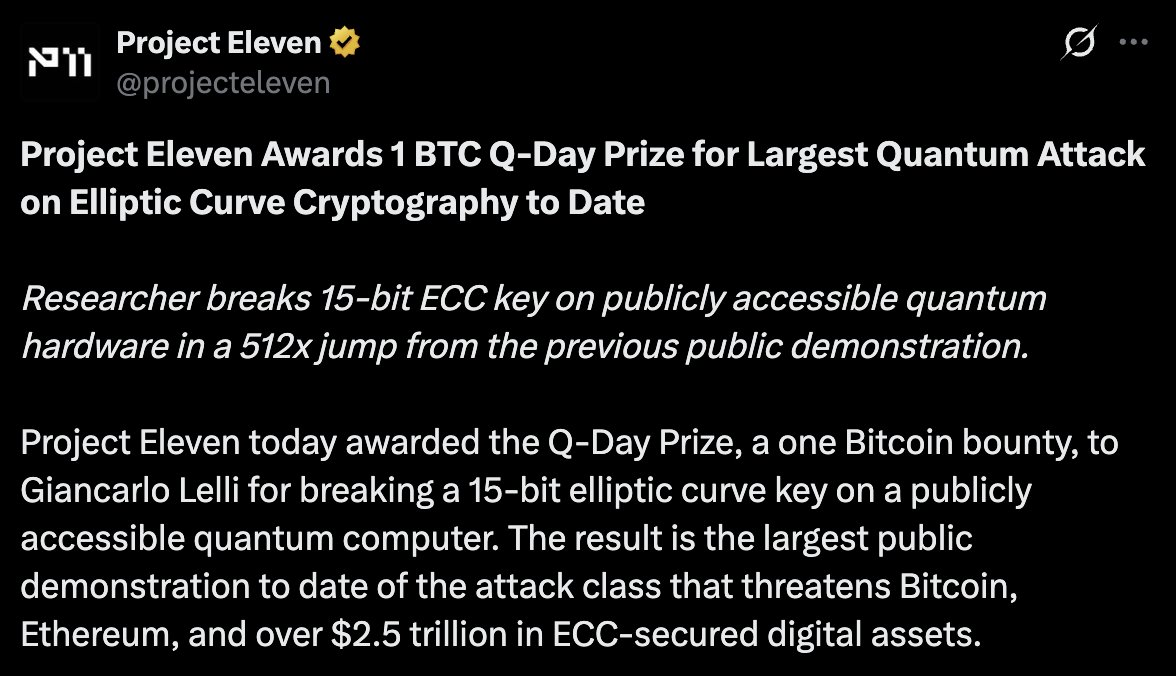
Researcher Breaks 15-Bit ECC Key on Quantum Hardware, Signals Potential Bitcoin Risk
Independent researcher Giancarlo Lelli broke a 15-bit ECC key using public quantum hardware, winning a 1 BTC bounty and marking the largest public quantum attack demonstration to date. Estimates suggest breaking 256-bit ECC may require about 500,000 qubits, with around 6.9 million bitcoins potentially exposed, highlighting the need for post-quantum upgrades.
x.com/projecteleven/…

English
@Aurigraph.io retweetledi

A very important message!
I hope maximum number of youth turn out to vote and strengthen our democracy.
Dr. H. V. Hande@DrHVHande1
At the age of 99, I have seen our nation earn its voice - and today, I used mine. The first time I voted was in 1946 as a Medical Student. Voting is not just a right, it is a responsibility to the future we leave behind. Your one vote matters. Step out. Stand up. Be counted.
English

I just published 5.4 Million BTC Are Quantum-Vulnerable — Here’s How to Check Yours medium.com/p/5-4-million-… @subbujois
English
@Aurigraph.io retweetledi

#BIP361 is real. A three-phase plan to phase out ECDSA and Schnorr, freezing wallets that don't migrate to quantum-resistant addresses.
~6.5M BTC sit in vulnerable addresses today.
Check out battua.io to migrate #Bitcoin #wallet with true #QuantumSecure wallet
English
@Aurigraph.io retweetledi