Andrew Aziz

23.7K posts

Andrew Aziz banner
Andrew Aziz

Andrew Aziz

@BearBullTraders

Helping professionals to achieve financial freedom and success with day trading @PeakCapTrading

Katılım Ağustos 2017
994 Takip Edilen109.8K Takipçiler
Sabitlenmiş Tweet
Andrew Aziz
Andrew Aziz@BearBullTraders·
Day trading isn't luck. For me, an engineer turned full-time trader, it was a system built from near-total loss. After a layoff, I lost $30k in the market. Fast. I realized: the market transfers money from the emotional to the disciplined. I rebuilt by treating it like engineering: Profit = Discipline × Risk Management × Action Success comes from the daily grind, not a single win. Start small. Stay disciplined. Let your process work.
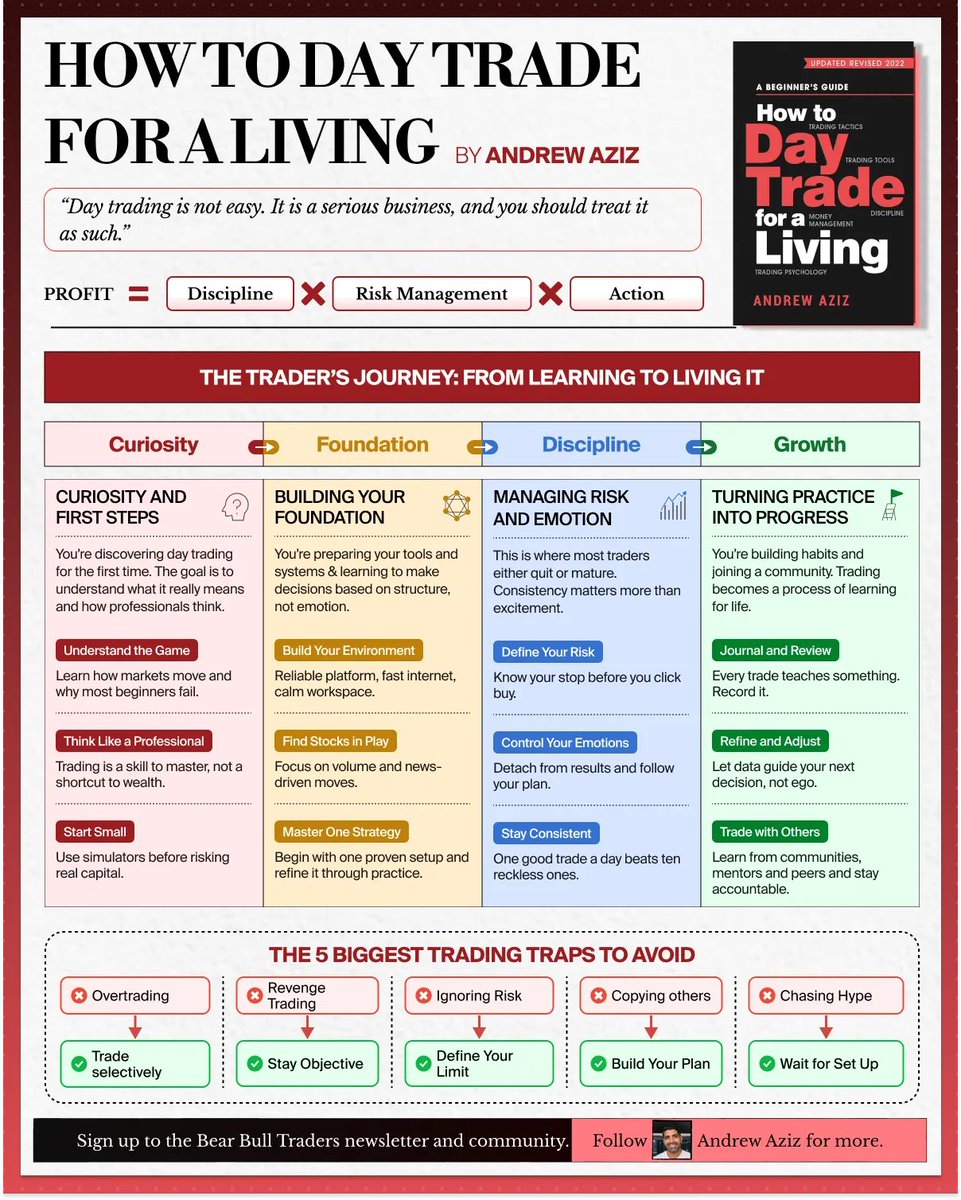
Andrew Aziz tweet media
English
38
225
1.4K
99K
Andrew Aziz
Andrew Aziz@BearBullTraders·
Markets are closed today for Good Friday. Enjoy the long weekend, and for those who observe, wishing you a meaningful day. Take the time to relax and be with family. I’ll see you next week for live day trading in the chatroom.
English
26
20
125
11.1K
Andrew Aziz retweetledi
Eyal Yakoby
Eyal Yakoby@EYakoby·
BREAKING: Iran has executed 657 Iranians in the past three months. The UN? Silent. Amnesty International? Silent. Mehdi Hasan? Silent. Cenk Uygur? Silent.
Eyal Yakoby tweet media
English
215
2.1K
4.4K
82K
Andrew Aziz
Andrew Aziz@BearBullTraders·
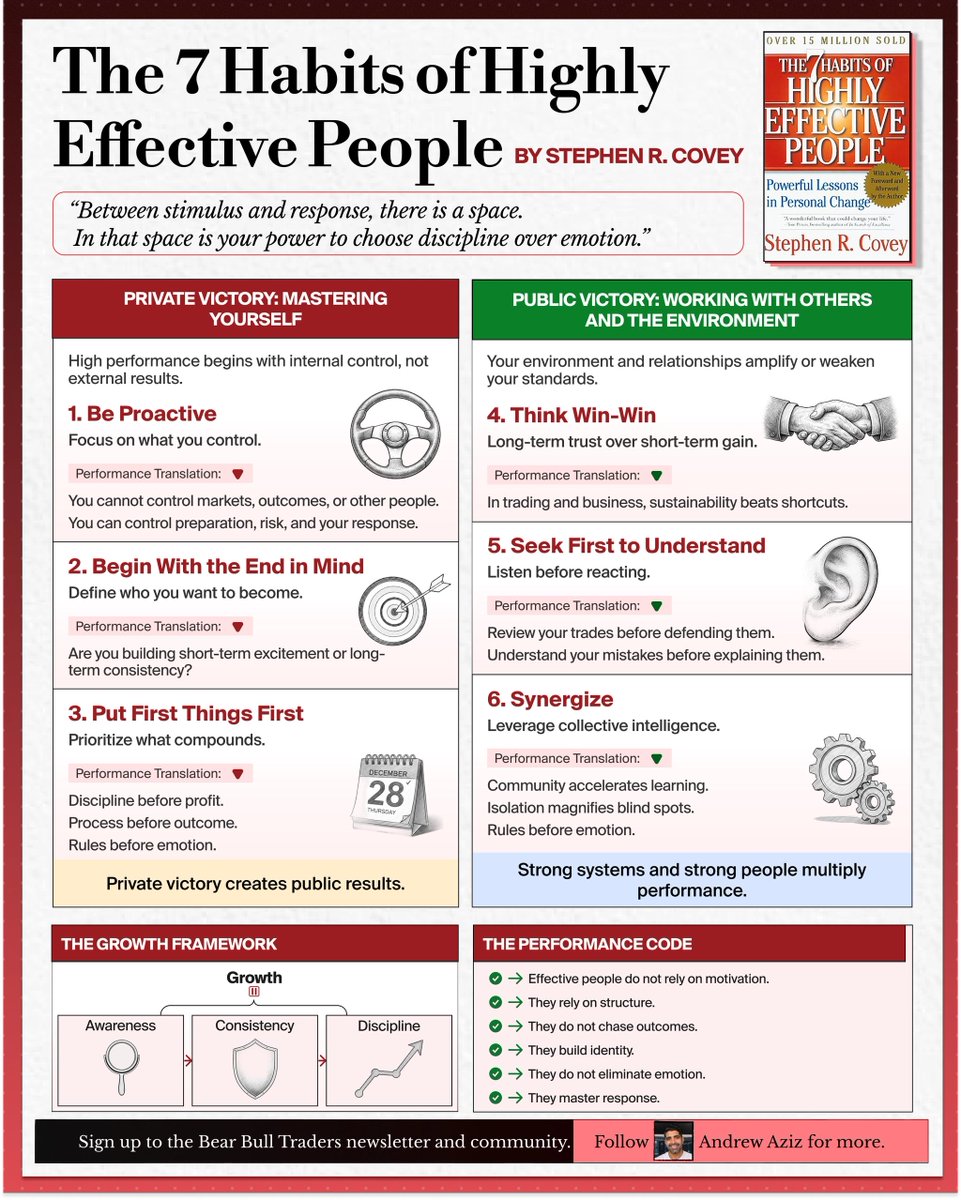
Everyone wants the outcome. Few want the discipline. The gap between average and exceptional performance is self-governance. Stephen Covey's 7 Habits of Highly Effective People highlights the importance of independence and self-improvement. And the book makes one thing clear: Success is built on character, not tactics. Covey argues that effectiveness is an inside-out process. When you study high performers long enough, you see the same pattern. 👉 Real performance begins within. Here’s how that principle shows up in practice ⬇️ Habit 1️⃣: Take responsibility Being proactive means you stop blaming conditions. Markets fluctuate, businesses shift, and people will disappoint you. You have control over your response. High performers don’t ask, “Why is this happening to me?” Instead, they question, "How should I respond?” That shift alone changes outcomes. Habits 2️⃣ and 3️⃣: Think long term, then act accordingly Always begin with the end in mind, and reverse engineer your future. Ask yourself: - Who do I want to become? - What does that version of me do daily? - What must be removed? Without clarity, discipline feels restrictive. With it, discipline feels aligned. Habits 4️⃣, 5️⃣, and 6️⃣: Emotional maturity Have a win-win mindset. Seek to understand and synergize. And watch your performance scale. Ego destroys teams, impatience ruins opportunity, and poor communication breaks trust. You cannot scale results without scaling emotional control. Habit 7️⃣: Renew yourself High performers do not just push harder. They recover intentionally. They protect energy, focus, health, and their environment. Burnout happens when you stop renewing yourself. Longevity requires regular recalibration. This applies far beyond trading. People fail when they: ❌ React instead of respond. ❌ Blame instead of own. ❌ Chase instead of plan. ❌ Burn out instead of renew. High performance comes when you learn to govern yourself better. The real edge lies in ownership, emotional discipline, and structured habits. As Covey says, you're a "product of your decisions". And character comes before results. The real question is not: “Do you know the strategy?” It is: “Can you govern yourself when it matters?” Which habit has had the biggest impact on your performance? Share the wisdom in the comments.
Andrew Aziz tweet media
English
22
27
153
11.6K
Andrew Aziz
Andrew Aziz@BearBullTraders·
Stand up and support the US in their efforts to make the world safer. NATO helped in Libya for 7 months; they can do so now too. Iran has been killing Canadians in planes and prisons. Stand up, Mr. Carney. You can oppose Trump but support a good cause. That’s what powerful leadership is.
English
13
0
31
3K
Mark Carney
Mark Carney@MarkJCarney·
Plus tôt, j’ai discuté avec le président Trump. Je l’ai félicité du lancement réussi de la mission Artemis II.  Nous avons discuté du courage des astronautes, dont le colonel Jeremy Hansen, de l’importance de la coopération dans l'espace et de l’évolution du conflit au Moyen-Orient.
Français
132
59
521
64.1K
Andrew Aziz retweetledi
Créde Sheehy-Kelly
Créde Sheehy-Kelly@crede_perform·
Visualization is sim trading for your brain. You're firing the exact neural pathways you'd use in live market conditions — rehearsing execution, building consistency, training your response to pressure. But many traders who use visualization are essentially daydreaming with good intentions. The key is to practise it the same way elite athletes do — with a defined structure, consistent repetition, and a reliable mechanism to access the same mental and emotional state every time. Deliberate practice makes all the difference .
English
1
4
22
3.7K
Matt Gyra
Matt Gyra@MFGyra·
@BearBullTraders Just signed up to trading terminal premium yesterday ! Looking forward to giving it a try before I do anything else
English
1
0
1
300
Andrew Aziz
Andrew Aziz@BearBullTraders·
I blew up multiple trading accounts when I started. And it was 100% my fault. When I was younger, I chased trades, ignored risk, increased size when I shouldn’t have, and trusted my gut over a system. I thought I was smarter than the market. Spoiler alert: I wasn't. Because it wasn’t the market’s fault. It was my ego. My ego led everything I did. My business, my trading, my relationships. Until one day, I lost $30,000 in a single session. Years of hard work gone in a matter of hours. I said publicly, “It was my fault.” And that moment changed everything. I admitted why I was losing... because I lacked structure. And, more importantly, because my ego got the better of me. So I rebuilt my trading from the ground up. I stopped guessing and started building rules. It was these two shifts that reduced my ego and rebuilt my career: 1️⃣ Strategy first I stopped trying to outsmart the market, and instead committed to one simple, proven setup: ❌ No chasing. ❌ No improvising. ❌ No switching systems when it felt uncomfortable. Pick one approach, master it, and stop jumping. 2️⃣ Build a system that survives losses Losses are normal, but your structure must: ✅ Control position size. ✅ Protect capital. ✅ Limit downside. 3️⃣ Trade on a real-time simulator or funded training account - Test yourself under real market conditions, emotions, and pressure. - Get rewarded if you demonstrate consistency and profitability. - No risk to your real capital. Any plan that cannot survive mistakes is not a real plan. It’s just gambling with better branding. Once I had rules, I didn’t need to be right all the time. I just needed to be consistent. After that, growth was slow. Not flashy, not dramatic, just consistent. And that gradual growth is what scaled my business dramatically. But that result and business growth is not the point. The discipline is. I succeeded because I stopped repeating the same mistakes. My ego was the main driver of my mistakes, and I had to kill it to move on. Because ego destroys progress. Systems rebuild it. And sometimes the hardest progress, but the best growth, starts with admitting: "It was my fault." That's the moment you stop defending your past and start designing your future. Have you ever had to admit your biggest setback was self-inflicted? Let me know in the comments, I know I'm not alone here! If you want to test yourself and prevent future fallout, try out Trading Terminal today: tradingterminal.com/funded-account This is where you can trade in real market conditions without risking your own capital, and earn funding by proving your consistency.
Andrew Aziz tweet media
English
30
15
163
26.8K
Andrew Aziz retweetledi
unusual_whales
unusual_whales@unusual_whales·
BREAKING: US and Iran discussing ceasefire for reopening Strait, per Axios
English
243
130
1.9K
195.3K
Andrew Aziz
Andrew Aziz@BearBullTraders·
Today I’m starting a new series of articles about my life, career changes, and the lessons I learned along the way. People often see the visible parts of my journey, trading, writing books, building a community, climbing Everest. But the real story started much earlier. This first article is about growing up between cultures, and how that experience shaped the way I think about risk, career choices, and building your own path in life. Many of us follow paths that feel “expected.” But sometimes the most important question we can ask ourselves is simple: Is this the only path? In this article I share some reflections about identity, expectations, and how early experiences quietly shape the decisions we make later in life. If you have ever thought about changing direction in your career or life, I think you might relate to this. Here is the first article: Growing Up Between Cultures. linkedin.com/pulse/growing-… via @LinkedIn
English
22
18
109
11.2K
Andrew Aziz retweetledi
Eyal Yakoby
Eyal Yakoby@EYakoby·
Iranian Ballistic Missile launches: Day 1 — 350 Day 2 — 175 Day 3 — 120 Day 4 — 50 Day 5 — 40 Day 6 — 32 Day 7 — 28 Day 8 — 15 Day 31 — 3 They’re running out of missiles and launchers.
English
1.4K
3.1K
20.8K
1.3M
Andrew Aziz retweetledi
The Kobeissi Letter
The Kobeissi Letter@KobeissiLetter·
BREAKING: Iran's President Pezeshkian says Iran is ready to end the war with the US but wants guarantees. US stocks are surging on the news.
The Kobeissi Letter tweet media
English
1K
2.8K
16K
2.4M
Andrew Aziz retweetledi
Overton
Overton@overton_news·
🚨 JPMorgan CEO Jamie Dimon just dropped an UNEXPECTED take on Iran. “It’s much more important that this be successfully completed, than what the market does.” Dimon says the markets are unpredictable right now, but regardless, EVERYONE should be hoping for Trump to succeed in Iran. DIMON: “I think the market...you know, markets are unpredictable and it’s hard for me to tell you exactly what.” “But I think they’re just looking at is there a chance something can go wrong?” “Now we should all hope nothing goes wrong. We should all hope that these bad people are...you know, that we win this thing and clean up straits and that Iran is no longer a threat to anybody.” “The markets will be concerned until it is over.” “But I think it’s VERY important...it’s much MORE important that this be successfully completed than what the market does.” Wall Street’s most powerful CEO just said winning in Iran is more important than the what stock market does in the short term.
English
542
2.7K
12.9K
1.2M
Andrew Aziz
Andrew Aziz@BearBullTraders·
Most people are being brainwashed every day. Peak performers choose who does the programming. Most are distracted by their phone, stress, and doubts. But peak performers do something different. They brainwash themselves on purpose. It sounds intense, but it isn’t. Repeated thoughts become beliefs, which drive actions, which form your identity. Your brain gets programmed whether you like it or not. The question is: Are you doing it intentionally? I once interviewed a 3x Olympian - Elizabeth Gleadle. Yes, talent helped her succeed, but it was her deliberate mindset that shaped her. Instead of using medals as her metric, She measured success every 24 hours through daily wins. That’s how you stay consistent long enough to become great. Here’s a simple framework you can use to do this as well. And it'll keep you consistent. 1️⃣ Prime your mind before the day starts If you start reactive, you'll perform reactive. Before checking your phone, write down: - The 3 things that matter today - The mindset you want to bring: calm, focused, patient You are setting the tone before the world sets it for you. 2️⃣ Make your days winnable If your only win is a big outcome, you'll burn out. Define one small win you control in 24 hours. - One focused practice session - 30 minutes of deep work - One hard conversation - One workout Small wins build confidence, and confidence leads to consistency. 3️⃣ Review the day like a coach Peak performers don’t just live the day; they process it. At night, answer: - What moved me forward? - What will I repeat tomorrow? - What will I stop doing? Three bullet points. That's all you need. Keep it simple. 4️⃣ Train below pressure before you face pressure Most people jump into stress too early. Practice in controlled conditions first. In trading, that might mean simulation. In life, that could be rehearsing or doing a smaller version of the real task until it feels normal. This is how you “brainwash” your brain. You stack evidence, instead of relying on hope or motivation. Then, every small win tells your brain: “I’m the kind of person who shows up.” That identity is what holds under pressure. What’s one “daily win” you can lock in today? Let's make it happen!
Andrew Aziz tweet media
English
22
21
88
12.2K
Andrew Aziz retweetledi
TrendSpider
TrendSpider@TrendSpider·
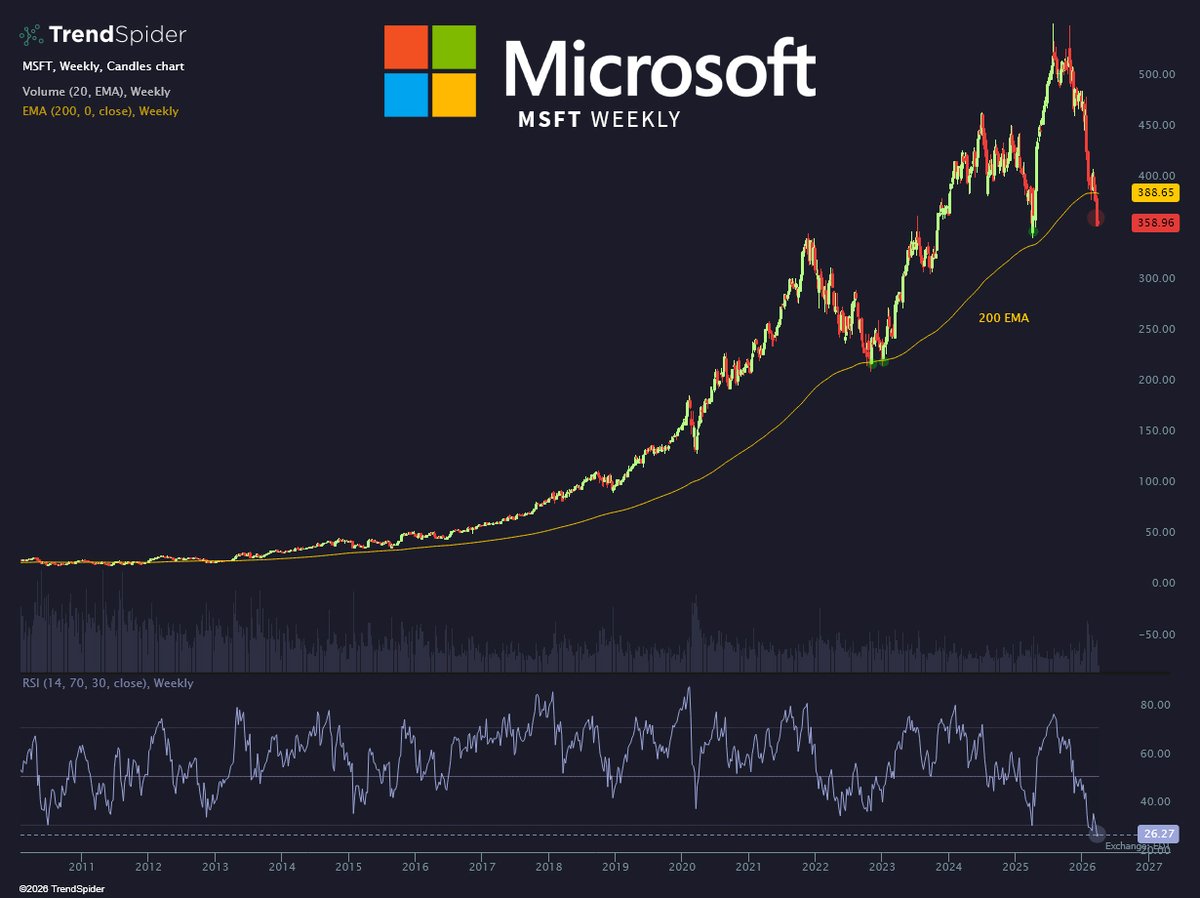
Oversold doesn't even begin to cover it. $MSFT weekly RSI hasn't seen this low in over 15 years.
TrendSpider tweet media
English
86
153
1.6K
159.2K
Andrew Aziz retweetledi
AimanBBT
AimanBBT@AimanBbt·
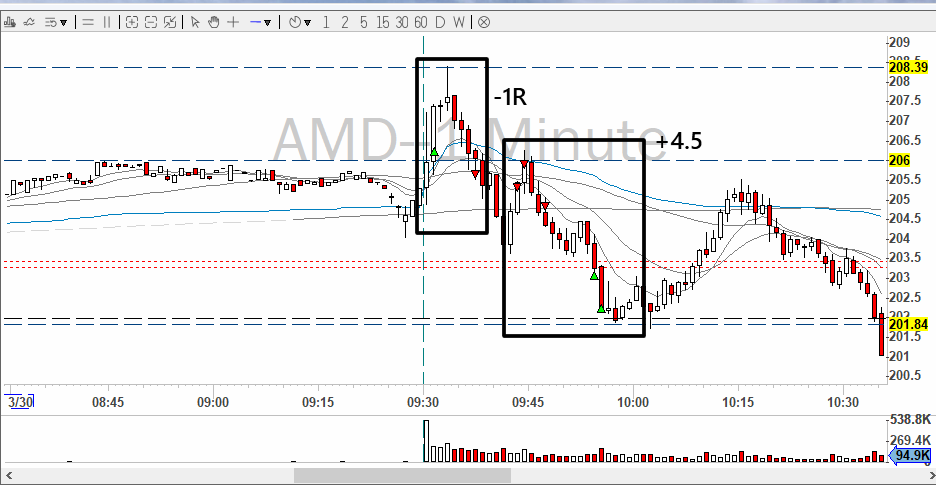
+9.5Rs day! Missed these big days! $AMD was called by one of my mentees in the MTF Mentees Hub server. Planned $QQQ trade in the @BearBullTraders chatroom. My initial stop loss was wide, fixed that by an add. Hope you all had an amazing trading day! #BBTFamily
AimanBBT tweet mediaAimanBBT tweet media
English
0
1
27
3K
Andrew Aziz
Andrew Aziz@BearBullTraders·
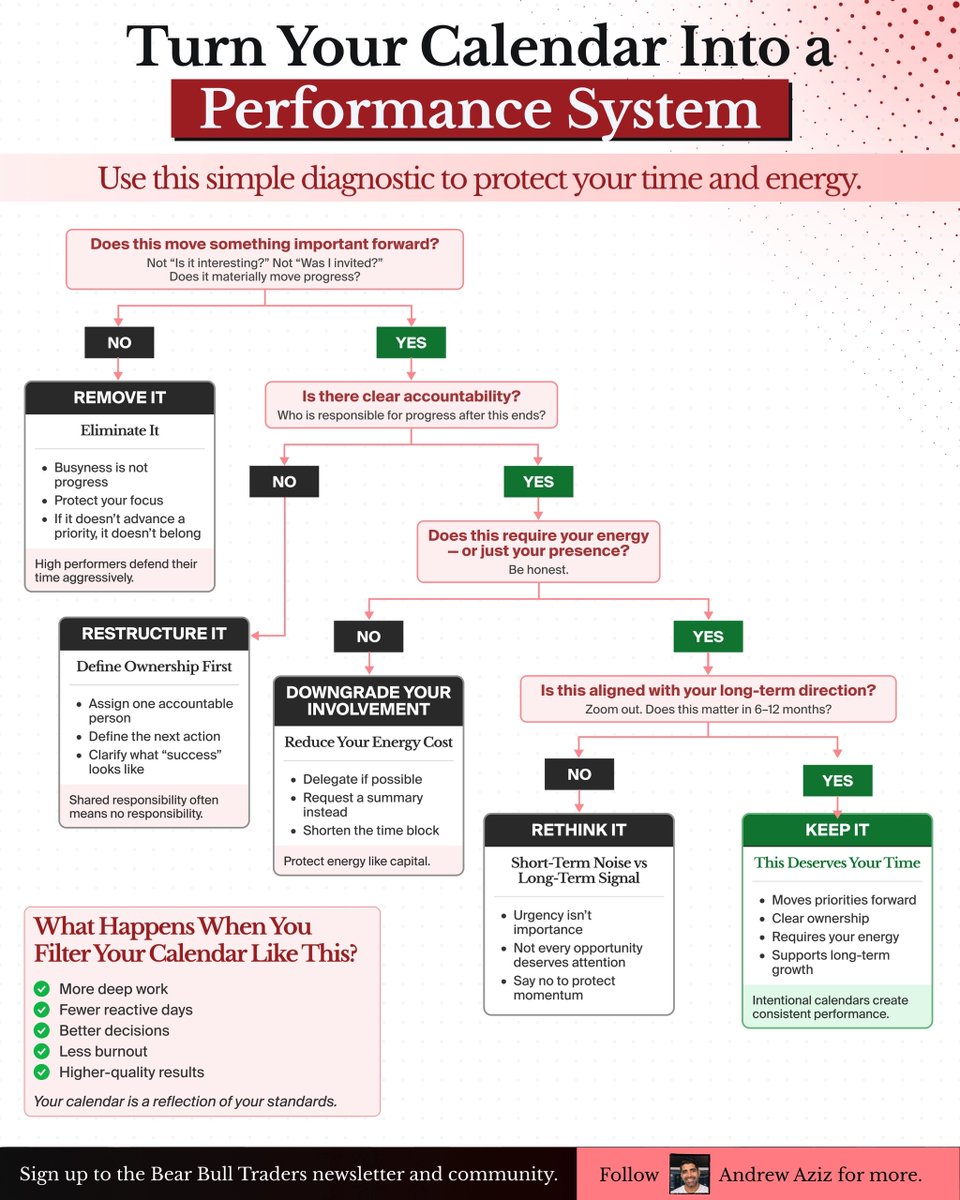
If it’s not scheduled, it’s optional. And the optional never gets done. One of the biggest differences I see between amateurs and professionals is structure. In trading, my day is not random. It follows a roadmap. 👉 Pre-market preparation. 👉 Defined trading window. 👉 Post-market review. Every day. Not emotional or reactive. Not based on how I feel. Because when you do anything based on mood, you do it inconsistently. And inconsistency is expensive. That's why the best professionals operate on a calendar. Yes, a calendar. But not a calendar full of meetings and tasks. A performance calendar. Where review time is blocked, risk management is reviewed weekly, capital allocation is planned, and skill development has a fixed slot. Every day is intentional. Whereas amateurs operate on emotion. And I see this pattern show up everywhere. 💰 In personal finance: Amateurs check their accounts randomly. They react to market moves. Professionals review monthly. They adjust quarterly. They track performance like a business. 💪 In skill development: Amateurs practice when they feel inspired. Or when they “have time.” Professionals train on schedule. They review mistakes weekly. And refine execution deliberately. They build competence through repetition. That's what proper scheduling does. It removes negotiation. So when something is on your calendar, it’s no longer a debate. And that kind of structure protects your energy. You don’t waste mental bandwidth deciding. You just execute instead. This isn't about being rigid. It’s about building freedom through consistency. If you want to apply this, start simple: 1️⃣ Block one fixed weekly review. Same day. Same time. 2️⃣ Set a monthly financial check-in. 3️⃣ Choose one skill and assign it a recurring slot. 4️⃣ Track results, not effort. Do this for 90 days. And you'll feel the difference. Because professionals don’t wait for motivation. They follow a structured plan. And that’s how they achieve results while others start over every Monday. What would change in your life if your goals were scheduled instead of hoped for? Let me know in the comments.
Andrew Aziz tweet media
English
21
17
99
12.4K
Andrew Aziz retweetledi
Kalshi
Kalshi@Kalshi·
JUST IN: Bill Ackman says it’s time to buy the dip
English
252
184
2.6K
197.9K
Andrew Aziz retweetledi
Charlie Bilello
Charlie Bilello@charliebilello·
% Below All-Time High ExxonMobil: 0% S&P 500: -9% Apple: -14% Gold: -20% Nvidia: -21% Google: -22% Amazon: -23% Tesla: -28% Palantir: -32% Meta: -34% Microsoft: -36% Silver: -43% Bitcoin: -48% Ethereum: -60% MicroStrategy: -77% Fartcoin: -94% Trump Coin: -96% Melania Coin: -99%
English
103
508
2.9K
324.8K