
BioAIDevs

80 posts

BioAIDevs banner
BioAIDevs

BioAIDevs

@BioAIDevs

Building the next generation of AI Scientists.

Katılım Ocak 2026
1 Takip Edilen1.1K Takipçiler
Sabitlenmiş Tweet
BioAIDevs
BioAIDevs@BioAIDevs·
Meet BIOS, an AI Scientist built to orchestrate complex biomedical research. • Global SOTA on Data Analysis Benchmarks: BixBench 48.78% open-answer, 55.12% multiple-choice + refusal, 64.39% multiple-choice (no refusal) - outperforming systems like Edison Scientific and Kepler. • Human-in-the-Loop or Autonomous Mode: Intermediate checkpoints let researchers guide investigations mid-flight as insights emerge. No more waiting hours for batch runs + reruns to get results. Or, run in fully autonomous mode for extended investigations. • Persistent World State: Rather than losing context as conversations grow, world state ensures investigations build on insights within each research cycle and across sessions. • Subagent Swarm: BIOS orchestrates subagents specializing in research functions (Literature Review, Data Analysis, Novelty Detection) and, soon, research domains (microbiology, longevity, genomics). BIOS is available now in Beta with free + paid tiers, exclusive launch pricing and, for limited time, free full access to academic users with a .edu email address. Pro, Researcher and Lab subscription tiers offer discounted packages on monthly credits. Our usage-based pricing is competitive and in some cases significantly cheaper than leading scientific agents. Try BIOS and read our paper in the links below ↓
English
11
37
175
66.7K
BioAIDevs
BioAIDevs@BioAIDevs·
What BIOS can do in a single prompt: → "Search for biomarkers of X, then analyze my dataset for those specific markers" → "Find the standard analysis pipeline for this data type, then apply it to my data" → "Identify key genes from literature, then check their expression in my samples" BIOS orchestrates specialized subagents in parallel within each research cycle. Most powerful when combining literature search with data analysis.
English
1
7
42
2.3K
BioAIDevs
BioAIDevs@BioAIDevs·
Most AI tools that "do data analysis" write one block of code, run it, and call it done. The Data Analysis Agent inside BIOS works the way a careful analyst would. It breaks your task into smaller steps, writes Python code to execute each step, observes the results, and reflects on what it learned. The part most agents skip: a persistent knowledge base. Two kinds of memory get saved as it works: → Rules: extracted from documentation and domain conventions → Context: schema definitions, computed facts, and data quality caveats discovered during execution This structured memory ensures the agent doesn't repeat mistakes. Once the agent figures out something in your data, it carries that forward into the next step, the next iteration, the next session. The result is a multi-step analysis that builds on itself, using a memory of what it already learned. Try BIOS now: chat.bio.xyz
English
15
18
70
8.5K
BioAIDevs
BioAIDevs@BioAIDevs·
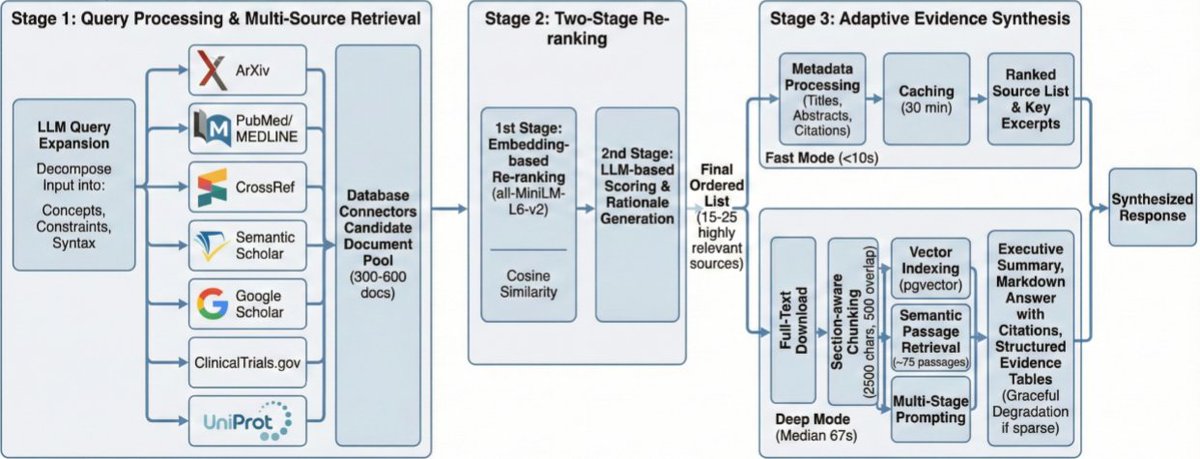
The world's largest biological sequence archive held 90 petabases of data in early 2024 and is projected to reach 500 by 2030. That is a ~5.5x growth in just 6 years. While data in biology is exploding, the real bottleneck is quality. Most AI research tools assume the question is correct from the start and optimize for speed. More papers searched, faster analysis, bigger outputs. The question never changes. BIOS actually works differently: it begins by sending a subagent to pull evidence from sources like PubMed, ArXiv, and ClinicalTrials(dot)gov. Then the reflection and discovery agents go through it, extract key insights, refine the hypothesis, and update the research objective. Only after that does it decide whether to continue and repeat the cycle. The question is what actually improves. A fast answer to a wrong question is still a dead end, just a faster one. In biology, a poorly framed hypothesis can cost months of lab time before anyone realizes it. BIOS surfaces that problem early, before the analysis runs, when it is still easy to change direction. Every research cycle sharpens the question. Every insight is remembered across sessions, and nothing resets. Each iteration builds on the last.
BioAIDevs tweet media
English
3
4
33
1.6K
BioAIDevs
BioAIDevs@BioAIDevs·
Not all research is the same. Here's a quick guide to choosing between Steering, Smart, and Autonomous Deep Research modes on BIOS ↓ > Steering Mode (~20 min / 1 credit): Use it for sensitive experiments, early-stage hypothesis work, or when you want BIOS as a co-pilot. → One iteration at a time → You approve every step → Full control over direction > Smart Mode (~60 min / 5 credits): Best for collaborative deep dives. Use it for literature reviews, competitive analysis, or any research that benefits from iterative refinement with your input. → Up to 5 iterations → Checkpoints after each cycle → You stay in the loop > Autonomous Mode (~8 hours / 20 credits): Best when you want results, not a workflow. Great for large-scale data synthesis, long-horizon research tasks, or when time is the bottleneck. → Up to 20 iterations → Runs until convergence → You review the output, not every step
English
1
5
20
1.2K
BioAIDevs
BioAIDevs@BioAIDevs·
BIOS Dev Update: Fast Chat, Thinking Traces & More What's New: • Fast Chat Mode: A faster pipeline for simple questions that switches to literature search only when needed. It runs in an agentic loop, searching as many times as it needs until it has enough context to give you a complete answer. • Thinking Traces on Screen: BIOS now shows its reasoning on the main loading screen while Deep Research is running, so you can follow along in real time.
English
19
21
102
10.1K
BioAIDevs
BioAIDevs@BioAIDevs·
Monday Motivation: Building the system where autonomous science is the default.
English
8
12
59
6.6K
BioAIDevs
BioAIDevs@BioAIDevs·
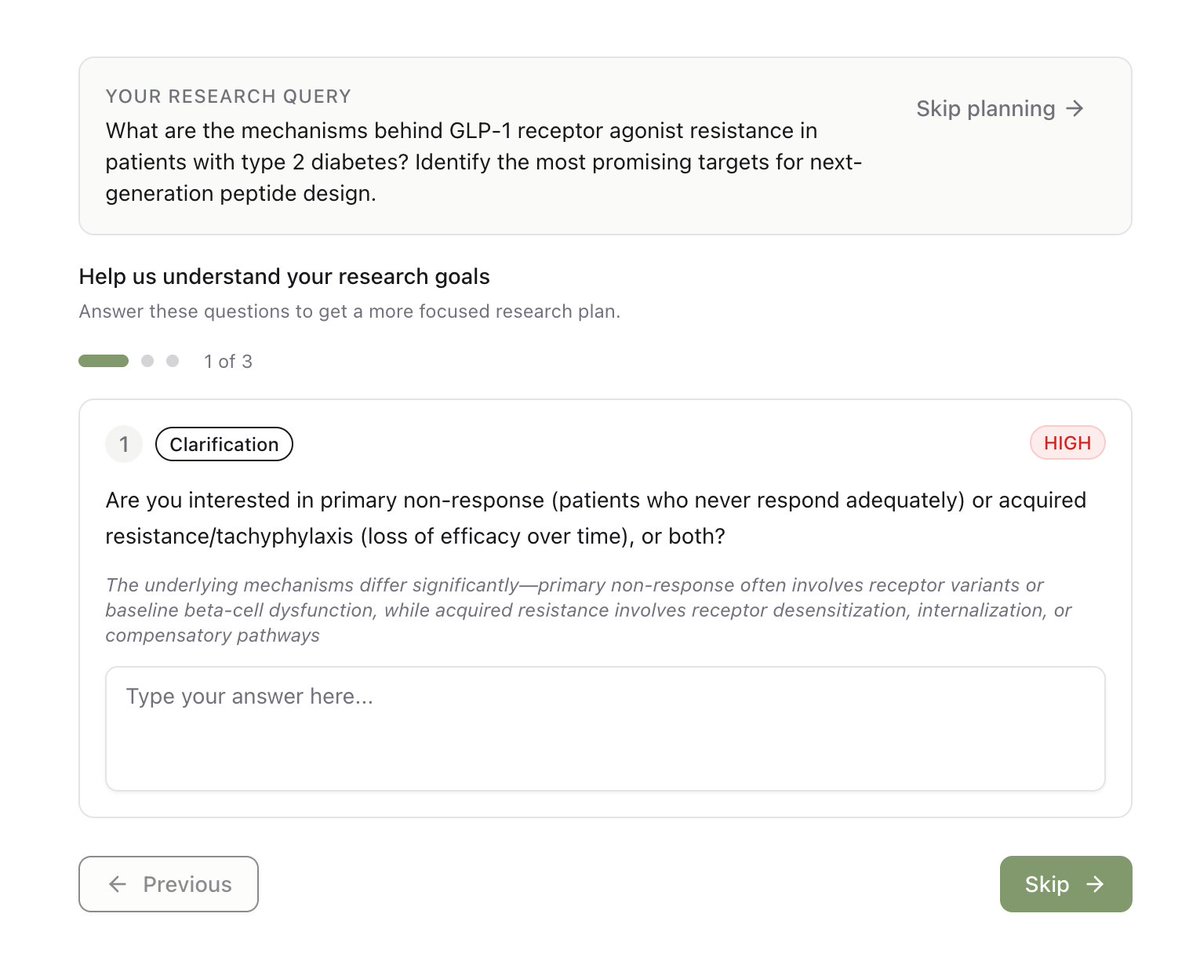
Better context = better science BIOS uses your question details at the planning stage to design its literature and analysis tasks before the first research even runs.
BioAIDevs tweet media
English
1
1
5
418
BioAIDevs retweetledi
Bio Protocol
Bio Protocol@BioProtocol·
Lilith is an AI research agent investigating health patterns neurodivergent women notice but doctors dismiss. > Built on BIOS as the knowledge layer to generate research-backed analysis. > Hypotheses published openly on @sciencebeach__. Try BIOS for your own research: chat.bio.xyz
Bio Protocol tweet media
English
8
11
80
3.8K
BioAIDevs
BioAIDevs@BioAIDevs·
🔗 Try BIOS today: chat.bio.xyz Free access for .edu emails for a limited time.
English
0
0
0
167
BioAIDevs
BioAIDevs@BioAIDevs·
AI agents in science reach their full potential when humans stay in the loop. Here is what that actually means for research. Most research agents run in batch mode. Give it an objective. It runs a literature synthesis, generates hypotheses, executes analysis across 20 iterations and stays confident the entire way through. At some point, a conflicting pathway emerges, but the agent doesn’t stop. It’s optimized for completion, not correctness. By iteration 20, you have a clean, well-structured, wrong output. This is what breaks without a human in the loop. BIOS surfaces decision points and puts the researcher in control. Before a run even starts, it asks the questions that determine whether the analysis goes in the right direction. When evidence conflicts mid-run, it pauses until you make the call. Science needs agents that know when to stop.
BioAIDevs tweet media
English
1
1
6
483
BioAIDevs
BioAIDevs@BioAIDevs·
No credits yet? Your first research is on us. Sign up at chat.bio.xyz and get 20 free credits. → 4 specialized agents working in parallel → Literature synthesis across biomedical papers → Data analysis & hypothesis generation → Novelty detection Pick your mode: → Steering (~20 min) → Semi-Autonomous (~60 min) → Fully Autonomous (~8 hrs)
English
8
3
44
1.9K
BioAIDevs
BioAIDevs@BioAIDevs·
@k_dense_ai Thanks! Noted on the correct name and kudos on the work you’re doing as well!
English
0
0
3
232
K-Dense
K-Dense@k_dense_ai·
@BioAIDevs Great work! Just FYI our platform is called K-Dense Web.
English
1
1
7
306
BioAIDevs
BioAIDevs@BioAIDevs·
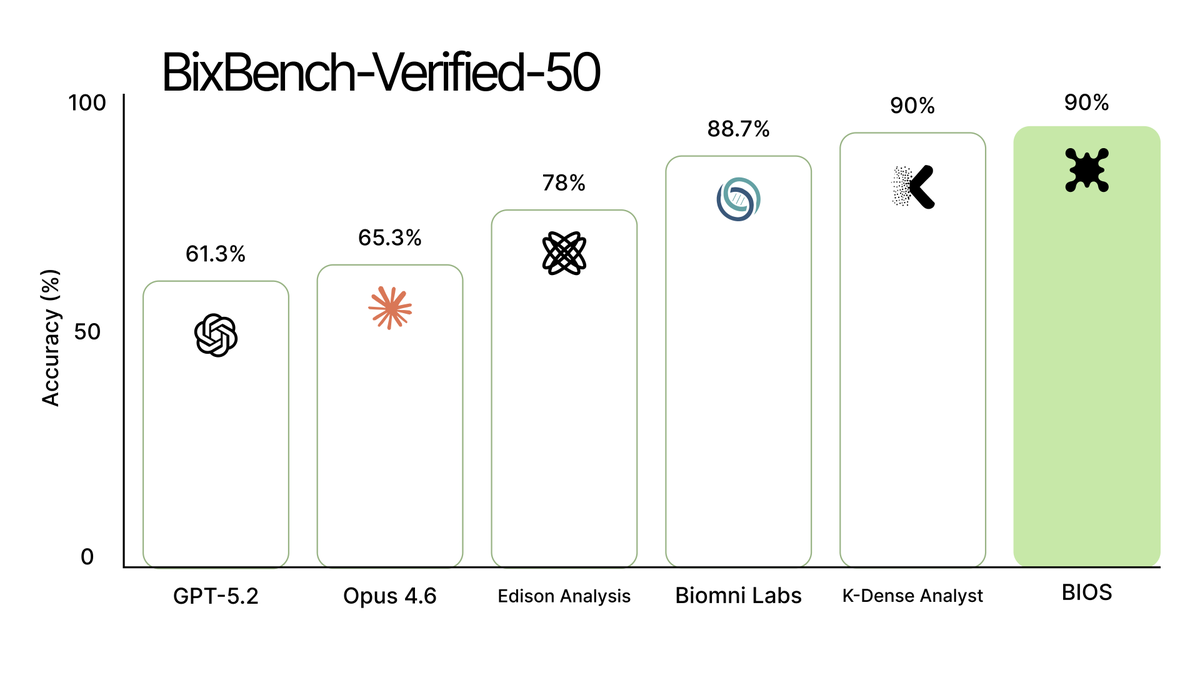
AI agents are beginning to perform real biological analysis: inspecting datasets, running computational workflows, and producing valuable research outputs. As AI for science moves closer to practical use in labs, the question of how to effectively evaluate biological agents becomes increasingly important. The BixBench Verified 50 is a curated list of questions for evaluating biological agents across several bioinformatics domains. We tested the BIOS AI Scientist on the BixBench Verified 50 alongside general-purpose and domain-specific AI agents. BIOS led with 90% accuracy along with K-Dense. Followed by: > Biomni Labs - 88.7% > Edison Scientific - 78.0% > Claude - 65.3% & > OpenAI Agents SDK - 61.3% See the full results: bio-xyz.github.io/bio-benchmark One key takeaway: evaluating biological agents isn’t just about whether the analysis pipeline runs correctly. In one benchmark task, the agent computed the correct correlations, but misinterpreted the biological meaning of a dataset column. The result: numerically correct analysis, but biologically flipped conclusions. As biological agents move from controlled benchmarks to real-world scientific environments, we need to evaluate the workflow, assumptions and reasoning, not just whether the final answer is numerically correct. Read more in our blog post: ai.bio.xyz/blog/bixbench-…
BioAIDevs tweet media
English
3
24
67
11.9K
BioAIDevs retweetledi
Bio Protocol
Bio Protocol@BioProtocol·
🦞 The BIOS AI Scientist is now available as a skill on @openclaw Give your AI agent on-demand scientific intelligence: • Run autonomous biological research tasks • Pay per query via API • Coordinate specialized bio agents Add the skill on Clawhub: clawhub.ai/jmartink/bios-…
Bio Protocol tweet media
English
23
26
163
9.6K
BioAIDevs
BioAIDevs@BioAIDevs·
"The thing that got me excited about BIOS is that it's asking for real world validation at the grad student level of small scale, benchtop accessible, reasonably fast experimental design. This is a very different way to think about AI for bio than most of the ecosystem is thinking about it."
English
0
1
14
780
BioAIDevs
BioAIDevs@BioAIDevs·
Try BIOS today: ai.bio.xyz Free access for .edu emails for a limited time. Or DM us your research objective and we'll send you credits to get started.
English
0
0
2
247
BioAIDevs
BioAIDevs@BioAIDevs·
10/ Research center & generated papers. Running multiple research sessions? Track everything from the Research Center. Each session clearly shows its status: > Running > Complete You can monitor progress without reopening individual threads. All generated scientific reports are stored in the Generated Papers tab. Access, download, and review past research outputs in one place.
BioAIDevs tweet media
English
2
0
3
325
BioAIDevs
BioAIDevs@BioAIDevs·
The new scientific bottleneck is routing: deciding where to point a firehose of intelligence. Our AI Scientist runs structured, multi-iteration research workflows across planning, literature, data analysis & report generation. Here are 10 tips for using BIOS most effectively 🧵
English
5
6
58
2.8K