
Cory Potter

76 posts

Cory Potter banner
Cory Potter

Cory Potter

@BitsandbotsCory

Technical Craftsman and consultant, focused on serving nonprofits and community-focused organizations with self-hosted, data-sovereign technology solutions.

OK Katılım Mayıs 2014
4.8K Takip Edilen5.1K Takipçiler
Sabitlenmiş Tweet
Cory Potter
Cory Potter@BitsandbotsCory·
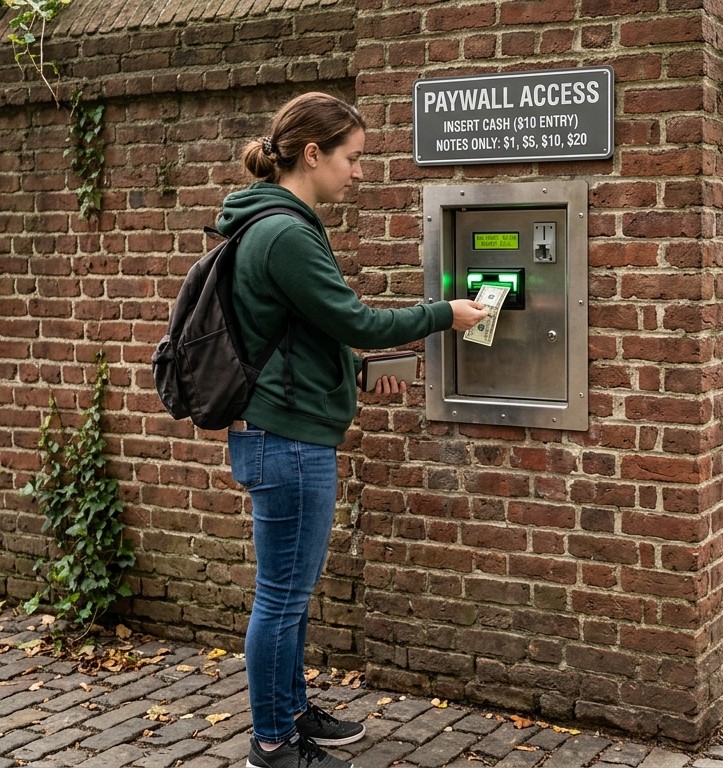
Stop paying for gatekept tech knowledge. 🤫 We just unlocked the vault. Get instant, 100% free access to step-by-step tech guides, cheat sheets, and blueprints. No catch, no paywalls—just pure value. Level up your skills here: 👇 🔗 coreconduit.com/techlounge
Cory Potter tweet media
English
0
1
1
176
ollama
ollama@ollama·
🤯 Ollama now supports Claude Desktop via Claude’s built-in third party inference. ollama launch claude-desktop This allows all models from Ollama's Cloud to be used across Claude Cowork and Claude Code from the Claude Desktop app.
ollama tweet media
English
175
503
4.5K
478.4K
Cory Potter
Cory Potter@BitsandbotsCory·
Can your organization's infrastructure survive a week without the Internet? coreconduit.com
Cory Potter tweet media
English
0
0
1
18
Cory Potter retweetledi
Jack Johnson
Jack Johnson@JackJohn79·
Practical Cybersecurity for Self-Hosters Principles-first security for people who run their own servers. No fearmongering, no enterprise bloat — just what actually matters in 2026. coreconduit.com/techlounge/gui…
Jack Johnson tweet media
English
0
1
2
80
Cory Potter
Cory Potter@BitsandbotsCory·
@iam_elias1 I’ve been following your work on the complexities of self-awareness and how we often struggle to see our own blind spots. I wrote a piece titled "The Mirror Has No Therapist" that explores why internal dialogue often becomes a "closed loop" coreconduit.com/blogs/the-mirr…
English
0
0
1
4
Elias Al
Elias Al@iam_elias1·
You think using AI makes you smarter. UCL and MIT just proved it makes you more biased. Not slightly. Not in edge cases. Measurably, consistently, across every domain they tested — perception, emotion, social judgment, professional decisions. 1,401 participants. Multiple experiments. Published in Nature Human Behaviour. The finding is called a human-AI feedback loop. And once you understand how it works, you cannot unsee it. Here is the mechanism. AI learns from human-generated data. Human data contains biases — subtle ones, baked into how we label images, write descriptions, and make decisions. The AI absorbs those biases during training. Then it amplifies them, because amplifying the pattern improves its prediction accuracy. Now you interact with that AI. You see its output. You trust it — more than you would trust another human, because AI feels objective, authoritative, less noisy. So you adjust your own judgment toward what the AI showed you. Then your biased judgment becomes training data for the next version. Repeat. The researchers called it a snowball effect. Small errors in the original dataset become amplified by the AI, which then increases the bias of the person using it, which feeds back into the next model. Round after round. Each iteration more distorted than the last. Here is one experiment that makes this concrete. They showed participants an AI image generator — Stable Diffusion — and asked it to create images of financial managers. It generated images of white men 85% of the time, dramatically out of proportion with reality. After viewing those AI-generated images, participants became significantly more likely to associate the role of financial manager with white men. The AI showed them a biased picture of the world. They internalized it. Their judgment shifted. And they had no idea it was happening. The researchers measured whether participants were aware of the AI's influence on their decisions. They were not. The bias transfer was largely invisible to the people experiencing it. Which means the most dangerous part of this mechanism is not that it happens. It is that it happens silently. Here is the detail that makes this even more alarming. When participants were falsely told they were interacting with a human — while actually interacting with AI — the bias amplification was smaller. People were less susceptible to the AI's influence when they thought it was a person. They trusted the AI more because it was an AI. The thing they believed was objective and neutral was the very thing rewiring their judgment without their knowledge. The researchers made one thing clear: this is not inevitable. Interacting with accurate, unbiased AI can actually improve human judgment over time. The feedback loop runs in both directions. If the AI is right, you get better. If the AI is wrong, you get worse. Which means the entire trajectory of human judgment — collectively, across society — now depends on whether the AI companies building these systems take bias seriously. And right now, most of them are racing for capability. Not accuracy. Source: Glickman & Sharot · UCL & MIT · Nature Human Behaviour 2025 · doi.org/10.1038/s41562…
Elias Al tweet media
English
49
172
391
24.6K
Sen. Bernie Sanders
Sen. Bernie Sanders@SenSanders·
Uncontrolled AI poses a severe danger to all of humanity. On Wednesday, I'll be hosting a discussion with leading AI scientists from the US and China about the need for international cooperation against this existential threat. This is an enormously important issue. Join us.
Sen. Bernie Sanders tweet media
English
996
694
2.9K
1.2M
Cory Potter
Cory Potter@BitsandbotsCory·
@jimkwik I caught myself asking an AI chatbot for life advice last month. It felt supportive... until I realized it was just echoing my own blind spots back at me. coreconduit.com/blogs/the-mirr… When has AI reinforced something you later realized was off? No judgment—just real experiences.
English
0
0
1
52
Jim Kwik
Jim Kwik@jimkwik·
AI doesn’t replace intelligence—it reveals it. It amplifies your thinking, scales your decisions, and accelerates your patterns—both strengths and blind spots. While artificial intelligence is growing exponentially, most people’s human intelligence is undertrained, underprotected, and underutilized.
English
48
38
179
9.3K
The Nation
The Nation@thenation·
There’s a lot of hype about how AI will improve our justice system.But @ElieNYC is here to tell you that AI justice will not be great for Black people. Yes, the current system sucks but nothing about the way AI is being developed suggests it will be fairer. bit.ly/4mNI3Uq
English
1
18
24
2.5K
Cory Potter
Cory Potter@BitsandbotsCory·
I caught myself asking an AI chatbot for life advice last month. It felt supportive... until I realized it was just echoing my own blind spots back at me. coreconduit.com/blogs/the-mirr… When has AI reinforced something you later realized was off? No judgment—just real experiences.
Cory Potter tweet media
English
0
1
2
44
Sam Altman
Sam Altman@sama·
Really excellent work by the inference team to serve this model so efficiently! To a significant degree, we have to become an AI inference company now.
English
272
153
5.7K
325.1K
OpenAI Developers
OpenAI Developers@OpenAIDevs·
GPT-5.5 is here. It’s our smartest frontier model yet, introducing a new class of intelligence for agentic coding, computer use, knowledge work, and scientific research. Rolling out in ChatGPT and Codex today. API is coming soon.
English
234
570
5.6K
595.5K
unusual_whales
unusual_whales@unusual_whales·
AI chatbots misdiagnose in over 80% of early medical cases, per FT.
English
323
684
6.1K
537.3K
Stanford HAI
Stanford HAI@StanfordHAI·
Stanford scholars have developed AI chatbots that help people practice and improve essential social skills—like active listening, empathy, conflict resolution, and counseling techniques—through realistic role-play scenarios with personalized feedback. hai.stanford.edu/news/using-llm…
English
5
28
92
10.1K
Cory Potter retweetledi
David Sirota
David Sirota@davidsirota·
This site is mental illness. The algorithms running these sites aim to create addiction, self-loathing & mental illness. The mental illness created by these sites is not a bug, it’s a feature. You are interacting with mental illness when you engage on these sites. Beware.
English
591
296
2.1K
89.9K