
CIAN - Yield Layer of DeFi 🟡

2.9K posts
CIAN - Yield Layer of DeFi 🟡 banner
CIAN - Yield Layer of DeFi 🟡

CIAN - Yield Layer of DeFi 🟡

@CIAN_protocol

Redistribute yield sources for sustainable DeFi DC: https://t.co/qbQXJSkCJC https://t.co/J75bImjFWR
Crypto Katılım Mart 2022
446 Takip Edilen34.2K Takipçiler
CIAN - Yield Layer of DeFi 🟡
CIAN - Yield Layer of DeFi 🟡@CIAN_protocol·
The Resolv USR exploit had no reentrancy vulnerability, no flash loan, no oracle spoofing. The smart contract executed exactly as written, and that is precisely the problem. USR minting relied on an off-chain service holding a privileged SERVICE_ROLE key to finalize how much USR to mint. The contract had no maximum output, no on-chain collateral ratio check, no mint cap. Whatever the key signed, the contract minted. The attacker compromised Resolv's AWS KMS environment, deposited ~$200K USDC, and minted $80M USR, which was roughly 500 times the legitimate amount. Within 17 minutes, USR crashed from $1.00 to $0.025. ~$25M extracted. Resolv had completed 18 security audits. None could have caught a compromised operating key. That is not a smart contract vulnerability, and our monitoring frameworks have not kept pace with where the real attack surface now lives. Damage doesn't stay contained. Several lending protocols held USR exposure, and yield protocols sitting upstream of those positions now face secondary pressure as a result. For any lending protocol that accepts external assets as collateral, "vault drained" and "token supply diluted" are two different vectors with the same outcome: collateral loses value, and lent-out USDC cannot be recovered. This event does not expose a single protocol's oversight. It exposes a systemic absence of real-time defensive infrastructure across how collateral assets are onboarded and monitored in DeFi lending. The following four dimensions represent what we believe every lending protocol and curator should have in place. ① Real-time collateral sufficiency monitoring vault underlying assets / vault minted token supply ≥ 1Track vault balances on-chain for drainage. Monitor total supply vs. protocol-recorded legitimate issuance, with live Mint event listeners, for dilution. Both failure modes need independent tracking. ② Mint permission audit as a mandatory onboarding requirementWho holds mint authority? On-chain or off-chain? Is there a contract-enforced mint cap? Is the signing key protected by multisig or HSM? These questions are largely absent from current onboarding checklists. They should be required fields. ③ Shell value assessment: quantifying the exploit incentiveExtractable value = DEX liquidity depth + borrowable capacity across lending protocols + CEX liquidity. Flag any protocol where the oracle is hard-coded to $1, because these become extraction amplifiers post-exploit: an attacker can continue borrowing against depegged collateral at full face value while the market has already repriced it to near zero. If extractable value exceeds project market cap or TVL, the incentive to exploit is not incidental but structural. ④ Automated pauseAny single trigger should suspend new borrowing against that collateral: supply spike exceeding 10% of total in a rolling window, DEX price deviation greater than 3% from oracle, or a backing ratio breach. In the Resolv case, the price deviation trigger alone would have fired before the attacker completed conversion to ETH and exited. A false positive costs friction. No trigger at all costs what we saw. And even with a hard-coded oracle, a timely pause lets the protocol redeem underlying collateral directly, bypassing the depegged market price entirely and protecting LP principal without relying on a market that may already be in freefall. The underlying collateral in the Resolv case remained intact throughout, meaning legitimate holders could have exited whole had a pre-exploit snapshot and proportional redemptions been implemented. That outcome was technically achievable. It did not happen because no fast enough response mechanism existed. This is why, when evaluating assets for Bondify, we treat the following as non-negotiable: Is mint authority fully auditable? Is there a readable on-chain backing ratio? In a stress scenario, can LP principal be protected through direct collateral redemption? These are not criteria we arrived at after this event. They are the questions we have always believed cannot be skipped, and events like this make clear why.
English
2
1
7
532
CIAN - Yield Layer of DeFi 🟡
CIAN - Yield Layer of DeFi 🟡@CIAN_protocol·
We just joined Mantle State of Mind: Ep.07 @Mantle_Official, and here's what's coming from @CianProtocol 👇 Aave on Mantle isn't just another deployment. Under current market conditions, it's the only one that truly made sense, and its growth has exceeded even our own expectations. So what comes next for us? Here's our 2-stage playbook. Stage 1: Migrate our yield strategies to Aave Mantle, starting now. The reason is straightforward. Aave Mantle currently has strong supply but relatively low utilization, which means borrow rates are lower than on other networks. Lower borrow rates translate directly into better net yield for the same strategies we've already proven at scale. The assets we rely on most heavily, Ethena, Maple and Kelp, are all live on Mantle. The infrastructure is there. The rates are better. So we're moving billion-dollar-level strategies here. Stage 2: Build a new generation of interest-bearing RWA strategies on Aave Mantle, over the next few months. What makes this opportunity different from anything we've seen before is the scale of capital sitting behind it. Bybit and Mantle together hold tens of billions in assets that can be redeployed on-chain. That's not potential that exists anywhere else. Once high-quality RWA primitives are in place on Aave Mantle, that capital has a home, and it will move. We know this space better than most. Cian was one of the first teams in the industry to build yield strategies around RWA, and that experience taught us exactly where the gaps are and what still needs to be built. The DeFi primitives have to be redesigned from the ground up to accommodate RWA at scale. That work is underway, and Aave Mantle is where we're helping build it. Do we think RWA will dominate lending markets in two years? Without a doubt. The on-chain world is orders of magnitude smaller than the off-chain economy, and that gap will close. The question isn't whether it happens, it's whether the right infrastructure is ready when it does. That's exactly what we're here to build.
Mantle@Mantle_Official

Mantle State of Mind: Ep.07 x.com/i/broadcasts/1…

English
3
1
5
544
CIAN - Yield Layer of DeFi 🟡
CIAN - Yield Layer of DeFi 🟡@CIAN_protocol·
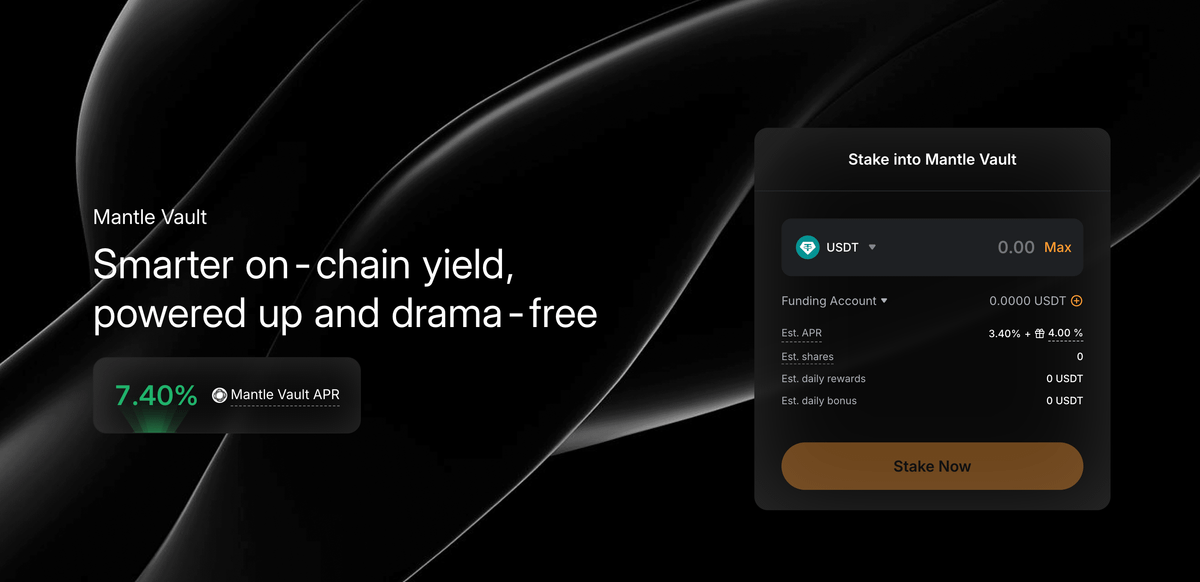
Excited to join the conversation. Our founder @Luffy_Cian will be speaking at Mantle State of Mind Ep. 07 alongside other ecosystem builders to unpack the CeDeFi flywheel in motion on Mantle. Tune in with us.🔥
Mantle@Mantle_Official

Reminder: Join us in an hour as we get into everything CeDeFi on Mantle, alongside the leaders and builders shaping it. Mantle State of Mind Ep. 07, 10 PM UTC+8. Right here on 𝕏. Never fade the MoMNTum. Drop your questions (if any) ↓
English
1
1
5
321
CIAN - Yield Layer of DeFi 🟡
CIAN - Yield Layer of DeFi 🟡@CIAN_protocol·
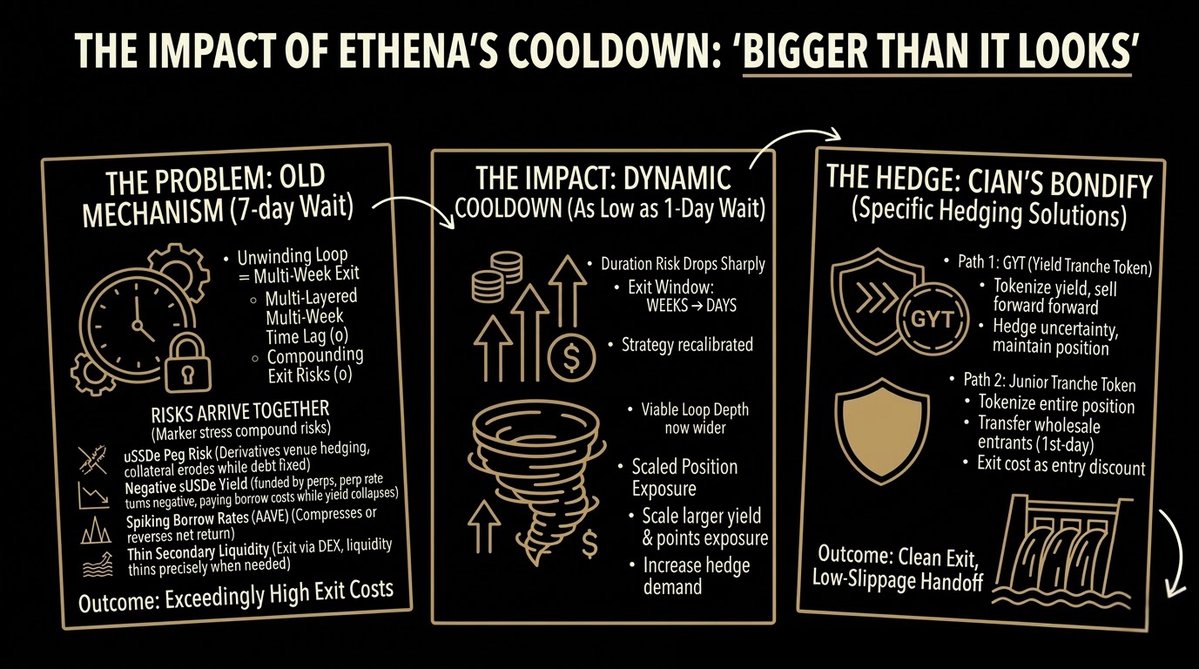
Cian is building Bondify for exactly this moment. Once your loop position is established, you have two paths. You can tokenize your future yield as GYT and sell it forward to buyers who want that yield exposure, hedging your uncertainty while keeping the position running. Or you can go further: tokenize the entire leveraged position as a Junior tranche token and transfer it wholesale to a new entrant who wants leveraged exposure from day one. Your exit cost becomes their entry discount. The looper gets out cleanly, the buyer steps in without building from scratch, and Bondify's marketplace is where that handoff happens. A shorter cooldown makes sUSDe a better foundation for everything built on top of it, and the cleaner the underlying, the more reliably both mechanisms function.The infrastructure is getting tighter, and that opens up the next layer of what's possible. The infrastructure is getting tighter — and @ethena just made the foundation cleaner.
English
0
0
1
221
CIAN - Yield Layer of DeFi 🟡
CIAN - Yield Layer of DeFi 🟡@CIAN_protocol·
With the cooldown now dynamic and as short as 1 day, the exit window collapses from weeks to potentially just 1-2 days. Duration risk drops sharply, and the yield threshold needed to justify the strategy comes down with it. Exit risk isn't just an operational inconvenience; it's embedded in how deep you're willing to go. When that risk compresses, loop depth that previously wasn't viable now is.The strategy's risk-reward window just got meaningfully wider, more capital can be deployed at higher leverage, and the aggregate yield and Ethena points exposure across the position scales up accordingly.Bigger positions carry bigger exposure. The more capital you deploy at depth, the more you need a way to manage what you've built — not just ride it. The deeper the loop, the larger your future yield stream and your accumulated points exposure grow. Both are valuable. Both carry uncertainty. Yield rates fluctuate, points value is unresolved, and that uncertainty creates a natural demand to hedge: to lock in what you've built rather than ride the variability indefinitely. That demand didn't have a clean home before. It does now.
English
1
0
1
248
CIAN - Yield Layer of DeFi 🟡
CIAN - Yield Layer of DeFi 🟡@CIAN_protocol·
Ethena announced a dynamic sUSDe unstaking cooldown, dropping to as little as 1 day. This is bigger than it looks.@Ethena Unwinding a looped sUSDe position isn't a single action. Each layer of leverage requires unstaking sUSDe back to USDe to repay debt, and under the old mechanism, each unstake meant a 7-day wait. A multi-layer loop translated to a multi-week exit, and during that window, the risks stack up in ways that compound each other. USDe's peg stability relies on delta hedging across derivatives venues — under acute market stress, depeg risk rises precisely when you need to exit, eroding collateral value while your debt stays fixed. At the same time, sUSDe's native yield is funded by perpetual funding rates, which can turn negative in a risk-off environment, meaning you're paying borrowing costs on one side while your yield on the other collapses. USDC/USDT borrow rates on AAVE can spike sharply during periods of market stress, further compressing or outright reversing the strategy's net return. And if you try to bypass the cooldown entirely by selling sUSDe on the secondary market, you'll find that liquidity thins out exactly when everyone else is trying to do the same thing, leaving you to absorb significant slippage at prices well below NAV. The cruelest part of the old mechanism was that all four of these dynamics tend to arrive together. At some point, the loop strategy stopped making sense. Not because the yield wasn't there, but because the exit cost made deeper loops too expensive to justify.
CIAN - Yield Layer of DeFi 🟡 tweet media
English
1
1
2
506
CIAN - Yield Layer of DeFi 🟡
CIAN - Yield Layer of DeFi 🟡@CIAN_protocol·
Thrilled to be invited to @Mantle_Official's State of Mind Ep. 07 🔥 Join our founder @Luffy_Cian as he dives into the CeDeFi flywheel in motion — exploring how Cian fits into the bigger picture. 🗓 March 17 | ⏰ 10 PM UTC+8 | 📍 Mantle Official X Don't miss it — set your reminder!
Mantle@Mantle_Official

Mantle State of Mind returns with Ep. 07. Join us live as we unpack the CeDeFi flywheel in motion behind Mantle's latest milestones, DeFi strategies, and the teams ascending the ecosystem. 🗓️ Mar. 17, 10 PM UTC+8 📍 Mantle Official 𝕏 Set your reminder and do not fade this.
English
0
1
3
346
CIAN - Yield Layer of DeFi 🟡
CIAN - Yield Layer of DeFi 🟡@CIAN_protocol·
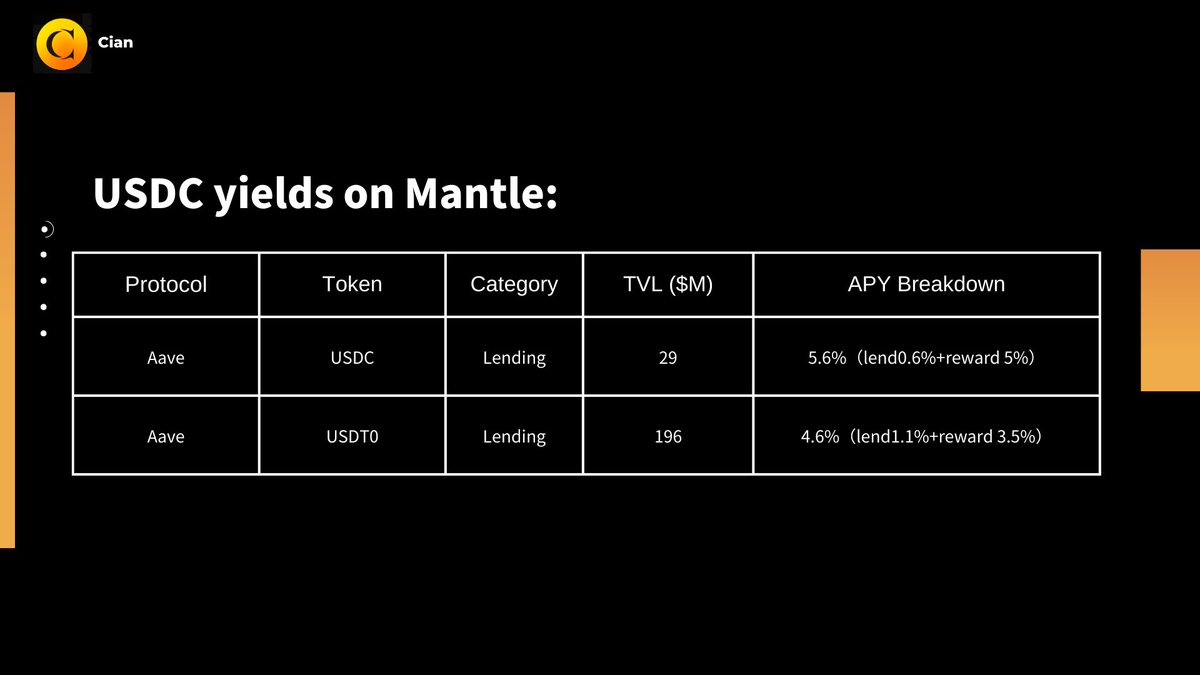
🟡 Stablecoin Yield Update: Since our last update, the big picture still looks like deleveraging → lower utilization → softer “base” lending rates on the major venues. On ETH, USDC on Aave is sitting around ~2.0% with ~$1.39B TVL, while Maple USDC remains a steady high-liquidity anchor at ~4.5% on ~$3.26B TVL. Where yields still pop, it’s mostly incentives / fees: Avantis USDC vault (Base) is around ~9.8% on ~$89M, and we’re also watching Aave on Mantle @Mantle_Official, both USDC and USDT are now live, with USDC supply ~5.6% headline APY on ~$29M and USDT0 supply ~4.6% APY on ~196M (mostly incentive-driven, so expect compression as size scales). Solana stays in the mid-single digits with Jupiter Lend USDC ~4.0% on ~$530M. Not financial advice — DYOR always. #DeFi #RWA #Stablecoin #Yield #CianYieldlayer
CIAN - Yield Layer of DeFi 🟡 tweet media
English
1
1
3
624
CIAN - Yield Layer of DeFi 🟡
CIAN - Yield Layer of DeFi 🟡@CIAN_protocol·
3Jane’s USD3 (USD3 / sUSD3): at present, USD3’s assets are entirely supplied as USDC on Aave, totaling about $21.04M. Using the calculated usd3-susd3 value ~ $18.15M, the ratio is ~1.15905 (>1) (under this scope, traceable backing exceeds the combined value measure). Structurally, USD3’s traceable backing is a single Aave USDC exposure, with relatively clear visibility and quality. The main risk concentration is in sUSD3: it involves unsecured lending / credit extension, which makes ongoing trace-through and continuous verification more difficult. In addition, the timing for 3Jane’s “phase 2” (where USD3 may also be allocated into unsecured lending) is currently not clearly scheduled. We will continue tracking updates to ensure funds remain as safe and traceable as possible.
English
0
0
0
231
CIAN - Yield Layer of DeFi 🟡
CIAN - Yield Layer of DeFi 🟡@CIAN_protocol·
Strata’s srUSDe (srUSDe / jrUSDe): the base layer is Ethena’s USDe/sUSDe ecosystem, with a senior/junior tranche split built on top. Our tracking shows the underlying base recorded as susde 159,549,852; the combined value of srUSDe and jrUSDe supplies at their respective prices is approximately $156.4M, implying a ratio of ~1.0000034 (>1), which indicates the base amount and the tranched liabilities broadly reconcile under this scope. The risk concentration is relatively single-source: it largely inherits the mechanics of the underlying susde/sUSDe, while tranching changes how gains/losses are distributed between sr and jr (risk is not removed—just reordered). Theo’s thBILL: the underlying we can identify is a single asset, tULTRA, amount 157,903,819, price 1.01455 (roughly $160.20M). For Theo, the key concern is fund routing and traceability/verifiability. At present, it is difficult to trace where the tULTRA underlying ultimately sits onchain, there is a lack of widely verifiable NAV reporting, and around ~50% of funds are observed as routed into Binance, which reduces traceability. As a result, monitoring focus shifts to offchain proofs and operational controls, and if disclosure/audit cadence becomes unstable, risk can surface with a lag.
English
1
0
0
245
CIAN - Yield Layer of DeFi 🟡
CIAN - Yield Layer of DeFi 🟡@CIAN_protocol·
There are many USD stablecoins on the market today. It’s also common to see a “yield-bearing version” (staked / savings / share-based), and that yield stream can be further wrapped into fixed-maturity rate instruments (e.g., Pendle PT). We’ve tracked the currently traceable underlying assets for cUSD, iUSD, srUSDe, thBILL, and USD3. This is a very important information for our asset selection in Bondify, and we aim to provide users with a safer and more traceable investment environment.
English
1
1
3
404
CIAN - Yield Layer of DeFi 🟡
CIAN - Yield Layer of DeFi 🟡@CIAN_protocol·
🟡 Stablecoin Yield Update: Weekly Refresh! Since our last update, the biggest shift has been rate compression on the major lending venues, and the main driver looks like market deleveraging (loops getting unwound, borrows being repaid, utilization dropping). On Aave (ETH) this showed up very clearly: USDC supply TVL rose to 1340M (from 398M) while supply APY fell to 2.22% (from 4.15%), and USDT supply TVL increased to 2280M (from 1660M) with APY down to 1.9% (from 2.79%). Outside of Aave, we also saw incentive normalization: Morpho Gauntlet USDC Core (Arb) cooled to 3.7% (from 6.2%), and Fluid USDC (ETH) eased to ~4.2% (from ~6.3%). On the incentive-heavy tail, USD1 continued rotating venues—Kamino USD1 is no longer on our sheet, while Dolomite USD1 (ETH) softened to ~8.8% (from ~9.5%) as TVL grew to ~39M (from ~29M), consistent with reward dilution as deposits scale Not financial advice — DYOR always. #DeFi #RWA #Stablecoin #Yield #CianYieldlayer
English
1
2
4
638
CIAN - Yield Layer of DeFi 🟡
CIAN - Yield Layer of DeFi 🟡@CIAN_protocol·
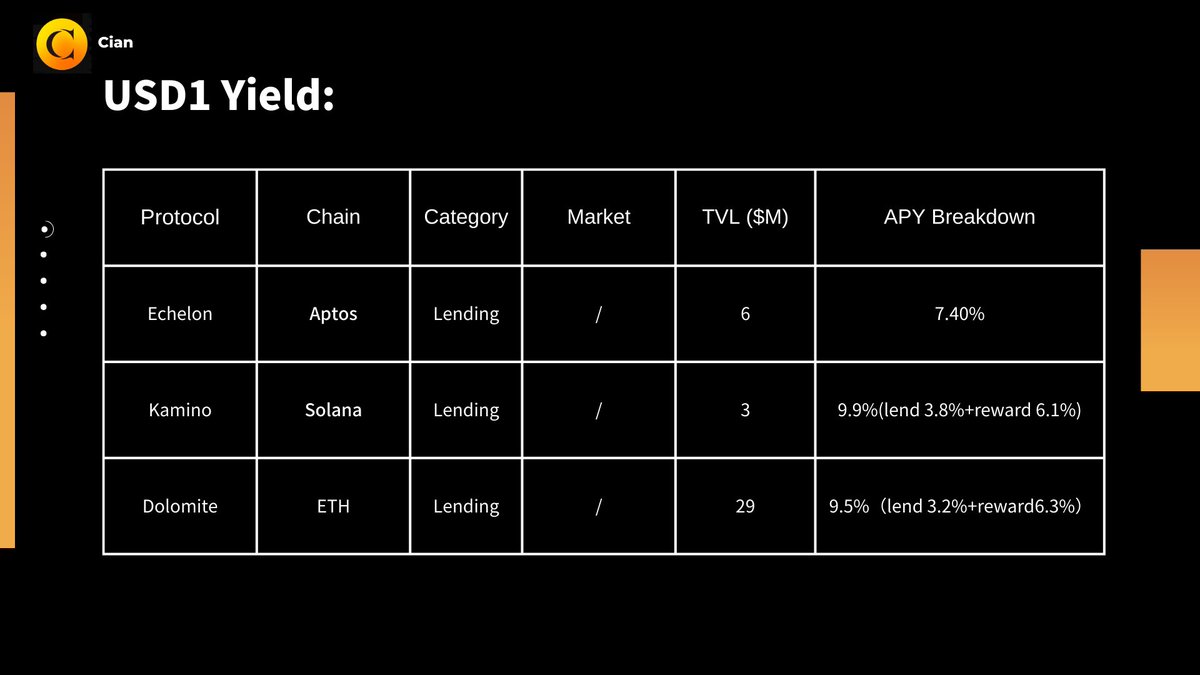
🟡 Stablecoin Yield Update: Weekly Refresh! This week’s biggest change is a USD1 venue rotation: we’ve added USD1 on Dolomite to the tracker (currently around ~9.5% supply APY with ~29M TVL, largely incentive-driven), and removed USD1 on Lista DAO from our weekly sheet for risk & liquidity considerations (the pool remains live, we’re just not tracking it as a “baseline” stable option right now). Also worth noting: Kamino’s USD1 market is still showing elevated headline yields, but it’s reward-heavy, so the displayed APY can compress quickly as deposits flow in—better to assume some dilution rather than anchoring on yesterday’s print. Elsewhere, a couple of notable moves: Fluid USDC (ETH) repriced higher to ~6.3% (from ~4.5%) with TVL rising to ~366M (from ~318M), while Aave USDT (ETH) saw supply APY compressed to ~2.8% (from ~3.5%). Not financial advice — DYOR always.
CIAN - Yield Layer of DeFi 🟡 tweet media
English
0
1
8
693
CIAN - Yield Layer of DeFi 🟡
CIAN - Yield Layer of DeFi 🟡@CIAN_protocol·
Last week, we joined the Mantle Vault AMA with @Bybit_Official & @Mantle_Official. Within a month, Mantle Vault grew from 0 to 120M USD AUM. In a market where uncertainty and volatility are back on the table, the demand for “trust” and “stability” becomes very real—what Mantle Vault is trying to deliver is simple: a one-click, low-friction experience that makes verifiable, sustainable onchain yield accessible to users of all portfolio sizes. As the strategy engine behind Mantle Vault, Our founder Luffy @Luffy_Cian shared our core perspective on building a Yield Layer: the bar for a mass-market onchain yield product is never just “can you print a higher APY.” The real question is whether you can hold the risk boundary over time, through scaling, continuous operations, and changing market regimes. Luffy summarized our decision order with four words: Security > Scalability > Sustainability > APY. Over the past 3.5 years, Cian’s strategy platform has maintained a record of zero security incidents and zero forced liquidations. Even during sharp market moves when many protocols and positions got stressed, we kept positions within controlled ranges. That’s not luck; it’s what happens when risk engineering is treated as the first principle, not an afterthought. Why is building a public, always-on strategy system harder than running a small fund or a personal playbook? Because scale collapses the option set. At 10k or even 1M, there are always “tactical opportunities.” But to support broader users and larger capital, the viable base yield sources narrow down to a small set of battle-tested venues with deep liquidity and strong responsiveness. We won’t chase headline yields by routing user funds into shallow or operationally fragile risk. Execution is where the difference is made. The hard part isn’t having an idea but building the mechanics. Luffy emphasized that what makes strategies reliable at scale is automation: smart-contract–driven operations that can handle frequent inflows/outflows and large rebalances, while maintaining a dynamic balance between capital efficiency, flexibility, and safety. In parallel, monitoring parameters, alerts, and failover playbooks need to be “always-on,” because the biggest enemy in onchain risk isn’t volatility. It’s being blind or stuck when you need to act. The other key is determinism in extreme conditions. To keep liquidation risk low, you need to ensure critical rebalancing transactions still land quickly even during network congestion (e.g., within the next 1–2 blocks). In edge cases, that can mean coordinating with block builders so that important strategy transactions don’t get “stalled” exactly when timing matters most. This is one of the clearest lines between “institution-grade strategy engineering” and manual, ad-hoc operations. Ultimately, this methodology serves a simple goal: make onchain yield more reliable, more explainable, and easier to access, with a low operational burden for users across all capital sizes. That also shapes how we evaluate yield sources: we prefer durable structures over short-cycle incentive spikes, and we expand coverage with conservative parameters, rigorous stress testing, and a disciplined scaling cadence—making sure a strategy can withstand before we let it scale. Huge thanks again to @Bybit_Official and @Mantle_Official for the invitation and the collaboration. Mantle Vault is just the start. We’ll keep refining these Yield Layer capabilities into more general infrastructure, and we’re excited to keep building with Bybit and Mantle to bring more high-quality onchain yield products to a wider audience
Bybit@Bybit_Official

🔴 LIVE: Inside Mantle Vault’s 100M USDT AUM milestone Get exclusive insights from Bybit product leaders and our ecosystem partners. Watch now and win from 500 $USDT prize pool 👉 i.bybit.com/ztboabH #Bybit #CryptoArk twitter.com/i/broadcasts/1…

English
0
3
5
878
CIAN - Yield Layer of DeFi 🟡
CIAN - Yield Layer of DeFi 🟡@CIAN_protocol·
🟡 Stablecoin Yield Update: Weekly Refresh! This week’s main highlight is Kamino launching a USD1 lending market on Solana. The headline supply APY is ~8% (currently ~8.2%), but it’s mostly incentive-driven (base lend is only ~1.4%, with ~6.8% coming from rewards), so realized APY can dilute quickly once deposits pile in. You can already see that compression in real time: it was ~10% yesterday and has cooled to ~8% today. Outside of that, the larger “anchor” venues stayed broadly range-bound (e.g., Maple USDC/USDT ~5% with multi-bn TVL; Aave USDC/USDT ~3–4%), and Kamino PYUSD remains elevated (~7–8%) for a similar reason (reward-heavy yield). Not financial advice — DYOR always. #DeFi #RWA #Stablecoin #Yield #CianYieldlayer
CIAN - Yield Layer of DeFi 🟡 tweet media
English
0
0
4
673