Crowe BGK - Tax Insights with Samuel LeCavalier

6 posts

Crowe BGK - Tax Insights with Samuel LeCavalier banner
Crowe BGK - Tax Insights with Samuel LeCavalier

Crowe BGK - Tax Insights with Samuel LeCavalier

@CroweBGK

Accounting firm specializing in audit, tax and advisory. Cabinet comptable spécialisé dans l'audit, la fiscalité et le conseil.

Katılım Eylül 2024
0 Takip Edilen3 Takipçiler
Crowe BGK - Tax Insights with Samuel LeCavalier
⚠️ New Capital Gains Tax Legislation Delayed – What Should Taxpayers Do? Political turmoil in Parliament has delayed the passage of new capital gains tax legislation, creating uncertainty for taxpayers. A recent Globe and Mail article highlights the challenges faced by private corporations and estates with financial year-ends on or after June 25, 2024. With the CRA stating that tax forms won’t be available until January 2025, taxpayers face these challenges: 🔸 Software providers can’t release updates until legislation is passed. 🔸 Filing and payment delays may result in interest and penalties for affected taxpayers. What should taxpayers do? (1) Estimate and pay tax using the new 66.67% inclusion rate to avoid interest on the additional tax. (2) File the tax return on time, even if uncertain, to avoid late-filing penalties. (3) Monitor developments for possible legislative changes before year-end. (4) Work with advisers to prepare returns manually, when necessary: - Include capital gains realized after June 24 in Schedule 6 and add 16.67% of these gains on line 113 of T2 Schedule 1. - Amend the return later if the legislation doesn't pass. Given the uncertainty, early action can minimize risks while waiting for clarity from the CRA and Parliament. 📅 theglobeandmail.com/investing/glob…
English
0
0
0
28
Crowe BGK - Tax Insights with Samuel LeCavalier
Did You Know? Strange but True Canadian Tax Facts🔔 - Part 5 - * Rich From the Womb: LCGE Benefits for the Unborn * Did you know that an unborn child can still benefit from the Lifetime Capital Gains Exemption (LCGE) on a transaction? In situations where a family trust includes unborn children as beneficiaries, and the child is born in the same year the transaction closes, even if after the transaction, the trust can still allocate a portion of the capital gain to the child. This is possible because the trust allocates its income at the end of the taxation year (December 31), meaning that if the child is born before year-end, they can have a portion of the gain allocated to them and potentially use their LCGE if the shares sold qualify. In fact, the child can even be born in a subsequent year if the transaction was subject to an earnout clause and the cost recovery method is used to report the proceeds. This is also true for a new spouse or common-law partner who becomes a beneficiary after the transaction (if the trust deed allows it). This was confirmed in TI 2015-0571801E5. However, note that the Alternative Minimum Tax (AMT) may apply, although recent rule changes allow a child with no income to receive a important portion of his LCGE without paying any AMT!
English
0
0
0
68
Crowe BGK - Tax Insights with Samuel LeCavalier
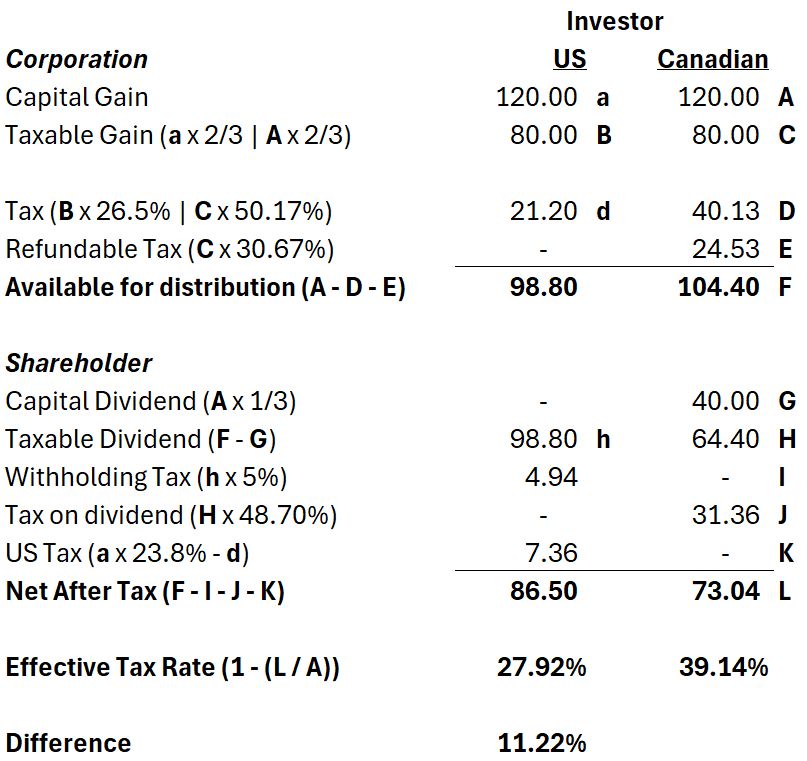
Did You Know? Strange but True Canadian Tax Facts🔔 - Part 4 - * Capital Gains Hike That Misses U.S. Real Estate Investors!* When it comes to selling real estate in Quebec, U.S. investors can achieve a significantly better tax rate than their Canadian counterparts on the very same asset—even with the introduction of Canada’s new capital gains inclusion rate. Let’s consider two scenarios: 1. A U.S. person owns an S-Corp, which in turn holds a Canadian Unlimited Liability Company (ULC) that owns real estate in Quebec. 2. A Canadian resident owns a Canadian corporation that holds the same type of real estate in Quebec. Even with the new 2/3 inclusion rate for capital gains in Canada, the effective tax rate for the U.S. investor remains significantly lower. This is due to the favorable tax treatment on passive income for corporations controlled by non-residents. When the property is sold, the Canadian resident investor ends up facing an effective tax rate that is 11.22% higher than the U.S. investor. This disparity highlights a key flaw in the tax system—one that unintentionally allows U.S. investors to capitalize on Canadian real estate at a lower tax cost. See below for the detailed breakdown (assuming dividends are paid via a PUC increase in the U.S. and that the withholding tax cannot be used as a foreign tax credit for the U.S. investor):
Crowe BGK - Tax Insights with Samuel LeCavalier tweet media
English
0
0
0
62
Crowe BGK - Tax Insights with Samuel LeCavalier
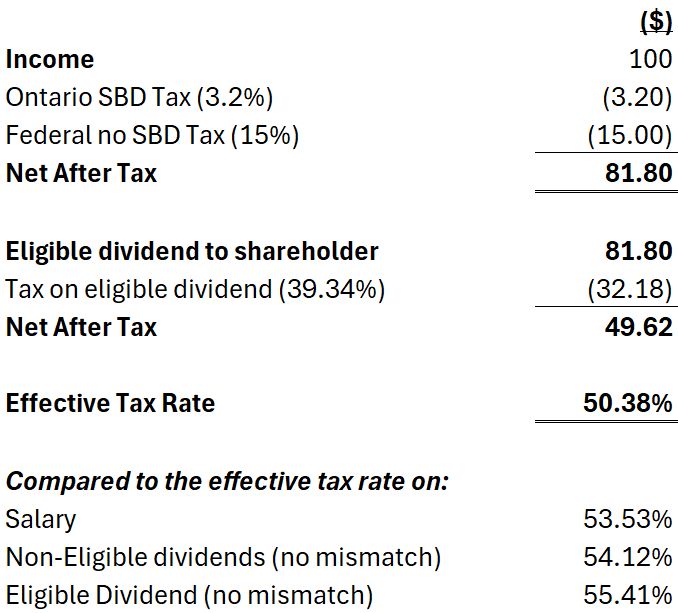
Did You Know? Strange but True Canadian Tax Facts🔔 - Part 3 - *The Clawback That Gives Back* The federal clawback of the Small Business Deduction (SBD) via the Passive income business limit reduction doesn't apply in Ontario. For Canadian-controlled private corporations (CCPCs), the Small Business Deduction limit of $500,000 - allowing them to access the lower small business tax rate - is reduced if the CCPC and any associated corporations earn combined passive income between $50,000 and $150,000. If this income exceeds $150,000, the CCPC loses access to the SBD entirely on the federal side, resulting in a higher tax rate on active business income. But here’s where it gets interesting: Even though this clawback increases the federal tax rate on the CCPC's income, it doesn’t affect the lower provincial tax rate in Ontario as they didn't harmonize with this measure. This means that the income is taxed at a low provincial rate but a higher federal rate. Because the General Rate Income Pool (GRIP) - from which eligible dividends can be paid - is calculated based solely on the federal tax rate paid, this situation allows dividends to be classified as eligible dividends from the GRIP. Ironically, this setup can lead to an effective tax rate on these dividends that is lower than the tax rate on salaries or other forms of "regular" distributions... see below (at the highest marginal tax rate):
Crowe BGK - Tax Insights with Samuel LeCavalier tweet media
English
0
0
0
51
Crowe BGK - Tax Insights with Samuel LeCavalier
Did You Know? Strange but True Canadian Tax Facts🔔 - Part 2 - *Penalty on Excessive Capital Dividend Designation... or benefit?* The Capital Dividend Account (CDA) plays a crucial role in Canada's tax integration system, enabling corporations to pay out the tax-free portion of capital gains to their shareholders. This mimics the tax treatment shareholders would receive if they had realized the gains personally. It makes sense, right? To prevent corporations from paying dividends that exceed this account, the Income Tax Act imposes a steep penalty of 60% on the excess amount under a special tax called the Part III tax. Alternatively, an election can be made to treat the excess as a taxable dividend to the shareholder, avoiding the penalty. According to the Department of Finance: "[t]he tax under Part III is set at a rate which ensures that shareholders in the highest marginal rate brackets cannot obtain any advantage through an excessive election." But is this always accurate? Consider a corporation with $500 in earnings that aims to give its shareholder $100 net after tax. Surprisingly, paying the penalty might actually result in a better outcome ! (see below) (Note: This post is intended to highlight inconsistencies in the Tax Act and should not be taken as advice to deliberately exceed your CDA.)
Crowe BGK - Tax Insights with Samuel LeCavalier tweet media
English
0
0
0
43
Crowe BGK - Tax Insights with Samuel LeCavalier
Did You Know? Strange but True Canadian Tax Facts🔔 You might have heard that nieces/nephews and uncles/aunts aren’t considered related for income tax purposes in Canada. But did you know that this isn’t always the case? In fact, there’s an unusual exception! If an uncle or aunt has been adopted, they are deemed related to their nieces and nephews under the Income Tax Act. Specifically, paragraph 251(6)(c) of the Act deems an uncle or aunt to be related to anyone who is related to their adoptive mother or father, which includes all their grandchildren! So, while it’s commonly believed that uncles, aunts, nieces, and nephews aren’t related for tax purposes, the rules are a bit more nuanced... !
English
0
0
0
44