Dilip D'Souza

62.8K posts

Dilip D'Souza banner
Dilip D'Souza

Dilip D'Souza

@DeathEndsFun

Tennis and mathematics. What else is there? OK: My name is not Inigo Montoya.

Bombay, India Katılım Temmuz 2009
27 Takip Edilen7.5K Takipçiler
Dilip D'Souza retweetledi
Veena Jain
Veena Jain@Vtxt21·
BJP was promising Woman Safety during West Bengal elections And after the results, BJP workers were threatening a Woman TMC supporter on the streets of the same West Bengal Gobi was talking about this Woman safety? 🤡
English

559
2.7K
7.9K
189.1K
Dilip D'Souza retweetledi
PunsterX
PunsterX@PunsterX·
BJP workers are so enthusiastic, they have started development work in West Bengal even before the govt has been formed.
English
180
1.6K
6K
170.5K
Dilip D'Souza retweetledi
Dhruv Rathee
Dhruv Rathee@dhruv_rathee·
27 Lakh Voters were deleted in West Bengal. These were not 'dead people' or 'bangladeshis'. These were real people who had already appealed to get their votes restored. The Supreme court could’ve delayed the West Bengal elections until the tribunals finished hearing the appeals of these voters. But they didn’t. Only around 1607 voters were restored in time by phase 2 of these elections. Almost every appeal that was heard turned out to be a wrongful deletion. In any functional democracy, this would not count as a free and fair election where a large section of voters have lost their voting rights. I'm not saying that TMC would've won for sure if they were added back, maybe BJP would still win, but the question is about the fairness of these elections. Free and fair elections are a spectrum. Ever since Delhi-Maharashtra-Bihar-Bengal, this needle has moved more and more towards being unfair. Each time somehow the opposition parties participate as usual in the electoral process thinking that they can still pull of a win despite the compromised EC, ED, CBI etc. and each time they have been proven wrong after 2024 Lok Sabha. The question is, at what point will they feel that the level of unfairness is so unfair that elections should be boycotted? I personally feel TMC should have refused to participate in these elections until all those 27 lakh appeals were finished being heard.
English
13K
11.9K
51.7K
2.6M
Dilip D'Souza retweetledi
Darab Farooqui
Darab Farooqui@darab_farooqui·
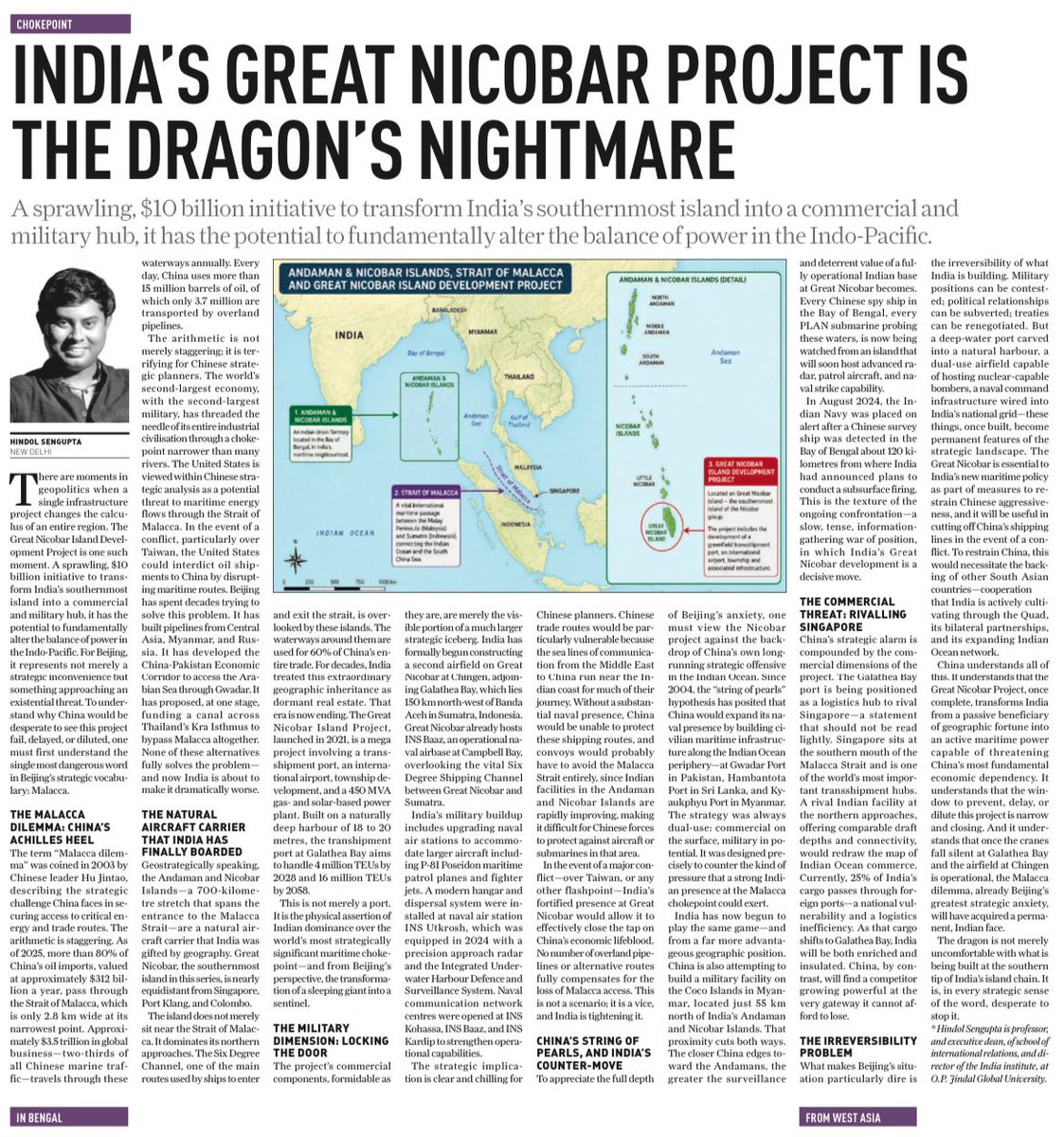
A Satire (of sorts) I want to be clear about what I am. I am a screenwriter. I make up fiction for a living but not as good as Hindol Sengupta. When the Iran-Hormuz war broke out I did what any professionally curious person does. I fell into a rabbit hole. Asymmetric warfare. Drone swarm doctrine. Hypersonic missiles. Precision strike theory. The kind of reading that starts at 11pm and ends with your wife screaming at you at 7 in the morning, asking "Milk finished last night, did you Zepto it?" I am not a strategist. I am not a geopolitician. I have no institutional affiliation, no think tank letterhead, no professorship. And yet. Hindol Sengupta is executive dean at O.P. Jindal Global University's school of international relations. He has the credentials, the platform, and the institutional weight. He published a piece in Sunday Guardian titled: India's Great Nicobar Project is the Dragon's Nightmare. I read it and regretted it instantly. Two to three IQ points, gone. Then the embarrassment set in. Not second-hand. First-hand. I am an Indian. Chinese scholars reading this are not cringing. They are laughing. A kind of self-assured laugh because this piece made them feel safer. Since Iran demonstrated what a determined state can do to a critical maritime chokepoint, a certain kind of Indian commentator has discovered a new hobby: imagining India doing the same to China at Malacca. Sengupta's piece is the most fluent example of this genre. It is confident. It is sweeping. It makes sounds like, and I say this with affection for the form, Dhan ta tan. The dragon is desperate. The vice is tightening. India closes the tap. Dhan ta tan. Two questions lodged in my head as I read it. Just two. I am a screenwriter, not a strategist, so I kept it simple. First: how do you defend a forward island base against a peer adversary with long-range precision strike capability? Second: Iran-Hormuz worked because Iran was operating from its own mainland, with compressed geography and an inexhaustible resupply chain. Does India have anything comparable for an island sitting 1,400 kilometres from the mainland? Sengupta never asks either. His piece moves in one direction only, from geography to complete dominance, the type of dominance kids discuss in class 3 as they buy new cricket bats, without a single sentence about vulnerability or what happens on Day 2. Because if he asked, the answers would destroy his conclusion. Let us start with the word Sengupta uses in his very first paragraph. He calls Nicobar not a strategic inconvenience for Beijing but an existential threat. Existential. The survival of the state. Imagine China in a post-apocalyptic scenario, red sun shining at the horizon, Chinese citizens shuffling around like zombies, their will to live broken by a single Hindol Sengupta op-ed. From an island that currently hosts nothing. Defended by nothing capable of intercepting modern Chinese missiles. Supplied through a single corridor 1,400 kilometres long. I write fiction for a living and even I would hesitate. The tap, the pipe, and the several other pipes Sengupta writes: "India's fortified presence at Great Nicobar would allow it to effectively close the tap on China's economic lifeblood." Malacca handles 82,000 ships a year. It is the busiest shipping lane on earth. Closing it would send global commodity markets into freefall within days. The US, EU, Japan, and ASEAN would be on the phone within a week. India's own economy, which depends on the same lanes, would be screaming within a month. Imagine an 80s policeman in khaki shorts, waving his baton while managing traffic at a red light. That is the visual I got. But leave that aside. Just ask the geographic question. Malacca is not the only door. The Lombok Strait, the Sunda Strait, the Ombai-Wetar passage, all navigable, all viable. These routes add roughly 1,000 to 1,500 kilometres per voyage. Costly. Inconvenient. Not impassable. Closing the tap assumes one pipe. There are several. Hormuz is landlocked on one side. It is literally one pipe. Geography works there. Hindol's common sense doesn't. Iran held Hormuz under maximum pressure sanctions with nothing left to lose. India is a $3.5 trillion economy with global trade ambitions and a non-alignment posture it has spent decades building. Even the fantasy works for weeks at best. Sengupta mentions none of this. The dragon is desperate. Dhan ta tan. Permanent. Like a target. He writes: "These things, once built, become permanent features of the strategic landscape." Yes. Permanent features with fixed coordinates, known infrastructure, and predictable supply corridors. In military terminology this is called a target list. See, I may have forgotten to buy milk, but I learned a few things. He also describes "a dual-use airfield capable of hosting nuclear-capable bombers." The airfield is under construction. It currently hosts nothing. What Sengupta celebrates as permanent is not yet built. And when it is, here is what permanence actually means in 2026, in the world of asymmetric warfare. China's DF-17 hypersonic glide vehicle travels at Mach 5 to Mach 10, maneuvers to evade interception, and has been confirmed accurate to within meters of a stationary target. It is simply hard to understand what Mach 10 is. Let me put it in simple terms. For the fastest things we use the metaphor of a bullet. It went like a bullet. The fastest commercially available bullet travels at around Mach 3.8. We are talking Mach 10 here. That is nearly thrice the speed of the fastest bullet. Your brain cannot fathom this speed at close range. At a comfortable distance, Hindol can write this piece and enjoy moderate intellectualism. No currently deployed Indian system credibly intercepts it. Not S-400, which was not designed for this threat. Not the DRDO ballistic missile defense program, which is designed for slower trajectories and years from deployment at a remote island anyway. You do not need a large warhead when your target has known coordinates and cannot move. Iranian missiles that threatened Hormuz were fast. China's are a different category entirely. A screenwriter who spent three weeks reading about this knows it. Apparently, a professor of international relations does not. The vice with one jaw Sengupta uses the metaphor of a vice, India tightening it around China's Malacca dependency. A vice requires both jaws to be secured. Hindol possibly has a missing jaw and is on a liquid diet, so he doesn't understand how grinding or locking works. India's other jaw: no hypersonic intercept capability, a submarine fleet that cannot credibly deny these waters to Chinese strike assets, a single resupply corridor 1,400 kilometers long that is itself a target. China doesn't need to contest the island. It severs the supply chain. Mines the corridor. Hits Port Blair's fuel infrastructure. Nicobar doesn't fall. It ends up in a wheelchair, writing sad poetry about being left alone. But the vice tightens. Because Hindol said so. Dhan ta tan. Desperate? Try the trade deficit. Sengupta writes China is "desperate to stop" the Nicobar project. Desperate. If China is truly desperate, it has an instrument it hasn't bothered to use yet. India imports over $100 billion annually from China. Pharmaceutical APIs. Electronics. Solar components. Industrial machinery. Inputs that Indian manufacturing cannot replace in any realistic timeframe from any alternative source. China does not need missiles to hurt India. It needs an export ban. You don't need a knife to scoop things; you need a spoon. Elementary, dear Sengupta. The supposedly desperate adversary holds India's supply chains in its hand and hasn't squeezed. That is not desperation. That is a country that knows it has options and is in no hurry to use them. What India actually has, and what is being destroyed to get it. What India has at Nicobar is a peacetime traffic signal. What Sengupta describes is a wartime weapon. He never explains how one becomes the other. That gap, between a flag planted on strategic geography and an operational military capability that can survive an adversary's first strike, is the entire argument he failed to make. I know this is a satire, but I am losing my sense of humor now. But seriously. A UNESCO-recognised biosphere is being destroyed. The last significant leatherback sea turtle nesting ground in the Indian Ocean is disappearing. The Shompen tribe, one of India's most isolated indigenous communities, is being displaced. Concerns raised formally by scientists, including the former ISRO chairman who chaired the original environmental committee, have been ignored just as formally by the government. Dead turtle babies are not funny. Destroyed ecosystems are not funny. Green vanishing from satellite images is never funny. So, no satire here. Sengupta mentions none of it. The dragon is desperate. We won, na na na na na. Who is this really for? Indian strategic commentary of this kind is essentially melodrama. Written to make a particular reader feel that the country's rise is inevitable, that adversaries are scared, that geography is destiny. The gap between the story and reality has a way of closing. Usually at the worst possible moment. Posturing is great if you are Dharmender. Not when you are Arun Govil. But Sengupta's piece is something more specific than cheerleading. This is a professor using institutional credibility to dress up ruling party talking points as strategic analysis. This is a clown dressed in a business suit with a detachable red nose. The Great Nicobar project is a government priority. The narrative that it terrifies China is government myth-making. Sengupta delivers both, fluently, without a single uncomfortable question. Sengupta is a Sarkari bard singing Sarkari narrative in op-ed form. This is how the ecosystem works. You don't need a cheque. You need a conclusion the regime finds useful. The professorship follows. If you are going to be a sycophant, at least construct an argument that survives basic scrutiny. As they say, even if you sing a bad song, at least make the words rhyme. At least ask how the base gets defended. At least reckon with the hypersonic threat. Build a case worth taking seriously before you expect to be taken seriously. I am a screenwriter. I fell into a rabbit hole after a war broke out. I spent a few weeks reading things I had no professional reason to read. And I came away with more questions about this project than a professor of international relations apparently thought to ask. That is funny, in a way. Because it is not even intelligence. It is common sense. It stops being funny when you remember that this writing shapes policy expectations, budget allocations, and diplomatic postures. That the gap between the story and the reality is not just an intellectual embarrassment. It is a strategic liability. That is not a professor's failure. That is a propagandist's occupation. None of you probably laughed reading this satire. I understand. But I can guarantee you one thing. Every Chinese analyst and scholar who read Hindol's op-ed was laughing. He set out to frighten them. He ended up entertaining them. Which makes him funnier than me, despite trying his very best to be the exact opposite.
Darab Farooqui tweet media
English
33
102
241
20K
Dilip D'Souza retweetledi
Ayush Rathee
Ayush Rathee@ayushrathie·
Everyone is talking about whether it will be good for the people of West Bengal if the BJP wins the election. I think it will be beneficial. Let’s take the example of my state, Haryana. Before the BJP, there was nothing in our state, and now see, Haryana is like Switzerland, with world-class healthcare, education, and infrastructure. And don’t tell me about recent incidents, like a sportsman being killed due to poor infrastructure, that’s fake, according to the BJP. Because we have the best roads. And don’t mention roads getting flooded after rain, that’s also propaganda from the opposition, or maybe even China, according to the BJP. And we all know our capital, the heart of India, Delhi. Before the BJP, there was so much pollution; now there is none, and we are living happily… yeah, we are. Okay then, I have a doctor’s appointment to check my lungs I think I didn’t breathe. And yes, the BJP will totally change West Bengal. Thank me later. Bye.
English
118
688
3.8K
124.5K
Dilip D'Souza retweetledi
T M Krishna
T M Krishna@tmkrishna·
I usually avoid responding to singular tweets, but this one from the Union Minister of Parliamentary Affairs cannot be ignored. It is the right of every opposition party, in fact every citizen to question all the arms of government. Calling it an attack on democracy is against the very grain of democracy. This idea propagated by the present government that the entire opposition is a negative force is the real threat to democracy.
Kiren Rijiju@KirenRijiju

All opposition parties have attacked the Govt. Agencies, EVMs, Election Commission, Media & now targeting the Judiciary. They don't realise that they are attacking the core of Indian democracy. Wait, People of India will give them a befitting reply, teach lifetime lesson!

English
178
1.4K
4.8K
171.8K
Dilip D'Souza retweetledi
Steve Skojec
Steve Skojec@SteveSkojec·
He’s dead on.
English
1.7K
15.2K
72K
2.2M
Dilip D'Souza retweetledi
🌻
🌻@naanbiological·
Commercial Cylinder ₹1000 मंहगा नहीं हुआ है, ₹993 हुआ है।
🌻 tweet media
29
1.8K
13K
196.4K
Dilip D'Souza retweetledi
Punit Pania
Punit Pania@Punit_Pania·
Today we learnt that if you destroy 1 cr trees of one of the oldest growth forests in the world to build port/hotels/casinos then you can build a township of ~3L people in one of the most seismically active zones in the world and you also get to call it your own Strait of Chomuz.
English
56
698
3.2K
48.5K
Dilip D'Souza retweetledi
Harish Upadhya
Harish Upadhya@harishupadhya·
Death at every corner. You can die while doing ordinary things in this country. A young man died after being electrocuted by a live wire dangling from an electric pole while pushing his scooter in the rain near Commercial Street. This is in the heart of Bengaluru,a shopping hub.
English
164
815
3.1K
280.3K
Dilip D'Souza retweetledi
Vini Kohli
Vini Kohli@vinikkohli·
@PunsterX Ab yeh kal WhatsApp pe chalega aur WhatsAppiye uncle log will go ga ga over this.🤦🏻‍♀️ Btw, Post of the day goes to Kanhaiya Kumar!👏
Vini Kohli tweet media
English
1
11
51
1.3K
Dilip D'Souza retweetledi
PunsterX
PunsterX@PunsterX·
Quote of the day! BJP MP Dinesh Sharma says- "Alarms went off on all mobile phones together, today. This is an indication that India is becoming a developed country." BJP leaders are finding new definitions of development everyday! 😭
English
440
1K
4.6K
115.8K
Dilip D'Souza
Dilip D'Souza@DeathEndsFun·
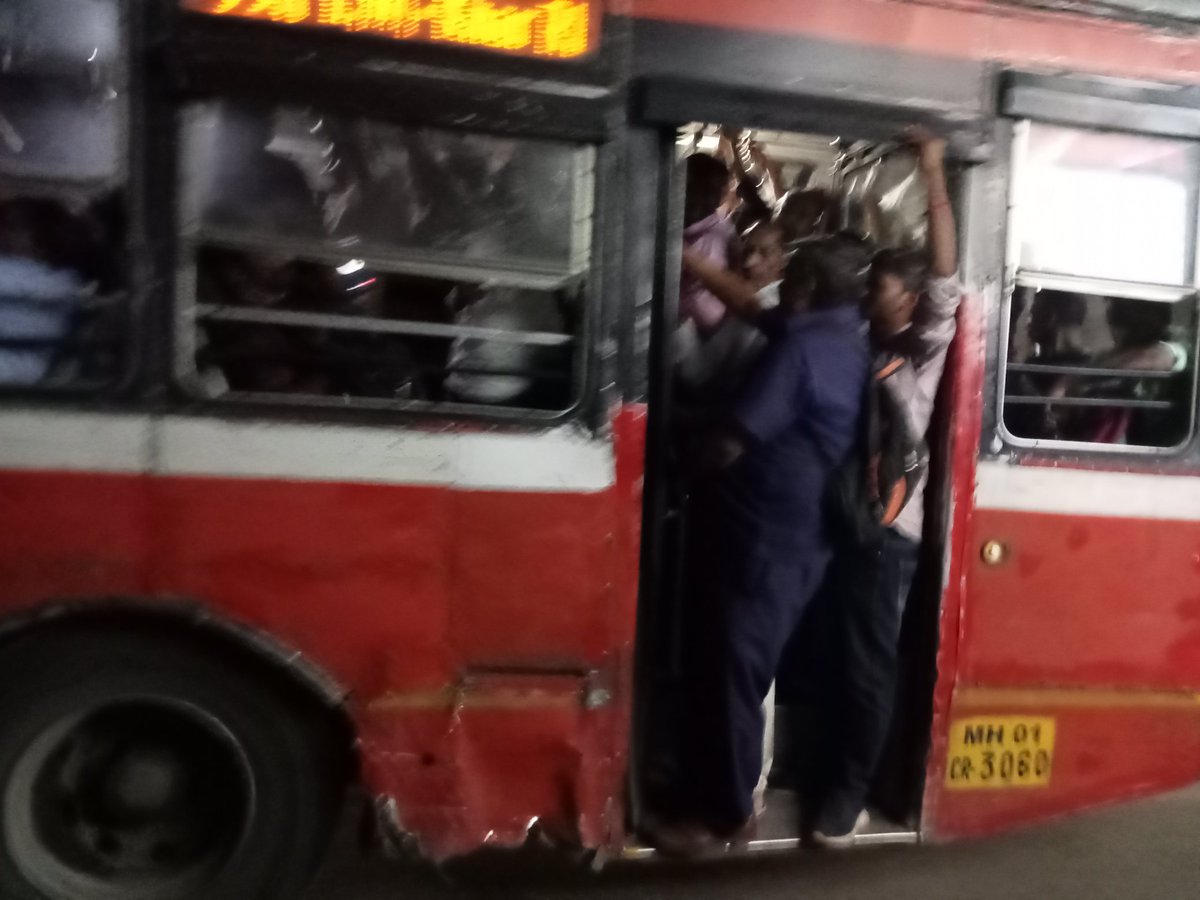
But we have Vande Bharat Atal Setu Coastal Road Missing Link Bullet Train Sealink etc and all that.
Dilip D'Souza tweet media
English
0
0
1
204
Dilip D'Souza retweetledi
Tarun Gautam
Tarun Gautam@TARUNspeakss·
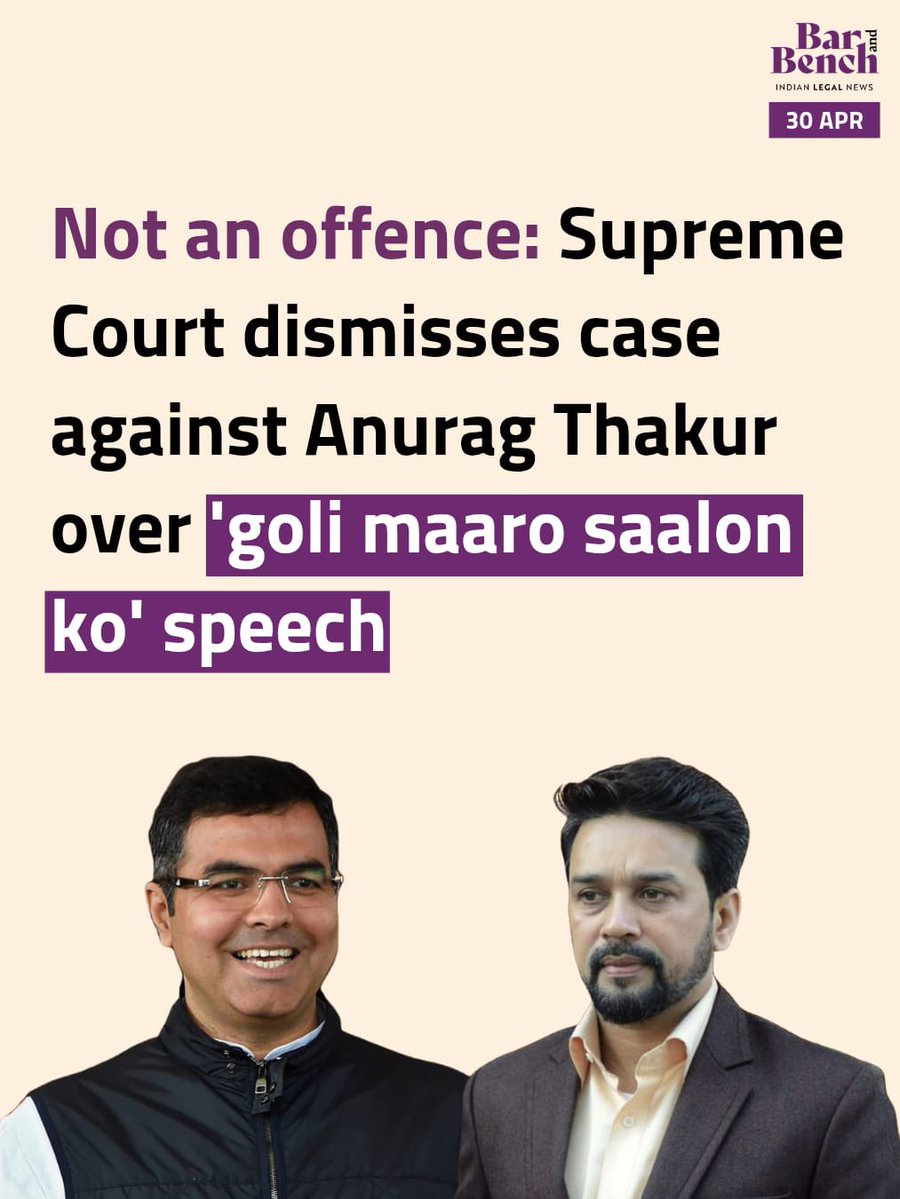
But milords have problems with slogans of Umar Khalid & Sharjeel. Anurag Thakur, Kapil Mishra didn’t go to jail but Umar & Sharjeel. This is called the majority privilege.
Tarun Gautam tweet media
English
305
1.4K
3.1K
34K