What if you could kill cancer cells by tricking them into destroying themselves — no drugs, no DNA damage, just mechanical deception? That’s exactly what a new paper from @anirbanbandyo shows. His team built a nano-machine called PCMS, about 8 nanometers across, that finds cancer cells by listening for an electromagnetic resonance signature only cancer membranes produce.. Only ~350 molecules enter a single cell, where they self-assemble into a ring around the nucleus — a fake wall between the cell’s brain and its body. This triggers two repair systems at once: the cytoskeleton pulls inward, trying to reconnect to what it thinks is a membrane, while the nucleus pushes outward to restore contact with the cell edge. One pulls in, the other pushes out, both doing exactly what they’re supposed to do — but the fake wall makes their goals incompatible. Tension builds until the nucleus ruptures. The cell’s own survival instincts destroy it. Gene expression profiling confirms this isn’t chemical toxicity — major pathways are untouched. It works at picomolar doses, is harmless to normal cells even at concentrations 100 million times higher, and cancer cells can’t develop resistance because nothing is being blocked. The machinery runs perfectly — the geometry is just wrong. Life and death reprogrammed through spatial conflict. doi.org/10.1002/adbi.2…
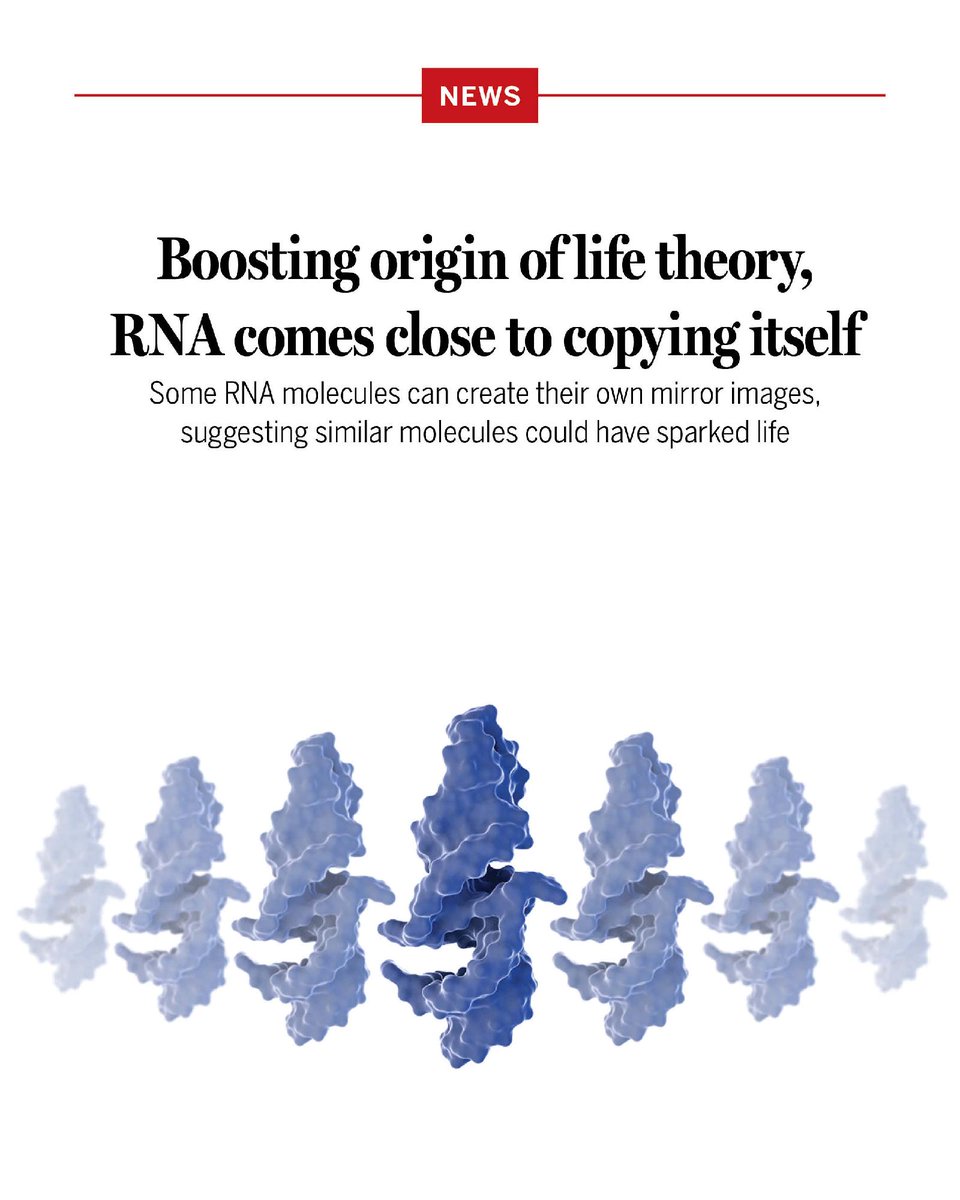
Today RNA may seem overshadowed by its glamorous cousin DNA, but many scientists think RNA molecules were the star players in the origin of life. By both storing genetic information and copying themselves, they might have touched off the march of evolution that produced increasingly complex life forms.
So far, researchers haven’t found RNAs that can replicate themselves, a key feature of living things. But they now have something close.
In a new paper, researchers report creating RNAs that can generate a sort of mirror image of themselves and use that template to generate the original. Learn more: scim.ag/4azrUw4@NewsfromScience
🚨 We aren’t just orbiting a star. We are a high-speed convoy screaming through the dark at 500,000 miles per hour. >
Every breath you take is in a location you have never been before, and to which you will never return.
An aerial view of Porcupine Rim in eastern Utah reveals the dramatic geological boundary where the Colorado Plateau rises abruptly above Castle Valley.
Erosion over millions of years.
Self-replicating molecules such as RNA are considered a plausible foundation for the origin of life on Earth. A remarkably small RNA molecule of only 45 nucleotides (QT45) that can synthesize itself and its complementary strand is now published in Science: science.org/doi/10.1126/sc…
Today RNA may seem overshadowed by its glamorous cousin DNA, but many scientists think RNA molecules were the star players in the origin of life. By both storing genetic information and copying themselves, they might have touched off the march of evolution that produced increasingly complex life forms.
So far, researchers haven’t found RNAs that can replicate themselves, a key feature of living things. But they now have something close.
In a new paper, researchers report creating RNAs that can generate a sort of mirror image of themselves and use that template to generate the original. Learn more: scim.ag/4awamko
By studying samples analyzed by the Curiosity rover, scientists have taken another step toward understanding whether life could have ever existed on Mars.
A new study suggests that non-biological sources cannot fully account for the abundance of organic compounds found in a sample collected by the rover.
Dig into the details: go.nasa.gov/46AGzG5
Crows discovered antibiotics millions of years before humans.
When a crow gets sick, it does something that looks insane — it finds an ant colony and deliberately pisses them off.
The ants attack. They spray formic acid everywhere in defense.
The crow? Doesn't run. It spreads its wings and just... takes it. Lets the ants crawl all over its body.
Here's the genius part: Formic acid is a natural antibacterial and antifungal compound. It kills the parasites and microbes that destroy feathers. The crow is basically giving itself a chemical bath.
Scientists call this "anting." Over 200 bird species do it. First documented in 1831, but birds have been doing it for millions of years.
It gets weirder.
When ants aren't available, some birds grab LIT CIGARETTE BUTTS and rub themselves with the smoke instead. They found a substitute for their medicine.
We spent centuries "discovering" antibiotics. Crows were running their own pharmacy this whole time.
Here's what strikes me: evolution is the original drug discovery engine. Billions of years. Trillions of experiments. No hypothesis — just relentless trial and error until something works.
Now we're building AI systems that do the same thing for antibody design — searching vast molecular spaces, predicting protein structures, optimizing binding affinity. What took nature millions of years, AI can explore in days.
Each second, the Sun blasts about 1.5 million tons of matter into space at speeds of hundreds of miles per second, while Earth’s magnetic field shields the planet from this solar wind.
Credit: NASA Goddard