Ding ding ding!
Less than $1,200 deposited, but more than $10,000 won.
A lucky saver just won a Grand Prize on @ethereum!
Become a winner. Deposit into PoolTogether.
OpenSea has evolved.
Beta complete. Full token universe unlocked.
New rewards program live. Welcome to the new OpenSea — the best place to discover, own, and trade anything onchain.
Announcing N1/Accelerate.
We take founders from 0 → 1.
Open to both founders with and without ideas, and to those with the drive and motivation to build something great.
Join today! Link in bio.
Announcing Bless: The world’s first shared computer, powered by everyday devices.
Users can now power the applications and websites they use automatically, and be rewarded for doing so.
Our incentivized testnet just launched on @solana - join us at bless.network 🌅
1/2 Layer N Explained: Seeking Blockchain Performance for Traders and first multi-tenant L2.
@LayerN_Official - Ethereum's L2 network using ZK and a modular structure for building financial applications with inbuilt liquidity and application-to-application connectivity. Let's dive into this narrative and see how Layer N works 👇
🔵 Introduction 🔵
The on-chain derivatives market in DeFi has been steadily growing, ranging from RWA synthetics and future yield spread trading to the ever-growing market of crypto perpetuals and options. Naturally, futures trading and options take the lead as they resemble what many access in traditional markets today. Moreover, these two markets are highly composable for strategy building and portfolio hedging, methods classically used by institutions and portfolio managers alike.
However, the perpetual market has taken off more rapidly than the options market when considering user usage and liquidity allocation. Yet, that will not be the focus of this article. Instead, we will delve into the various models that perpetual protocols have adopted due to the inherent challenges of conducting high-frequency, high-leverage trading on-chain. We will also examine how these models affect the actors within the perpetual trading ecosystem and discuss potential improvements from both an experience and cost perspective.
🔵 An Introduction to Layer N 🔵
In keeping with the theme of exploring the limitations of base-layer blockchains, such as Ethereum, this article will focus on Layer N and their quest to build a horizontally scalable blockchain layer suited for highly performant applications that require monoithic-like composability.
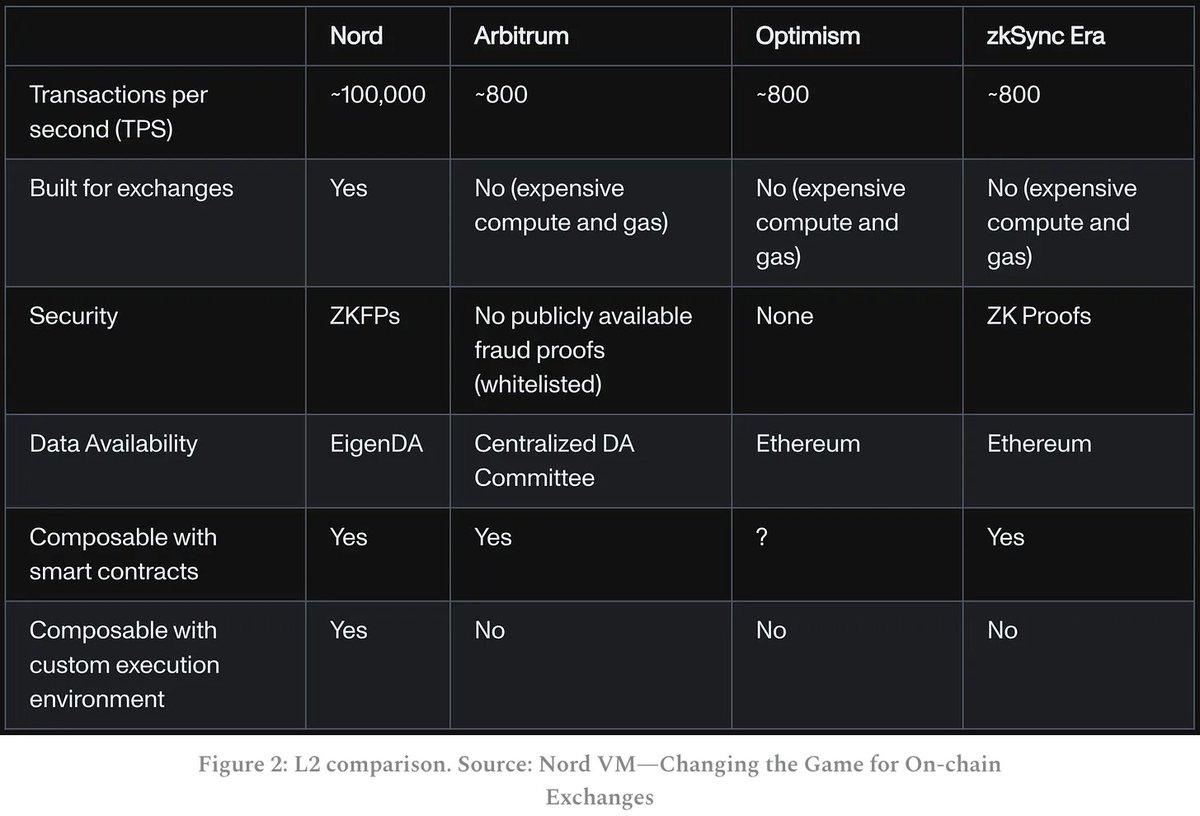
Each Layer N rollup leverages a “one-shot” ZK-fault-proof system coupled with optimistic state settlement to ETH, achieving low latencies. Data availability is posted to dedicated high-bandwidth decentralized networks, thus bypassing the bandwidth restrictions that alternative rollups face.
Layer N uses its own type of proofs - zero-knowledge fraud proofs (ZKFP). Layer N originally published the idea of ZKFP in May 2023, which allows a network to provide proof of validity only when fraud occurs, rather than every single transaction. This means that applications can perform logical inference without worrying about unnecessary verification costs. This solution is different from both Optimistic and ZK, but takes the best from them. The minus of Optimistic is that they take a long time due to the peculiarities of interactions between prover and verifier are extremely time consuming and compute costly on Ethereum. And ZK's is that they require high hardware requirements and lead to expensive overheads for generating proofs, which become prohibitively expensive when the exchange is launched. ZKFPs are a hybrid solution that leverages the best of both worlds: cheap and fast optimistic transaction execution with brevity and zero-disclosure security for proof-of-stake fraud.
Another important component of Layer N is N-EVM, a publicly available and permission-less universal virtual machine. N-EVM provides a development environment that developers are already familiar with and love: EVM. N-EVM is the primary publicly available instance of the Layer N drive on which any developer can deploy arbitrary smart contracts. N-EVM is fully composable with other Layer N and XVM virtual machines such as NordVM (more on this in the "Layer N Architecture" and "Layer N Value Propositions" sections).
XVMs on Layer N use WASM as the base ISA. This allows extensibility of programming languages and tools. This opens up a wider range of possibilities for the shape and compatibility of future Layer N virtual machines (see the Backers section for more on RISC Zero integration).
To solve the bandwidth problem, the N layer is using EigenDA, a new solution that provides megabytes of block space per second. What differentiates EigenDA from other off-chain DA solutions is that data continues to be protected by Ethereum validators through recapture, meaning that the "off-chain DA risk" is mitigated. Unlike existing blockchains, which have a fixed capacity regardless of the number of validators, EigenDA expands its capacity along with the number of validators. This innovation effectively overcomes the traditional capacity limitations inherent in blockchains, allowing Nord to scale horizontally and support significantly lower transaction fees.
🔵 Layer N Architecture 🔵
Before coming to an overview of the Layer N architecture, it is worth paying some attention to the basic chaining approaches:
🔹 The monolithic approach of building at the L1 or L2 layer has the advantage of synchronously linking applications that share a common state. The main disadvantage is performance degradation due to over-subscription of underlying blockchain resources by a potentially unlimited number of applications.
🔹 In the case of an rollups, the advantage is a purpose-built and dedicated computing environment that facilitates the creation of scalable applications. The main disadvantage is the loss of synchronous composability and the resulting fragmentation of liquidity.
And N layer StateNet is a solution that provides the performance of modular autonomous associations while retaining the benefits of synchronous monolithic stack layout. As we mentioned above, the base layer uses Ethereum as its security layer and Eigen DA as its Data Availability layer.
🔵 XVMs and their connection 🔵
Each StateNet node runs a separate virtual machine (VM). Some VMs are generalised virtual machines such as EVMs and others are application-specific virtual machines called XVMs. Virtual machines in StateNet send input data to a public data availability layer, such as EigenDA, and send state update blocks to Ethereum to complete the state of the network.
Virtual machines are divided into three types:
🔹 System Virtual Machines (SysVMs) are the underlying virtual machines that take on functional roles at the system level. Their role is to support the network in providing system-level functions and capabilities. Examples include a Router, which integrates messaging and management functions for a group of logically connected virtual machines, and a Gate Virtual Machine (or simply Gate), which unifies liquidity management across the network.
🔹 Generalised Virtual Machines (GVMs) are virtual machines that provide a generalised smart contract execution environment. GRNs allow developers to deploy smart contracts in their favourite language that can be combined with other virtual machines, whether generalised or not. An example of a GVM is N-EVM, an EVM implementation from Null Studios that provides public and permission-less deployment of smart contracts. Other potential GVMs include SolanaVM, MoveVM, or any other generalised runtime environment.
🔹 Application-specific virtual machines (XVM) - used for specific applications, to run a single programme. Unlike GVMs, XVMs run fully customisable pre-deployed application logic. Each XVM runs a single application. The application logic does not have to conform to the constraints of an EVM or any other generalised virtual machine, allowing for specialised implementations that are not constrained by other programs and environments. An example of an XVM is NordVM
XVMs consist of 5 modules:
1⃣ The input module deterministically schedules input messages for the virtual machine's finite state machines. Input messages are stored in a queue, and network acknowledgments are used to reply to the message sender to confirm proper execution and receipt of messages.
2⃣ The execution engine module defines the execution logic. This is the part of the virtual machine that takes input data, executes program logic on the input data, and outputs the results to the output module for messages to be sent to another virtual machine. For a GVM, the mechanism is a generalised finite state machine such as EVM, SolanaVM, etc.
3⃣ The output module contains the data that needs to be forwarded to other virtual machines.
4⃣ The rollman module is responsible for publishing network level and transaction level data to the data availability layer, as well as ensuring that state blocks are correctly calculated in Ethereum.
5⃣ With the cron module, developers can schedule the execution of events and callbacks without relying on third-party offchain services. Tasks scheduled in the cron module are initially redirected to the input module and passed to the appropriate virtual machines.
Further, as we have already learnt, at the heart of Layer N is the connectivity between all its parts and products. This is done by Inter-VM Communication, which lays out the channels and mechanisms to enable message passing across the entire StateNet network. The following key components can be identified in this technology:
🔹 Message Queues - Virtual machines communicate by maintaining two-point message queues. The queues guarantee the semantics of exactly one-time delivery for messages between summaries. Each virtual machine manages separate request and response queues. The state and operation of the queues are then validated and authenticated using the virtual machine's own state validation scheme, allowing validators to demonstrate state inconsistency without having to run the entire network.
🔹 Routers are intermediate system virtual machines that route transactions between logical clusters of virtual machines, which we call the failure domain. Routers provide load balancing and atomicity by acting as a sequence converter between a cluster of virtual machines.
🔹 Gate - A gate VM is a specialised system virtual machine that handles all inputs and outputs from the N layer StateNet. The gateway functions as the entry and exit point for the N level. Once liquidity enters Level N through the gateway, it can move freely between all other virtual machines. Asset transfers between virtual machines do not need to subsequently pass through the gateway, as GMP functionality is provided by the N layer message queue infrastructure. This design ensures that there are no double costs when moving assets between virtual machines.