Lakehon

4K posts

Lakehon banner
Lakehon

Lakehon

@lekzy54

Physicist | Data Scientist | Machine Learning Engineer | ELVS Engineer | Arsenal fan

Lagos Nigeria Katılım Eylül 2010
1.8K Takip Edilen671 Takipçiler
Lakehon retweetledi
A.Y.O
A.Y.O@YusufAsunmogejo·
Since the past 24 hours that I made the tweet on child parenting solution, my DM has been buzzing. I checked them, and one thing was quite common to all: Parents who are not happy about their kid’s performance in school, and they have approached it the wrong way. If you fall in this category, this post is for you. Many of us use brutal force because expectations are too high, and the anger is just too much. The scholar Ibn al-Jawzi explained in his book Sayd al-Khatir that intellect is a Rizq (provision) from God, just like money or health. He said some people are born with a wide vessel and others with a narrow one. If you try to force the water of a whole sea into a small cup, you will only spill the water and ruin the cup. This is what many of us are doing. We are trying to force a "doctor's brain" into a child whose cup was designed for something else. By that, it causes a soul-crushing resentment in the child. Imam Al-Ghazali described this beautifully in Ihya’ Ulum al-Din. He warned parents about a state called “Al-Malal”, where a child builds resentment because they are pushed beyond their limit. Everyone wants the best for their child. No doubt. However, if you keep yelling at them for things they cannot grasp yet, you make them hate the very sight of a book. You are closing the door to their heart while trying to kick open the door to their mind. Then what is the solution? It is simple. Going forward, every parent should make efforts to start looking for the Fath (the opening) in their kids. What does this mean? This is the lane the Almighty has prepared for them. In our history, if a child is slow with grammar or math, the scholars don’t call them a failure. They move them to a trade, a craft or a service. How then do you identify this Fath (Opening) in your child? Please pay close attention to me… (1) The first phase is Observation. Ibn al-Qayyim mentioned a concept called Istid’ad (natural readiness) in his book titled: Tuhfat al-Mawdud. This means you want to watch/observe/look at the child when they think nobody is looking. This is your first tool. For the next two weeks, stop talking about school. Do not worry yourself about how they perform on their homework. Instead, keep a "Strength Log." Every evening, write down one thing they did well that had nothing to do with a classroom. Did they fix a broken toy? Did they calm down a crying sibling? Did they organise their shoes? You are looking for their Istid’ad (natural readiness). If they are "book-slow" but "people-smart" or "hand-smart," that is where the key has been placed. (2) Introduce “Project or Craft” early on. Ibn Khaldun, in his Muqaddimah, argued that projects/crafts are high forms of intelligence that build civilizations. He argued that some minds are designed to understand the physical world better than the abstract one. Give them a "Project Day." Buy a basic tool kit, a sewing machine, or a coding starter kit. Give them a broken radio or a piece of furniture to fix. Delegate. Give them a real-world task that has a visible result. When a child who fails at math sees that they can build a table or bake a perfect loaf of bread, their internal shame starts to heal. They realize they are not stupid; they were just in the wrong room. (3) Kill the Comparison Virus. Imam Al-Zarnuji, in his classic work Ta’lim al-Muta’allim, explained that a student should only study what fits their nature. He said that forcing a student into a field they have no taste for is a waste of their life and the teacher's time. When you compare your child to others, you are catching a virus that blinds you to their path. Always filter. When family members start bragging about their kids' grades, you must be the shield. Tell them, "My child is mastering the art of (so so and so)." You are teaching your child that success is not a single ladder. There are many ladders to it. And if you do not value their ladder, they will stop climbing. (4) Prioritize Character Building. Put more efforts to praise your kids for their good character. Always tell them you love them when they behave well or show good character. Character recognition helps the child build a good self-image, which translates into self-confidence and barrier-breaking for the child. Prioritise this. (5) Don’t underestimate the power of your words. Always pray to God to grant them their opening. The scholars taught that the "opening" is a gift from Al-Fattah (The Opener). Supplicate. In your Sujud or in your prayers, stop asking for them to be a doctor/engineer, and what have you. Ask for the door that was made for them to be opened. Ask Him to show you the Fath so you can stop pushing them against a closed wall. Always remember, a parent who finds the "Fath (The Opening)" for their child has given them a gift better than a degree. You have given them a purpose. Start that journey NOW. It’s never too late… Thank you for your attention. Allah knows best.
English

91
887
2.3K
53.5K
Lakehon retweetledi
Toluwase
Toluwase@Toluwase_x·
On a highway? 😭 Nigeria 🇳🇬 dey another planet 😂😂
English
224
690
4.9K
438.6K
Lakehon retweetledi
A.Y.O
A.Y.O@YusufAsunmogejo·
Dear Zuha, I know you are inquisitive about how our religious days fit into the modern world. It is a brilliant question. I will be breaking this down for you so you can clearly see that Islam is not a copycat. It is a complete system with its own deep, independent roots. Firstly, you asked: if the Gregorian calendar is not real, why do Muslims pray on Friday, and is there a different Friday in the Islamic calendar? To help you and others understand, we have to go back to history. Pope Gregory was the one who introduced the Gregorian calendar, and he introduced it in 1582. However, when you look at Islamic history, you will see that Muslims had been observing Jumu'ah for nearly a thousand years before that Pope was even born. If you open classical books of Islamic history such as the Seerah of Ibn Hisham or The Sealed Nectar, the physical proof is right there. These books documented the very first Jumu'ah prayer held by the Prophet Muhammad (peace be upon him) in 622 CE. It took place in the valley of Ranuna during his migration from Mecca to Medina. In that same era, Allah revealed an entire chapter in the Quran called Surah Al-Jumu'ah, where He commanded the believers to leave their worldly trades and gather. This proves Yawm al-Jumu'ah was a lived reality in the 7th century, over 900 years before the Gregorian calendar existed in Rome. Now, you might wonder how this connects to the Friday we know today. Frankly, the seven day weekly loop is an entirely different system from how we count solar or lunar months. It is an ancient, unbroken mathematical cycle. You do not even have to take my word for it. Non Muslim historians and sociologists agree on this. For instance, Eviatar Zerubavel in his book The Seven Day Circle confirmed that this weekly cycle has remained completely unbroken for thousands of years across different empires. The day the Western world decided to call Friday aligns seamlessly with the sixth day of that ancient cycle. In Arabic, the days are just numbered. Sunday is Day One. Monday is Day Two. The sixth day is Yawm al-Jumu'ah, the Day of Gathering. This means we do not pray on this day to honor a Roman calendar. That is, it was just a coincidental relationship. We pray on it because Allah established it on a divine timeline. Secondly, you asked: why is Friday night considered so blessed, and what are you missing here? To understand this, we have to look at the foundations of human existence. Friday goes more than just the end of the work week. The Prophet Muhammad (peace be upon him) taught us that Friday is the day Prophet Adam (peace be upon him) was created, the day he entered Paradise, the day he was sent to earth, and the day the world will end. This is why the Prophet had a very profound routine. Every Friday during the early morning Fajr prayer, he would recite Surah As-Sajdah and Surah Al-Insan. He did this deliberately. These two chapters detail the creation of the universe, the biological creation of man, and the intense realities of the Day of Judgment. Praying these chapters every Friday morning is a divine reset. It reminds you of your origin and your final destination, both of which are tied to this specific day. Because Friday carries the heavy weight of the end of times, reciting Surah Al-Kahf is your spiritual shield. The Surah contains stories about the ultimate trials of wealth, power, and faith. Reading it provides a divine light that protects your heart from the materialistic noise of the world and the deception of the Dajjal until the next Jumu'ah. So by this fact, you are not missing anything. You just need to see that we are not following a Gregorian Friday. We are following a divine timeline. Don’t fret. Allah knows best.
Zuha Malik@zoemalyks_chai

I have a question. If the Gregorian calendar isn't real, why do Muslims pray jummah and recite surah kahf on Friday? Why is Friday night considered so blessed in Islam? Is there a different Friday in the Islamic calendar? What am I missing here?

English
259
2.5K
7.7K
291.7K
Lakehon retweetledi
Àyíndè ómó oni jersey 😊❤️
if you’re a muslim and this come across your timeline, please us retweet this, so the people who haven’t complete their solat for the day will see it and go and complete their solat, may the retweets stand as a witness for us on the day of judgement.
English
1
511
627
8.3K
Lakehon retweetledi
Àyíndè ómó oni jersey 😊❤️
if you’re a muslim and this come across your timeline, just retweet, so people who haven’t complete their solat for the day will go and complete it.
English
7
1K
1.8K
20.6K
Lakehon retweetledi
dijjerhv🌌
dijjerhv🌌@KhadijaBashirs2·
Repost the Quran. Your hands will testify for you on judgment day…. A beautiful recitation ❤️
English
47
3.9K
9.9K
141K
Lakehon retweetledi
big coco ✨🔴⚪️
big coco ✨🔴⚪️@iyalode__afc·
This is so accurate 🔴⚪️ 90 mins of watching arsenal play every 3 days these days 😂
big coco ✨🔴⚪️ tweet mediabig coco ✨🔴⚪️ tweet mediabig coco ✨🔴⚪️ tweet mediabig coco ✨🔴⚪️ tweet media
English
200
599
2.3K
75K
Lakehon retweetledi
Big Uncle
Big Uncle@Usmanashafe·
Ya Allah, please don’t take Islam away from me and my family 🤲🏽
English
32
112
421
11.9K
Lakehon retweetledi
The Muslim Cowboy
The Muslim Cowboy@MercifulMessage·
The best decision any human can make Become a Muslim
English
229
609
5.5K
52.3K
Lakehon retweetledi
Caliph®
Caliph®@CaliphRidwan·
What a time to be a Muslim Alhamdulillahi ‘ala ni’matil Islaam
Indonesia
8
103
365
4.2K
Lakehon retweetledi
AJE
AJE@Riddwane·
Yah Allah, grant Muslims victory over their oppressors and destroy people hiding behind Islamic identities to perpetrate atrocities against humanity 🤲🏽
English
175
567
1.9K
28.5K
Lakehon retweetledi
𝐌
𝐌@MooreRMFC·
This is the Arsenal you all call boring? Incredible level of jealousy that is.
English
239
4.8K
31K
591K
Lakehon retweetledi
𝑰𝒅𝒓𝒊𝒔 𝑨. 𝑶𝒏𝒊 PhD
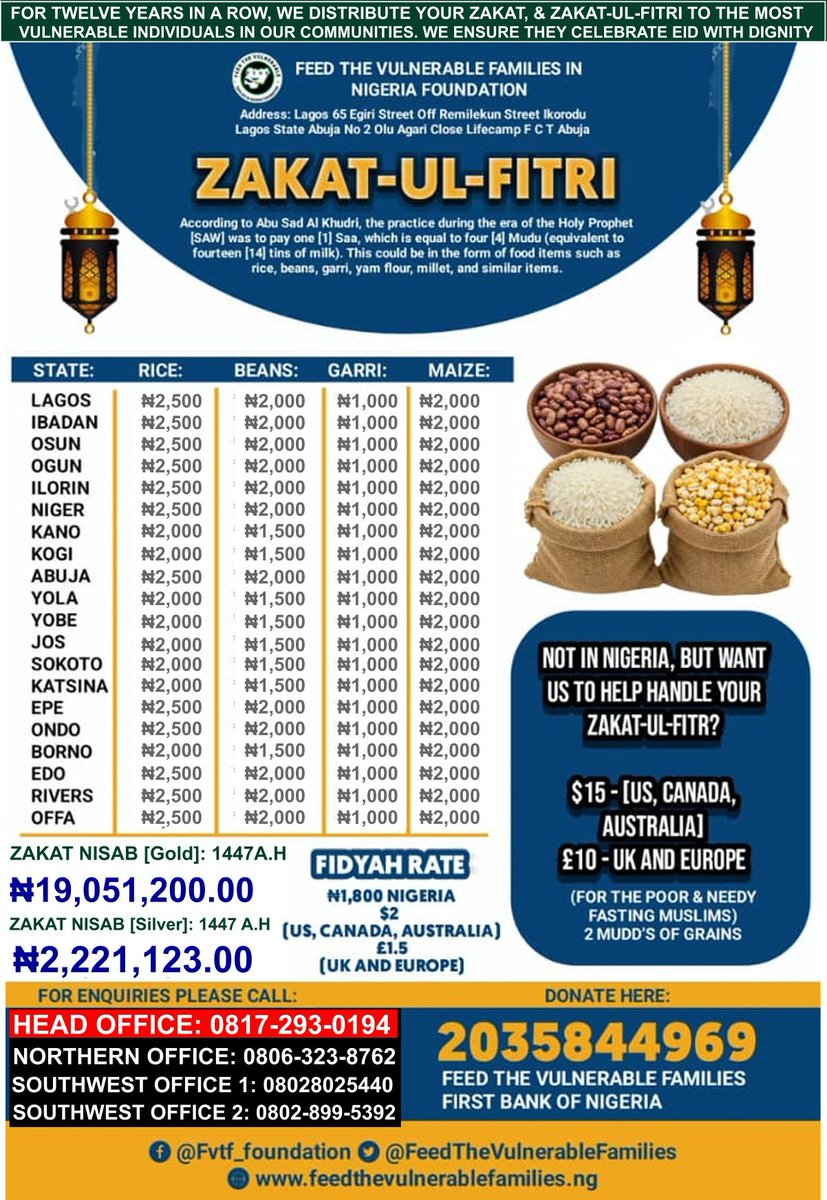
𝗜𝘁 𝗰𝗼𝘀𝘁 ₦𝟬.𝟬𝟬 𝘁𝗼 𝗿𝗲𝗽𝗼𝘀𝘁 𝘁𝗵𝗶𝘀 𝗳𝗼𝗿 𝘁𝗵𝗲 𝗺𝘂𝘀𝗹𝗶𝗺 𝘂𝗺𝗺𝗮𝗵 The Messenger of Allah ﷺ said: "You see the believers in their mercy, love, and compassion for one another like a single body. When one part of the body suffers, the whole body responds with sleeplessness and fever." As Eid-ul-Fitr approaches, many of us are concerned about our Eid clothes being ready, filling our fridges with food, and buying gifts for our children so they can celebrate with happiness. Yet, many indigent Muslims are worried about something far more basic—what they will eat on the day of Eid. Our brothers and sisters who are in dire need are part of this Ummah, and their hardship should move our hearts to act. This is why Zakat-ul-Fitri was prescribed—so the poor and vulnerable can share in the joy and dignity of Eid. Your Zakat-ul-Fitri can be a lifesaver for families who have nothing to prepare for the blessed day. We humbly seek your support to ensure that as many indigent Muslims as possible have food on their tables and a reason to smile on Eid day. Kindly entrust us with your Zakat and Zakat-ul-Fitri, and we will ensure it reaches the most vulnerable members of the Ummah. May Allah (SWT) accept our fast, dua, supplications, our charity, purify our wealth, watch over us, grant us the best, and reward us all abundantly for bringing relief to those in dire need. [Ameen] 🤲🌙✨
𝑰𝒅𝒓𝒊𝒔 𝑨. 𝑶𝒏𝒊 PhD tweet media
English
26
2.3K
1.7K
43.8K
Lakehon retweetledi
Jimoh Zainab
Jimoh Zainab@zyainy·
There is never a moment on earth without Adhan 🥹🥹🥹🥹❤️❤️❤️
English
21
371
1.4K
49.5K
Lakehon retweetledi
𝐉𝐎𝐑𝐃𝐀𝐍
𝐉𝐎𝐑𝐃𝐀𝐍@great_j0rdan·
We are the people of La ilaha illa Allah, there is no god but Allah. That is our FIRST and LAST word.
English
42
324
1.3K
14K
Lakehon retweetledi
A.Y.O
A.Y.O@YusufAsunmogejo·
Dear Big Ayo @47kasz , I can understand why people ask this same question almost every time. Especially to a non-Muslim like you, it may look weird when you see a massive crowd fighting to touch a rock. It’s a fair observation. This is why I want to establish a logical precedent before I go into historical and religious facts. Let’s think about how we behave as human beings. Imagine a soldier sitting in a dirty trench. He pulls out a faded photograph of his wife and kisses it. Is he worshiping the photographic paper? Is he praying to the paper to protect him from bullets? No. The paper has zero power. The kiss is a physical expression of a deep emotional connection. Or look at a national flag. People cry when it is raised. Soldiers take a bullet to stop that specific piece of fabric from touching the dirt. Are they worshiping cotton? No. It is immense reverence. This is the intellectual difference we need to establish. When someone bows down to a statue or an Ifa relic, the fundamental belief is that the object possesses independent power. The worshipper believes the statue can grant wealth, heal sickness, or curse an enemy. They pray to it. However, for the Black Stone, the theology is completely different. Muslims do not pray to the stone. Nobody asks the stone for a visa, a child, blessing or even a record deal. If a Muslim stands in front of the Kaaba and says, "O Black Stone, heal my mother," they have committed Shirk (idolatry) and are immediately outside the fold of Islam. This is because the stone has zero divine power. So what is the impact like you have asked, and why the intense desire to touch it? For you to understand this, let me walk you through how humans interact with history across the Abrahamic faiths. Let’s start with the Jewish faith. When Jewish pilgrims travel to the Western Wall in Jerusalem, they press their foreheads against the stones. They weep. They kiss the wall. They slip little written prayers into the cracks of the rock. Are they worshipping the limestone? No. That wall is a surviving remnant of their holy Temple. It is a physical anchor to their history. The wall itself has no divine power to grant the prayers on those pieces of paper, but touching it is a profound emotional release. You see the same deep emotion in Christianity. If you walk into the Church of the Holy Sepulchre in Jerusalem, right near the entrance is the Stone of Anointing. Tradition holds this is the slab where the body of Jesus was prepared for burial. You will see Christian pilgrims from all over the world fall to their knees the moment they see it. They kiss the stone, they cry over it, they rub their hands and clothes on it. Are they praying to a piece of marble? No. They are overwhelmed by the historical weight of what that stone represents to their faith. It is tactile love. The Black Stone operates on this universal human wavelength. Historically, it is an ancient relic tracing back to Prophet Ibrahim (Abraham), the father of faith. It is a surviving piece from the original foundation of that sacred house. It serves as the physical starting line for the Tawaf, the seven rounds of walking around the Kaaba. Spiritually, it is about deep emulation and love. The Prophet Muhammad (peace be upon him) touched and kissed it, so Muslims want to touch it. It is a physical connection to a historical and spiritual lineage. You are trying to place your hand where the Prophet placed his. The companions of the Prophet drew this intellectual line 1,400 years ago to prevent this very confusion. Umar ibn al-Khattab (May Allah be pleased with him) stood before a massive crowd, looked directly at the stone, and declared: "I know you are a stone that neither harms nor benefits. If I had not seen the Prophet kiss you, I would not have kissed you." That is the core of it. It is emulation, not worship. It is a relic of reverence, not a deity of power. No more. No less. Thank you for your attention.
BIG AYO🔰@47kasz

What impact does touching that stone have??? I need an unbiased explanation.. cos this & bowing down in front of a stature or ifa handkerchief has no difference

English
109
621
1.5K
62.9K
Lakehon retweetledi
Emerald 💚 هداية
Emerald 💚 هداية@Mz_Tosyn·
I bear witness that there is no god except Allah, and I bear witness that Muhammad is the Messenger of Allah.
English
22
490
1.4K
22.5K
Lakehon retweetledi
officer w👀s
officer w👀s@officerwoos·
I bear witness that there is no god except Allah, and I bear witness that Muhammad is the Messenger of Allah.
English
803
5.8K
28.6K
687.4K