

Lila
371 posts

Lila
@LilaShroff
writer covering tech @TheAtlantic, previously @stanford
Katılım Haziran 2019
1.1K Takip Edilen3K Takipçiler

Ever since the Pentagon-Anthropic drama, talk of AI nationalization has been growing. But what would this actually look like in practice?
We spoke to a dozen former Pentagon and Trump administration officials, AI-policy experts, and legal scholars.
Here's what they told us:

English
Lila retweetledi

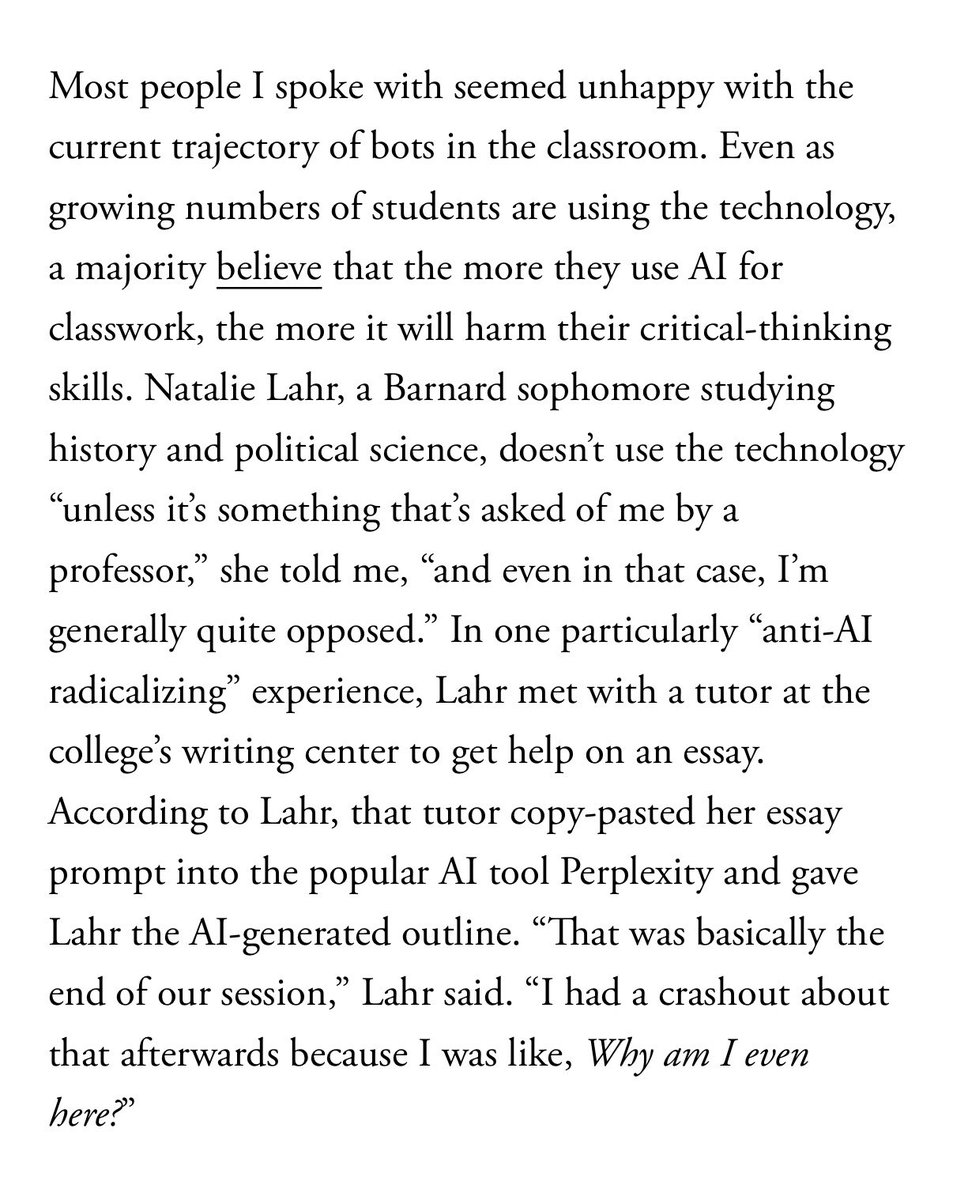
What’s it like in college right now when you actually want to learn while everyone—students, tutors and professors—is cutting corners with AI.
“That was basically the end of our session,” Lahr said. “I had a crashout about that afterwards because I was like, Why am I even here?”
English
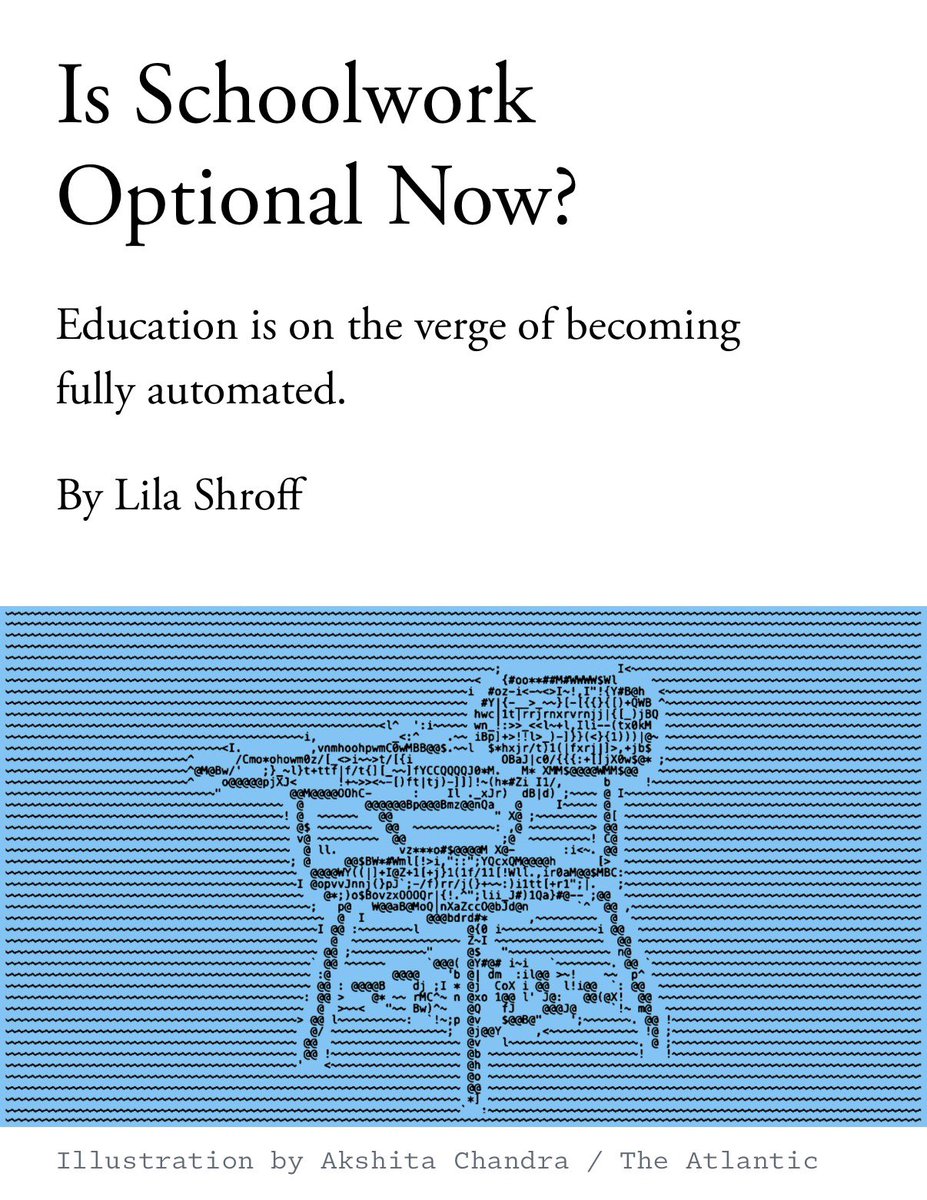
What happens when agents can do schoolwork? My latest for @TheAtlantic on the next phase of AI in the classroom:
theatlantic.com/technology/202…
English

Now I get to call @jasminewsun a colleague, which is a huge win
jasmine sun@jasminewsun
Personal news: I’m joining @TheAtlantic as a contributing writer! It drives me nuts how wide of an understanding gap there is between SF AI world and everywhere else — especially given the immense public stakes. There's so much AI hype, anxiety, and misinformation; so doing translation and synthesis feels more important than ever. (This role is in addition to Subst*ck, where I’ll keep writing at the same cadence.) I'm using this excuse to share some rambly media thoughts: namely that tech journalism can & must be great again. The problem with “old media” is that it often refuses to take tech bros at their word, and the problem with “new media” is that it’s often just advertising, which is boring even for the subjects. There’s a doom loop where some reporters write poorly-informed stories, so insiders won’t talk to them, so sourcing is worse; not to mention that most journalists are not based in the communities they cover. This makes people bad-faith, but it also means a lot of AI reporting is 6-12 months behind. Yes, fantastic blogs/podcasts abound — these are the bulk of my info diet — but they are largely insiders talking to insiders, too niche to recommend to policymakers or smart non-AI friends. These fractures are a disaster for shared public knowledge, and make us less prepared to navigate AI well. Magazine writing offers the ability to rise above of the hourly play-by-play (squinting at every new model release, every new jobs report) and to the bigger questions. I actually think the most impactful AI writing has *months*, not days of longevity! Rather than over-anchoring to any particular forecast, it offers generalized frames for operating under uncertainty. A few types of pieces I’m especially keen to write: 1) AI culture: A few people’s idiosyncratic personal beliefs regularly change the world. It thus matters tremendously how AI builders view their work, politics, philosophy, and the future. I think most individuals in the AI industry are good and want their tech to do good. Journalists can portray AI workers’ earnest beliefs while being appropriately skeptical of how that can clash with or be shaped by industry incentives, and how it might diverge from the public. "Smart people confront hard moral/intellectual problem" is one of my favorite genres. 2) AI diffusion: AI discourse disproportionately focuses on its impact on software and writing because those are the jobs the messengers do (obviously I’m guilty of this). That makes me want to do more field reporting on AI in education, manufacturing, healthcare, etc: e.g. can I ride along with a team trying to integrate AI tutors into a school? Diffusion is rarely as smooth as economic models predict, and “how AI will go” depends largely on the speed, and where it hits first. Relatedly: AI in the non-western world. 3) AI superusers: Polls show people are highly anxious about AI’s speculative effects but sanguine about their personal use. I think more people should experiment with AI to feel both the pace of progress *and* its jagged edges. While AI can produce slop/surveillance/etc, it can also extend human ability & creativity. I want to paint portraits of people already “living in the future" so we can ask: is that a life we want? The tech is here, but we can choose how to relate to it. If you have ideas/feedback/etc my DMs are open, and my Signal is jws.27. For me 1-1 conversations are *not* on the record unless we say so. (I always thought this was a weird norm, and in general am happy to answer people's questions about “how journalism works” from my POV because it can be quite opaque.) (also I'm replacing my blurry macbook selfie with a b&w portrait profile picture to signify reluctant induction into the label of "capital-j Journalist.” I spent most of last year pretending to be funemployed, but I suppose this is graduation. end of an era!)
English
Lila retweetledi

Jill Lepore examines how the language of constitutionalism has migrated from democratic governance to private A.I. systems, and what it means to entrust machines, and their makers, with the work of moral judgment. newyorkermag.visitlink.me/OwrBOx

English
Lila retweetledi

In shutting down Sora—its app for AI-generated videos—OpenAI seems to “finally be learning that slop is not a business strategy,” @LilaShroff argues: theatlantic.com/technology/202…
English
Lila retweetledi
'Modern Love' with a dash of AI? A 'New York Times' contributor acknowledges using chatbots, and artificial intelligence seems to be turning up in major news publications, @vauhinivara writes: theatlantic.com/culture/2026/0…
English
"After the builders of the atomic bomb finished their work in the New Mexico desert, they very quickly learned how little say they would have in its use."
Ross Andersen@andersen
I wrote about Dario’s Oppenheimer moment and the utopian dreams of the nuclear age theatlantic.com/technology/202…
English