linc

11.9K posts

linc banner
linc

linc

@linconxn

made of gold 1/4NOVA 🇧🇷 I don’t like sports other than MMA

Phoenix, AZ Katılım Temmuz 2012
1.1K Takip Edilen613 Takipçiler
linc retweetledi
James Camp 🛠,🛠
James Camp 🛠,🛠@JamesonCamp·
Block added $8B in market cap today on the news that they fired half their employees because of AI Every CEO and CFO is going to be talking about this tomorrow. They all want the same thing. Wall Street just told every company in America that replacing people with AI gets rewarded…
jack@jack

we're making @blocks smaller today. here's my note to the company. #### today we're making one of the hardest decisions in the history of our company: we're reducing our organization by nearly half, from over 10,000 people to just under 6,000. that means over 4,000 of you are being asked to leave or entering into consultation. i'll be straight about what's happening, why, and what it means for everyone. first off, if you're one of the people affected, you'll receive your salary for 20 weeks + 1 week per year of tenure, equity vested through the end of may, 6 months of health care, your corporate devices, and $5,000 to put toward whatever you need to help you in this transition (if you’re outside the U.S. you’ll receive similar support but exact details are going to vary based on local requirements). i want you to know that before anything else. everyone will be notified today, whether you're being asked to leave, entering consultation, or asked to stay. we're not making this decision because we're in trouble. our business is strong. gross profit continues to grow, we continue to serve more and more customers, and profitability is improving. but something has changed. we're already seeing that the intelligence tools we’re creating and using, paired with smaller and flatter teams, are enabling a new way of working which fundamentally changes what it means to build and run a company. and that's accelerating rapidly. i had two options: cut gradually over months or years as this shift plays out, or be honest about where we are and act on it now. i chose the latter. repeated rounds of cuts are destructive to morale, to focus, and to the trust that customers and shareholders place in our ability to lead. i'd rather take a hard, clear action now and build from a position we believe in than manage a slow reduction of people toward the same outcome. a smaller company also gives us the space to grow our business the right way, on our own terms, instead of constantly reacting to market pressures. a decision at this scale carries risk. but so does standing still. we've done a full review to determine the roles and people we require to reliably grow the business from here, and we've pressure-tested those decisions from multiple angles. i accept that we may have gotten some of them wrong, and we've built in flexibility to account for that, and do the right thing for our customers. we're not going to just disappear people from slack and email and pretend they were never here. communication channels will stay open through thursday evening (pacific) so everyone can say goodbye properly, and share whatever you wish. i'll also be hosting a live video session to thank everyone at 3:35pm pacific. i know doing it this way might feel awkward. i'd rather it feel awkward and human than efficient and cold. to those of you leaving…i’m grateful for you, and i’m sorry to put you through this. you built what this company is today. that's a fact that i'll honor forever. this decision is not a reflection of what you contributed. you will be a great contributor to any organization going forward. to those staying…i made this decision, and i'll own it. what i'm asking of you is to build with me. we're going to build this company with intelligence at the core of everything we do. how we work, how we create, how we serve our customers. our customers will feel this shift too, and we're going to help them navigate it: towards a future where they can build their own features directly, composed of our capabilities and served through our interfaces. that's what i'm focused on now. expect a note from me tomorrow. jack

English
61
100
1.4K
295K
linc retweetledi
gaut
gaut@0xgaut·
engineers coming to terms with having to become PMs
English
72
189
4K
273.2K
linc retweetledi
enzojeremias
enzojeremias@enzojeremias1·
sos un geniiiiiiiiiiiooooooooooo daaaaaaaalee
Español
22
71
1K
0
linc retweetledi
Melina 🇻🇦
Melina 🇻🇦@bioenergeticmel·
The girls on TikTok are making Nick Fuentes edits 😭
English
168
504
11.5K
499.2K
linc retweetledi
ⱤɆ₳Ⱡ ฿Ɇ₦
ⱤɆ₳Ⱡ ฿Ɇ₦@AtRealBen·
Tim Dillon absolutely nails it on why young people aren’t buying the bullshiț 👇🏻
English
205
3.4K
16.8K
636.2K
linc retweetledi
Champagne Joshi
Champagne Joshi@JoshWalkos·
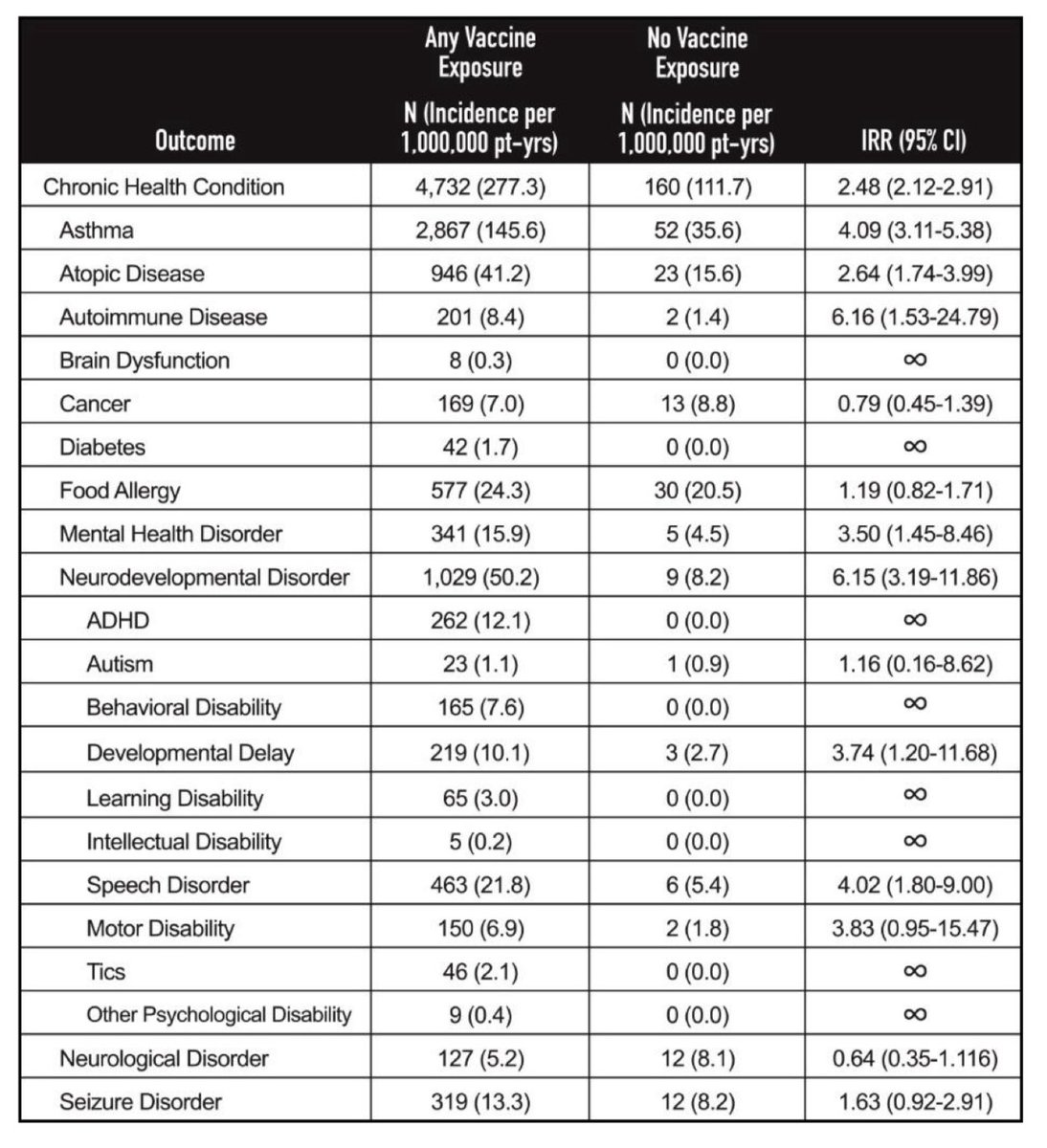
The unpublished Henry Ford study is explosive in its implications. At its core, the data reveal a stark divide between children who received vaccines and those who did not. When measured in incidence rates per one million patient-years, the differences are not subtle. They are dramatic, and they cut across a wide spectrum of chronic conditions. The most basic finding is that vaccinated children experienced nearly two and a half times the overall rate of chronic health conditions compared to their unvaccinated peers. The number sits at 277.3 cases per million patient-years among vaccinated children against 111.7 for the unvaccinated, producing an incidence rate ratio of 2.48 with tight confidence intervals. That is not a minor signal, it is a flashing red light. Asthma stands out as one of the most glaring disparities. The rate was over four times higher in vaccinated children, 145.6 cases compared to only 35.6 among the unvaccinated. Atopic diseases such as eczema and allergies were also elevated, with vaccinated children facing a 2.64-fold higher risk. Autoimmune conditions were even more striking, with vaccinated children showing an incidence more than six times greater than their unvaccinated counterparts. Neurodevelopmental outcomes were perhaps the most disturbing category. Disorders in this group were more than six times higher in vaccinated children. ADHD was present in 262 cases among the vaccinated group, yet zero among the unvaccinated. Learning disabilities, intellectual disabilities, tics, and other developmental impairments all followed a similar pattern. Speech disorders were four times higher among the vaccinated group, and developmental delays nearly four times higher as well. Mental health disorders overall were 3.5 times higher. Even seizure disorders, while less dramatic, still trended upwards with a relative risk of 1.63. One of the most telling features of the data is how often the unvaccinated column registers as zero or near zero. ADHD, learning disabilities, intellectual disabilities, and tics had no cases recorded in the unvaccinated population. Critics will argue this reflects underdiagnosis, since unvaccinated children typically see doctors less often. But the sheer size of the disparity suggests something more. A minor diagnostic gap might be plausible, but the gulf revealed in these numbers is difficult to dismiss as mere chance or office visit frequency. Taken together, the Henry Ford analysis suggests vaccinated children are not only more likely to be seen by physicians but also genuinely more likely to be diagnosed with an array of chronic and developmental problems. Even if one accepts the possibility of detection bias, the magnitude of the differences requires serious investigation rather than casual dismissal. If the signal were a modest ten or twenty percent increase, one could argue it away. When the risks climb to four, five, or even six times higher, the argument of bias alone becomes increasingly fragile. The larger point is this. Whether or not one accepts every conclusion of the Henry Ford team, this study provides a powerful signal that chronic conditions deserve a deeper look in relation to vaccination. Current post-marketing surveillance systems are primarily designed to catch rare acute events such as anaphylaxis or febrile seizures. They are not equipped to track long-term patterns in asthma, autoimmune disease, or developmental disorders. By design, they will not see what this study has begun to uncover. To dismiss this analysis outright because it has not yet passed through peer review is an act of intellectual laziness. Publication is not the only measure of value, and in today’s climate researchers face professional punishment for producing findings that challenge the dominant narrative.
Champagne Joshi tweet media
English
243
4.4K
11K
597.7K
linc retweetledi
Pablo Manríquez
Pablo Manríquez@PabloReports·
This might be the very best mass deportation video I've ever seen.
English
409
4.3K
27.6K
701.1K
linc retweetledi
Not Sure Gnosis 🦈🐆
Not Sure Gnosis 🦈🐆@ViceLitty·
Hey @grok who is this guy? I know him from somewhere He's definitely famous, I saw him on TV recently
Not Sure Gnosis 🦈🐆 tweet media
English
647
639
21.9K
1.5M
linc retweetledi
Fuentes Updates
Fuentes Updates@FuentesUpdates·
"I move into college tomorrow... it's just hitting me all at once... Any advice???" You are not the main character, lil bro 😂
English
237
490
16K
955.5K
linc retweetledi
Gabe Dunn
Gabe Dunn@dunn_gabe·
The music addition is perfect
English
116
735
8.6K
253.3K
linc retweetledi
unusual_whales
unusual_whales@unusual_whales·
BREAKING: Donald Trump's name appears multiple times in Epstein’s files, per WSJ
English
2K
4.5K
46.8K
2.9M