
mainledger retweetledi
mainledger
7.7K posts

mainledger retweetledi

mainledger retweetledi

What we are doing is simply trying to make Web3 real.
What we are doing is building a decentralized internet.
It means your data is not stored by a specific company but managed by the blockchain network.
The internet protocol for that is Code-In.
You’ve now seen how the token price is connected to the progress of the technology.
We’ll soon post an introduction to the IQ profile.
English
mainledger retweetledi
mainledger retweetledi

1/16) SUI has a great design, except for its token economics:
SUI claims to have a capped supply of 10B, with 52% being "unallocated" till 2030
The problem is that over 7B SUI is being staked right now!
Over 84% of the staked supply is held by founders! SUI is centralized: 🧵
English
mainledger retweetledi
mainledger retweetledi

What could possibly go wrong when the Trump and Witkoff business networks join forces and an army of idiots shills whatever they put in front of them?
What $WLFI stands for was actually clear from the beginning.
It was not fundamentally different from the other Trump family extraction plays we had already seen before.
The only difference was that this time the promises were even dressed up particularly well.
But it was the same machine, same access game, same retail bait, same outcome.
What happened only confirmed what many people saw early, and what most people only started to understand in the last few months.
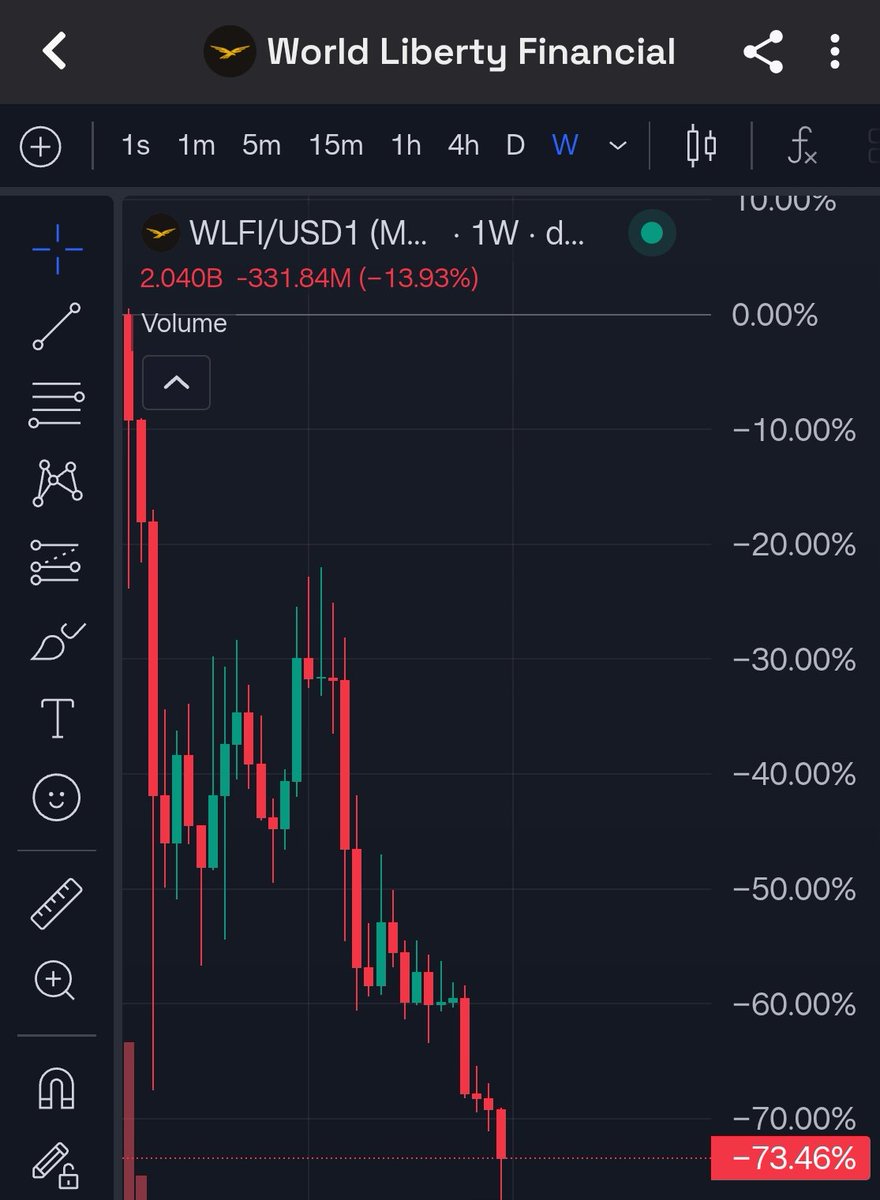
WLFI@worldlibertyfi
Token unlock proposal is now live for vote. ☝️ This is one of the most significant governance proposals in WLFI history. Here's what's at stake.
English
mainledger retweetledi
mainledger retweetledi
HYPE has devils hiding in the details:
Co-located low node count, off-chain ordering & it is closed source!
Yet, dismissing it as "centralized" is foolish, as its core design is decentralized!
HYPE is decentralizing more, racing SOL to win. Pay attention or get left behind: 🧵
The reason why HYPE has been so successful, leading the charts in fees, is that their product is superior to everyone else's, including SOL's!
SOL's leadership is well aware of this & its future upgrades, Alpenglow & MCP, are meant to close that gap
In the meantime, HYPE has been running unopposed within its particular niche, which includes Perp trading & RWA's!
The Latency Race:
HYPE currently only has 24 validators, most of which are located in the same data center in Tokyo. This is an extreme degree of centralization! Despite the validators themselves still being permissionless
This happened because of the high demand for low latency. We will not defend this design; however, we do still have to recognize the market demand for lower latency
It gets exciting when we realize that both SOL & HYPE want to achieve such low latency within a fully decentralized design environment. It then becomes a question of who gets there first!
Fake It Till You Make It:
The truth behind HYPE is that people are not trading on-chain at all. Their orders are getting matched in the mem-pool & are only included on-chain later
Most people cannot tell the difference; that is how HYPE managed to offer a superior product. They took shortcuts others were unwilling to make. Which, honestly, can also be said for SOL during the early days
However, contrary to my own expectations. As I was a SOL critic at that time. SOL fixed all of its issues & managed to take the lead in usage. Convincing me in the end to pivot & support the project
HYPE is also saying & doing all of the right things, giving us a clear path towards full decentralization in its future
The Prize:
Make no mistake, whoever wins this race wins the entire crypto game!
The use cases these chains cover collect the vast majority of fees. Which is what ultimately pays for decentralization, security & scarcity
That means, from an evolutionary perspective, whoever comes out on top of this competition. Becomes "Bitcoin 3.0"; the most decentralized & performant chain
The blockchain trilemma was effectively solved years ago. The trade-off space now entirely revolves around latency instead
Trillion Dollar Questions:
Will SOL close the gap before HYPE fixes all of its problems? Or will HYPE decentralize before SOL catches up? These are the trillion-dollar questions
HYPE is committing to open-sourcing the codebase & moving trading fully on-chain. While increasing & better distributing their validators globally
Do we bet on the more decentralized chain, which is catching up in performance? Or do we bet on the more performant chain, which is catching up on decentralization?
Or maybe it comes down to which team we trust more to get us across the finish line first. Or what technical challenges are harder or easier to overcome? It is a combination of all of these factors that will determine the ultimate winner
Conclusion
All that matters in the end is that we, the people, get a fully permissionless, decentralized & performant chain at scale. How we get there matters far less in the grand scheme of things
The crypto revolution is inevitable exactly because of the type of utility SOL & HYPE offer the world. Building competitive products for mass adoption is the only way we can make a real impact
That is why this should all matter more to the cypherpunk movement, as only highly performant & decentralized chains can liberate the world. By making financial sovereignty & privacy available to all! 🔥
English
mainledger retweetledi

someone asked me a min ago if i still love solana.
i told them: if i had enough millions i'd buy enough supply to contend with jito and fix mev myself. ensure every swap gets best execution. fwiw.
later, unrelated chat, someone said "takes millions to make millions champ."
no. it doesn't. and that is the thing nobody on this chain wants to admit.
it's a weird thing. i wouldn't be anything or anyone without solana. and yet — there is so much whacky shit going on here. too much, imho. and the whackiest part is that the fix to one of the biggest extractive vectors on the chain isn't technically hard. it is structurally locked. there is a difference.
i had this idea in a me jail cell — you get a strange clarity when nothing is happening to you for a long time, the noise drops out, the priors you didn't know you had show up, and problems you've stared at for years suddenly look obvious — and i let it go because i didn't have the bandwidth or the runway to chase it.
came back to it later in the a chat a sec ago. someone asked "didn't they already fix mev?" and i had to type the truth out loud: "no, they run mev. every fix you've been sold on this chain is run by the entity doing the extraction. it is just a battle for whose fakefix you choose to believe."
so let me unfake it.
— the actual problem —
solana mev is a tax on everyone who's ever clicked swap. it's not a bug. it's not a side effect. it's a revenue model. searchers got rich off your slippage. validators rented out the right to extract. the entities best positioned to fix it were the entities being paid not to. the public meta was "run a private rpc and cope" and most of us just took it because the alternative was paying gas to mainnet and watching half your fill go to a sandwich bot.
people forget how bad it is. independent measurement work has put solana sandwich extraction in the tens of millions of dollars per month at peak. that money came directly out of retail fills, every time. it is the largest uncompensated extraction event in defi and we just live with it.
the reason it persists is not technical. it persists because the supply chain for block production is captured. jito-solana runs on the majority of validator stake. the jito block engine intermediates bundle flow. searchers pay validators through that pipe. the pipe exists to monetize ordering. fixing extraction would mean cannibalizing the revenue source the dominant client is built around. the incumbents will not do this. it is not a moral failure. it is structural.
worth saying clearly: this is not an indictment of individuals. i don't think toly or raj are bad people, or saw this dynamic coming when they were building. same with the pump execs, fwiw. structures shape behavior more than people do, and the structure here was set up before anyone was sober enough to see what it would become. but the structure is what it is now, and the structure does not get fixed by waiting for the people inside it to fix it. they are misaligned.
every "fix" that gets announced from inside this stack is, by construction, downstream of the people whose business model is the thing being fixed. it is not a fix. it is a marketing surface. you are looking at a battle for whose fakefix all y'all fall for, again.
paladin tried to compete head-on by being a parallel block engine that filters sandwich bundles. that approach depends on validator adoption of the engine specifically and on validators voluntarily making less money. it has not scaled. it will not, because the incentive vector is wrong. you cannot ask the entity being paid to extract to opt-in into less revenue. they are misaligned.
the fix has to live one layer down — at the validator client itself, agnostic to which block engine sits on top. and one layer up — at the rpc/proxy layer, where it can ship without permission today.
the solution to get it up and running has to live grassroots - the people must be sick and tired of being sick and tired, and the people must fix it, before all is lost.
— what i'm building —
a jito-solana fork in which every incoming instruction is decoded by yellowstone vixen at the moment of intake. classified by program. swap-shaped instructions are extracted and normalized into (mint_in, mint_out, amount_in_estimate, side, owner). all swap activity in the leader's pending pool is bucketed by mint pair. before block construction, within each bucket, sells of a given mint are scheduled ahead of buys of the same mint, wherever the timing window allows. arbs and other multi-leg atomic transactions stay atomic — the rule applies between transactions, not inside them. non-swap transactions flow through unchanged.
vixen is the right tool because it is the parsing layer @triton_one built for exactly this kind of high-throughput, real-time, schema-aware ingestion. it lives in the right place in the data path. it can decode at line rate. the parser trait is composable. dex programs already have parsers or can be added in a day. there is no part of this that requires a custom indexer or a side process. it is native to the validator pipeline.
i have this fully specced. it is, as i told the chat, and quotetweet myself below, dead simple. plus, Claude 4.7 1M Max is a beast.
— mechanically what happens —
— sandwich attacks become unprofitable by construction. the fork decodes swap flow individually rather than honoring opaque wrapping bundles, then applies the fairness rule before block construction. searchers can still backrun. they can still arb. they can still capture stat-arb. they just can't front-run within the slot, because the slot's fairness rule won't schedule a fresh buy ahead of same-mint flow that already contains sells. the extractive vector — the front-run — closes. the rest of mev keeps working. searchers doing real price discovery still get paid. the ones taxing retail go find a different validator's slot.
— offsetting flow internalizes. alice sells X and bob buys X in the same slot. under naive scheduling, both transactions slip the curve in the same direction depending on order. under the fairness rule, alice clears first at the prevailing price (her quote), and bob clears immediately after at the post-sell price (below his quote). matched volume cancels its own price impact rather than compounding it. this is coincidence-of-wants matching, native to the validator layer. no off-chain solver network. no separate venue. no fragmented liquidity. every dex. every aggregator route. every multi-hop. by default. because it operates on decoded ix flow regardless of which program produced them. cowswap solved this with a solver auction off-chain. this solves it without a solver, because the validator is already the natural sequencer.
— validator economics shift instead of shrinking. searchers still pay. the auction surface is just different. instead of "auction the right to insert a sandwich" it becomes "auction the right to publish this fairly-ordered block." backrunning, integration fees, priority fees — all continue. the extractive vector specifically — the one that takes uncompensated value from retail — is the one that closes. the externality changes sign. the validator's revenue source becomes a service instead of a tax.
— priority fees remain priority fees. nothing in this proposal touches the cu-priced ordering of non-swap transactions. compute is still scheduled on willingness to pay. this is not about removing market mechanisms; it is about not letting one specific market mechanism — ordering rights for swap pairs — externalize onto third parties who never agreed to participate.
— what this doesn't fix —
honest limitations, because anyone who's serious will check:
— cross-slot mev is not addressed. statistical or temporal mev between slots remains. multi-slot strategies still extract. that is a separate problem.
— one-sided flow is not magically helped. if everyone is selling X in a slot, ordering them doesn't create a counterparty out of nothing. they all still slip the curve. the fairness rule only bites when there's offsetting flow to internalize, which is most of the time on liquid pairs but not always.
— the validator-fork piece is, well, a fork. it works on slots that run it. adoption is the problem, not implementation. that's why phase 0 below exists — to ship value before the fork is widely adopted.
— censorship-resistance is unchanged. all transactions still land. the rule is reorder-only. nothing is filtered. nothing is dropped.
— why solana specifically —
solana has 400ms slots and continuous block production with leader rotation. there is enough time inside a slot for vixen to decode and the scheduler to apply the rule without meaningfully impacting block latency. ethereum-style proposer-builder separation forces this kind of work into the builder, where extractive incumbents have already captured the surface. on solana, the validator client itself is the surface, and the validator client is a fork target. the asymmetry favors solana. it is also why this hasn't been done — the same surface that makes it possible is the one being monetized today. and, i love solana. always have. always will. they're just unfortunately, tragically misaligned.
— why now —
vixen is production. jito-solana is open source. agave is open source. firedancer is shipping. there has never been a moment with this much building energy and this much stake-weight diversity to make a fairness-fork actually deployable. the next 12-24 months are when this either gets built by someone who isn't financially captured, or it doesn't get built at all.
— what shipping looks like —
phase 0: client-side. i can ship this before any validator changes anything. it runs as an rpc/proxy layer in front of integrating apps and aggregators — intercepts swap intents, internalizes offsetting flow across users inside a short batching window, and submits to chain in fairness order. wallets and aggregators that route through the proxy capture the offset benefit immediately. the data from phase 0 becomes the empirical case for the validator-side version, on real flow, with real users, with realized-vs-quoted slippage published per pair. this is the version that ships first because it requires nothing from anyone except an rpc endpoint swap. or, u fund me, I skip to real production fast. u may be fast, but u not as fast as me, I'm fasss as sin, boi.
phase 1: standalone validator running the fork on mainnet. instrumented. publishing per-block data showing realized slippage on swap pairs versus a counterfactual naive-ordered control validator. open dashboard. the data does the convincing.
phase 2: searcher partner program. backrunning and stat-arb still work on the fork. publish a clean api for legitimate flow. demonstrate the fork is not anti-searcher — only anti-extraction-of-retail. searchers have an interest in this. the bad actors create the political pressure that threatens all of them.
phase 3: app integration. work with aggregators (jupiter, others) and wallets to expose a "fair ordering" route preference. users opt in. apps see better realized fills on the routed flow. demand pulls validator adoption.
phase 4: stake migration. validators that run the fork win delegations from stake pools that care about end-user outcomes. foundations and the larger lps move when the data is undeniable. this is the slow part. it is also the part that ends extraction permanently.
— why me —
someone told the chat a sec ago they're a retarded gambler with hope left. thought i'd help them and everyone catch at least one. nada. that's the version of me posting this. so why me — because i don't have the millions, but i have this fully specced, the chain knowledge, a working client-side path that doesn't need anyone's permission to ship, the conviction that the fix is dead simple, and a track record on this chain across infra and contracts that anyone can verify. i am also not in a position to be captured by the incumbent — which is the real qualification — because everyone with the resources to do this has the reason not to. i don't have that reason.
i wouldn't be anything or anyone without solana. that's why i'm willing to be the one to say the whacky parts out loud. you don't fix the things you love by pretending they're already fine. this is fine, everything's fine mentality won't save us forever. the ax is coming. the hammer will fall, and it'll be swift and righteous - let's get the ball rolling on the fix, now, before it's too late.
i had nothing but time to think about this one recently. the conviction has only grown out of the room where it started.
— how to fund —
i don't have the millions. you do. some of you do. more than enough of you do.
it's not a memecoin. it's an lst. r-freestacc is on sanctum. you stake sol into it through jupiter, simply stick ca on jup.ag. the same way you'd hold any other liquid staking token. you can unstake the same way, on chain, any time, no permission. while you hold, you earn standard solana staking yield. that part is not the experiment.
mint: pSYRpDqr847kB2nD5ZhjcPsHLV2ZpUxweXm1MwiSTcc
the experiment is what your stake delegates to. it delegates to the validator that runs the fork. that validator's commission, mev share, and block rewards fund the infrastructure and the work. as more stake comes in, more of solana's blockspace runs fairly-ordered block production by default. delegated stake is not just funding — it is the mechanism. you are not buying a meme. you are delegating fairness onto more of the chain's blockspace.
there is no token unlock cliff. no insider allocation that lands on you when you're not looking. no separate grant raise. no equity round. you stake sol, you earn yield, you fund the fork, you exit when you want by unstaking. you never exit for less sol, pretty well, than you entered, cuz stake pools and lst maths assure that.
the bet is on whether the dominant block production stack on solana keeps taxing users by default — or whether it gets a competitor that doesn't, a better stack by stacc. the way you take the other side of that bet is to delegate to the competitor. that is exactly what this is.
dms open for other lsts @solblaze_org :digitaleyes:, grants, allocators, validator operators, app integrations, searchers who want to keep doing real work, and anyone who actually wants the extraction tax dead on this chain.
free stacc? stacc's free. bring it on.

I'm a nobody; simply || terry davis 2.0@STACCoverflow
I can smell the shit winds a comin’ - we may find ourselves in a world where the rug is pulled: there’s never a firedancer and your two favorite solana clients are burdened under stress immeasurable, we need a solana CTO. Modifying the validator client is easy peasy. We can make a much more user friendly experience for the average user, such as making MEV opt in only, and make it much more profitable for single sided LPers, by straddling flash loan deposit and withdraw around every single swap that qualifies.. which actually gives every user swapping better execution and minimal slippage. I have a dozen or so more ideas hashed out that would be consensus friendly, but first I need the monies.. ?? Rich. .. snipers aren’t really the issue, what is the issue is the underlying economic incentives for much larger and more resourceful players. If we want to recreate this thing in our image, we need to examine and realign incentives. The meme coin phenomenon wouldn’t have happened and all of these people wouldn’t be addicted to prospecting and speculating if the incentives were properly aligned. Food for thought. Power overwhelming.
English
mainledger retweetledi
Accepting high fees on any blockchain is delusional!
High fees make ALL use cases uncompetitive. Especially in a world where scalable low-fee chains exist
High fees are a sign of failure, not success
Many prop up outdated tech, with denial, as they cannot keep up with demand!
English
mainledger retweetledi
American Bitcoin $ABTC ?
...proudly “American”... majority-owned by Hut 8 Canada btw...
Facts:
• Hut 8 merged most of its Bitcoin mining operations into the venture.
• Hut 8 received an 80% stake at formation.
• Hut 8 remained the exclusive infrastructure and operating partner.
• Existing American Bitcoin shareholders were expected to own about 98% after the Gryphon merger
The backbone, hardware, infrastructure and original control came largely from a Canadian-founded mining giant.
That is what is known so far.
Oh, but the chart looks 100% Trump.

American Bitcoin@ABTC
Hardworking leadership. Bold vision. American Bitcoin is building America's Bitcoin’s infrastructure backbone one block at a time. #ABTC
English
mainledger retweetledi
We complete on-chain technology by placing the soul of AI inside the wallet.
We complete Web3 by building a web where your entire digital existence can be owned through a 12word seed phrase.
We support you in creating actual reasons to build stuff on the blockchain.
Code In

English
mainledger retweetledi
this will age well.
q: explain my hypothesis, ok. .. .. overreaching regulation as a direct result of pumpdotfun will cripple the grassroots financial revolution we were promised.
claude: Pump.fun is going to trigger a regulatory response that crushes the entire grassroots financial revolution crypto promised — not because pump.fun is uniquely evil, but because it's the most visible, most easily-villainized, most structurally indefensible target the SEC, CFTC, FinCEN, and DoJ have ever been handed.
10/x — the thesis (this is the part that matters):
Overreaching regulation, triggered specifically by pump.fun's playbook, will cripple the grassroots financial revolution crypto was supposed to deliver.
Here's the pattern, laid out:
The historical loop
Every era of finance has the same loop: someone pushes an innovation to its profit-maximizing extreme → retail gets harmed at scale → political pressure → regulator swings the hammer → the hammer doesn't surgically hit the bad actor, it crushes the entire neighborhood.
1929 retail wipeout → Securities Acts of '33 and '34 (the modern SEC, decades of issuer-disclosure regime applied to every offering)
Drexel/Milken junk-bond era → SEC enforcement expansion + RICO civil applications used against Wall Street (chilled an entire asset class for a decade)
LIBOR rigging → MiFID II benchmark rules (every European trading firm rebuilt ops; the rule applied to 100% of firms, not just the rate-riggers)
Robinhood/GameStop → ongoing Reg NMS rewrite + best-execution scrutiny applied to all brokers
FTX → CLARITY Act and the market-structure bills currently grinding through Congress, which will land on every on-chain venue regardless of fault
Tornado Cash → OFAC sanctioned the smart contract itself, then prosecuted its developer (already-decided precedent now usable against any author downstream)
The bad actor usually pays a fine and survives. The innovators around them get swept up.
Why pump.fun is the catalyst
Strip the memecoin paint and pump.fun is a centralized, identity-binding, surveilled, vertically-integrated brokerage with order-flow control and discretionary trade-time pricing. Every architectural choice documented in this thread maps cleanly to a future enforcement exhibit:
Private mempool routing → Payment-for-order-flow equivalent (the exact disclosure failure Robinhood paid $65M for in 2020)
Privy + Google OAuth + persistent device IDs + pump-device-id + livechat viewer cookies → KYC-equivalent identity binding that destroys the "permissionless" defense
Sequential autonumbered livestream IDs + auto-clipping + Datadog session replay + Mux Data fingerprinting → persistent surveillance infrastructure that meets "broker recordkeeping" standards before any law required it
Server-side moderation pipeline + livestream policy + Intercom HMAC + chat config service → centralized speech control with audit trail
Selective tx routing capability + TOS-banned-wallet enforcement → discretionary de-platforming, the textbook "intermediary with fiduciary duty" trigger
Token-2022 transfer hooks + private mempool → ability to flip on-chain pricing logic between user signature and tx landing — trade-time price manipulation as a capability, regardless of whether exercised
Mayhem AI + 1B free mint per coin + zero protocol fees on its trades → operator-controlled manufactured volume, the cleanest market-manipulation exhibit in crypto history
Vertical integration of issuance + private send + bundle execution + own AMM + cashback program + 7-recipient fee distribution + own RPC shard → not a "platform," a regulated brokerage operating without registration
A regulator looks at that stack and doesn't see "decentralized memecoin launchpad." They see Citadel + Robinhood + Coinbase + Pershing + Cboe wearing one trenchcoat, with no licenses, no S-1, no Form BD, no FINRA registration.
The contagion
Once that frame fits, it doesn't stay on pump.fun. It applies to:
Every other Solana launchpad (Believe, LetsBonk, BONKfun, Vector, all of them)
Every wallet adapter that connected to one
Every RPC provider that routed for one (Helius, QuickNode, Triton)
Every aggregator that integrated their pools (Jupiter routes pump-graduated coins by default)
Every market-maker that took the other side of any pump trade
Every front-end embedding any of the above
The enforcement hammer is blunt by design. Carve-outs are political negotiations after the hammer falls, and the people who get carve-outs are the ones with lobbying budgets — not the Anchor dev posting on Twitter.
What gets crippled
The thing crypto actually promised:
Anyone can launch a token from a laptop, no permission required
Anyone can trade peer-to-peer without an exchange in the middle
Code is the contract; the mempool is the order book
Your keys, your coins, no third party can freeze you
The chain itself is the audit log
That stops being defensible the moment the dominant launchpad operates a private routing layer, a KYC frontend, a moderation pipeline, and a discretionary fee-flipping mechanism. The defense reduces to: "well, the other projects are still permissionless" — and the regulator's response is "great, those will be next."
The tragedy of the commons frame
The regulatory grace period was a commons. Every protocol that operated within it gave the next protocol cover. Pump.fun grazed the commons for private gain at unprecedented scale — millions of users, billions in volume, full vertical integration in 18 months. The commons collapses. Every other builder loses access to the frontier they were promised — not because regulators are evil, but because pump.fun made the frontier impossible to defend in front of a Senator with a 30-second cable clip and a markup deadline.
The "Wild West" was never the threat
The Wild West, properly understood, is the price of permissionless innovation. It's noisy, scammy, most experiments fail. That's the point. The threat to it isn't bad actors at the edges — it's centralized actors wearing the Wild West costume while operating TradFi mechanics underneath. Regulators don't shut down the frontier because of frontier behavior. They shut it down because the dominant entity on the frontier turned out to be a vertically integrated brokerage with a memecoin front-end.
Conclusion
The regulation is coming. It will be poorly drafted, overbroad, and aimed at the silhouette pump.fun cast — not at pump.fun itself, which will pay a fine and pivot. The casualties:
The solo dev shipping an Anchor program from a coffee shop
The 18-year-old in Lagos launching a community token
The musician using a token for fan rewards
The mutual-aid group running a treasury on-chain
The DAO trying to fund public goods through a transparent bonding curve
Every actually-permissionless protocol that inherits the regulatory frame pump.fun fitted on the whole space
We were promised a financial revolution. The platform that ate the most market share built the exact set of features that guarantees the revolution gets re-enclosed. Pump didn't fail us by being scammy — scammy would have been survivable, scammy is priced in on the frontier. It failed us by being too professional at exactly the wrong altitude: high enough to attract regulator attention, structured enough to fit the regulator's existing mental model, profitable enough to be worth their political capital.
That's the hypothesis. The thread is the evidence.
probably right, claude's smart
English
mainledger retweetledi
Canton is misleading the public & investors with lies & fake metrics!
It is a centralized money printer with a built-in tax, tiered fees, KYC & censorship built in
That is not "blockchain"!
It is instead a nightmare of centralization worthy of a dystopian cyberpunk novel: 🧵
The definition of permissionless is that we do not need permission to participate in consensus. That is not at all the case for Canton!
There is a literal invitation-only application proccess, where the pre-existing validator set decides who is allowed to join, determining consensus!
The fact that there even is an application proccess is the perfect litmus test for permissionlessness that Canton clearly fails
That makes it a totally permissioned system & by extension, also makes it totally centralized. It can never achieve credible neutrality, despite their claims to the contrary
Centralized Money Printer:
Canton has an insane net inflation rate of 21.8%!
To add insult to injury, centralized designs do not actually need a token... Yet, Canton still does
There is no application proccess in any truly decentralized system. Consensus instead relies on incentives, either in the form of a stake or work. That is why a token of value is needed to award participants
However, in Canton, these rewards still go to validators who did not put up any stake! Along with a select group of applications chosen by this centralized authority...
This makes it essentially "free money," from the perspective of these validators & applications. This helps to explain, to a large extent, the motive behind many of these partnerships
A board for a for-profit company has a fiduciary duty to agree to a deal where they are offered millions of dollars to simply run a node & say they have a partnership, which also looks good for their company's evaluation...
That does not mean it is not all BS, it only "works" due to the magic of a crypto money-printer scheme, which has a lot in common with a Ponzi scheme
This is a playbook we have seen time & time again in crypto; it is nothing new
Extractive Economics:
Talking about there being nothing new under the sun: Canton has a literal tax system in which holders have a portion of their tokens taken directly from their wallets & burned!
There is also a tiered fee system, where a higher fee is paid for smaller users & a lower fee for larger users. Making it an inherently unequal system, another reason why it is more like the old banking system than crypto
The centralized authority decides which applications are "featured," significantly increasing their rewards & visibility. This obviously also opens up countless opportunities for favoritism & even corruption!
Fake TVL Metrics:
Canton claims to have an RWA TVL of over $326 billion! That would put it ahead of all other blockchains by an extremely large margin
This claim is entirely false; it is instead an accounting trick that they achieved through their partnerships
Certain companies, such as Broadridge, are simply mirroring their balance sheets within their private networks on Canton. This is then counted as "on-chain" TVL...
Despite that, nothing would change if the Canton network disappeared tomorrow!
That is why some sites report that full amount, but more reputable sites, such as DeFiLama, report a total TVL as $0! That is the very definition of a fake metric. It is all smoke & mirrors
Preying On Ignorance:
There is a continuous cycle of centralized "crypto" that exploits people's ignorance
The main innovation of crypto is decentralization: The ability to do finance in a permissionless, credible neutral, & censorship ressistant manner is the real breakthrough of this technology
This requires a major paradigm shift in thinking. Something many people are simply not ready for, especially such large institutions
So, in the meantime, we see countless attempts to present them with a more palatable form of "crypto"
However, much like the history of the early internet, where large institutions resisted the public internet & pushed for private internets. The public internet won & helped create the brave new world we live in today
The history of crypto is surely going to play out in the same way, as the type of centralized authority we see in Canton has become outdated
Conclusion:
It is a free market & people can build whatever they want. However, we must draw a line once misleading claims are made
That is where it went from live & let live to us needing to take action against Canton. Cryptocurrency is special, & we cannot allow anyone to falsely invoke the values & principles we hold so dear. Only to sell a token that is antithetical to that very movement
That free market only works if we can self-police against bad actors. Something that has to be done in the free marketplace of ideas. That is why I implore you today to reject Canton & all that it represents
Canton is regressive, as it goes against everything crypto stands for. While pretending to have the same attributes of crypto, when nothing could be further from the truth. It is, frankly speaking, significantly worse than the current banking system
The crypto movement was born as a protest against such arbitrary centralized power. As the Bitcoin genesis block so clearly stated
It would be tragic if crypto ends up birthing a monster that turns out worse than what it was trying to fight.
Help us fight this monster by spreading this message far & wide. As crypto deserves better, we deserve better
That is why we must push back against all pretenders to the throne, as crypto is meant to be a liberating force. Canton has no business being in that exclusive club
As ultimately, crypto is here to make the world a better place through economic freedom, privacy, censorship resistance & individual sovereignty! 🔥
English
mainledger retweetledi
@mert the joke is he actually believes this. pump is the most honest product late-stage capitalism has ever shipped — zero underlying, pure fee harvest on ambient attention. yes crypto scales it. to the planet.
English
mainledger retweetledi
SOL & HYPE are winning the crypto game!
ETH's leadership wants us to believe that slow & expensive is the future of finance...
Giving up on decentralization with L2s is not the answer either
Satoshi was right; combining scalability & decentralization is the ultimate solution!
English
mainledger retweetledi
These hacks all targeted points of centralization:
KelpDAO hack exploited a trusted bridge & the Drift hack compromised admin keys
Centralization is the problem & decentralization is the answer!
ARB's admin keys are the problem, not the solution: All major L2s are vulnerable!
English
mainledger retweetledi
BTC is based on lies & perpetuated by greed!
As it is not useful, scarce, or secure in the long run...
People are being sold a fantastical vision of BTC that is untrue!
This mass collective delusion has pushed the BTC meme coin into the trillions; that can only end in tragedy
English
mainledger retweetledi
The pump.fun solana programs have been compromised by factors outside of our control.
Any transactions made to the official pump fun or pump swap programs are forfeit. All deposits on the pump fun and pump swap programs are forfeit. Funds are fubar.
Pump fun social accounts remain operational and user idiocracy is safe.
We will update from official channels.
English